

Affiliate marketing can be an effective growth strategy for an e-commerce brand.
The problem, though, is knowing where to start. Do you reach out to just any affiliate marketer, or vet them first? Do you go with one or multiple partners?
Is a spreadsheet a good enough management tool, or do you need an affiliate management system?
How about the commission structure? What commission percentage encourages affiliate partners to promote you?
This guide introduces what e-commerce affiliate marketing means for e-commerce businesses, including how to know if you’re ready to launch such a program.
Let’s get into it.
What is an e-commerce affiliate program?
An e-commerce affiliate program is a digital marketing system where a brand pays commissions to affiliates (publishers or creators) for promoting and selling its products or services.
You have the products, and the affiliate has a website or a strong social following. They help you sell and get a cut of the money.
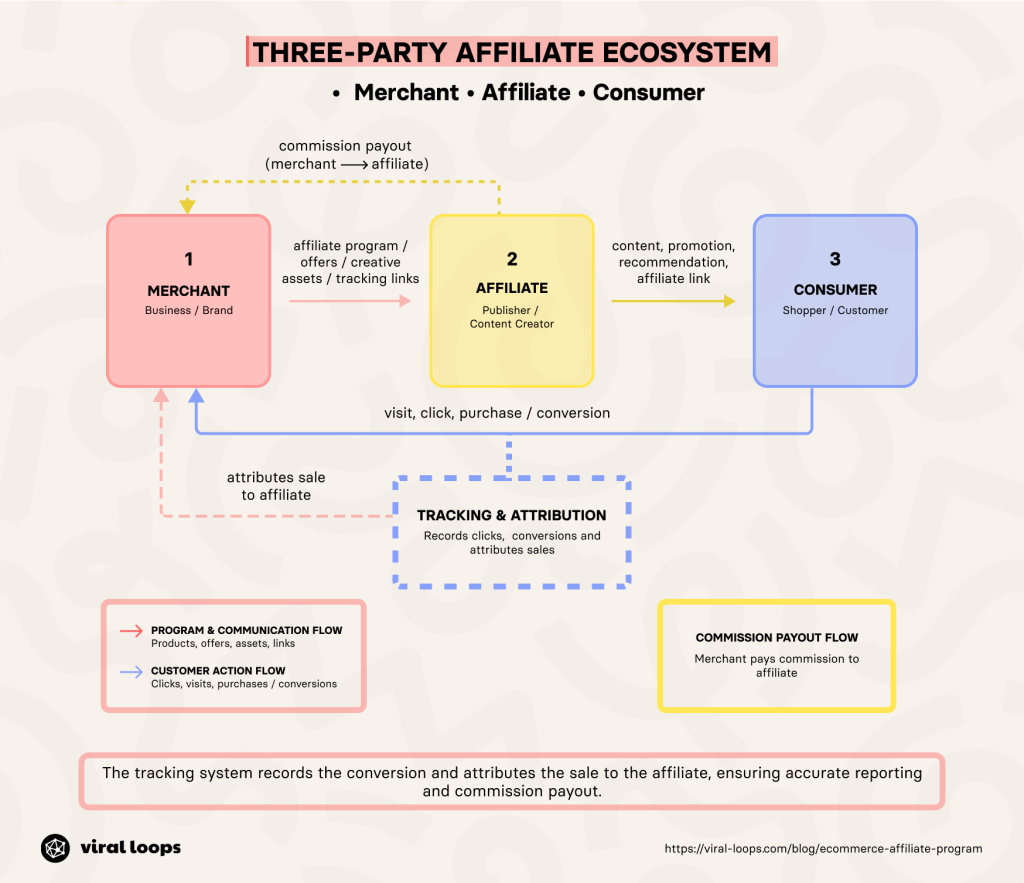
It’s a three-party relationship involving the merchant, affiliate, and shopper.
The process begins with you creating a program, preferably with affiliate software that provides affiliates with unique tracking links they can share.
The affiliate partner shares the referral link on their website, social media, or digital channel. When customers click on the link, their interaction is tracked so you know when a sale is made.
If someone buys the product, the affiliate earns a commission for bringing in a buyer.
Here’s a graphic explaining the affiliate marketing ecosystem:

Unlike influencer marketing or referral campaigns, affiliate programs are very performance-oriented. Partners get paid for actual results, e.g., sales or traffic that leads to sales.
4 Benefits of launching an e-commerce affiliate program
Instead of spending funds on traditional marketing campaigns or ads that may not work, you pay your affiliate partners for each sale they bring in.
Here’s how they could help your business:
- Improved ranking on search engines and AI search visibility: With affiliate marketing, you can tap into a full-funnel marketing strategy that makes your e-commerce brand visible everywhere. The partnership can earn your business backlinks from affiliate sites, social media mentions, and citations on YouTube. This strengthens your brand’s authority and increases its chances of appearing in AI search results.
- Low risk involved: You pay a commission only when a customer completes a sale.
- Wider reach: It can generate significant growth in both website traffic and revenue while letting you leverage the affiliate’s influence and popularity to reach a highly targeted audience.
- Faster testing and scaling: Affiliate marketing lets you launch growth campaigns quickly, test different partners and commission structures, and get performance data to identify what works. Most affiliate software provides detailed insights into the partners driving the most revenue, making it easy to optimize campaigns and scale successful strategies.
Is an affiliate program the right choice for your e-commerce business?
While affiliate marketing programs can drive consistent growth and increase revenue, they may not be the right fit for every business. Your business needs to meet certain criteria before launching an affiliate campaign.
Here’s how to know your e-commerce business is ready for affiliate programs:
- High profit margins: Does your product have a high-enough profit margin to pay affiliates without losing money? You need enough profit per sale to ensure commissions fit your margins.
- Reliable tracking capabilities: A good affiliate program needs tracking features to measure clicks, conversions, sales, commissions, and ROI. If your business has no plan for this, you won’t know whether a campaign is profitable.
- Resources to manage the program: Someone needs to own affiliate recruitment, management, and approval; provide promotional resources; monitor performance; handle commissions; and prevent fraud.
- Room to scale: Affiliate marketing campaigns can grow quickly, especially if you have a valuable program customers love. As such, you need a solid structure for conversion, customer management, commission payment, and order fulfillment that won’t crumble under high traffic.
- Fast-loading website or landing page: You need a website with quick load times and a seamless checkout process so affiliates and customers can purchase easily. Otherwise, the program risks losing potential sales and weakening affiliate performance.
After evaluating whether your e-commerce business is set up for an affiliate campaign, the next step is to choose a model that fits your brand.
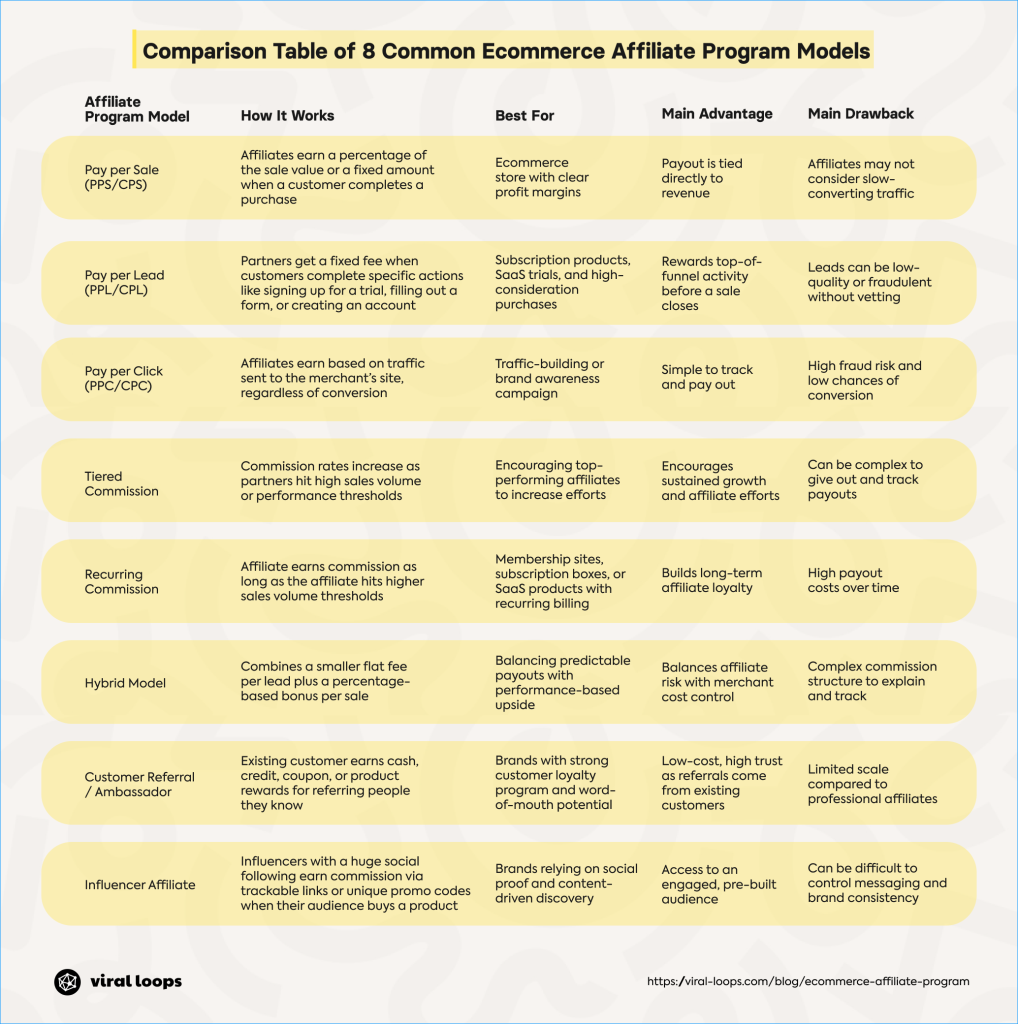
8 Common e-commerce affiliate program models explained
An affiliate program model helps you determine who gets paid, when, and for what.
Many e-commerce brands opt for a flat percentage commission, but choosing a model randomly up front may not match your sales cycle or price point.
The result is either underpaying affiliates who bring in revenue or overpaying for low-conversion actions.
Below is a breakdown of models businesses use and why they make sense:

Once you’ve decided on a model, you’re ready to set it up. That’s what we’ll cover below.
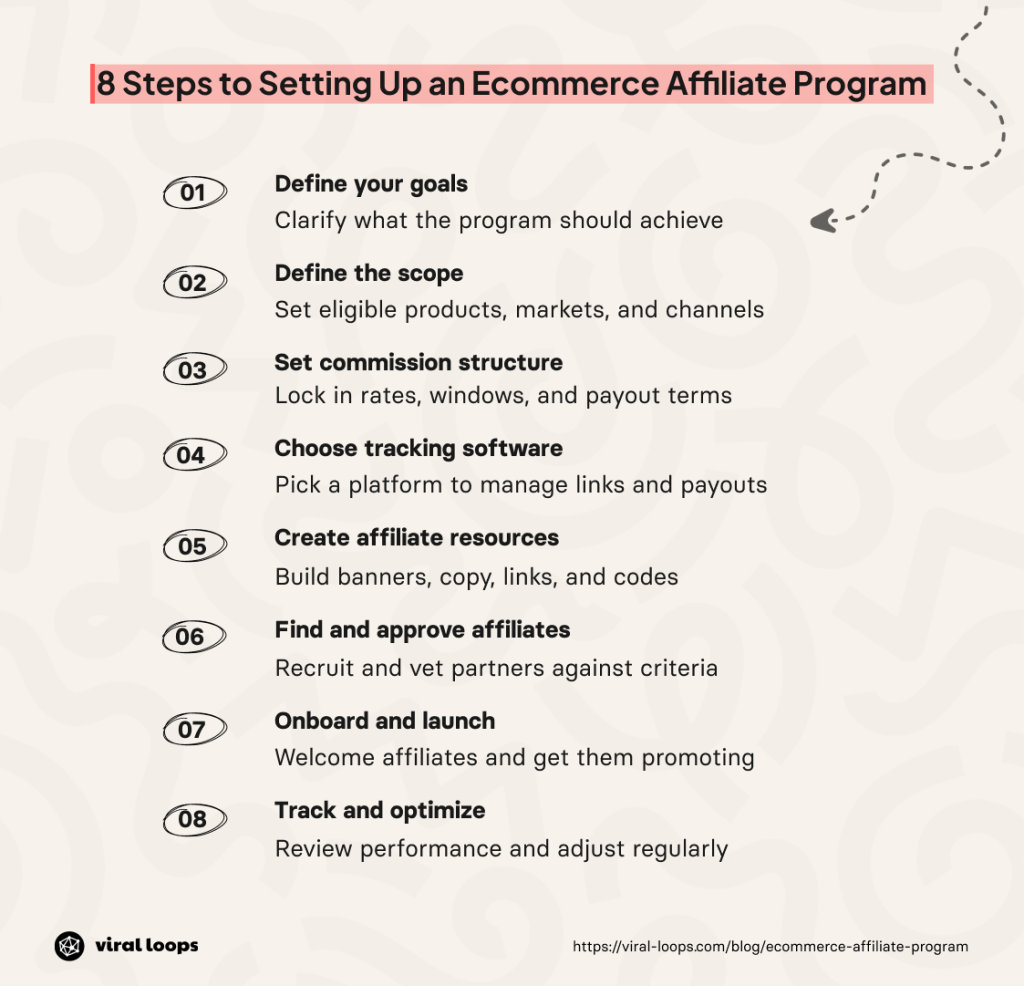
How do you set up an e-commerce affiliate program step-by-step?
To create an affiliate program, here’s a step-by-step process to follow:

Step #1: Define your affiliate program goals
First, be clear about what the program is meant to achieve. Do you want to drive new customer acquisition? Expand into a new market? Grow revenue from an existing audience? Or reduce customer acquisition cost by shifting from paid ads to performance-based marketing?
Each goal points toward a different structure.
For example, your goal could be increasing new customers for ‘X’ product line by 50% within five months using ten affiliates. This gives you a benchmark on which to evaluate future decisions.
Step #2: Define the scope of your affiliate program
Determine the ideal partners for the campaign, which products are eligible for the affiliate program, and whether you can afford discounts.
For products, go through your catalog to identify options with high profit margins. Avoid items with thin margins, as they don’t have enough room to absorb commission, clearance offers, or gift cards.
You want to check which markets you can ship products to profitably and limit recruitment to those regions. Consider where your fulfillment, shipping, and payment systems deliver a good experience, and focus there.
A discount policy is also something to set when defining scope. Would it come from margins or affiliate commissions? What channel would discounts be permitted on, e.g., content, social media, or email newsletters?
Step #3: Set your commission structure and terms
Pick an affiliate model or commission structure like those described earlier that can support your goal.
Here, you want to choose:
- An attribution window, e.g., 30/90 days.
- A tracking approach, e.g., cookie-based or server-to-server.
- Payout threshold and schedule.
- Clawback policies to protect your brand on sales that are canceled or returned.
- Eligible products with high margins as discussed in Step #2.
Put all of this into writing, including code stacking or channel restrictions.
Step #4: Choose affiliate tracking software or a platform
You’ll need an affiliate tool to monitor commissions and enforce them at scale. This tool should generate unique affiliate links, track links and conversions, attribute sales to the right partner, and automate payouts.
Platforms like our Viral Loops software handle end-to-end referral, word-of-mouth, and affiliate marketing, letting you set commission rules, generate trackable links for each partner, and monitor performance from a single dashboard.
Whichever platform you’re considering, make sure to choose one that natively integrates with your e-commerce platform. Request a demo or trial for each option you’re evaluating to check how well the tool or attribution works.
Before committing, confirm the tool offers payout automation, deep reporting, reliable customer support, and integration with your existing tech stack.
Step #5: Create affiliate resources and promotional assets
Once you have a tool to manage and track affiliate campaigns, build marketing assets that help partners learn about the product and promote it.
This can be:
- Product info sheet describing its specs, pricing, and key selling points.
- Brand guidelines doc that mentions what classifies as an approved claim, tone, or best practices for logo usage.
- Banner assets in standard ad sizes and product photos.
- Sample social captions and email copy that affiliates can repurpose.
- Discount codes if you’re offering them and pre-built tracking links.
Place all these in a centralized folder or an affiliate resource center on your website so they’re easily accessible to partners the moment they’re approved.
Step #6: Find, recruit, and approve affiliates
You can find affiliates by:
- Researching the top options in your niche through Google, social media, or online forums.
- Identifying your top advocates from your customer base.
- Searching an affiliate marketplace to find partners with industry knowledge.
Once you find affiliates whose audiences align with your ideal target audience, you need to create a system for contacting them or for affiliates to apply to you.
For affiliate applications:
- Build an application form that asks for a site or channel URL, audience size, and niche relevance.
- Create approval criteria, e.g., minimum traffic threshold or content relevance to your product category, to ensure the same standard is used to filter every affiliate.
- Manually review each applicant’s channel or website before approving to verify content quality and brand and audience fit to reduce fraud risk.
- Determine commission levels and cooperation terms, such as the minimum number of promotional posts, partnership duration, bonuses, and more.
For direct outreach, build a target list of the top 20 or 30 affiliates in your industry and craft a personalized message highlighting your interest in their services, quality perks to be offered, and referencing their expertise and existing content.
Step #7: Onboard affiliates and launch the program
Affiliates who’ve shown interest in your campaign need to be onboarded properly, as it can set the tone for how they engage with the program.
Set up an automated email sequence that welcomes them to your affiliate program once they’re approved.
It should begin with a welcome message and another email should explain how the program works.
You also want to provide dashboard login details, links to affiliate resources and the promotional asset folder, tracking links or coupon codes, commission terms, and a payout schedule.
Assign a liaison from your team who will be the point person for affiliates and make an introduction.
Step #8: Track performance and optimize the program
After your affiliate partners are fully onboarded, start monitoring the campaign’s performance against the goals you defined earlier.
Use the affiliate management software’s dashboard to monitor conversions, revenue generated, and ROI, which are typically your core metrics.
You want to track partner performance individually: clicks, average order value per affiliate, and conversion rate. This way, you separate top performers from underperformers.
Another important metric to track is the customer quality from the campaign. Do they have high customer retention and return rates, or are they typically one-off sales? This helps you identify affiliates bringing high-intent traffic that converts and stays.
Monitoring performance helps you adjust the program, so you can:
- Raise commissions or add tiers to encourage top affiliates and lower or pause payouts to low-performing partners.
- Shift recruitment to channels and affiliate types driving results.
- Refresh commission structure to keep momentum.
- Know when to update promotional resources.
Common e-commerce affiliate program mistakes to avoid
The best affiliate programs can run into problems quickly if you don’t follow the right practices.
Here are mistakes that could set your business back so you know to avoid them:
- Recruiting the wrong affiliates: Chasing partners with huge follower counts and popularity is good, but it may not always be the best option for your e-commerce business. Sometimes, their audiences are low-intent traffic that will never convert. So, focus on affiliates who match your audience and product and are also well-known.
- Low commission rates: Affiliate marketing is meant to be a win-win situation for both brands and partners. Potential affiliates typically compare offers across brands before deciding which one to sign up with. So, if your offer is too low relative to your competitors, affiliates might choose them over you.
- Not providing the right tools: Affiliates without promotional materials like banners, discount codes, tracking links, or clear best practices will struggle to promote your e-commerce products.
- Ignoring affiliate feedback: Dismissing suggestions from those who directly interact with customers could mean missing out on real optimization opportunities. If you treat affiliates as one-off partners instead of building long-term relationships, you could see high partner churn.
- Failing to track and analyze performance data: Without visibility into which affiliates and products perform well, it becomes difficult to identify what’s working or fix what needs improving.
Over to you
Launching an affiliate program is one of the most effective ways to run stable performance-based marketing.
But for it to work, you need to choose the right affiliate program model for your e-commerce business and follow the steps we’ve outlined to build a campaign from scratch.
You also need the right infrastructure to launch and scale a campaign with ease.
Here are some of the ways ViralLoops helps e-commerce brands do this:
- Generating trackable unique links and coupons.
- Setting flexible commission structures with automated payouts.
- Managing affiliate approvals.
We also provide fraud detection features to prevent activity like self-referrals, click fraud, or coupon abuse, plus a reporting and analytics dashboard that shows affiliate performance, conversion rates, and earnings so you can optimize the program based on real data.
Why not book a demo to see how we can help with your affiliate program efforts?
Frequently asked questions (FAQs)
Q1. How much commission should I offer e-commerce affiliates?
Commission rates vary by industry and niche. Many affiliate marketers on forums like Reddit look for 30%+ on digital products, with 40–50% considered strong, especially when paired with recurring or lifetime commissions rather than one-time payouts.
Levanta also suggests that rates could run between five and 30%, depending on product category and margins. Some Shopify DTC brands typically offer 10–15%, with beauty and supplement brands often needing 30–60% to attract top affiliates.
Q2. What is the best affiliate software for an e-commerce store?
The option depends on scale and platform. Shopify-native brands often use apps like Viral Loops for affiliate management, link generation, and fraud detection.
Larger, omnichannel brands may need dedicated affiliate networks like Impact, Refersion, Rakuten, or Levanta. You want to match the tool to your intended program size and sales channels.
Q3. How do affiliate links and conversion tracking work?
Each affiliate partner gets a unique tracking link containing an identifier code. They share this link with their network, and once a customer clicks it, a browser cookie logs the referral.
If the customer completes a purchase within the specified attribution window, the sale is credited to the affiliate’s commission account, and the affiliate marketing platform automatically calculates and records it.
Q4. Should affiliates get a discount code as well as an affiliate link?
Yes, if you have the margins for it. Discount codes give customers an added incentive to buy, which can boost conversion rates, and also help attribute sales when cookies fail because of ad blockers or cross-device shopping.
You just need to decide how the discount costs will be offset, from your margins or affiliate commissions. And restrict codes for affiliate types prone to abuse.
Q5. Affiliate programs vs. referral programs — what’s the difference?
Affiliate programs involve third-party marketers, influencers, or publishers promoting your product to their audience for commissions.
Referral campaigns incentivize existing customers to refer people they know in exchange for credit or a discount.
Q6. How can you turn existing customers into your best affiliates?
You need to identify loyal customers, specifically those who already understand and trust your product, have been consistent buyers, or have referred others in the past.
Invite them to become affiliates, offering a simple sign-up flow, trackable links, and tangible rewards like cash or online store credit.
Q7. Should I use an affiliate platform or build my own tracking system?
For most e-commerce stores, using an existing platform is faster and more reliable since it handles link generation, attribution, reward fulfillment, and fraud detection.
Building in-house might make more sense for large brands with dedicated developer resources and very specific tracking needs that traditional tools can’t meet.