“Master how to write referral program emails that get opened by leading with the ‘Give $X’ benefit, using scannable 3-step copy, and automating the process for explosive word-of-mouth growth.”
You’ve built a fantastic product. Your customers love it. You’ve even launched a referral program, complete with a great “give $20, get $20” offer.
You hit “launch.”
And then… crickets.
Your dashboard shows a few clicks, one or two half-hearted shares, but none of the explosive word-of-mouth growth you were promised. What went wrong?
Let’s be blunt: Your referral program isn’t failing. Your emails are.
The email you send to promote your program is the most critical part of the entire system. It’s the engine. It’s the invitation, the sales pitch, and the instruction manual all rolled into one. If that email is tedious, confusing, or (worst of all) unopened, your program is dead on arrival.
We treat referral emails like an afterthought, a quick “Hey, refer a friend” dashed off and stuffed into an automated sequence. But this email isn’t just an update; it’s a critical marketing message. It requires serious copywriting skill.
Welcome to the masterclass.
This isn’t just a list of templates. This is a comprehensive breakdown of the psychology and strategy behind writing referral program emails that people actually want to open, read, and—most importantly—share.
We will dismantle every component, from the subject line that earns the click to the call-to-action that demands action. We will provide clear, actionable examples at every step of the way.
Part 1: The Foundation (Before You Write a Single Word)
You can’t write a compelling email if you don’t know who you’re talking to or what you’re really asking. Before you open a new draft, you must nail down these three things.
1. Know Your Audience (And Their Motivation)
Who is receiving this email? The tone you use for a long-term, loyal advocate is entirely different from the one you use for a brand-new customer.
- The New Customer: They just made a purchase. They’re in the “honeymoon” phase. The email should extend that good feeling.
- Motivation: Excitement, a good deal.
- Tone: Welcoming, enthusiastic, simple.
- The Loyal Advocate: They’ve been by your side for years. They’ve purchased multiple times.
- Motivation: Status, helping the brand, a genuine desire to share.
- Tone: Exclusive, appreciative, “you’re part of the inner circle.”
- The B2B Professional: They use your software to perform their job.
- Motivation: Financial reward, looking smart to their peers, and helping a colleague.
- Tone: Professional, benefits-driven, efficient.
Don’t send one generic blast. Segment your list. Send a different email to your power users than to your new sign-ups.
2. Nail the “Double-Sided” Value Proposition
A referral is a three-party transaction. Your email must clearly and simply state the value for both active parties.
- WIIFM (What’s In It For Me?): This is the reward for your current customer (the referrer). This must be crystal clear. Is it $20 cash? A 25% discount? A free month of service? Don’t make them hunt for it.
- WIIFT (What’s In It For Them?): This is the offer for the friend. This is arguably more important. People are far more motivated to give a gift than to get a reward. It feels less transactional and more like an act of generosity.
Good: “Give your friends $50 off. When they buy, you get $50.”
Bad: “Refer friends to our program and get a commission.”
See the difference? The first example leads with generosity. The second leads with a vague, selfish-sounding process. Your referral email copy must emphasize the “give.”
3. Perfect Your Timing
When you ask, it is just as important as how you ask. The “referral” ask is a moment of high trust. You need to make it at a moment of high customer satisfaction.
The Golden Moments to Send a Referral Email:
- Immediately Post-Purchase: This is the peak of excitement. They just committed to you. Send a P.S. in the order confirmation or a separate email 24 hours after the order is confirmed. “Enjoying your new [Product]? Share that feeling with a friend.”
- After a Positive Customer Service Interaction: They just got a problem solved. They love you. Now is the time. “Glad we could help! By the way, if you know anyone else who could use this level of service…”
- After They Leave a 5-Star Review: This is a no-brainer. They just told you they love you. “Thank you for the amazing review! Want to get rewarded for spreading the word?”
- During a Milestone: “Congrats on being a customer for one year! To celebrate, here’s a special referral link…”
Don’t just blast your whole list at random. Target these high-satisfaction points.
Part 2: The Anatomy of a Perfect Referral Email
Okay, foundation set. Let’s build the email, piece by piece. We’ll use active voice, keep sentences clear, and focus on one goal: getting that share.
Section 2.1: The Subject Line (The 4-Second Audition)
Your email lives or dies in the inbox. Your subject line isn’t just a title; it’s a pitch. You have about four seconds to convince a busy person to stop scrolling.
Here are the hard and fast rules for subject lines for referral emails.
The “Do’s” of Referral Subject Lines:
- DO Be Clear and Direct: “Give $20, Get $20” is one of the most successful subject lines ever. It’s not clever, but it’s a perfect, bite-sized explanation of the entire program.
- DO Lead with “Give”: “Give your friends a free month” feels better to the reader than “Get a free month.”
- DO Personalize (If You Can): “A little gift for your friends (and you!)”
- DO Use Numbers: “Get $50 for you and a friend.” Numbers stop the eye and quantify the value.
- DO Keep It Short: 5-7 words is the sweet spot. Assume it will be read on a phone.
- DO Use Emojis (Wisely): A single, relevant emoji can make your subject line pop.
- Give a gift, get a gift
- Your friends want this $20
- Refer a friend, get paid
The “Don’ts” of Referral Subject Lines:
- DON’T Be Vague: “An offer for you” or “Our referral program” will be ignored.
- DON’T Be Deceptive: “You’ve Received a Payment!” (Clickbait will get you marked as spam).
- DON’T Be Selfish: “Help Us Grow” or “Join Our Referral Program.” This makes it sound like a chore for them to help you.
- DON’T Use All Caps or Excessive Punctuation: “FREE CASH!!! REFER NOW!!!” This is spam, period.
Subject Line Examples: The Good, The Bad, and Why
| Category | Good Subject Line | Bad Subject Line | Why It Works / Fails |
| Direct Offer | Give $25, Get $25 | Our New Referral Program | The “Good” is a balanced and clear value proposition. The “Bad” is a boring announcement. |
| Generosity | Share the love (and 20% off) | Refer a Friend | The “Good” is emotional and tangible. The “Bad” is a generic command. |
| Benefit-Led | A $50 gift for you | Help Us Find More Customers | The “Good” is 100% about the reader’s benefit. The “Bad” refers to the company’s benefits. |
| Simple | Got friends? Get paid. | Info about our partner system | The “Good” is short, conversational, and intriguing. The “Bad” sounds like corporate jargon. |
| Emoji-Led | A gift for you and a friend | Special Offer Inside! | The “Good” uses the emoji to support the message. The “Bad” is a spam filter’s best friend. |
Pro-Tip: Always A/B test your subject lines. Test “Give $20, Get $20” against “Share 20% off with a friend.” You might be surprised by what your specific audience responds to.
Section 2.2: The Opening (The First 3 Sentences)
The user opened the email. Great. Now you have another three seconds to hook them.
Your opening must do two things:
- Acknowledge them (Personalization)
- State the purpose (The benefit)
Personalization is Not Just a Name.
Yes, use “Hi [First Name].” That’s the bare minimum. Real personalization is about context.
- Weak Opening: “Hi John, As a valued customer, we wanted to let you know about our new referral program.”
- Why it’s weak: “Valued customer” is generic. “We wanted to let you know” is about the company, not the customer.
- Strong Opening (Post-Purchase): “Hi John, Thanks again for your recent order! We hope you love your new [Product]. Since you’ve got great taste, we figured your friends do too.”
- Why it’s strong: It’s specific, timely, and includes a light compliment.
- Strong Opening (Long-Term Customer): “Hi Sarah, You’ve been a part of the [Company] family for two years now, and we’re so grateful. We’d love to give you a way to share [Company] with your friends—and get rewarded for it.”
- Why it’s strong: It acknowledges loyalty and frames the program as a “thank you” gift.
Your opening sets the tone. Make it human, personal, and focused on them.
Section 2.3: The Body Copy (The 3-Step Pitch)
This is the core of your referral email copy. And the biggest mistake brands make is writing a novel.
Rule #1: Be Scannable.
Nobody reads marketing emails. They scan them. Use:
- Short sentences.
- Single-line paragraphs.
- Bullet points or a numbered list.
- Bold text to highlight the rewards.
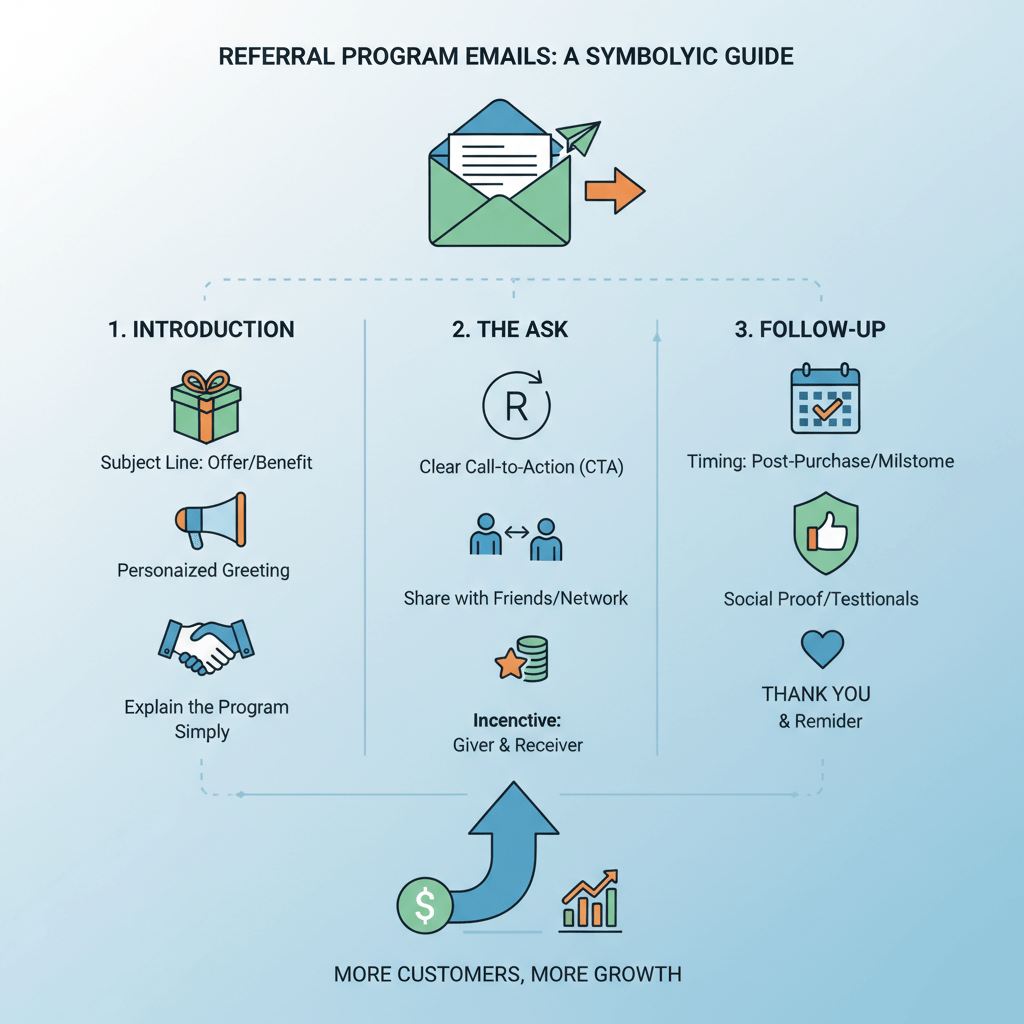
Your email body should clearly explain the 3-step process. This is the magic formula.
The Magic Formula: How It Works
- Step 1: The “Give” (What the friend gets)
- Step 2: The “Get” (What the referrer gets)
- Step 3: The “How” (The action you want them to take)
Let’s look at a full-body example.
Subject: Give $30, Get $30
Body:
Hi Chloe,
The best compliment we can receive is a referral. If you’re loving your [Product], why not share the feeling?
We’ve made it simple.
1. Give Your Friends $30
Share your personal referral link, and your friends will get $30 off their first order.
2. You Get $30
When they make their first purchase, we’ll send you $30 in credit as a thank you.
3. Start Sharing
Click the button below to get your unique link. You can share it via email, text, or on social media.
[ Get My $30 Referral Link ] (This is your CTA button)Thanks for spreading the word!
– The [Company] Team
Why This Copy Works:
- It’s clear: The 1-2-3 structure is foolproof.
- It begins with “Give”: The first step involves being generous to a friend.
- The rewards are bolded: The reader’s eye goes straight to “$30 off” and “$30 in credit.”
- The CTA is simple: “Start Sharing” is a clear next step.
Referral Marketing Email Best Practices: Body Copy Do’s & Don’ts
- DO: Use a hero image. A simple, on-brand graphic that says “Give $30, Get $30” can convey value more effectively than any text.
- DON’T: Use complex terms. Don’t say “commission,” “affiliate,” or “revenue share.” Say “cash,” “credit,” or “a gift.”
- DO: Reassure them it’s easy. Use phrases like “It’s simple,” “Just two clicks,” or “Get your link instantly.”
- DON’T: Add any other offers. Don’t try to sell them on your new spring collection. This email has one job. Let it do it.
- DO: Reinforce your brand voice. If you’re a playful brand, use playful copy. “Your friends are awesome. You’re awesome. Let’s make this official.” If you’re a professional B2B brand, stick to “Reward your colleagues with…”
Section 2.4: The Call to Action (The “Do This Now” Button)
Your call to action (CTA) is the gateway. A weak CTA can significantly impact your conversion rate.
The Button:
- It must be a button, not just a text link.
- It must be big, bold, and high-contrast. It should be the most “clickable” thing in the email.
- It must be above the fold (visible without scrolling) and often repeated at the end of the content.
The Copy:
The text on your button matters. Avoid passive, boring words. Your CTA copy should be a clear action command that implies a tangible benefit.
- Bad CTA Copy:
- Submit
- Click Here
- Learn More
- Referral Program
- Good CTA Copy:
- Start Sharing
- Get Your Referral Link
- Refer a Friend Now
- Give $20
- Claim Your $20
See the energy difference? “Start Sharing” is an exciting beginning. “Submit” is a boring end.
Pro-Tip: Provide Secondary Sharing Options
Below your main CTA button, you can make life even easier. Instead of just a button that goes to a landing page, offer pre-built sharing options.
[ Get Your Link ]Or, share directly:
[Share on Facebook] [Share on Twitter] [Share via Email]The easier you make it to share, the more people will. This reduces friction to almost zero.
Part 3: Beyond the First Email (Building a Referral Funnel)
Your referral program promotion email isn’t a “one and done.” A single email blast won’t create a culture of advocacy. You need a sequence.
1. The “Reminder” Email
People are busy. They might have seen your email, thought “Cool, I’ll do that later,” and then forgotten.
Send a follow-up email 5-7 days later to anyone who didn’t open or click on the original message.
- Subject: Re: Give $20, Get $20
- Subject 2: Don’t miss your $20 referral bonus
- Body: Keep it short. “Hi [Name], Just a quick reminder that you can get $20 in credit for every friend you send our way. It’s an easy way to share the love (and get rewarded). Click here to get your link.”
2. The “Success” Email (CRITICAL!)
This is the most important email you can send. The moment a friend uses the link and the reward is “earned,” you must notify the original referrer.
- Subject: You did it! Your friend [Friend’s Name] just signed up!
- Subject 2: You’ve got $20! A friend just used your link.
- Body: “This is the best. Your friend, [Friend’s Name], has just made their first purchase. As promised, we’ve just added $20 in credit to your account. It will be automatically applied to your next order. Want to earn more? [Share Your Link Again]”
This email does two things:
- Delivers the Dopamine: It’s an instant “win” that feels great.
- Reinforces the Behavior: It proves the program is real, it works, and it’s fantastic. This is the email that turns a one-time referrer into a serial advocate.
3. The “Friend’s Invitation” Email
Don’t forget the other side of the coin! What does the friend see?
The subject line and “from” field are key here. The “from” field should be the friend’s name. (e.g., “From: John Smith via [Your Company]”).
- Subject: John Smith sent you $20!
- Subject: A gift from your friend John
- Body: “Hi! Your friend, John Smith, is a customer of ours and thought you might also love [Company]. He’s sent you $20 off your first order. We’re a [brief description of what you do]. [Claim Your $20 Gift]”
This email needs to build trust fast. Using the friend’s name is the key.
Part 4: The Master Summary (The Do’s and Don’ts)
Here’s your quick-reference checklist.
DO:
- Have one clear goal for the email (get the click).
- Lead with the “Give” (generosity) over the “Get” (reward).
- Use a “Give X, Get X” subject line for ultimate clarity.
- Use your customer’s name and reference a recent, positive interaction.
- Explain the program in a 1-2-3 list (Give, Get, How).
- Use a big, bright, bold CTA button with action-oriented copy.
- Send a “Success!” email the instant a referral converts.
- Make it mobile-first. Assume it will be read on a phone.
DON’T:
- Don’t be vague (“Our new program”).
- Don’t make it all about you (“Help us grow”).
- Don’t write a wall of text. Use short sentences and bullet points.
- Don’t use corporate jargon (“affiliate,” “commission,” “synergy”).
- Don’t hide the CTA button at the bottom of a long email.
- Don’t add other promotions. No “P.S. check out our new sale.”
- Don’t make them think. It should be obvious what to do.
Part 5: The Final, Crucial Piece: Great Copy Needs a Great Tool
You’ve done it. You’ve written the perfect email. The subject line is magnetic. The body copy is a masterclass in scannable, benefits-driven persuasion. The CTA button is a beautiful beacon of action.
Your customer reads it. They’re excited. They click “Start Sharing.”
…and the link goes to a broken 404 page.
…or it goes to a clunky Google Form.
…or it redirects to a landing page where they have to copy a long, ugly URL manually.
Your perfect email copy is now completely worthless.
This is the failure point nobody talks about. Your referral email copy is the engine, but you need a powerful transmission to get that power to the wheels. All the copywriting in the world can’t save a clunky, high-friction user experience.
When your customer clicks “Get My Link,” they should be transported instantly to a simple, beautiful, and functional sharing experience.
This is where a platform like Viral Loops comes in.
Your email is the invitation, but Viral Loops is the party. It provides the essential “backend” that makes your “frontend” copy actually work.
- It generates unique links: The “Get Your Link” button in your email needs to create a unique, trackable link for every single customer.
- It hosts the Sharing Widget: When clicked, it opens a clean, on-brand sharing modal. This is where they find the “Share on Facebook,” “Share on WhatsApp,” and “Copy Link” buttons.
- It Tracks Everything: It’s the system that sees when a friend clicks the link, when they make a purchase, and which referrer to credit.
- It automates the Reward: it’s what triggers the all-important “Success!” email and issues a $20 credit or a 20% off coupon code.
Your email’s job is to sell the idea of sharing. The tool’s job is to make that sharing action frictionless, instant, and measurable.
When you combine powerful, persuasive referral marketing email best practices with a seamless sharing tool like Viral Loops, you don’t just get clicks. You don’t just get shares. You get a predictable, scalable, and powerful engine for word-of-mouth growth.
Frequently Asked Questions (FAQs)
Q: How often should I email my customers about my referral program?
A: Don’t just blast them. Integrate the “ask” into key moments of happiness:
- Post-purchase: (In the confirmation or 24 hours later).
- After a 5-star review: (A perfect time to say “Thanks! Want to share?”).
- In your regular newsletter: (As a permanent, secondary CTA at the bottom, e.g., “P.S. Love us? Give $10, Get $10.”).
- Quarterly Campaigns: You can run a dedicated campaign once a quarter, maybe even with a “double rewards” bonus to create urgency.
Q: What’s the best subject line for a referral email?
A: The “best” one is the one your audience clicks. However, the most reliable and high-performing subject line across all industries is a variation of “Give [Reward], Get [Reward]” (e.g., “Give $20, Get $20”). It’s clear, concise, and explains the entire program in 5 words.
Q: Should the reward be cash, a discount, or store credit?
A:
- Store Credit/Discount: (e.g., “$20 off”). This is usually best. It’s cost-effective for you and guarantees the referrer becomes a repeat customer.
- Cash: (e.g., “$20 via PayPal”). This is particularly effective for B2B or high-cost services. It feels very tangible, but doesn’t guarantee a repeat purchase.
- Non-Monetary: (e.g., “Free month,” “Swag,” “Early access”). This works great for subscription services or brands with a strong community.
Rule of thumb: The reward should be valuable to your specific audience and ideally, pull them back into your ecosystem.
Q: How do I ask for referrals without sounding “salesy” or desperate?
A: Frame it as an act of generosity, not a transaction.
- Don’t say: “Help us find new customers.”
- Do say: “Give your friends 20% off.”
The focus should always be on the wonderful gift your customer can give to their friends. The fact that they get a kickback is just a “thank you” bonus. This removes the social awkwardness and reframes the referrer as a helpful friend, not a salesperson.
Q: What’s the difference between a B2B and a B2C referral email?
A:
- B2C (Business-to-Consumer): More emotional. Use words like “share the love,” “friends,” and “a gift.” The rewards are often discounts or store credit.
- B2B (Business-to-Business): More professional and results-focused. Use words like “colleagues,” “partners,” and “reward.” The rewards are often cash, a significant service credit (e.g., “one month free”), or gift cards to places like Amazon. The “Give” is often a “free demo” or an “extended trial.”