“Boost your practice with a strategic Referral Program for Financial Advisors that attracts high-trust, pre-qualified leads by empowering your most satisfied clients.”
Let’s be honest. The part of your job that keeps you up at night isn’t portfolio allocation or retirement planning. It’s the constant, nagging pressure of client acquisition. You can be the best financial advisor in the world, but if your pipeline of new clients runs dry, your business stagnates.
You’ve likely tried it all. Cold outreach feels soul-crushing. Digital advertising is a money pit with questionable returns. Networking events often yield a stack of business cards but few actual meetings. You’re competing in a noisy marketplace where everyone claims to have the secret to wealth.
But what if your best source of new, high-quality leads is already in your business book?
I’m talking about referrals. Not the random, once-in-a-blue-moon “Oh, you should talk to my guy” kind of referral. I’m discussing a systematic, predictable, professional referral program for financial advisors. A well-built referral program doesn’t just generate leads; it generates the only kind that truly matters in this industry: the high-trust lead. These prospects come to you believing in your value because someone they know and respect vouched for you.
This article is your blueprint. We will move you from inconsistent word-of-mouth to a structured, compliant, powerful growth engine. We’ll cover why trust is your non-negotiable currency, how to build a program step-by-step while navigating SEC compliance, and how technology like Viral Loops can put the entire system on autopilot, freeing you to do what you best—advise your clients.
Why Trust is Your Most Valuable Asset (And Why Referrals are its Purest Form)
In finance, trust isn’t just a nice-to-have; it’s the entire foundation of your business. No one hands over their life savings, retirement dreams, or family’s future to a stranger they found on Google. They hand it over to someone they trust implicitly. The challenge is that trust is complicated to build from scratch.
Think about the typical sales process. A cold lead is inherently skeptical. Their guard is up. They’re waiting for the sales pitch, questioning your motives, and comparing you against a dozen other advisors. You spend the first several interactions trying to climb out of a trust deficit. You must prove credible and competent and have their best interests at heart. It’s an uphill battle.
Now, consider a referral.
Something magical happens when a happy, long-term client introduces you to a friend, colleague, or family member. It’s a phenomenon called trust transfer. The trust that you’ve spent years building with your existing client is instantly transferred to the new prospect.
They don’t see you as a random advisor; they see you as “the person who did wonders for Sarah’s portfolio.” Their starting point isn’t skepticism; it’s curiosity and positive expectation. The initial conversation is warmer, more open, and focused on solutions, not on you having to sell yourself.
This is especially true when targeting high-net-worth clients. This demographic operates almost exclusively within trusted circles. They rely on recommendations from peers for everything from accountants to private bankers. Breaking into these circles through traditional marketing is nearly impossible. A referral from an existing high-net-worth client is your golden ticket. It’s a peer-to-peer endorsement that bypasses all the usual gatekeepers.
A referral isn’t just a lead. It’s a pre-qualified, pre-vetted, and pre-warmed prospect who is already inclined to work with you. The sales cycle is shorter, the closing rate is significantly higher, and these clients often prove to be more loyal over the long term because the relationship started on a foundation of trust. Your marketing efforts shift from “convincing strangers” to “serving friends of friends.” That’s a powerful transformation for any practice.
From Accidental to Intentional: Moving Beyond the “Hope and Pray” Referral Strategy
If referrals are so great, why don’t more advisors build their entire business on them? The answer is simple: most advisors don’t have a referral strategy. They have a referral hope.
The “hope and pray” strategy looks like this:
- You provide excellent service to your clients.
- You hope they have a good experience.
- You hope they have a friend who needs a financial advisor.
- You hope they remember your name at the exact right moment.
- You hope that your friend actually follows up and calls you.
That’s a lot of hoping. It makes your most potent lead generation channel completely passive and unpredictable. You’re leaving your business growth up to chance, which is something you’d never advise your clients to do with their investments.
This informal approach is riddled with problems:
- It’s Inconsistent: You might get three referrals one quarter and zero for the next two. You can’t plan your growth or forecast revenue when your lead flow is a random trickle.
- It’s Not Scalable: You can’t increase the number of referrals you get simply by “hoping harder.” There’s no lever to pull or system to optimize.
- Clients Forget: Your clients are busy. They love the work you do for them, but they aren’t thinking about your business development 24/7. Without a gentle, professional reminder, they simply won’t think to refer you.
- Clients Don’t Know How: Many clients are willing to refer but don’t know the best way. “Should I give them your card? Your email? Should I tell them just to call you?” This friction is often enough to stop a potential referral in its tracks.
- There’s No Tracking: When a lead does come in, you might not even know who sent it. This makes it impossible to thank the referrer properly, making them less likely to refer again.
Relying on accidental word-of-mouth is like trying to catch rain in a thimble. You’ll see a few drops, but you’re missing the downpour. You need to build a system to harness the power of your happy clients truly. You need to develop a professional, structured referral program.
The Architect’s Blueprint: How to Build a Structured Referral Program for Financial Advisors
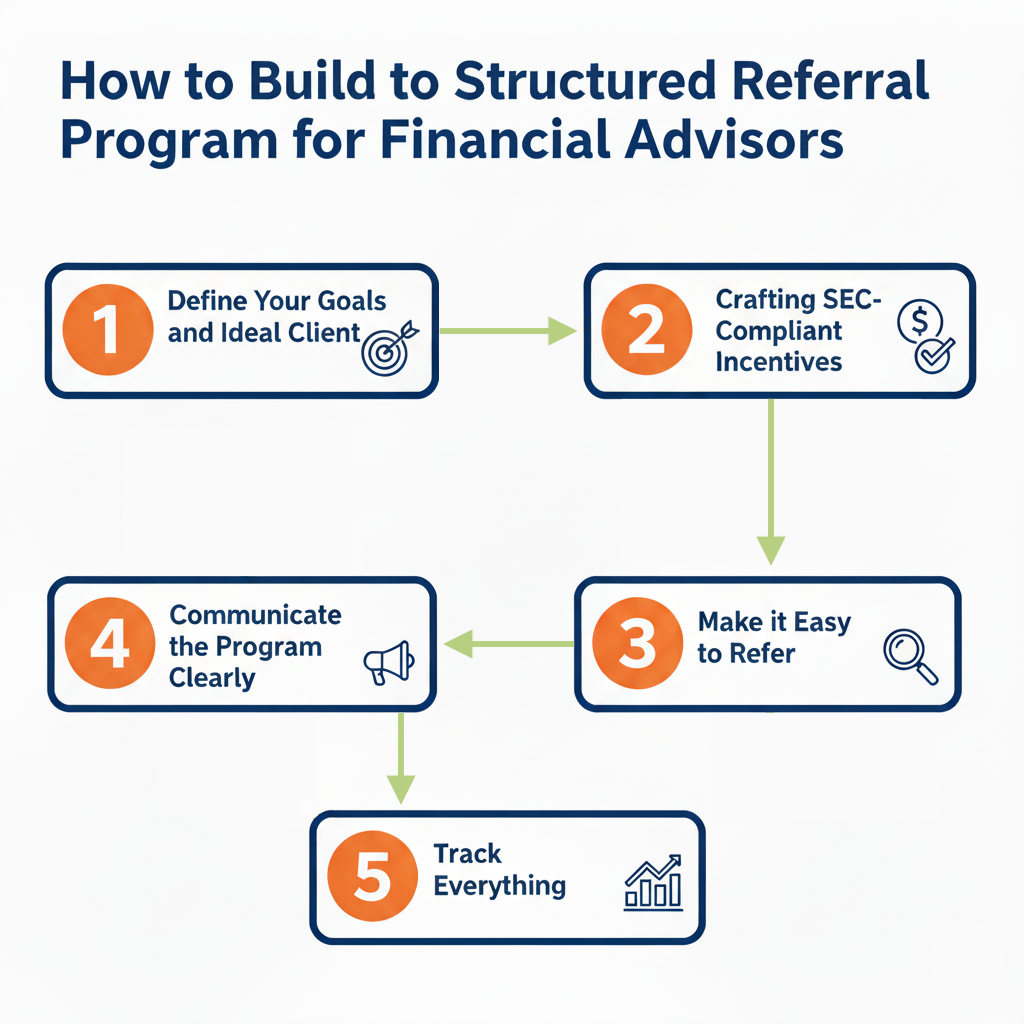
Building a referral program isn’t about plastering “Refer a Friend!” banners everywhere. It’s about creating a refined, professional, easy-to-use system that respects your clients and aligns with your brand. It’s a deliberate process of building client trust into a repeatable growth machine.
Here’s the step-by-step blueprint.
Step 1: Define Your Goals and Ideal Client
Before you build anything, you need to know what you’re creating it for. What does success look like? Get specific.
- Goal: Is it to acquire five new clients this quarter? Is it to increase your assets under management (AUM) by $5 million this year? A clear, measurable goal will guide your decisions.
- Ideal Client: Who do you want more of? Don’t just say “anyone with money.” Think about your best clients right now. What are their professions? What are their financial concerns? Are they pre-retirees, small business owners, or tech executives?
Create a simple “Ideal Client Profile.” For example: “We are best suited to help doctors and medical professionals within 10 years of retirement who want to consolidate their investments and create a reliable income plan.”
Why is this so important? Because it tells your existing clients exactly who to look for. When you ask for a referral, you’re not just saying “send me anyone.” You’re saying, “If you know other doctors like yourself who are worried about retirement, I’d be honored to help them.” It makes it easier for your clients to identify the right people in their network.
Step 2: The Compliance Tightrope: Crafting SEC-Compliant Incentives
This is the step where most advisors get nervous, and for good reason. The words “SEC” and “marketing” can be intimidating. But the rules have changed, and you can create a compliant and effective program with the right approach.
The SEC’s Marketing Rule (Rule 206(4)-1) governs how investment advisors can market their services, including testimonials, endorsements, and referrals. In the past, offering compensation for referrals was highly restricted. The new rule provides more flexibility, but it comes with strict requirements.
The key is understanding that a referral program rewarding a client for an introduction is considered an “endorsement.” The SEC allows this, provided you meet several conditions, the most important of which are disclosure and written agreements.
Cash vs. Non-Cash Rewards: This is a critical distinction.
- Cash Rewards: Offering direct cash payments (e.g., “$500 for every new client who signs up”) can classify your referring client as a “solicitor.” This brings a much higher level of regulatory scrutiny and complex disclosure requirements. For most independent advisors, this path is fraught with compliance headaches.
- Non-Cash Rewards (De Minimis Compensation): Offering modestly valued non-cash gifts is a much safer and more professional approach. The SEC allows for de minimis compensation, which generally means non-cash gifts totaling no more than $1,000 to any person over 12 months.
This is where you can get creative with client appreciation ideas that double as referral rewards. The goal is to offer something that feels like a genuine “thank you,” not a transactional payment.
Excellent Non-Cash Reward Ideas:
- Gourmet Experiences: A gift certificate to a high-end local restaurant, a curated wine or whiskey tasting set.
- Exclusive Access: Tickets to a local sporting event, concert, or theater performance.
- Personalized Gifts: A high-quality engraved pen, a leather-bound journal, or a donation to the client’s favorite charity in their name.
- Business Tools: For clients who are business owners, a subscription to a valuable service or a ticket to a relevant industry conference.
The reward should be thoughtful and reflect the caliber of your clientele. A $25 Amazon gift card might feel cheap, but a $150 gift certificate to the best steakhouse in town feels like a genuine gesture of appreciation.
The Golden Rule of Compliance: Always consult your compliance officer or legal counsel. Before launching any program, have them review your proposed structure, reward system, and all communications (emails, landing pages, etc.). Document everything.
Step 3: Make it Ridiculously Easy to Refer
If your referral process involves your client downloading a form, writing a long email, or remembering complex instructions, they won’t do it. The entire system must be frictionless. Simplicity is key.
This is where technology becomes your best friend. The ideal process should look like this:
- Unique Sharing Link: Every client in your program gets their own personal, unique referral link.
- Simple Sharing: They can share this link in whatever feels most natural for them—a quick text message, an email, or a private message on LinkedIn.
- Branded Landing Page: When their friend clicks the link, they are taken to a clean, professional webpage. This page should feature your photo, your firm’s branding, a clear explanation of your value proposition (e.g., “Helping Tech Executives Navigate Stock Options”), and a simple way to book a no-obligation introductory call.
- Automatic Tracking: When someone clicks that link and fills out a form, the system knows precisely which client referred them.
This removes all the friction. Your client doesn’t have to play matchmaker or write a long-winded introduction. They just have to say, “Hey John, I was telling you about my financial advisor. She’s been fantastic. Here’s a link to her site if you want to learn more.” It’s a simple, low-pressure action.
Step 4: Communicate the Program Clearly and Consistently
You can build the world’s best referral program, but it’s useless if nobody knows it exists. You need a communication plan to launch the program and keep it top-of-mind without being pushy.
- The Launch Email: Draft a well-written, personal email to a select group of your best clients. Don’t mass-blast your entire list. Start with your “raving fans”—the clients you know already love working with you.
- Frame it as an offer, not a request. Instead of “Please send me referrals,” phrase it as, “As one of my most valued clients, I wanted to extend a special invitation to you. Should you know of any colleagues or friends who could benefit from the same type of financial planning we’ve done together, I’ve created a simple way for you to introduce them. As a small token of my appreciation for your trust, I’d like to offer [the reward].”
- Integrate into Your Process: Make it a natural part of your client relationship. The best time to mention the program is right after a positive milestone.
- At the end of a successful annual review meeting, “I’m so glad you’re happy with our progress. As you know, my practice grows through introductions to people like yourself. If you ever come across someone who could use this kind of help, here’s an easy way to introduce us.”
- Subtle Reminders: Include a small, elegant section in your quarterly newsletter or on your client portal. “Know a friend who could benefit from a clear financial future? Learn more about our referral program.”
The key is to be consistent but not repetitive. It should feel like an integrated, professional part of your service, not a desperate plea for business.
Step 5: Track Everything and Acknowledge Everyone
This step separates the pros from the amateurs and is vital for building client trust.
- Acknowledge the Referral Immediately: When you receive a notification that a client has referred someone, send them a personal thank-you email. Do this before you even speak to the new prospect. A simple message like, “Hi Susan, thank you so much for introducing me to Mark. I truly appreciate your confidence in my work and will be reaching out to him shortly. Thank you again!” shows that you are attentive and appreciative.
- Keep the Referrer in the Loop (Briefly): After the initial meeting, let your client know. “I just wanted to let you know I had a great conversation with Mark. Thanks again for the introduction!” You don’t need to share confidential details; just close the loop.
- Fulfill the Reward Promptly: The moment the conditions for the reward are met (e.g., the prospect completes their discovery meeting), send the reward. Don’t make your client wait or have to ask for it. A prompt delivery reinforces your professionalism and makes them feel valued.
This level of follow-up demonstrates that you are organized and grateful and that their trust was well-placed. It’s a powerful way to strengthen existing client relationships while building new ones.
Systematize, Don’t Agonize: The Case for Automating Your Referral Program
Reading through the steps above, you might think, “This sounds great, but it also seems like a ton of administrative work.”
How do you create hundreds of unique links? How do you build a landing page without being a web developer? How do you keep track of who referred whom in a messy spreadsheet? What happens when you forget to send a thank-you note or a reward?
Manually managing a referral program is a recipe for disaster. It’s time-consuming, prone to error, and ultimately, unprofessional. A forgotten thank-you or a missed reward can damage a client relationship you’ve spent years building.
This is precisely why professional services marketing is moving towards automation. You need a dedicated technology platform explicitly designed to run referral programs. A good platform will handle all the tedious, manual work, allowing you to focus on your clients.
It should be your silent partner, working in the background to:
- Generate and distribute unique referral links for each client.
- Host a professional, branded landing page for incoming referrals.
- Track every single click, lead, and successful referral in real-time.
- Connect each new prospect back to the client who referred them automatically.
- Notify you the instant a new referral comes in.
- Automate reward fulfillment by telling you exactly when to send a reward and to whom.
By systematizing the process, you ensure every referral is handled perfectly every time. It makes your firm look more professional, saves countless hours of administrative headaches, and provides a clear, data-driven view of your most important lead generation channel.
Meet Your New Growth Partner: Viral Loops for Financial Advisors
So, where do you find this kind of technology? While there are many marketing tools, most are too complex, too expensive, or not designed for the specific needs of a professional service like financial advisory.
This is where Viral Loops comes in.
Viral Loops is a powerful yet straightforward no-code platform that allows you to build, launch, and automate a sophisticated referral program in hours, not weeks. It’s designed for busy professionals who are experts in their field, not in coding or complex marketing software.
Here’s why Viral Loops is the ideal solution for a referral program for financial advisors:
- No-Code Simplicity: You don’t need a developer. Viral Loops uses pre-built, customizable templates. You can choose a template, add your logo, change the colors to match your brand, and write your text. The entire setup is visual and intuitive.
- Professional and Branded Experience: Your brand is built on professionalism. Viral Loops ensures every touchpoint, from your client’s email to the landing page their friend sees, is perfectly branded and looks polished. It enhances your image; it doesn’t detract from it.
- Seamless Automation: This is the game-changer. Once you set it up, Viral Loops runs the show.
- It automatically generates a unique link for every client you invite.
- It tracks every referral from click to conversion.
- It sends you instant notifications for new leads.
- Its dashboard shows you exactly who your top referrers are.
- It manages the reward logic, telling you when to send a reward.
- Compliance and Record-Keeping: Good records are essential in a regulated industry. Viral Loops creates a clear, digital audit trail of your referral marketing activities. You have a central dashboard that shows who referred whom and when, which can be invaluable for fintech marketing compliance.
- Scalability: The system handles it effortlessly, whether you’re inviting an initial group of 20 clients or expanding the program to 500. It grows with your practice.
Instead of wrestling with spreadsheets and manual follow-ups, you can log into a simple dashboard and see your most powerful growth engine at work. It transforms your referral strategy from a series of manual tasks into a streamlined, automated, and professional system.
A Real-World Scenario: What Success Looks Like
Let’s imagine an advisor named David. For years, David relied on hope. He had a great practice with loyal clients, but his growth was flat. He’d get a random referral every other month, but it wasn’t enough to move the needle.
He decides to get serious about a referral program for financial advisors.
- The Setup: David signs up for Viral Loops. He uses their “Milestone” template. He sets up one milestone: when a referred friend completes an initial “Financial Discovery Session,” the referring client will receive a $150 gift certificate to a popular local restaurant. He customizes the landing page with his firm’s logo, professional headshot, and a clear message: “Let’s Build Your Financial Future.” The whole setup takes him about two hours on a Tuesday afternoon.
- The Launch: David identifies his top 30 clients—the ones who are true advocates for his work. He sends them a personal email explaining the new program, including their unique sharing link from Viral Loops.
- The First Referral: That Friday, he got an email notification: “New Referral from Sarah Jones!” He saw that Sarah’s friend, Michael, had booked a discovery session for the following week through the Viral Loops landing page. David immediately emailed Sarah to thank her.
- The Results: The meeting with Michael goes great. He’s a perfect fit for the firm. Because Sarah referred him, the conversation was easy and built on trust. He becomes a client within two weeks. Viral Loops automatically notifies David that the milestone has been met, and he promptly sends Sarah the restaurant gift certificate with a handwritten note.
- The Snowball Effect: Over the next three months, David receives 15 high-quality introductions through his program—more than he received in the previous year. Nine become new clients, adding over $7 million in AUM to his practice. The system works flawlessly in the background, allowing him to focus on nurturing these new relationships.
David didn’t have to become a marketing expert. He just used the right tool to systematize the trust he had already earned.
Stop Hunting for Leads and Start Attracting Them
Your time is your most valuable asset. Every hour you spend cold calling or chasing dead-end leads is an hour you’re not providing value to your clients.
The most successful financial advisors aren’t the best hunters; they’re the best farmers. They cultivate deep relationships with their existing clients. They build so much trust that those clients become their most effective and enthusiastic marketing team.
A structured, automated referral program is the tool that makes this possible. It turns random acts of advocacy into a reliable, predictable stream of high-trust leads. It respects your clients’ time, enhances your professional image, and keeps you compliant. It is the single most effective strategy for lead generation for advisors because it is built on the only currency that matters in this business: trust.
Stop hoping for referrals. Start engineering them.
Frequently Asked Questions (FAQs)
Q1: Is it actually compliant to offer rewards for referrals?
It complies with the SEC’s current Marketing Rule, provided you follow the rules. The key is to treat it as an “endorsement.” This means you must have proper disclosures in place, and for any compensation over the de minimis amount ($1,000 per year), you’ll need a written agreement. Offering modest, non-cash rewards is the simplest and safest way to stay compliant. Always consult your compliance officer before launching.
Q2: What’s better, a cash or a non-cash reward?
For most financial advisors, non-cash rewards are far better. They avoid the complex “solicitor” regulations that come with cash payments and feel more like a genuine gift of appreciation rather than a transaction. A thoughtful gift certificate, event tickets, or a donation to charity reinforces the relationship-based nature of your business.
Q3: How do I ask my clients for referrals without sounding needy or desperate?
The key is in the framing. Don’t “ask for referrals.” Instead, “invite them to participate” in a program. Frame it as a way for them to help their friends and colleagues achieve the same financial peace of mind they have. The message should be confident and centered on your value, not your need for new business. Mentioning it after a positive client review is a natural and effective time.
Q4: Who should I invite to my referral program? All my clients?
Start small. Don’t email your entire client list on day one. Curate a list of your most satisfied, long-term clients—your biggest fans. These are the people most likely to participate and provide high-quality referrals. You can continually expand the program to more clients once you’ve perfected the process with this initial group.
Q5: What if a referred lead doesn’t become a client? Should the referrer still get a reward?
This is up to you, but the most effective programs reward the action of referring, not the outcome. Tying the reward to a completed introductory meeting (rather than a signed contract) encourages more referrals because your client doesn’t feel the pressure of needing their friend to sign up. It keeps the process clean and focused on making valuable introductions.
Q6: Can I set up a system like Viral Loops without a tech team?
Absolutely. That’s the entire point of no-code platforms. They are designed for business owners and professionals, not developers. With intuitive templates and step-by-step guides, you can have a sophisticated, automated referral program up and running in an afternoon.