“The Referral vs. Influencer Marketing guide reveals why earned customer trust and a lower, measurable CAC make automated referral programs the superior, more scalable growth engine for ROI over rented influencer reach.”
In the constant battle for customer acquisition, marketing teams are under immense pressure. Budgets are tight. The demand for measurable results has never been higher. Every dollar spent must be justified, tracked, and proven to deliver a positive return on investment (ROI).
Two strategies dominate the conversation: Influencer Marketing and Referral Marketing.
On one side, you have the glamorous, obvious world of influencer marketing. It’s built on partnerships with creators, massive social media reach, and the allure of instant brand awareness. It feels new, it’s exciting, and when it works, it can put your brand in front of millions.
On the other hand, you have the quiet, consistent, and often underestimated world of referral marketing. This strategy is as old as business itself, built on the simple power of a recommendation from a friend. It’s the digital evolution of word-of-mouth, the original and most trusted marketing channel.
Many brands allocate their budgets to influencers, chasing vanity metrics such as likes and shares. They hope these will translate into sales. But hope is not a strategy.
The truth is, when you compare referral versus influencer marketing on the metrics that really matter—such as trust, cost, and long-term value—a clear winner often emerges.
This article makes a data-driven case for why referral marketing frequently outperforms influencer marketing in delivering a superior, more predictable, and more scalable ROI. It’s a deep-dive comparison to find the true champion of efficient, sustainable growth.
The Allure of the Influencer: What is Influencer Marketing?
Before we can compare these two giants, we must understand them. Let’s first examine the contender that receives the most press.
Influencer marketing is a form of social media marketing. It involves a brand paying an individual—the “influencer”—to promote its products or services to their established audience. The brand is, in effect, “renting” the influencer’s audience and, more importantly, their “borrowed” trust.
This strategy isn’t monolithic. It operates on a spectrum:
- Mega-Influencers (1M+ followers): These are celebrities or top-tier social media stars.
- Pros: Massive, broadcast-level reach.
- Cons: Extremely high costs (often six or seven figures per post), lower engagement rates, and a more cynical audience that knows it’s a paid transaction. Authenticity is usually very low.
- Macro-Influencers (100k – 1M followers): These are established creators, often experts in a specific niche, such as fitness, technology, or cooking.
- Pros: Large, yet more targeted, reach than a mega-influencer.
- Cons: Still costly. They are professional “influencers,” and their feed is often a mix of many sponsored posts, which can dilute your message.
- Micro-Influencers (10k – 100k followers): This is the sweet spot many brands aim for. These creators have smaller, highly-engaged, niche audiences.
- Pros: Seen as more authentic. Their audience trusts their recommendations more. They also cost significantly less than macro-influencers.
- Cons: The reach is smaller. To achieve a significant impact, you need to manage dozens or even hundreds of them, which can become a logistical nightmare.
- Nano-Influencers (1k – 10k followers): These are everyday people with a small, hyper-loyal following.
- Pros: Extremely high trust and engagement within their small circle—very low cost.
- Cons: Tiny reach. The effort to find, vet, and manage them at any scale is immense.
How It Works (And Where It Breaks Down)
Typical influencer engagements involve a contract. The brand pays a flat fee, provides free products, or sometimes (less commonly) works on a commission basis. In return, the influencer creates content—a post, a video, a story—featuring the brand’s product.
The primary benefit is awareness. Your product gets seen by thousands of people. The secondary benefit is a form of social proof. “If this cool person uses it, maybe I should too.”
But this is where the cracks start to show. The entire transaction is rented. The moment you stop paying, the promotion stops. The audience belongs to the creator, not to you. And, most critically, the audience knows it’s a paid advertisement. The required #ad or #sponsored tag is a constant reminder that this is a business deal, not a spontaneous recommendation from a trusted friend.
The Original Social Network: What is Referral Marketing?
Now, let’s turn to the other contender. Referral marketing is a formalized strategy that encourages and rewards your existing, satisfied customers for referring new customers.
It’s crucial to make a distinction. Many people confuse referral marketing with word-of-mouth (WOM).
- Word-of-mouth is passive and organic. A customer loves your product and might mention it to a friend if the topic comes up. It’s powerful, but it’s unpredictable.
- Referral Marketing is active and incentivized. It’s an activated word-of-mouth. It gives that same happy customer a reason to share right now, a tool to make sharing easy (like a unique link), and a reward for a successful outcome.
You’re not leaving it to chance. You are building a system —an engine for growth — powered by your best customers.
The Mechanics of a Modern Referral Program
A typical program works like this:
- The Advocate: Your existing customer, “Jane,” loves your product.
- The Incentive: You offer Jane a reward (e.g., a $20 Amazon gift card, 15% off her next order) for every new paying customer she refers to you.
- The Friend: Jane shares her unique referral link with her friend, “Mark.” To make it compelling for Mark, he also gets an incentive (e.g., 15% off his first purchase). This is a dual-sided incentive.
- The Conversion: Mark clicks the link, receives his discount, and makes a purchase. He’s happy.
- The Reward: Because Mark made a purchase, the system automatically validates the referral and sends Jane her $20 reward. She’s happy.
- The Business: You just acquired a new, high-quality customer (Mark) for a fixed, predictable cost (the $20 reward + the 15% discount). You’re pleased.
The most important part of that process? The reward is only paid after a successful conversion has occurred. It is a proper performance marketing channel. You pay for results, not for reach.
The Main Event: Comparing the Contenders for Your Marketing Budget
Now that we have a clear picture of both strategies, let’s put them in the ring. This is the referral vs. influencer marketing showdown, judged on the metrics that define ROI.
Round 1: Trust & Authenticity (The “Who Do You Believe?” Test)
This is the most critical factor in marketing, and it’s not even close.
- Influencer Marketing: Trust is borrowed and fragile. The audience has a relationship with the influencer, not with your brand. However, that relationship is increasingly transactional. An audience sees a post from their favorite creator, and the internal calculation begins: “Does she actually love this face cream, or did they pay her $50,000 for this post?” The Federal Trade Commission (FTC) requires influencers to disclose paid partnerships for this very reason. The disclosure itself is an admission of inauthenticity.
- Referral Marketing: Trust is earned and powerful. The recommendation comes from someone the new customer knows and trusts personally—a friend, a family member, a colleague. The primary motivation for the share is often genuine: “I use this product, I love it, and I think you, my friend, will love it too.” The reward is simply a bonus, a “thank you” that helps overcome the social inertia of sharing.
A Nielsen study famously found that 88% of consumers trust recommendations from people they know more than any other form of advertising. No influencer, no matter how “authentic,” can compete with the genuine trust between two friends.
Winner: Referral Marketing, by an absolute landslide.
Round 2: Cost, ROI, & Customer Acquisition Cost (CAC)
Let’s follow the money. This is where the business case becomes undeniable.
- Influencer Marketing:
- Cost Structure: You pay high upfront fees. You are paying for the potential for reach and impressions. There is no guarantee of sales. A mega-influencer might charge $100,000 for a post that generates only 20 sales. In that scenario, your Customer Acquisition Cost (CAC) is an astronomical $5,000.
- Calculating ROI: It’s a nightmare. It’s often called “influencer marketing ROI,” but it’s really “influencer marketing guesswork.” Brands are forced to rely on “vanity metrics” like likes, comments, and estimated “Earned Media Value” (EMV). These numbers are soft and nearly impossible to tie directly to revenue. How many of those sales came from the post? How many came from the 10 other marketing channels you have running? Attribution is a black box.
- Referral Marketing:
- Cost Structure: It is 100% performance-based. You only pay a reward after a successful sale is completed. You set the reward, so you control your cost. If you decide a new customer is worth $30 to you, you set your advocate reward at $15 and your friend incentive at $15.
- Calculating ROI: It is crystal clear. The math is simple and direct.
Your CAC is exactly the cost of the rewards. (Advocate Reward + Friend Incentive) = CAC - If you give a $20 reward to the advocate and a $10 discount to the friend, your CAC is $30. You know this with 100% certainty. You can directly compare this $30 CAC to your $150 CAC from Google Ads or your (estimated) $200 CAC from influencer campaigns.
Winner: Referral Marketing. It’s not just more cost-effective; it’s one of the only channels with a perfectly predictable, measurable, and performance-based cost.
Round 3: Customer Quality & Lifetime Value (LTV)
Acquiring a customer is one thing. Acquiring a great customer is another. A great customer spends more, stays longer, and tells their friends.
- Influencer Marketing: You are targeting a broad audience. They followed the influencer for their content (lifestyle, comedy, beauty), not because they were actively looking for your product. The new customers acquired are often impulse buyers or deal-seekers. They have no prior connection to your brand, and their loyalty is to the influencer, not you. As a result, their churn rate is often higher, and their Lifetime Value (LTV) is average at best.
- Referral Marketing: The customer is pre-qualified. The advocate (your existing customer) is acting as a high-precision filter. They know their friends’ needs, tastes, and budget. They are not just blasting a link to 100,000 strangers; they are sending it to one or two specific people they know will be a good fit.
- This has a profound effect. A landmark study from the Wharton School of Business found that referred customers have a 16-25% higher LTV than customers acquired through other channels.
- Why? They churn less. They are more loyal. They trust your brand from day one because that trust was transferred from their friend. They are a better fit for your product from the very beginning.
When you combine a lower CAC (from Round 2) with a higher LTV, the overall ROI (LTV: CAC ratio) for referral marketing explodes. It’s not just a little better; it’s in a completely different league.
Winner: Referral Marketing.
Round 4: Scalability & Sustainability
This is the final round, and it is often the one that confuses many people.
- Influencer Marketing: How Do You Scale This? You must do more manual work. To 10x your influencer program, you must 10x your effort. You have to find, vet, negotiate with, onboard, and manage 10x as many creators. You have to check 10x as many posts, approve 10x as much content, and process 10x as many payments. It is a linear and manual grind. It’s a series of one-off, finite campaigns. It’s not a sustainable, “always-on” engine.
- Referral Marketing: This is the big “if.”
- Without a system, referral marketing is not scalable. If your “program” is just a “contact us” form, it will fail.
- With a system, referral marketing is infinitely scalable. An automated platform enables 10, 100, or 100,000 of your customers to become advocates simultaneously, 24/7, worldwide. The system runs itself. It grows with your customer base. In fact, it’s exponential. The more new customers you get, the more new advocates you create. This is the viral loop.
Once you build the engine, it runs independently. Your only job is to keep the engine tuned (e.g., test new rewards) and give it high-quality fuel (e.g., a great product that makes customers happy).
Winner: Referral Marketing (with the crucial caveat of automation).
But Wait… What About Micro-Influencers vs. Referrals?
This is a common question. “Micro-influencers are authentic! They’re just like a friend. Isn’t that the same thing?”
No. It’s a critical distinction.
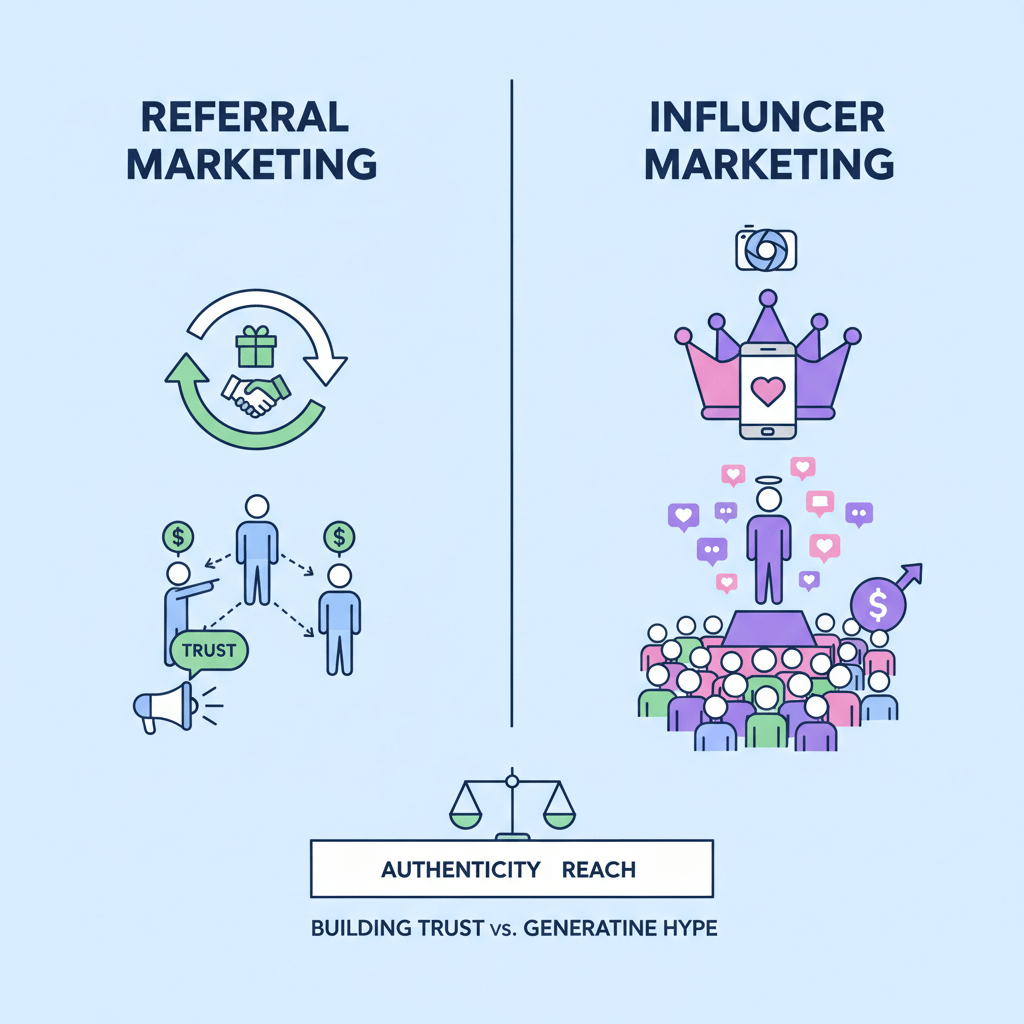
The micro-influencers vs. referrals debate boils down to one thing: Relationship and Motivation.
A micro-influencer is, at the end of the day, running a media business. Their primary relationship is with their audience as a whole. Their motivation is a transaction: you pay them, they create content. It is a one-to-many broadcast, even if it’s to a small, niche audience.
A referral advocate is a customer. Their primary relationship is with their friend. Their motivation is a personal recommendation to a specific individual. The incentive is a reward for a successful outcome, not a payment for a post.
Think of it this way:
- An influencer post is a broadcast.
- A referral is a conversation.
A 1-to-1 recommendation from a true friend, even one with only 200 Instagram followers, carries more authentic weight than a 1-to-10,000 post from a micro-influencer who is being paid to say it. Micro-influencer marketing is still a trusted form. Referral marketing is earned trust.
The Big “If”: Why Your “Refer-a-Friend” Link Isn’t Working
At this point, you might be thinking, “I have a ‘Refer-a-Friend’ link in my website’s footer. It gets zero clicks. You’re wrong.”
I’m not. Your tactic is wrong.
Referral marketing has the potential for massive ROI, but that potential is only unlocked when you treat it like a serious, scalable marketing strategy, not an afterthought.
Most “programs” fail for a few simple reasons:
- They Are Invisible: A link in the footer is not a program. It’s a wish. Your customers may not be aware of it.
- They Have High Friction: “Just email us your friend’s name and we’ll send you a coupon.” Nobody has time for that. It’s a manual, clunky process.
- They Are Untrackable: You are using spreadsheets to track who referred whom. It’s a mess. You have no idea what’s working, what your valid CAC is, or who your best advocates are.
- The Incentives Are Boring: “$1 off your next purchase” is not compelling. It doesn’t motivate anyone to do anything.
To win, you need a system. It must be automated, visible, measurable, and compelling.
The Missing Piece: Making Referral Marketing Scalable and Measurable
This is the final piece of the puzzle. The reason referral marketing wins on ROI is that modern tools have solved the scalability problem.
Influencer marketing is a tactic. A great referral program is a growth engine. But every engine needs a dashboard and a transmission.
This is where a platform like Viral Loops comes in. It’s the “engine” that turns passive, hopeful word-of-mouth into an active, data-driven, and scalable marketing strategy.
It solves every problem that causes referral programs to fail:
- Automation: Viral Loops handles the entire process. It generates unique referral links for every customer. It tracks every share, click, and conversion. It validates new sales. It automatically issues the rewards (both to the advocate and the friend). No more spreadsheets. No more manual work.
- Visibility: It provides you with the tools to put your program front and center. You can run milestone-based campaigns (like the Dropbox “Get More Free Space” model), or post-purchase widgets (“Share with a friend and you both get $15!”). It makes sharing a natural part of the customer experience.
- Measurability (The True ROI Dashboard): This is the game-changer. Viral Loops provides a comprehensive dashboard that displays the actual numbers.
- Who are your top advocates?
- What channels are they sharing on?
- What is your conversion rate from share to click to sale?
- What is your actual Customer Acquisition Cost (CAC) from this channel?
- What is the total revenue driven by referrals?
Suddenly, referral marketing isn’t a “nice to have.” It’s a core performance marketing channel. You can look at your dashboard and say, “We spent $5,000 on referral rewards last month and generated $75,000 in new, high-LTV revenue.” That is a robust, undeniable ROI. You can finally compare its ROI directly against your Google Ad spend or your influencer budget.
The Final Verdict: Stop Renting Trust, Start Building It
Let’s be clear. Influencer marketing isn’t useless. It has a place—primarily for top-of-funnel brand awareness. If you have a substantial budget and simply want to increase your brand awareness, it can be a valuable tool in your toolbox.
But for the vast majority of businesses that live and die by their ROI, the choice is clear.
Influencer marketing is built on rented trust. It’s expensive, manual, and its true ROI is a guess wrapped in vanity metrics.
Referral marketing is built on earned trust. It’s cost-effective, automated (with the right platform), and delivers a perfectly measurable ROI. Most importantly, it provides a better customer—one who is more loyal, spends more, and is more likely to become an advocate themselves, starting the cycle all over again.
The choice extends beyond just marketing channels. It’s a philosophy. Do you want to buy a temporary audience? Or would you like to establish a lasting community of brand advocates?
Stop leaving your most powerful growth channel to chance. It’s time to build your engine.
Frequently Asked Questions (FAQs) on Referral vs. Influencer Marketing
Q1: Can’t I just use affiliate links for influencers? Isn’t that performance-based?
Yes, and this is a much more innovative way to work with influencers. This effectively turns the influencer into an affiliate. This is a significant step, as you’re now paying for performance (sales) rather than reach (number of posts). However, the core difference of trust remains. A recommendation from a friend (referral) is still fundamentally more authentic and trusted than a recommendation from a professional “affiliate” or creator, even if both are performance-based.
Q2: Can referral marketing and influencer marketing work together?
Absolutely. A brilliant strategy is to use your influencer budget to drive a great referral program. Instead of paying an influencer $10,000 to post about your product, pay them $1,000 and invite them to be the first advocate in your referral program. Let them share their unique referral link. They get paid for the sales they actually drive, and their audience gets a special discount (the “friend” offer). This aligns incentives and lets you test the influencer’s actual impact.
Q3: My product is new. I have no customers. Should I use influencers first?
This is one of the few scenarios where influencers might be the right first move. You can’t have a referral program without happy customers. Influencer marketing can be a way to get your first 100 or 1,000 customers. Your strategy should be to immediately enroll those new customers into a robust referral program (using a tool like Viral Loops) to build your self-sustaining engine. The influencers are the spark; the referral program is the fuel.
Q4: What’s the difference between referral marketing and an affiliate program?
They are very similar, but the key difference lies in the person promoting them.
- Affiliate Programs are typically for professional marketers, bloggers, or influencers who want to earn cash commissions. It’s a business relationship.
- Referral Programs are typically for your customers. The rewards are often credit, discounts, or swag related to your product. It’s a community relationship built on brand advocacy.
Q5: How do I know what rewards to offer in my referral program?
The best reward is one that encourages both the advocate and the friend. A dual-sided incentive (e.g., “Give $20, Get $20”) is almost always the top performer. The reward should be compelling enough to motivate action while also being sustainable for your business. One of the best features of a platform like Viral Loops is that you can A/B test your rewards. Try “Give 15%, Get 15%” for a month, then try “Give $20, Get $20” and see which one drives a better ROI. Let the data decide.