“Launch a profitable, automated customer referral program using this ultimate blueprint to leverage word-of-mouth and cut your customer acquisition costs by rewarding advocates.”
Let’s cut to the chase. You’ve built a fantastic product. Your customers love it. But you’re still pouring money into the ever-growing furnace of paid advertising, watching your customer acquisition costs (CAC) climb higher every month. You know there has to be a better way.
There is. It’s called a customer referral program.
This isn’t some new-age marketing fad. It’s a supercharged version of the oldest marketing channel in the world: word-of-mouth marketing. Think about it. When your friend—someone you know and trust—raves about a new restaurant, a piece of software, or a pair of shoes, you listen. You’re far more likely to try it than if you saw a glossy ad from a faceless brand. In fact, Nielsen research suggests that 92% of people trust recommendations from friends and family more than any other type of advertising.
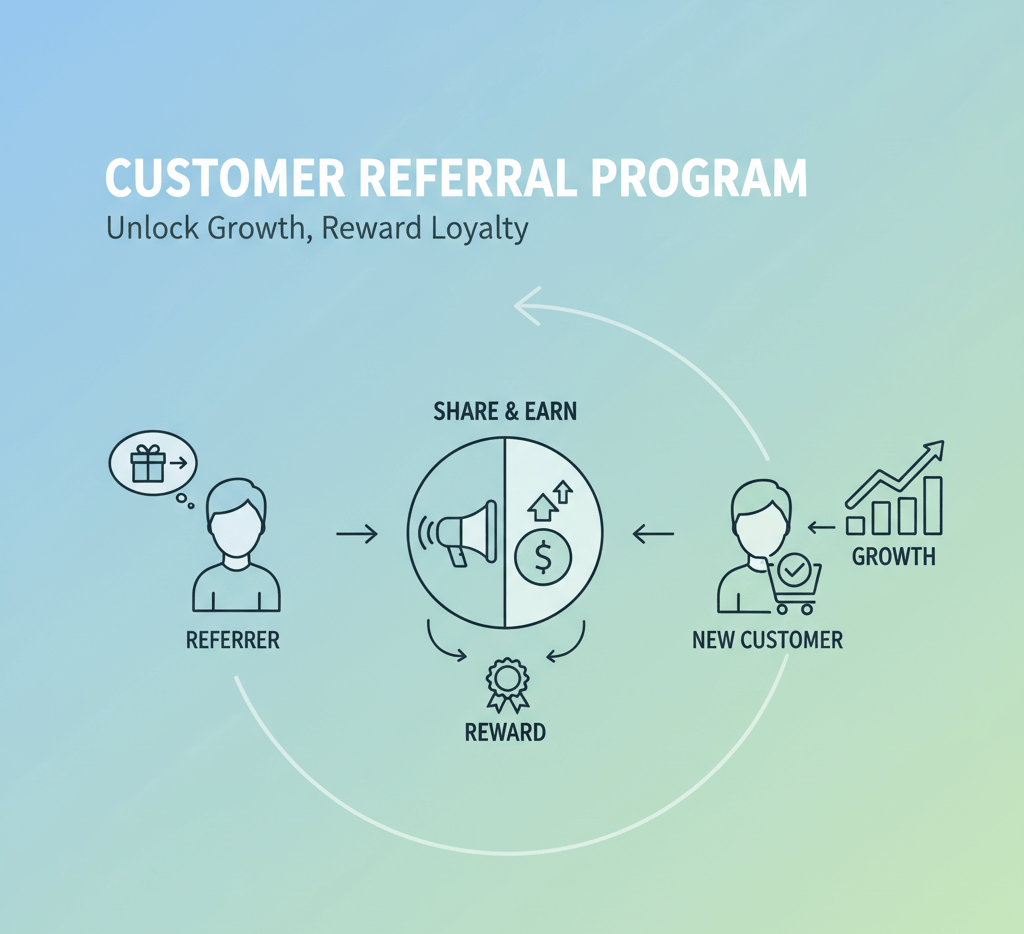
A customer referral program takes that probust organic conversation and systematizes it. It turns your happiest customers into your most effective sales team. Instead of just hoping for referrals, you actively encourage and reward them, creating a predictable, scalable, and incredibly cost-effective channel for growth.
This article is your step-by-step blueprint. We’re going to walk through every single stage of building a killer referral program from scratch. We’ll cover everything from the psychology of incentives and creating a seamless sharing experience to promoting your program and tracking its success. By the end, you’ll have a complete referral marketing strategy ready to deploy.
Part 1: First Things First — The Foundation of Any Great Referral Program
Before you even think about rewards or landing pages, you need to get two fundamental things right. Skipping this step is like building a house on a foundation of sand. It will eventually collapse.
Requirement #1: Have a Product People Genuinely Love
This might sound obvious, but it’s the most critical piece of the puzzle. A referral program is an accelerator, not a magic wand. It can’t make people share a product they don’t like. It can only amplify the love that already exists.
Your product or service needs to deliver a “wow” moment. It’s that point where a customer thinks, “This is amazing. This solved my problem perfectly.” That’s the emotional high point where they are most likely to share their thoughts. their thoughts
How do you know if you’re there?
- Talk to your customers. Ask for feedback. Send surveys.
- Track your Net Promoter Score (NPS). Your NPS score asks customers how likely they are to recommend your brand on a scale of 0 to 0. Your “Promoters” (those who score 9 or 10) are the people who will fuel your referral program. If your score is low, focus on improving your product and customer experience first.
- Look at your reviews and testimonials. Are people leaving unsolicited positive reviews? That’s a fantastic sign that you’re ready.
You simply cannot bribe people into making authentic recommendations. The passion has to be there first.
Requirement #2: Know Your Numbers (CAC and LTV)
A referral program is a marketing channel, and like any channel, it needs to be profitable. To ensure this, you must understand two key business metrics:
- Customer Acquisition Cost (CAC): How much does it cost you, on average, to acquire a new customer through your current channels (like Google Ads, Facebook Ads, etc.)? You calculate this by dividing your total sales and marketing spend over a period by the number of new customers acquired in that period.
- Customer Lifetime Value (LTV): How much total revenue can you expect from a single customer over the entire course of their relationship with your brand?
Why is this so important? Your referral reward must be significantly less than your CAC. If you spend $100 on ads to get one customer, offering a $20 referral reward is a massive win. You just got a new customer for 80% less than your usual cost!
Furthermore, customers who come from referrals often have a higher LTV. They trust the brand from day one because their friend has etted it for them, leading to better retention and increased spending over time. Knowing your LTV helps you understand the value of these referred customers and provides more flexibility in designing your rewards. Don’t start a program without knowing these two numbers.
Part 2: The Art of the Incentive — What Will You Offer?
Okay, your product is excellent, and you know your numbers. Now for the fun part: deciding on the reward. The incentive is the fuel for your referral engine. It needs to be compelling enough to motivate your customers to take action. This is where we dive into your referral program best practices.
The Great Debate: One-Sided vs. Two-Sided Incentives
This is the first significant decision you’ll make. Who gets the reward?
One-Sided Incentives
This is where you reward only one of the parties involved.
- Rewarding the Advocate (the Referrer): The existing customer receives a reward for bringing in a new one, but the new customer receives nothing. This approach will be practical for high-end brands where the endorsement itself holds value or in B2B scenarios where the advocate is motivated by strengthening a business relationship. However, it can sometimes feel a bit selfish for the advocate, as they are asking their friend to do something for their own gain.
- Rewarding the Friend (the new customer): The new customer gets an introductory offer or discount, but the advocate receives nothing. This is a purely altruistic model. It works best when your customers are deeply passionate about your mission and want to share it regardless of personal gain. Think non-profits or community-driven brands.
Two-Sided Incentives (The Win-Win-Win)
This is the most popular and effective model for most businesses. Both the advocate and their friend get a reward.
- Example: “Give your friends $20 off their first order, and you’ll get a $20 credit when they make a purchase.”
This structure is psychologically brilliant.
- It removes the social friction. The advocate isn’t just saying, “Hey, buy this so I can get something.” They’re saying, “Hey, I’ve got a gift for you. Here’s a discount.” It reframes the referral as a generous act rather than a selfish one.
- It provides a clear incentive for both sides. The advocate is motivated by their reward, and the friend has a compelling, time-sensitive reason to make their first purchase.
- It creates a win-win-win. The advocate wins (receives a reward), the friend wins (gets a discount), and you win (acquire a new, high-quality customer at a low cost).
Unless you have a particular reason not to, start with a two-sided incentive mode; it’s the gold standard for a reason.
Choosing Your Currency: Cash, Credits, or Swag?
Once you decide who to reward, you need to decide what to reward them with. There’s no single correct answer; it depends entirely on your business model and your customers.
1. Cash or Cash-Equivalents (PayPal, Gift Cards)
This is the most straightforward reward. Money is a universal motivator.
- Pros: Highly desirable and easy to understand. It can be a potent motivator for high-value actions.
- Cons: Can feel transactional and may attract “mercenary” referrers who don’t care about your brand and are just in it for the cash. It also doesn’t encourage repeat business, as the reward money can be spent anywhere.
2. Store Credit or Discounts (% or $ Off)
This is often the sweet spot for e-commerce and subscription businesses. You’re rewarding customers in your brand’s own “currency.”
- Pros: Incredibly cost-effective. A $25 store credit doesn’t actually cost you $25; it only costs you the margin on the product the customer eventually buys. It also directly encourages repeat purchases, increasing LTV.
- Cons: Only valuable to customers who plan on buying from you again. If you sell a one-time purchase product, store credit is useless.
3. Product or Swag (T-shirts, Freebies, Upgrades)
This involves giving away physical or digital products as a reward. Think Dropbox’s famous “get 500MB of extra storage for every friend you refer.”
- Pros: Can create a powerful sense of community and turn your customers into walking billboards (if you’re giving away branded swag). For SaaS companies, offering feature upgrades is highly valuable to the user but costs the company virtually nothing.
- Cons: Logistics can be complex for physical items (shipping, sizing, etc.). The perceived value might not be as high as cash or credit for some customers.
4. Tiered & Gamified Rewards
Why offer just one reward? A tiered system can turn your referral program into a game and supercharge your most enthusiastic advocates. This is the core of a strong customer advocacy program.
- Example:
- Refer 1 Friend: Get a $10 credit.
- Refer 5 Friends: Get a $75 credit.
- Refer 10 Friends: Receive a complimentary product valued at $200.
- Refer 25 Friends: Get a personal consultation and a huge swag box.
This motivates your power users to keep sharing long after their first referral. It creates a sense of achievement and status.
Part 3: Engineering for Ease — Creating a Frictionless Sharing Experience
You could have the most amazing incentive in the world, but if the process of sharing is confusing or takes more than 10 seconds, nobody will do it. Your job is to remove every possible point of friction. The entire experience must be intuitive, fast, and seamless.
The Referral Hub: Your Program’s Home Base
Every user should have a central place where they can easily access your program. This is often a dedicated page on your website or a section within their user account dashboard. This page must have:
- A Killer Headline: Make the value proposition instantly clear. “Give $25, Get $25.” “Share the Love and Get a Free Month.” “Invite Friends, Get More Storage.” Don’t be clever; be clear.
- A Simple Explanation: Briefly explain how it works in 2-3 simple steps. Use icons and minimal text. For example:
- Step 1: Share your unique link.
- Step 2: Your friend receives a 20% discount.
- Step 3: You get $20 after their first purchase.
- A Prominent Call-to-Action (CTA): The sharing options should be the most visible thing on the page.
The Sharing Mechanism: The Heart of the Machine
This is how users actually send he invitation. You need to make this part effortless.
- Unique Referral Links: This is a non-negotiable.Requirement: Every customer needs their own unique, personal link. This is the only way you can accurately track who referred whom. Manually creating these is a nightmare, which is why referral marketing automation is so critical.
- Pre-Written, Editable Messages: Give your customers a starting point. Provide a default message for email and social media that they can use with a single click. Make sure they can also edit it to add their own personal touch. A good default message clearly explains the benefit to the friend.
- Example: “Hey! I’ve been using [Your Brand] and I’m obsessed. I thought you’d love it too. Here’s a link to get $20 off your first order. You won’t regret it!”
- Multiple Sharing Channels: Don’t just offer a “copy link” button. Integrate direct sharing options for the platforms your customers actually use.
- X (formerly Twitter)
- SMS / iMessage
The more options you provide, the more likely they are to find one that feels natural to them.
The Friend’s Experience: The Critical First Impression
What happens when a friend clicks that shared link? This part of the journey is just as important.
- A Dedicated Landing Page: Don’t just dump them on your homepage. The link should take them to a page that acknowledges the referral. The headline should be something like, “Your friend [Advocate’s Name] sent you $20 off!” This confirms they’re in the right place and that the offer is genuine.
- Automatic Coupon Application: If the reward is a discount, don’t require the new customer to search for a coupon code and manually enter it. Automatically apply the discount to their cart or at checkout. The less work they have to do, the higher your conversion rate will be. This seamless experience shows that you’ve thought through the details.
Part 4: Spread the Word — Promoting Your Customer Referral Program
You’ve built the perfect machine. Now you need to get people to use it. A common mistake businesses make is to create a referral program and then hide it in the footer of their website, hoping people will stumble upon it.
You need to promote your program with the same energy you’d use for a significant product launch. Here’s how to get more referrals by making your program unmissable.
Use Email Marketing (Your Secret Weapon)
Email is your most potent tool for promoting the program to your existing customers.
- A Big Launch Announcement: When you first launch the program, send a dedicated email blast to your entire customer list. Explain the program, highlight the double-sided reward, and include a clear CTA that takes them directly to their referral hub.
- The Post-Purchase Email: This is the single most effective place to promote your program. Immediately after a customer makes a purchase, they experience “peak excitement.” This is the perfect moment to ask for a referral. Add a section to your order confirmation or shipping notification email that says, “Loving your purchase? Share with a friend and you both get $20 off your next one!”
- In Your Regular Newsletters: Include a permanent banner or P.S. section in every marketing newsletter you send. It’s a simple, non-intrusive reminder that the program exists.
- In Transactional Emails: Your most opened emails are transactional ones (order confirmations, password resets, etc.). A simple one-line reminder at the bottom of these emails can work wonders.
Promote it On-Site and In-App.
Integrate the program directly into your digital properties.
- Make it Visible: Don’t hide it. Include a clear link in your site’s main navigation menu, header, or footer. “Refer & Earn” and “Get $20” are standard, effective labels.
- The User Account Page: This is the most logical place for it to live. When a customer logs into their account, they should see a prominent tab or section for the referral program.
- Use Pop-Ups (Strategically): Don’t annoy your users. But a well-timed pop-up can be very effective. For example, trigger a pop-up promoting the referral program right after a user leaves a 5-star review or completes their second purchase.
Leverage Social Media
Use your social channels to remind your followers about the program.
- Announce the program launch.
- Post regular reminders (e.g., quarterly) to keep track of progress.
- Celebrate your top referrers (with their permission, of course!). This provides social proof and can inspire others to participate.
The key is to make the program a visible, consistent part of your marketing communication. Don’t let your customers forget about it.
Part 5: Measure Everything — The Metrics That Matter
So, how is all this effort paying off? You need to track the right referral program metrics. Guesswork won’t cut it. A data-driven approach enables you to understand what works, what doesn’t, and how to optimize your program for improved results.
Here are the key metrics you should have on your dashboard:
- Participation Rate: This is the percentage of your total customers who have signed up or engaged with your referral program. (Total Advocates / Total Customers). If this number is low, it means you’re not promoting the program effectively enough.
- Share Rate: Among the participating customers, what percentage are actually sharing their links? (Number of Advocates Who Shared / Total Advocates). If this is low, it may indicate that your incentive isn’t compelling enough or that the sharing process is too complicated.
- Impressions (or Reach): How many people are seeing the shared referral links out in the wild? This helps you understand the impact of your program. On brand awareness
- Click-Through Rate (CTR): Of the people who see a shared link, how many click on it? (Total Clicks / Total Impressions). A low CTR could indicate that the pre-written share messages aren’t compelling enough.
- Conversion Rate: This is the big one. What percentage of the friends who click the link actually make a purchase and become new customers? (New Referred Customers / Total Clicks). This is the ultimate measure of your program’s effectiveness.
- Referral Rate: What percentage of your total new customers are coming from your referral program? A healthy program should contribute a significant chunk of your overall growth. The legendary Dropbox program briefly saw referrals account for 35% of all new signups.
Tracking these metrics manually is nearly impossible. This is where the limitations of a DIY approach become painfully clear.
Part 6: The Scaling Problem — Why Spreadsheets Will Kill Your Program
When you’re starting, it is tempting to try to manage your referral program manually. You think, “I’ll just create some coupon codes in a spreadsheet, tell people to share them, and then track who uses them.”
This approach will fail. Miserably.
Here’s a glimpse into the logistical nightmare you’re signing up for:
- Generating unique codes: How do you give every single customer their own trackable code?
- Tracking conversions: How do you know for sure that a new customer came from a specific referral? What if they see the code but type it in later from a different device?
- Preventing fraud: How do you stop people from referring themselves with a different email address just to get the discount?
- Fulfilling rewards: Are you really going to spend hours every week manually sending out PayPal payments, gift cards, or store credits? What happens when you have hundreds or thousands of referrals to process?
A manual system is time-consuming, wildly inaccurate, prone to error, and provides a clunky experience for your customers. It simply does not scale. As soon as you get any traction, the entire system will break down, and you’ll spend more time on admin work than on growing your business.
Part 7: The Solution — Using a Dedicated Referral Program Software
To do this correctly and at scale, you need a dedicated platform. You need a purpose-built engine to run the entire machine. This is where referral program software becomes essential.
An all-in-one platform like Viral Loops is designed to handle every single aspect of your referral program, automating the entire process so you can focus on strategy, not logistics.
Reflect on all the steps and complexities we have just covered. Here’s how a platform like Viral Loops solves them instantly:
- Frictionless Onboarding: It allows you to create beautiful, branded landing pages and widgets for your program in minutes.
- Unique Link Generation: The moment a customer joins your program, Viral Loops instantly generates a unique, trackable sharing link just for them. No spreadsheets, no manual work.
- Seamless Tracking: Viral Loops integrates directly with your website or e-commerce platform (like Shopify). It automatically tracks every share, click, and conversion, providing 100% accurate attribution.
- Automated Reward Distribution: When a successful referral happens, the system automatically sends the correct reward to both the advocate and the new customer. Whether it’s a coupon code, store credit, or a notification for you to send a gift, it’s all handled for you. This is referral marketing automation at its best.
- Powerful Analytics: It gives you a real-time dashboard with all the key referral program metrics we discussed. You can see your participation rate, conversion rate, top advocates, and total revenue generated, all at a glance.
- Fraud Prevention: Built-in systems help detect and flag fraudulent activity, such as self-referrals, thereby protecting the integrity of your program.
Running a referral program without a tool like Viral Loops is like trying to run an email marketing campaign from your personal Gmail account. It might work for 10 people, but it’s impossible for 10,000. Investing in the right software turns your referral program from a complicated idea into a powerful, automated growth engine.
Your Next Move
Building a powerful customer referral program isn’t complicated, but it requires a thoughtful strategy and the right tools. It’s about turning the authentic love your customers already have for your brand into a sustainable engine for growth.
You start with a product people want to talk about. You design a compelling, two-sided incentive that feels like a gift. You engineer a sharing process that’s so easy it’s almost effortless. You promote it relentlessly. And you track your results so you can keep optimizing.
The manual, spreadsheet-driven approach is a recipe for frustration and failure. To truly unlock the power of word-of-mouth marketing at scale, you need to automate.
Viral Loops provides the all-in-one platform to do just that. It handles the links, the tracking, and the rewards, freeing you up to build the relationships that fuel your growth.
Ready to turn your customers into your most potent marketing channel? It’s time to get started.
Frequently Asked Questions (FAQs)
1. How much should I offer as a referral reward?
There’s no magic number, but a good starting point is to make the reward between 15-% and 0% of your Average Order Value (AOV). Most importantly, ensure your total reward cost (for both the advocate and friend) is comfortably below your normal Customer Acquisition Cost (CAC).
2. When is the best time to ask for a referral?
Ask when the customer is happiest! The best moments are immediately after a customer makes a purchase, after they leave a positive review, or following a significant interaction with your customer support team. Capitalize on moments of high satisfaction.
3. Can a customer referral program work for a B2B or SaaS company?
Absolutely! The principles are the same, but the incentives might differ. Instead of small cash rewards, B2B rewards are often more substantial, such as a free month of service, credits towards their next bill, access to premium features, or even high-value gift cards (like a $200 Amazon gift card).
4. What’s the biggest mistake people make when creating a referral program?
The biggest mistake is “set it and forget it.” They build the program, hide it on their website, and never promote it. You must treat your referral program as an active marketing channel. Promote it constantly through email, social media, and on your website to keep it top-of-mind for your customers.
5. What is the difference between a referral program and an affiliate program?
It’s all about the relationship. Referral programs are for your existing customers to refer people they personally know (friends, family, colleagues). The motivation is often a mix of brand love and a small reward. Affiliate programs are for marketers, influencers, and content creators to promote your product to their broader audience. The relationship is more commercial, and the motivation is primarily financial, often involving a commission on sales.