“Choose the best Incentives for Referrals to drive word-of-mouth; match rewards like cash, credit, or swag to your LTV and business model to maximize conversions.”
Word of mouth is, and has always been, the single most powerful marketing channel. When a friend, colleague, or family member recommends a product, it cuts through the noise of ads and sponsored posts. It comes with a built-in layer of trust that you simply cannot buy.
But here’s the hard truth: most people, even your happiest customers, won’t refer you on their own.
It’s not that they don’t love you. They’re just busy. They forget. Or, it feels a little awkward to “sell” a product to a friend, even if it’s a great one. This is where a referral program comes in. It’s the structured, systematic way to encourage and reward that word-of-mouth.
The heart of any successful referral program isn’t the fancy landing page or the clever slogan. It’s the incentive.
Choosing the right incentive is the difference between a program that explodes your growth and one that collects digital dust. A weak incentive (or the wrong kind of incentive) fails to provide the little push needed to turn a happy customer into a proactive advocate.
This guide is your comprehensive exploration of the world of incentives for referrals. We aren’t just going to list a few ideas. We’re going to explore the psychology behind why people share, break down every type of reward you can offer, and give you a framework for choosing the perfect fit for your business.
The Psychology of Motivation: Why Do People Really Refer?
Before we discuss what to give, we need to understand why people behave in specific ways. If you build your program around a faulty understanding of motivation, it’s doomed from the start.
Human motivation is a mix of two forces: intrinsic and extrinsic.
Intrinsic Motivation: The “Warm Fuzzies”
Intrinsic motivation is the desire to do something because it’s personally rewarding. You do it for the pure joy, satisfaction, or a sense of identity. In referrals, this looks like:
- Altruism: Your customer genuinely wants to help their friend solve a problem. Your product worked for them, and they want their friend to have the same success.
- Social Status: Recommending a great product makes the referrer look smart, savvy, and “in the know.” It gives them what marketers call “social currency.”
- Brand Love: Some customers are true evangelists. They love your mission, your team, and your product so much that they feel a sense of belonging. Referring is their way of supporting the “tribe.”
You cannot create intrinsic motivation. It’s a byproduct of having an excellent product and a strong brand. A referral program alone will not fix a bad product.
Extrinsic Motivation: The “What’s In It for Me?”
Extrinsic motivation is the desire to do something to gain an external reward or avoid punishment. This is the “what’s in it for me?” factor. This is your referral bonus.
It can be cash, a discount, a gift card, or exclusive status.
A common mistake is thinking these two forces are enemies. They aren’t. The best referral programs utilize an extrinsic reward (the incentive) to provide customers with the final “push” to act on their intrinsic motivation.
The customer wants to help their friend (intrinsic). The $20 bonus (extrinsic) just makes them do it today.
Your goal isn’t to “buy” referrals. It’s to catalyze them. The incentive is the fuel for the word-of-mouth engine that’s already there.
The Big Debate: One-Sided vs. Two-Sided Referral Programs
Now we come to the first primary strategic choice you must make. When you offer a referral bonus, who gets it?
This decision fundamentally changes the psychology of the entire transaction.
What is a One-Sided Referral Program?
A one-sided program rewards only one participant.
- Reward the Referrer: This is the most common one-sided model. You (the advocate) get $25 when your friend signs up. The friend receives nothing but your glowing recommendation.
- Reward the Friend: This is a less common but interesting approach. Your friend gets 20% off when they sign up using your link. You (the advocate) get nothing but the social currency of “giving a gift.”
Pros of a One-Sided Program:
- Lower Cost: You’re only paying out one reward per conversion, making your cost per acquisition (CPA) potentially lower.
- Simple to explain: “Share this, get $20.” It’s an obvious, direct message.
- Filters for True Fans: If you only reward the advocate, you’re primarily motivating people who really love your brand. If you only reward the friend, you’re relying entirely on the advocate’s intrinsic, altruistic motivation.
Cons of a One-Sided Program:
- Can Feel Selfish: Rewarding only the advocate can make them feel like they’re “using” their friends for a cash grab. This creates social friction and can reduce the sharing of information.
- Lower Conversion for the Friend: If the new customer doesn’t receive an immediate benefit, why should they use the referral link instead of simply searching for your brand later? There’s no urgency.
- Wasted Altruism: The model that only rewards the friend is often too selfless. It relies 100% on your advocates wanting nothing in return, which is a big ask for most people.
What is a Two-Sided Referral Program?
A two-sided referral program is precisely what it sounds like: both parties get a reward. This is the “Give $20, Get $20” model made famous by companies like Dropbox and Uber.
The advocate gets a reward for sharing. The new customer receives a reward for signing up.
This model is, in almost all cases, the most effective.
Pros of a Two-Sided Program:
- Solves the “Selfish” Problem: The advocate is no longer “selling” to their friend. They are giving their friend a gift (“Hey, here’s $20 off this service I love”). This reframes the entire interaction from a selfish to a generous perspective.
- Massively Increases Conversion: The new customer has a clear, compelling, and urgent reason to use the referral link now. They don’t want to miss out on their 20% discount or $50 credit.
- Leverages Reciprocity: It creates a win-win-win. The friend wins (gets a deal). The advocate wins (receives a reward). The business wins (gets a new customer). This positive-sum game is compelling.
Cons of a Two-Sided Program:
- Higher Cost per Acquisition: You are paying out two rewards for every single conversion. You must have your customer lifetime value (LTV) numbers dialed in to make this profitable.
- Slightly More Complex: The messaging has two parts (“Give X, Get Y”), which requires somewhat more clarity.
The Secret Third Option: Asymmetrical Rewards
You don’t have to split the reward 50/50. You can, and often should, make the reward asymmetrical to prioritize a specific goal.
- Prioritize New Customers (Give More, Get Less): “Give your friend $50 off, and you’ll get $25.”
- Why? This is a high-growth strategy. You’re putting the bigger incentive on the conversion, making the offer to the new customer almost irresistible. This is great for breaking into a new market.
- Prioritize Your Advocates (Give Less, Get More): “Give your friend $10 off, and you’ll get $40.”
- Why? This is a customer loyalty rewards strategy. You’re heavily rewarding your existing customers for their advocacy, strengthening their bond with your brand. This works well if your product is already well-known and the friend needs less of a push.
The Verdict: For most businesses (especially e-commerce, SaaS, and marketplaces), a two-sided referral program is the undisputed champion. It aligns everyone’s motivations, resulting in the highest number of successful conversions.
The Grand Menu of Referral Reward Ideas
Okay, you’ve decided on a one-sided or two-sided structure. Now for the big question: what, exactly, are you going to give?
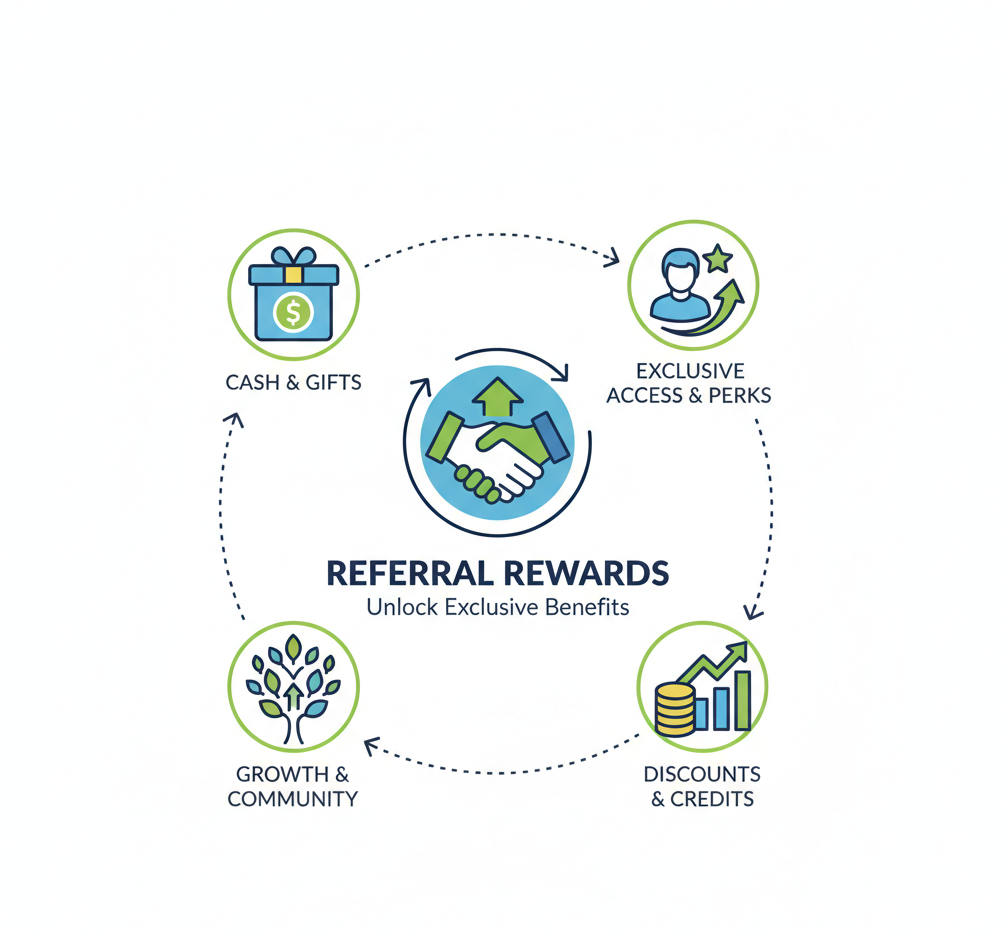
The reward you choose reveals a great deal about your brand and your customers. Here is a breakdown of the most common referral marketing rewards, including their pros, cons, and best use cases for each.
1. Cold Hard Cash (and Cash Equivalents)
This is the simplest, most straightforward reward. We’re talking about PayPal transfers, bank transfers, or (most commonly) third-party gift cards, such as Visa, Mastercard, or Amazon gift cards.
- Pros:
- Universal Value: Everybody understands and values cash. Its perceived value is exactly its face value. There’s no ambiguity.
- Highly Motivating: For products with no obvious repeat purchase, cash is a powerful motivator.
- Cons:
- Transactional: It can feel cold. It attracts “mercenaries” who may not be true fans, but are just there for the payout. This can lead to lower-quality referrals.
- No Loyalty Loop: The advocate receives a $25 Amazon card, makes a purchase from Amazon, and has no immediate reason to return to your store. It doesn’t build loyalty.
- Expensive: Cash is a 1:1 cost. $25 cash costs you $25. As we’ll see, other rewards are “cheaper” for you.
- Best For:
- One-Time Purchase Products: Consider items such as mattresses, tax software, or real estate. Your customer isn’t planning to buy another mattress next month, so store credit is of no use to them. Cash is the only sensible option.
- Financial Services: Banks, insurance companies, and investment apps. Their entire product is money, so rewarding with money is perfectly on-brand.
- B2B/High-LTV Services: When a new enterprise client is worth $10,000, offering a $500 cash referral bonus is a no-brainer.
2. Store Credit / In-App Currency
This is the king of e-commerce and SaaS rewards. Instead of giving cash, you provide the advocate and their friend with a credit to be spent with you.
- Pros:
- Drives Repeat Business: This is the magic. A $25 store credit reward guarantees your advocate will return to your store to spend it. It’s a reward that doubles as a retention tool.
- Better Profit Margin: A $25 store credit does not cost you $25. It costs you the cost of goods sold (COGS) for that $25. If your margin is 60%, the $25 reward only costs you $ 15. It’s significantly cheaper than cash.
- Builds Your Ecosystem: It keeps all the value and activity inside your brand. This is what Uber does with “Uber Cash” and Airbnb does with “Travel Credit.”
- Cons:
- Only Valuable to Repeat Customers: If your product is a one-and-done, this reward is worthless.
- Lower Perceived Value (Sometimes): Some people might prefer $20 cash over $30 in store credit, if they don’t plan on shopping with you again soon.
- Best For:
- E-commerce: This is the default, best-practice choice. “Give 20%, Get $20 in credit.”
- Subscription Boxes: “Give a free box, Get a free box.”
- Marketplaces & Apps: Uber, Airbnb, DoorDash. Credit keeps both drivers and hosts, as well as riders and guests, active on the platform.
3. Percentage or Fixed-Amount Discounts
This is a close cousin of store credit. Instead of a credit applied to their account, it’s a coupon code for a future purchase. (e.g., “Get 25% off your next order”).
- Pros:
- Extremely Easy to Understand: “25% off” is a simple, powerful value proposition.
- Drives Urgency: Unlike store credit, which may remain in an account, a coupon code typically has an expiration date, driving a faster repeat purchase.
- Flexible: You can set limits (e.g., “up to $50”) to control your costs.
- Cons:
- Value is Relative: 25% off a $20 item is only $5. 25% off a $200 item is $50. The value can be inconsistent.
- “Discount Fatigue”: If your brand already offers numerous sales, a “25% off” coupon might not feel as special. It just feels like another Tuesday.
- Best For:
- Subscription Services: “Get 50% off your next 3 months.” This is a fantastic retention tool.
- E-commerce Brands that have a high average order value (AOV), where a percentage off feels substantial.
4. Non-Cash Incentives (Swag & Gifts)
This is where things get creative. Instead of a monetary reward, you offer a physical item. This is the world of non-cash incentives.
A notable example is The Hustle’s (and Morning Brew’s) referral program. Refer five friends, get stickers. Refer 15, get a t-shirt. Refer 50, get a hoodie.
- Pros:
- Builds a Tribe: This is the most effective way to make a community. When someone wears your hoodie, they are a walking billboard. They’ve transitioned from customers to true brand ambassadors.
- High Perceived Value, Low Cost: A high-quality, well-designed t-shirt may only cost $15 to produce and ship, but its perceived value to a true fan is significantly higher. It’s an exclusive item that they can’t just buy.
- Generates Social Proof: People post pictures of their swag. This creates a powerful, user-generated marketing loop that money can’t buy.
- Cons:
- Logistical Nightmare (Without a System): You have to handle inventory, sizing, shipping addresses, and fulfillment. This presents a significant operational challenge if attempted manually.
- Subjective Value: Some people just don’t want more stuff. A $20 cash reward might motivate them, but a “free t-shirt” won’t.
- Best For:
- Media & Content Brands: Newsletters, podcasts, and YouTube channels. The “stuff” is the only thing they can give.
- Lifestyle Brands: Brands with a strong community and aesthetic (e.g., surfing, fitness, coffee).
- B2B SaaS: Sending a box of high-quality swag (coffee mug, notebook, hoodie) to an advocate who refers a new client feels personal and memorable.
5. Exclusive Access & Service-Based Rewards
What if your reward cost you almost nothing? These rewards are about status, not stuff.
- Examples:
- Early Access: “Refer three friends and get early access to our next product drop.”
- Premium Features: “Get 6 months of our ‘Pro’ plan for free.” (Dropbox’s “get more space” is a classic example).
- Exclusive Community: “Get an invite to our private Discord/Slack for power users.”
- “Skip the Line” Support: Get access to a premium, dedicated customer support agent.
- Pros:
- Extremely High Margin: These rewards often have a zero marginal cost. Adding one more person to a feature or Discord server incurs no additional cost.
- Appeals to Your Best Customers: The only people who care about “early access” or “premium features” are your true fans and power users. This reward brilliantly filters for and motivates your most valuable customers.
- Builds True Loyalty: It makes your advocate feel like a VIP, an insider. That’s a feeling cash can’t buy.
- Cons:
- Zero Value to Casual Users: A casual customer doesn’t care about your private Discord. This reward won’t motivate them at all.
- Hard to Communicate: The value is less tangible than “$25.” You have to work harder to explain why this reward is so great.
- Best For:
- SaaS & Software: This is the best reward type for SaaS. “More storage,” “more seats,” “unlocked features.”
- Gaming: “Get an exclusive in-game item” or “beta access to the new expansion.”
- Fashion & Hype Brands: “Get access to the private pre-sale” is compelling.
6. Tiered & Gamified Rewards
Why offer just one reward? A tiered or gamified system motivates customers to refer not just once, but repeatedly.
This turns your referral program into a game.
- Example (like Harry’s Razors’ famous launch):
- Refer 5 Friends: Get a Free Shave Cream.
- Refer 10 Friends: Get a free razor.
- Refer 25 friends and receive a premium razor set.
- Refer 50 Friends: Get a year of free blades.
- Pros:
- Finds Your Super-Advocates: This system is designed to identify and mobilize the 1% of your fans who will drive 80% of your referrals.
- Incredibly Motivating: It utilizes psychological principles such as “goal-setting” and “endowed progress.” Once a user has five referrals, they are highly motivated to reach 10.
- Drives Massive Volume: This is the best structure for a product launch or a massive growth campaign.
- Cons:
- Complex to Manage: This is 100% impossible to track on a spreadsheet. You must have an automated form to manage the tiers, track progress, and fulfill the different rewards.
- Can Burn Out: It’s often used for a specific campaign, as the “always-on” high-stakes game can be exhausting.
- Best For:
- Product Launches: Creating a pre-launch waitlist that people can climb by referring friends.
- Any business that wants to maximize volume and is willing to invest in the right tool to manage it.
How to Choose the Best Referral Rewards for Your Business
You’ve seen the menu. Now, how do you order? The “best” incentive is not universal. It’s specific to your business model, your customers, and your margins.
Here is a 4-step framework.
Step 1: Know Your Numbers (LTV and CAC)
Do not launch a referral program without knowing these two numbers under any circumstances.
- Customer Lifetime Value (LTV): How much profit does an average customer bring you over their entire relationship with you?
- Customer Acquisition Cost (CAC): How much do you currently pay to get one new customer (from ads, content, etc.)?
Your referral reward must be significantly lower than your LTV. A good referral program should also have a lower CAC than your other marketing channels.
Example:
- Your LTV is $300.
- Your current CAC from Facebook Ads is $80.
- A two-sided reward of “Give $25, Get $25” costs you $50 per acquisition.
- This is a perfect scenario. Your referral CAC ($50) is cheaper than your ad CAC ($80), and it’s massively profitable against your $300 LTV.
If your LTV is $60, you cannot offer a $50 reward. You’d lose money on every referral.
Step 2: Match the Incentive to Your Business Model
The reward must make logical sense for your product.
- E-commerce (High Repeat Purchase):
- Best: Store Credit or Percentage Discounts.
- Why: It drives the next sale and costs you less than cash.
- Subscription (SaaS, Subscription Box):
- Best: Credit (e.g., “one month free”), Service-Based (unlock features), or a Discount (50% off 3 months).
- Why: The reward enhances the existing product experience and builds retention.
- One-Time Purchase (Mattress, Insurance):
- Best: Cash or a High-Value Third-Party Gift Card (e.g., Amazon).
- Why: Your customer won’t be back for a repeat purchase soon, so store credit is useless. You must offer a reward with universal value.
- Marketplace (Uber, Airbnb):
- Best: In-App Credit.
- Why: It fuels both sides of your market, keeping supply and demand active within your platform.
- Media (Newsletter, Podcast):
- Best: Swag (T-shirts, stickers) or Exclusive Access (private content).
- Why: You don’t have a “product” to discount, so you reward with status and community.
Step 3: Align with Your Brand Identity
The reward is an extension of your brand. What does it say about you?
- If you are a Luxury Brand (e.g., Rolex): A “$20 Off” coupon cheapens your entire brand. It screams “discount.”
- Better Reward: Exclusive access to a VIP event, a free watch-cleaning service, or a high-end leather gift. The reward must feel premium and exclusive, not cheap.
- If you are a Budget Brand (e.g., a fast-food app): A high-value, exclusive reward will feel out of place.
- Better Reward: “Get a free burger” or “$5 off your next order.” It’s simple, direct, and aligns with the customer’s value-seeking mindset.
Step 4: Just Ask Your Customers!
You don’t have to guess. Run a simple one-question survey for your existing customers.
“If you were to refer a friend to us, which reward would you find most valuable?”
A) $25 Cash (via PayPal)
B) $40 in Store Credit for your next purchase
C) A free [Your Brand] Hoodie (a $50 value)
D) Early access to our new product releases
The results might shock you. You may think everyone wants cash, but 70% of your fans would prefer store credit or swag. This data is gold.
The “Silent Killer” of Great Referral Programs: Management Hell
Let’s say you’ve done it. You designed the perfect system.
It’s a two-sided, tiered program. “Give $20, Get $20” in-store credit for your first referral. However, if you refer five friends, you’ll receive a free limited-edition hoodie.
Your customers are excited. The referrals start pouring in.
And then… your program collapses.
Why? Friction and Management.
The friend signs up. The advocate emails you: “Hey, where’s my $20 credit?” You check your records. You should cross-reference the new customer’s email with your advocate’s name. It’s a “maybe.” You manually generate a one-time coupon code and email it to them. It takes you 15 minutes.
The next day, 30 more people do it.
A week later, someone emails, “Hey, I just referred my 5th friend! Where’s my hoodie? I need a size Large.”
You are now spending your entire day in a spreadsheet hell, manually tracking referrals, generating codes, and managing a shipping and logistics operation. Advocates get angry because their rewards aren’t instant. Friends get confused because their code didn’t work.
This manual management is the “silent killer” of 99% of referral programs.
A great incentive structure requires a great technical system to run it. You cannot motivate customers to refer if their reward experience is slow, broken, or manual. The reward must be instant, automatic, and accurate.
This is why your choice of platform is just as important as your choice of incentive.
The Solution: A Flexible Platform to Manage It All
You shouldn’t have to choose your incentive based on what you can manually track in a spreadsheet. You should select the best referral rewards for your customers; that’s the end of the story.
To achieve this, you need a flexible platform that can accommodate any incentive structure you envision.
This is precisely why we built Viral Loops.
Viral Loops is the engine for the world’s best referral programs. It was designed from the ground up to handle the complexity of motivating customers, so you don’t have to.
Here’s how it solves the management nightmare:
- It Automates Everything: Whether you choose cash, store credit, a percentage discount, or a two-sided asymmetrical reward, Viral Loops tracks it all automatically. When a successful referral happens, the system instantly issues the reward. No spreadsheets, no manual emails.
- It Handles Diverse Rewards: Want to run that “Get $20 credit” and “Get a free hoodie” tiered program? Viral Loops can manage it. It tracks the tiers and can even trigger webhooks to your shipping software (like ShipBob or a 3PL) to send the swag automatically.
- It Manages Payouts: Want to offer cash? Our PayPal integration handles the mass payouts to your advocates, saving you hours of administrative work.
- It Protects Against Fraud: The system automatically detects self-referrals, suspicious IP addresses, and high-volume fraud attempts, ensuring that you only reward real new customers.
- It Integrates with Your Stack: Viral Loops connects directly to platforms like WooCommerce, Mailchimp, and more, ensuring seamless integration with the tools you already use.
Your job is to build a great product and think creatively about your customer incentive programs. Our job is to provide a robust, automated system that keeps your advocates happy, motivated, and referring.
FAQs About Incentives for Referrals
1. What’s a good amount for a referral bonus?
This depends entirely on your LTV (Customer Lifetime Value). A good rule of thumb is that your total referral cost (e.g., “Give $25, Get $25” = $50 total) should be significantly less than your LTV and ideally lower than your average Customer Acquisition Cost (CAC) from other channels like paid ads.
2. Are cash rewards better than non-cash incentives?
Not always. Cash is “transactional” and universally valued, which is excellent for one-time purchase products. Non-cash incentives like store credit, discounts, or swag are “relational.” They build loyalty, drive repeat purchases, and often cost your business less, making them the superior choice for e-commerce and subscription businesses.
3. How soon should I give the referral reward?
As close to instantly as possible. Motivation dies when rewards are delayed. The moment a referred friend makes their qualifying purchase or signs up, the advocate (and the friend) should receive their reward. This instant positive feedback is key to motivating customers to refer again. If there’s a necessary delay (e.g., “after their 30-day trial ends”), communicate that clearly and up front.
4. Can my referral program work with no incentive?
It’s possible, but unlikely to be a significant driver of growth. A no-incentive program relies entirely on your customers’ intrinsic motivation (their genuine passion for your brand). This is great, but very few people will go out of their way to share. The incentive is the extrinsic push that overcomes friction and gets them actually to click “share.”
5. What’s the difference between a referral program and an affiliate program?
They’re similar but have one key difference:
- Referral Programs are for your customers to share with their friends and family. The relationship is 1:1. The rewards are often store credit or discounts.
- Affiliate Programs are for marketers, bloggers, and influencers to share with their audience. The relationship is 1:many. The rewards are almost always cash, paid as a commission.
6. How do I prevent people from cheating my referral program?
Referral fraud (like people referring themselves with a new email) is common. The best defense is to use a professional platform like Viral Loops, which has built-in fraud detection (tracking IP addresses, browser cookies, etc.). You can also set rules, such as “reward is only paid after the friend makes a valid purchase of $50 or more,” to make fraud unprofitable.