“Discover effective, low-budget buzz marketing examples & strategies like UGC, scarcity, and referral programs to earn conversations, not buy ads, for your small business.”
You’ve done it. You’ve built the app, designed the product, or perfected the service. You flick the switch, launch your website, and… crickets.
It’s the nightmare scenario for every startup founder and small business owner. You have a fantastic idea, but zero budget to shout about it. You see competitors with splashy banner ads, celebrity endorsements, and Super Bowl commercials, and your heart sinks. How can you possibly compete when your entire marketing budget is what they spend on coffee?
Here’s the good news: you don’t need their budget. You just need a different strategy.
The most powerful marketing in the world isn’t a million-dollar ad buy. It’s a conversation. It’s a recommendation from a trusted friend. It’s that feeling of “Have you heard about this?”
This, in a nutshell, is buzz marketing.
Buzz marketing isn’t about buying attention; it’s about earning it. It’s the art and science of getting people to talk about your brand, product, or service organically. It’s about creating something so interesting, so shareable, or so remarkable that your customers become your volunteer marketing department.
For a startup or small business, this isn’t just a “nice-to-have.” It’s a lifeline. This guide will show you how to build that buzz machine from the ground up, with a budget marketing plan that relies on creativity, community, and smart strategy—not a blank check. We’ll cover low-cost marketing ideas from the real world and digital realms, and I’ll show you plenty of buzz marketing examples to get your gears turning.
Finally, we’ll cap it all off with the single most powerful, performance-based buzz tool ever created: referral marketing.
Let’s get started.
First, What Exactly is Buzz Marketing? (And What It’s Not)
The term is often tossed around, frequently confused with its louder, flashier cousins, “hype” and “viral.” Let’s clear the air.
- Hype vs. Buzz: Hype is the noise you make. It’s the press release, the launch event, the countdown timer. It’s manufactured excitement. Buzz is the noise other people make. It’s the conversation that occurs after they’ve experienced your product. Hype is the movie trailer; buzz is your friend telling you, “You have to see this movie.” Hype is temporary; buzz has staying power.
- Viral vs. Buzz: Going “viral” is an outcome, not a strategy. It’s a lightning strike. You can’t plan for it, and you can’t replicate it on command. Buzz, on the other hand, is a strategy. You can absolutely plan to build buzz. You can create the tinder, stack the wood, and provide the spark. Buzz is the slow, steady burn that catches and spreads. A viral campaign is a lottery ticket; a buzz marketing strategy is a solid investment.
At its core, buzz marketing is about giving people a reason to talk about a product or service. It taps into a fundamental human desire: to be in the know, to share cool things, and to be part of a community.
Why is this so perfect for startups?
- It’s Cost-Effective: It multiplies your effort. Your job isn’t to reach 10,000 people. Your job is to reach 10 people who will then each reach 10 more. Your time and creativity are the primary currency, not your cash.
- It Builds Unbeatable Trust: We are all drowning in ads. We’ve built up mental walls to block them. But we haven’t built walls to block our friends. A recommendation from a peer cuts through the noise instantly. This is the heart of word-of-mouth marketing.
- It creates a Moat: Any competitor can copy your features. They can (and will) outspend you on ads. But they cannot easily copy a passionate community of fans who are genuinely excited about your brand. That’s your defensible advantage.
The Foundation: You Can’t Build Buzz Around “Blah”
Before you try a single tactic, you must be brutally honest with yourself. All the slick marketing in the world can’t create sustained buzz for a boring, “me-too” product.
Author Seth Godin coined the perfect term for this: your product must be a “Purple Cow.”
If you’re driving down the highway and see a field full of cows, you don’t even notice them. They’re boring. But if you see a purple cow? You stop the car. You take a picture. You call your family. You post it on Instagram. You talk about it for weeks.
Your business needs a Purple Cow. It needs to be “remarkable”—which means, quite literally, “worthy of being remarked upon.”
Before you spend one second on social media, ask yourself: What is our Purple Cow?
It doesn’t have to be the product itself. It could be:
- An Unbelievable Origin Story: TOMS Shoes wasn’t just a shoe company. It was a “Buy One, Give One” movement. The story was the buzz.
- Fanatical Customer Service: Zappos built a billion-dollar company by having legendary customer service (like 10-hour support calls and free overnight shipping). People had to share their experiences with friends and family.
- A Powerful Mission: Patagonia isn’t just a clothing brand. It’s an environmental activist group that happens to sell jackets. People wear the brand to signal what they believe in.
- A Unique Experience: Look at an ice cream shop like Salt & Straw. They don’t just sell vanilla. They sell “Pear & Blue Cheese” or “Honey Lavender.” You go there not just for ice cream, but for the experience of trying something wild.
- A Formidable “Enemy”: Apple’s iconic “1984” ad built buzz by positioning itself against the big, scary, monolithic “Big Brother” (IBM). They gave people a flag to rally around.
Your Action Step: Find your Purple Cow. Get your team in a room and don’t leave until you can excitedly finish this sentence: “We’re the only company that…”
Once you have your remarkable thing, you need to know who to share it with. You don’t tell everyone. You tell the “sneezers”—the people who are most likely to catch your “idea virus” and spread it.
This is your niche audience. Not “people ages 18-45.” It’s “baristas in Brooklyn who are passionate about sustainable sourcing” or “new dads who are also weekend woodworkers.” Get specific. Find these people, learn their language, and discover where they hang out online. These are the people you’ll target with the following strategies.
Low-Cost Buzz Marketing Strategies & Real Examples
Okay, you’ve got your Purple Cow, and you know who your first 100 fans should be. Now, it’s time to light the match. Here are some of the most effective, low-budget strategies for creating hype and genuine buzz.
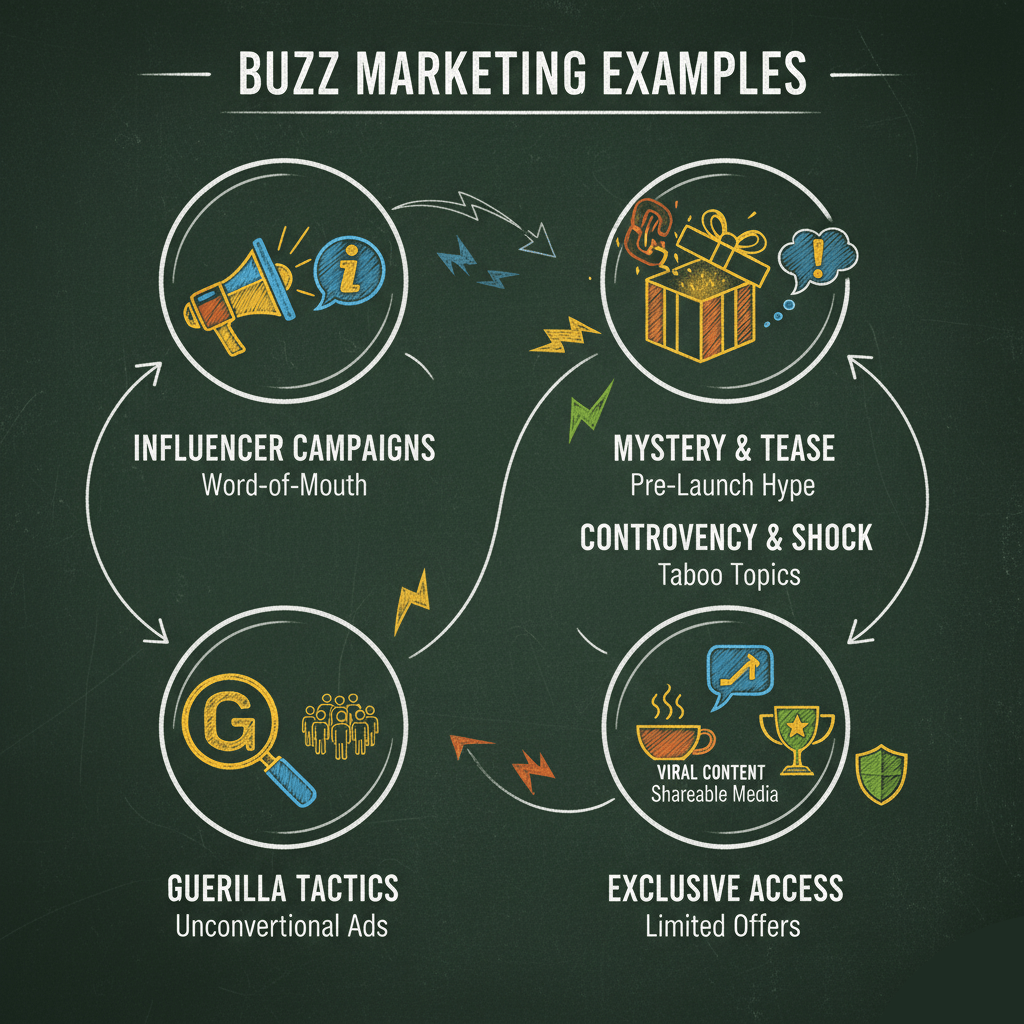
1. Guerrilla Marketing: The Real-World Ambush
Guerrilla marketing is the street-level special forces of marketing. It’s unconventional, unexpected, high-energy, and designed to create a “What just happened?” moment that people have to share.
- The Goal: To intercept people in their daily lives and give them a story to tell.
- The Cost: Often very low. Relies on creativity and nerve.
- The Risk: Can be high. Sometimes it borders on performance art, and sometimes it can get you in trouble (always check local laws!).
Buzz Marketing Examples (Guerrilla):
- The Blair Witch Project (Classic): Long before its release, the creators peppered the early internet with a low-fi website claiming the footage was real and the filmmakers were missing. They handed out “missing” flyers at film festivals. The resulting debate—”Is it real or fake?”—was the centerpiece of the entire marketing campaign. It was pure, unadulterated buzz, and it made the low-budget film a global phenomenon.
- Blendtec’s “Will It Blend?”This is a legendary startup marketing idea. Blendtec sold commercial blenders—a “boring” product. So, their CEO, Tom Dickson, put on a lab coat and started a video series where he attempted to blend everything: golf balls, an iPhone, and a rake. The videos were cheap to make but utterly compelling. People didn’t share them to sell blenders; they shared them because “You’ve gotta see this crazy guy blend an iPad!”
- Jeep’s “Reserved Parking”: Jeep created stencils and placed “Reserved for Jeep” markings in areas only a Jeep could park, such as on top of high curbs, in snowbanks, and on stair-steps. It was clever, visual, and perfectly reinforced their brand message (“Go anywhere”). People took pictures of these spots and shared them widely.
How to Do It on a Budget:
- Clever Chalk Stencils: Use chalk (or “reverse graffiti,” which involves cleaning a dirty sidewalk with a stencil) to display a funny or thought-provoking message in front of your shop.
- Sticker Campaigns: Create a visually interesting sticker with your brand and a simple URL or hashtag. People love to put stickers on laptops and water bottles. It’s a walking billboard.
- Publicity Stunts: Stage a (safe, legal) public event. If you’re a new coffee shop, host a “public funeral for bad coffee” with a tiny casket and a marching band. It’s absurd, it’s cheap, and it’s 100% shareable.
- Flash Mobs: If you can organize a group of volunteers, a well-timed flash mob in a public square (related to your brand, of course) is a guaranteed way to get phones out and recording.
2. User-Generated Content (UGC): Make Your Customers the Heroes
User-Generated Content (UGC) is the holy grail of social media buzz. It’s when your customers start creating (UGC) that is the holy grail of social media buzz. It’s when your customers start creating and sharing content about you, for free. It’s authentic, it’s powerful social proof, and it scales your content creation efforts infinitely.
- The Goal: To incentivize and encourage your fans to post photos, videos, or reviews featuring your product.
- The Cost: Next to nothing. The “prize” is often just recognition.
- The Key: Make it easy, fun, and rewarding.
Buzz Marketing Examples (UGC):
- GoPro (The King of UGC): GoPro’s entire marketing strategy is UGC. They don’t just sell cameras; they sell the “GoPro lifestyle.” Their social media feeds are almost 100% jaw-dropping photos and videos shot by their users. They host the “GoPro Awards” to incentivize people to submit their best content.
- Starbucks’ #RedCupContest: Every holiday season, Starbucks releases its plain red cups and encourages customers to draw on them, take a photo, and tag it with #RedCupContest. The result? Millions of pieces of free, festive, user-generated content flood Instagram, turning their coffee cups into cultural icons.
- Aerie’s #AerieREAL Campaign: The clothing brand Aerie pledged to stop retouching photos of models in its ads. They took it a step further, encouraging their customers to post their own unretouched images using the hashtag # AerieREAL. For every post, they’d donate $1 to the National Eating Disorders Association (NEDA). This tied UGC to a powerful mission, building a massive brand awareness campaign and a loyal community around a shared value.
How to Do It on a Budget:
- Create a Shareable Hashtag: Make it short, memorable, and unique to your brand.
- Run a Simple Contest: The prize doesn’t have to be big. It can be a $50 gift card, a free t-shirt, or simply the honor of being “featured” on your main social media page for a week.
- Just Ask! Put a small card in your packaging that says, “Love it? Show us how you use it! Tag us @[YourBrand] for a chance to be featured!”
- Make Your Packaging “Instagrammable”: Does your product arrive in a boring brown box? What if it were a beautifully designed box with a funny message inside the lid? People love to share a great “unboxing” experience.
3. Build an Online Community: The Insider’s Club
This isn’t just about having a Facebook page. A community is a space where your customers can interact with each other, not just with you. When you create a space for belonging, your fans develop an “insider” status. And what do insiders love to do? Talk about their exclusive club.
- The Goal: To foster a sense of belonging and turn customers into true fans.
- The Cost: Free, but it takes time and genuine effort.
- The Key: You must be a host, not a salesperson. Your job is to facilitate conversation, listen, and add value, rather than spamming your own links.
Buzz Marketing Examples (Community):
- Glossier (From Blog to Empire): Glossier didn’t start as a makeup company. It began as a blog called “Into the Gloss.” Founder Emily Weiss built a massive community of beauty enthusiasts who discussed products, shared routines, and trusted her recommendations. When she finally launched her own products, she had a built-in army of evangelists ready to shout about them. They even used a private Slack channel with their top 100 customers to get feedback on new products before launch.
- Duolingo: The language-learning app has a massive community built on a shared struggle (learning a language is hard!). Their forums are filled with people sharing tips and encouraging one another. Their social media (especially TikTok) is run like a comedy account, personifying the “Duo” owl mascot as an unhinged, passive-aggressive friend. It’s weird, hilarious, and it has created a cult-like following.
- Harley-Davidson (H.O.G.): The classic offline example. The Harley Owners Group (H.O.G.) turns buying a motorcycle into joining a brotherhood. It’s a lifestyle, complete with events, local chapters, and branded gear. They built a community so strong that people literally tattoo the logo on their bodies. That’s buzz.
How to Do It on a Budget:
- Start a Discord Server: Perfect for tech, gaming, or hobbyist brands. Create different channels for different topics.
- Create a Private Facebook Group: Make it an exclusive space for your “best customers” or “founding members.” Offer them early access to news or special Q&As.
- Use a Simple Forum: A simple, free forum on your website can serve as a hub for people to ask questions and share their expertise.
- Be Present: The founder or a core team member must be in the community every day. Not selling, just talking, answering questions, and being human.
4. Strategic Partnerships: Borrowing Credibility
You’re a small brand with 100 followers. You’re trying to reach a bigger audience. Why not “borrow” the audience of a brand that already has their trust? A strategic partnership is a “you scratch my back, I’ll scratch yours” arrangement with a non-competing business that shares your target customer.
- The goal is to gain a warm introduction to a new, highly relevant audience.
- The Cost: Usually free, based on a mutual exchange of value.
- The Key: It must be a natural fit. The partnership needs to make sense to both audiences.
Buzz Marketing Examples (Partnerships):
- Spotify & Uber: “A soundtrack for your ride.” When you were waiting for your Uber, you could connect your Spotify account and play your own music in the car. It was a simple, brilliant integration that added value for Uber riders and introduced Spotify to millions of new potential users.
- Red Bull & GoPro: The ultimate partnership. Both brands are about high-energy, extreme lifestyles. They co-create content (like the “Stratos” space jump) that is so epic, it becomes a global news event. They mutually benefit from being associated with each other.
- Local Level: Think simpler—a local gym partners with a local health-food café. The gym offers “free smoothie” cards for the café, and the café displays a “1-week free pass” for the gym on its counter. Both win.
How to Do It on a Budget:
- Co-host a Giveaway: Team up with 2-3 other small brands in your niche. You all contribute a product to a “grand prize” package. To enter, users have to follow all the brands. You all get a massive, immediate follower boost.
- Partner with Micro-Influencers: Don’t go for the mega-stars. Find someone with 5,000 highly-engaged followers who genuinely fits your brand. Don’t offer them money. Offer them free products, a unique experience, or co-design a product with them.
- Content Swaps: Find a blog or newsletter in your space and offer to write a high-value guest post for their audience, in exchange for them doing the same for you.
The Secret Weapon: Scarcity, Exclusivity, and FOMO
One of the most potent psychological drivers for creating hype is the Fear Of Missing Out (FOMO). We are hard-wired to want what we can’t have, or what’s challenging to get. You can use this to your advantage without being manipulative.
When something is scarce or exclusive, it immediately feels more valuable. It creates a “velvet rope” effect. People inside the rope feel special, and people outside want to get in.
Buzz Marketing Examples (Scarcity):
- Gmail (The Original): When Gmail first launched, you couldn’t just… sign up. You had to get an invitation from someone who was already a member. This made a Gmail address the ultimate status symbol in the tech world. People were begging for invites on forums. The scarcity made it the most talked-about product launch of the year.
- Clubhouse (2020): The audio-chat app experienced explosive growth during the pandemic for one simple reason: it was an invite-only platform. The exclusivity, combined with appearances from celebs like Elon Musk, made it feel like the most critical digital “room” in the world.
- Supreme: The streetwear brand built its entire empire on this. They release “drops” of new products in minimal quantities. This results in massive lines around the block and a resale market where a $50 t-shirt can sell for $1,000. The scarcity is the marketing.
How to Do It on a Budget:
- Launch a Waitlist: Before launching your product, create a simple landing page that says “Get on the list.” This builds anticipation.
- Offer a Beta Program: Invite your first 100 users to be “Founding Members.” Give them a special badge on their profile, a lifetime small discount, or direct access to you. Make them feel like co-creators.
- Use “Limited Edition” Drops: Don’t have your full product line available all the time. Release a new design, color, or “flavor” in a limited batch. “Only 100 of these will ever be made.”
- Run a Flash Sale: “Our secret 24-hour sale… for our newsletter subscribers only.” This makes your email list feel exclusive and valuable.
The Ultimate Budget Buzz Machine: Referral Marketing
We’ve covered some fantastic and creative strategies. UGC, community, guerrilla tactics… these are all fantastic.
However, they all share one commonality: they require sustained effort, and the results can be challenging to predict. You’re hoping your chalk art gets shared. You’re hoping your community takes off.
What if there was a way to take all the power of word-of-mouth marketing and put it on rails? What if you could build a system that guarantees buzz, and—here’s the best part—you only pay for successful results?
Welcome to referral marketing.
Referral marketing is a powerful marketing tool for any business, regardless of its budget. It’s not just “Hey, tell a friend.” It’s a structured, trackable, and scalable system that turns your existing customers into a motivated sales force.
It works by creating a “viral loop.”
- Customer A loves your product.
- You give Customer A a reward (like a discount, free product, or cash) for bringing in a new customer.
- Customer A shares their unique referral link with Customer B.
- Customer B signs up or makes a purchase (often receiving their own “welcome” reward).
- You get a new customer. Customer A gets their reward.
- Now, Customer B is in the system… and the loop repeats.
This is precisely how many of today’s tech giants got started.
Buzz Marketing Examples (Referral):
- Dropbox (The Gold Standard): This is the most widely used example for a reason. Dropbox was spending a fortune on Google Ads, and it wasn’t working. So, they created a simple referral program: “Get 500MB of free space for you and a friend who signs up.”
- Why it was brilliant: The reward wasn’t a t-shirt; it was more of the product itself. This was incredibly low-cost for Dropbox (just a number in a database) but high-value for the user. It also attracted new users who used the product more frequently, making them stickier.
- The Result: Dropbox grew by 3900% in just 15 months, fueled almost entirely by this referral loop.
- Harry’s (The Pre-launch Buzz): The razor company needed to make a splash in a crowded market. Before they even launched their product, they put up a simple landing page.
- The “ask” wasn’t “buy our stuff.” It was “Enter your email to be notified.”
- But then came the magic. After signing up, a new page appeared: “Refer friends and earn free stuff.”
- Refer five friends and receive free shave cream.
- Refer 10 friends and receive a free razor handle.
- Refer 50 friends = A year of free blades.
- The Result: In one week, they captured 100,000 email addresses. They had a massive, hyped-up customer base from the start.
- Uber/Lyft (The “Give/Get”): “Give $10, Get $10.” This simple, two-sided incentive fueled their explosive city-by-city growth. It gave riders a reason to share (by offering free rides) and provided new riders with a compelling, no-brainer reason to take their first trip.
The Problem: Building This Sounds Hard (And Expensive)
You’re probably thinking, “Okay, the Dropbox example is great. But I’m not Dropbox. I don’t have a team of engineers to build a custom referral-tracking system with unique links and automated reward fulfillment.”
Five years ago, you’d be right. It was a complex, expensive undertaking reserved for venture-backed startups.
This is no longer the case.
Today, platforms exist to make this accessible to everyone. This is where a tool like Viral Loops comes in. It’s explicitly designed to democratize this powerful buzz marketing strategy.
The whole point is to let you, the small business owner, launch a campaign inspired by giants like Dropbox or Harry’s, without writing a single line of code.
Here’s why this changes the game for budget marketing:
- It’s Built on Templates: You don’t have to reinvent the wheel. You can literally choose a pre-built, proven template, like the “Milestone Campaign” (just like Harry’s used) or the “Refer-a-Friend” campaign (like Dropbox). All the logic is already there.
- It’s Easy to Use: You can integrate it with your website, e-commerce store, or newsletter in minutes. It handles the unique links, the tracking, and the reward automation. You just focus on your rewards.
- It’s Truly Performance-Based: This is the most crucial part. You are not “spending” money on marketing. You are rewarding successful conversions. You set the rules. You only give the reward after the new customer signs up or makes a purchase. This flips your marketing from a cost to an investment with a guaranteed return.
This is how you put your word-of-mouth marketing on autopilot. You combine the genuine love for your “Purple Cow” product with a real, tangible incentive that encourages and scales that passion.
Your Buzz Marketing Blueprint: A Final Recap
Don’t let a small budget convince you that you can’t make a big noise. Buzz is not about money; it’s about creativity, community, and courage.
- Start with Your “Purple Cow.” Find the one remarkable thing about your business that will make people want to talk.
- Build Your Foundation. Use low-cost, high-impact strategies like guerrilla marketing, user-generated content (UGC), and strategic partnerships to find your first 1,000 true fans.
- Foster Your Community. Create an “insider’s club” where your fans feel a sense of belonging.
- Automate Your Buzz. When you’re ready to grow, don’t just hope for word of mouth. Build a system for it. Use referral marketing as your ultimate, performance-based growth engine.
Stop trying to out-spend your competitors. Start trying to outthink, outcare for, and outconnect with them. Build the buzz, and the customers will follow.
Frequently Asked Questions (FAQs)
Q: How long does it take to build buzz marketing?
A: Be patient. Buzz is a slow burn, not an explosion. You might see a small spike from a clever guerrilla tactic, but real, sustainable buzz—the kind that builds a brand—takes months or even years of consistent effort. The key is consistency: keep engaging your community, keep encouraging UGC, and keep giving people a great story to tell.
Q: What’s the difference between buzz marketing and influencer marketing?
A: They are related, but different. Influencer marketing is typically a transaction: you pay an influencer to post about your product. It’s a form of advertising. Buzz marketing is organic: it’s what happens after the post, when the influencer’s followers start discussing it among themselves. You can use influencers (especially micro-influencers) to spark a buzz campaign, but the goal is to get the conversation to take on a life of its own.
Q: My product is “boring.” Can I still create buzz?
A: Absolutely! Re-read the “Will It Blend?” example. Blenders are a boring, utilitarian appliance. But Blendtec created buzz by not marketing the blender. They marketed the spectacle of what it could do. Find your angle. Is your “boring” B2B software backed by the most hilarious, human-centered customer support on Twitter? Does an ex-circus performer run your “boring” accounting service with a wild backstory? Find your “Purple Cow.”
Q: How much should I budget for a “low-budget” campaign?
A: Your budget can be $0. Seriously. A UGC campaign based on featuring your customers costs nothing but your time. Building a Discord community is free. Writing a guest post for a partner is free. Your mental “budget” is time, energy, and creativity. When you’re ready to scale, your first cash budget should be allocated to a referral marketing program, as it’s the only one that pays you back for every dollar you spend.