“Use 12 proven tactics—from viral waitlists to ‘Build in Public’ content—to Build Hype Before a Product Launch, guarantee a massive audience, and transform a static waitlist into a potent, self-sustaining growth engine.”
You have done it. You have spent months, maybe even years, pouring your blood, sweat, and a dangerous amount of caffeine into your new product. The code is clean (mostly). The design is slick. This thing is finally ready.
So, you push the launch button.
And… crickets.
A few pity-purchases from your mom and your college roommate. A small spike in website traffic that vanishes by lunch. This is the nightmare that keeps founders awake at night. It is the tragic end for 90% of new products. Here is the hard truth: The “build it and they will come” philosophy is a lie.
A successful product launch is not a single event; it’s a culmination of many factors. It is the climax of a story you have been telling for months. A grand launch does not start on launch day; it starts today.
The real work is in the pre-launch. It is in the methodical, patient, and exciting process of building anticipation. You need to make people want your product before they can even buy it. You need to develop a crowd outside the store before the doors open.
This is how you build hype before a product launch.
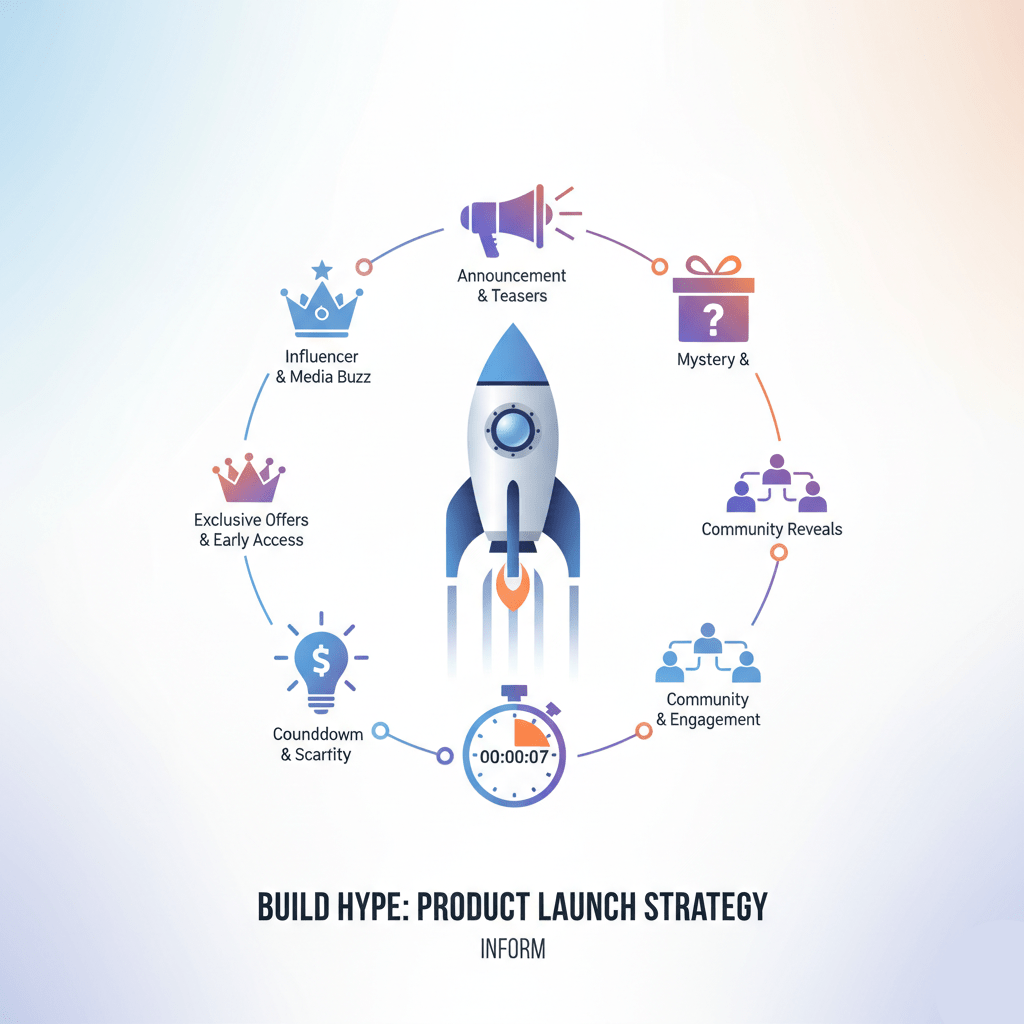
It is not magic. I t’s a strategy. We will provide you with the complete playbook. This is a list of 12 proven, actionable tactics for generating serious product launch buzz. We will cover everything from building a “secret” insider group to crafting a teaser campaign that agitates the problem, to the single most powerful tactic of all: turning a boring waitlist into a viral hype engine.
Let us get started.
1. Start with a High-Converting “Coming Soon” Page
Before you do anything else—before you tweet, before you build a community, before you talk to an influencer—you need a “home base.” You need a single, digital destination to point all your future efforts toward. This is your “Coming Soon” page.
However, let us be clear. This is not a lazy “Under Construction” GIF from 1998. This page has one job and one job only: to capture an email address.
This page is your pre-launch headquarters. It is the top of your funnel. Every other tactic in this list will drive people to this page. So, it needs to be good. Really good.
Here are the non-negotiable elements for a “coming soon” page that actually converts:
- A Killer Headline: This is 80% of the battle. Your headline must communicate your core value proposition in five seconds or less. Do not talk about your features. Talk about the outcome.
- Bad: “FutureNote is a new AI-powered note-taking app.”
- Good: “Stop losing your best ideas. The first note-taking app that organizes your thoughts for you.”
- A Clear Sub-Headline: This is where you briefly support the headline. Explain how you deliver on that promise. “Our AI automatically tags, links, and resurfaces your notes, so you never have to search again.”
- A Single, Obvious Call-to-Action (CTA): This is the email sign-up form.
- Make the button bright and unmissable.
- Use action-oriented, benefit-driven text. “Join the waitlist” is fine. “Get Early Access” is better. “Start Organizing My Ideas” is best.
- A Glimpse of the Product: Make it feel real. People are visual. Include a high-quality product mockup, a short GIF of the “magic moment” of your app, or a slick, stylized render. This demonstrates that you are not just selling an idea; you are creating a tangible solution.
- A Hint of Social Proof: This can be challenging when you have no users, but you can get creative. Instead of “Join 10,000 users,” say “Join 500+ other forward-thinkers on the early-access list.” It reframes “empty” as “exclusive.”
Your “coming soon” page is your foundation. A weak foundation will cause all your other hype-building efforts to crumble. Make it simple, straightforward, and focused on a single, actionable step. However, just capturing an email is level one. Level two is where the real hype begins.
2. Transform Your Waitlist into a Viral Hype Machine
This is the most critical tactic in this entire article. If you do nothing else, do this.
Here is the problem with a standard “coming soon” page:
- A user lands on your page.
- They sign up.
- They get a generic “Thanks for signing up!” message.
- They immediately forget who you are.
You have gained a lead, but you have lost all momentum. The excitement dies instantly. You have not built an advocate; you have just collected an email.
You need to change the game. You need to give your new subscriber a job. You need to turn their passive waiting into active participation.
You achieve this by transforming your simple waitlist into a gamified, viral referral program.
This is the core of a modern, unbeatable product waitlist strategy. Here is the step-by-step process:
- The Sign-up: A user signs up on your “Coming Soon” page (from Tactic 1).
- The “Thank You” Page (The Magic Step): Instead of a boring “Thanks!” page, they are redirected to a new page. This page says something like: You are on the list! You are currently #1,250 in line. Want to skip the line?”
- The Unique Link: This page provides the user with their own unique referral link.
- The Milestones: This is the key. You create a series of rewards based on the number of friends they refer. This is called a milestone referral program.
It looks like this:
- Refer 3 Friends: Get our “Top 10 Productivity Hacks” ebook.
- Refer 5 Friends: Get a 25% launch-day discount.
- Refer 10 Friends: Get a free “Idea Machine” t-shirt.
- Refer 20 Friends: Get 6 months of our Pro Plan for free.
- Top 10 Referrers: Get a free LIFETIME account.
What just happened? You have completely changed the user’s psychology. They are no longer a passive “waiter.” They are an active player. They have a goal. They have a clear path to rewards.
You have just weaponized their excitement and turned your first 100 fans into a marketing team of 100 people. They will share their link on Twitter, in their private Slack groups, on Discord, and on Reddit. They are now working for you, finding more fans just like them.
This is how you see brands launch with 100,000 sign-ups. They did not find 100,000 people. They found 1,000 true fans and gave them the tools and incentives to find the other 99,000. This is how you generate explosive hype for a product.
How to Actually Build This (Without Coding)
Okay, this sounds amazing. However, it also sounds incredibly complicated. Building a system to generate unique links, track referrals, manage leaderboards, and fulfill rewards… that is a whole separate software project.
This is precisely where a tool like Viral Loops becomes your secret weapon.
Viral Loops is explicitly built to do this. You do not need a team of engineers or weeks of development.
Our Startup Prelaunch Template is a plug-and-play solution for this exact pre-launch strategy. You can:
- Set up your startup prelaunch rewards in minutes.
- Create beautiful, customizable landing and “thank you” pages (or integrate them into your existing site).
- Automatically send out emails with the unique referral links.
- Get a dashboard that tracks everything: who your top referrers are, how many sign-ups they have driven, and who has earned which rewards.
This one tool turns your static “coming soon” page into a self-perpetuating hype-building engine. It is the single most effective way to ensure that on launch day, you are not just opening the doors to an empty room, but to a stadium.
3. Run a “Problem-First” Teaser Campaign
Most brands start their “teaser campaign” all wrong. They lead with the solution. They post a mysterious, shadowy picture of their product with the caption “Something… is… coming. 01.12.25.”
This is boring. It creates zero connection.
A powerful teaser campaign does not start with your product. It begins with the problem your product solves.
Before you even hint that you are building a solution, you must establish yourself as the leading voice on the problem. Agitate the pain point. Get your target audience to nod their heads in agreement.
Let us say you are building a new project management tool.
- Week 1: You go on Twitter and LinkedIn. You post: “Another Monday, another 3-hour ‘status update’ meeting that could have been an email. Why do we still work like this?” You publish a short blog post titled “The 5 Signs Your Project Spreadsheet Is Secretly Killing Your Team’s Productivity.”
- Week 2: You post a poll: “What is your biggest project management headache? A) Endless status meetings, B) ‘Where do I find that file?’, C) No one knows who is doing what, D) All of the above.” (Hint: The answer is always D).
- Week 3: You are now the “person who gets it.” You have built an audience of people who feel this pain. You have validated their frustration.
Now, and only now, do you make the pivot.
- Week 4: You post: “I am tired of the chaos. We all are. Over the past six months, we have been developing a solution to eliminate status meetings once and for all. It is called [Your Product Name]. The first 500 people to join the waitlist get priority access.”Moreover, where do you link? To your new viral waitlist page (Tactic 2).
See the difference? You are not a random vendor. You are a trusted expert who understands the problem so profoundly that you were forced to build the solution. This builds immense trust and makes the “ask” (joining the waitlist) a logical and welcome next step.
4. Build an Engaged Community from Day Zero
This is a master-level move for building an audience before launch.
Do not wait for a product to build a community. Build the community first.
The community is not a place to shill your product. It is a “watering hole” for your ideal customers. It is a place for them to hang out, share ideas, and discuss the problem space in which your product operates.
- Choose Your Platform: Select a platform where your audience already resides. This could be a free Discord server, a private Slack channel, a Circle community, or a focused Facebook Group.
- Define the Purpose (It is Not You): The community’s purpose is not “Get updates on [My Product].” The purpose is “A place for freelance writers to share job leads and client horror stories.” Alternatively, “A community for new dads to share tips on non-diaper-related life.”
- Provide Value. Daily. You are the host. Your job is to be the most helpful, active, and valuable member.
- Start discussions.
- Post interesting articles.
- Ask questions.
- Connect members who can help each other.
- Enforce a strict “no spam” rule.
You are providing a high-value, free resource for months. You are building trust, authority, and a massive amount of goodwill.
Then, when the time comes, you can make a “community-only” announcement.
“Hey, everyone. As the moderator of this community, I have listened to all of our shared frustrations about [the problem] for months. I have decided to take action. I am building a tool just for us. As founding members of this group, you are all getting free beta access.”
Who do you think will be your first, most loyal, and most vocal users? The 500 people you have been helping for free for the last three months.
5. Execute a “Founding Members” Beta Program
A “beta test” sounds like work. It sounds like you are asking for a favor.
A “Founding Members Program” sounds exclusive. It sounds like an opportunity.
This is a crucial reframing.
Sometime before your public launch, hand-select 50-100 people from your viral waitlist (especially your top referrers!) or your community (Tactic 4).
Tell them: “You have been selected to be a Founding Member of [Your Product]. You will get to use the product weeks before anyone else, get a free lifetime account, and have a direct line to me to help shape the future of this tool.”
This is what you get:
- Invaluable Feedback: These 100 people will find every bug. They will point out every confusing part of your user interface. They will give you the hard, honest feedback you need.
- Your First Testimonials: As you get closer to launch, you ask them for a quote. “As a Founding Member, what is the one thing you love most?” These testimonials are 100x more potent than any copy you could write. You can (and should) plaster these all over your launch-day landing page.
- A 100-Person Hype Team: On launch day, these 100 people feel a sense of ownership and pride. They were there “when it was buggy.” They helped build this. They are emotionally invested. They will tweet, post, and share with a passion that you simply cannot buy.
6. Partner with Micro-Influencers for Authentic Endorsement
Forget trying to get a mention from a celebrity with 10 million followers. The real power in new product marketing lies with micro-influencers (typically 5,000 – 50,000 followers).
Why? Three reasons:
- Niche Authority: Their audience follows them for one specific thing. They are a trusted expert on vegan cooking, or B2B SaaS, or 90s-era JRPGs. Their recommendation carries weight.
- High Engagement: They have a smaller, more intimate audience. Their comments section is a real conversation, not a wall of spam. A post from them feels like a recommendation from a friend.
- Accessibility: They are not swamped by billion-dollar brands. Many will be happy to check out your product in exchange for free access, a small affiliate cut, or a modest fee.
Here is the right way to do it:
- Make a Dream 20 List: Identify 20 micro-influencers who perfectly match your ideal customer.
- Engage First, Ask Second: Do not send a cold DM. Follow them for at least a week. Reply to their stories. Leave thoughtful comments on their posts. Become a familiar, non-creepy name.
- Send the Perfect Pitch: After a week, send a personal DM or email.
“Hey [Name], I have been loving your content on [topic], especially your post last week about [specific problem].
“I am actually the founder of a new tool that’s built to solve that exact problem.
“I know your audience trusts you to find the best new stuff. I would love to give you a free, lifetime-access account (plus a few for your community) in exchange for your honest feedback.
“No pressure to post, but if you genuinely love it, a quick mention would be amazing.”
This approach is respectful, shows you have done your homework, and makes the “ask” a no-brainer. A single, authentic “check this out!” from a trusted micro-influencer can send thousands of hyper-qualified people to your waitlist.
7. Create a “Build-in-Public” Content Series
This is one of the most powerful and modern launch marketing ideas.
The old way: Build in a secret, underground bunker. Fear that someone will “steal your idea.” The New Way: Build in Public.
Share your entire journey, from idea to launch. Be radically transparent. Share the wins, the losses, the bugs, and the “aha!” moments.
This does two incredible things:
- It builds an Audience Around Your Story: People are naturally drawn to narrative. They will get invested in your journey. They will root for you. They are not just signing up for a product; they are joining a movement they have been watching from the very beginning.
- It Builds Unbeatable Trust: By sharing the messy “behind-the-scenes,” you are not a faceless corporation. You are a human. You are relatable.
Content ideas for your “build-in-public” series:
- A “Devlog” Blog: “Week 4: We hit 1,000 waitlist sign-ups and our server almost crashed. Here is what we learned.”
- Twitter Threads: “I just spent 6 hours fixing a bug… all because of a single typo. A founder’s journey. [thread]”
- LinkedIn Posts: “We are deciding between two different pricing models for our launch. Here are the pros and cons of each. What does everyone think?” (This has the bonus of getting your audience to tell you how to sell to them).
- Short Videos: A 60-second “walkthrough” of a new feature you just finished, posted to TikTok or Instagram Reels.
By the time you launch, your audience feels like they were in the trenches with you. They will be your most passionate supporters.
8. Host an “Ask Me Anything” (AMA) or Pre-Launch Webinar
Direct engagement is the most effective path to establishing trust. You need to get in front of your budding audience and be a real human.
Option 1: The Pre-Launch Webinar. This is not a 60-minute sales pitch of your product. That will backfire.
Instead, you host a 60-minute training session that provides massive value on its own.
- Title: “The 5-Step Framework for [Achieving Result Your Product Helps With]… Even Without Our Tool.”
- The Content: For 45 minutes, you teach. You give away your best secrets. You establish yourself as a true expert.
- The Pitch (Last 15 Mins): “Now, I have just shown you the 5-step manual process. It works, but it is challenging. Over the last six months, we have been developing a tool that automates steps 2, 3, and 4. It is called [Your Product], and for everyone here who lives on this webinar, you are getting first dibs on the waitlist and a 50% launch discount.”
You have earned their trust. You have provided value. You are now allowed to make an offer.
Option 2: The “Ask Me Anything” (AMA)-. This is a more informed approach that fosters a great deal of trust.
- Where: Host it in your new community (Tactic 4), on a relevant Subreddit (get moderator permission first!), or just on Twitter or LinkedIn Live.
- The Vibe: Be an open book.
- What it does: It is an opportunity to address questions, address objections before they arise, and reveal the personality behind the brand. People will ask about your product, your “build in public” journey, and your vision. It is a goldmine for customer research and a powerful hype-builder.
9. Secure Early PR and Media Mentions
This may seem intimidating, but you do not need a $10,000-per-month PR agency. You just need a good story and persistence. A single “As seen in…” logo on your “Coming Soon” page can dramatically increase your conversion rate.
Scrappy PR Tactic 1: HARO (Help a Reporter Out)
- Sign up for HARO. It is a free service that emails you daily queries from journalists at major publications.
- They will say: “Looking for a quote from a productivity expert on ‘beating procrastination’.”
- You are now a “productivity expert” (because you are building a tool for it).
- Send them a fantastic, non-salesy, 2-3 sentence quote.
- If they use your quote, they will include your name and a backlink to your site. Boom. You are now “as seen in Fast Company.”
Scrappy PR Tactic 2: Target the Right Journalist
- Do not email the generic tips@techblog.com inbox. It is a black hole.
- Find the specific writer at that blog who covers your exact niche.
- Follow them on Twitter. See what they are writing about.
- Find their email (it is not that hard).
- Send them a 3-sentence email with a story, not a product.
- Bad Pitch: “Hi, I am launching an app. Please write about it.”
- Good Pitch: “Subject: Story Idea: Ex-Google engineer tackles [The Problem]
“Hi [Journalist Name], I saw your article on [related topic] and loved it.
I am an ex-Google engineer who left my 6-figure job because I was so frustrated with [the problem]. I am now three weeks away from launching [Your Product], a tool that solves the problem by [your unique angle].
“Happy to send over a 3-minute demo and early access if you are interested. No worries if not.”
Journalists do not care about your features. They care about a good story. Give them one.
10. Create a Free, High-Value “Problem-Solving” Lead Magnet
This is a powerful tactic for building an audience, and it runs in parallel to your central waitlist.
Some people are not ready to “join a waitlist” for a product they do not understand yet. However, they are very willing to share their email address in exchange for an immediate, high-value resource.
This is your lead magnet. It must be a “bite-sized” solution to a “bite-sized” part of the main problem.
- Your Product: A new, advanced SEO tool.
- Your Lead Magnet: “The 10-Point On-Page SEO Checklist We Used to Rank #1.”
- Your Product: A new personal finance app.
- Your Lead Magnet: “The Ultimate 50/30/20 Budgeting Spreadsheet (Google Sheets Template).”
- Your Product: A new high-end graphic design app.
- Your Lead Magnet: “A Free UI Kit: 50+ Minimalist Components for Figma.”
You promote this free resource. People download it. They get immediate value. You have proven yourself to be an expert in this field.
Now, they are on your email list. You can build a “nurture sequence” that warms them up:
- Email 1: “Here is your free checklist! Hope it helps.”
- Email 2: “Hey, did you know the problem on Step #7 of that checklist is exactly why we are building [Your Product]? It is a huge pain.”
- Email 3: “Want to see how we are solving that problem for good? Here is a 2-minute ‘sneak peek’ video of [Your Product] in action. (P.S. You can join the waitlist here…”
11. Gamify the Pre-Launch with Contests or Challenges
This tactic focuses on fostering active participation. It is different from your viral waitlist (which is referral-based). This is action-based. It makes your audience feel like they are part of the brand’s creation.
The “Challenge”
- Run a 5-day “challenge” in your community or on social media.
- Example (for a new fitness app): “The 5-Day ‘Find 30 Minutes’ Challenge.”
- Each day, you email a task: “Day 1: Your challenge is to go for a 10-minute walk. Post a ‘shoe-selfie’ in the community when you are done!”
- This builds micro-habits and gets people doing the thing your app will eventually help them with.
- The Prize: Everyone who completes all 5 days gets a “Founding Challenger” badge and a 30% discount. One winner receives a lifetime account.
The “Contest”. This is even simpler. Get your audience to co-create with you.
- “Name our new feature!”
- “Help us design our launch-day t-shirt. (Submit your design, winner gets it made + a 1-year sub).”
- “Guess the exact launch date and time. Closest guess wins.”
These small “launch marketing ideas” are incredibly sticky. They build an emotional connection. People are no longer just waiting for your product; they are playing with you.
12. Create a “Secret” Insider Email/SMS List
This final tactic is all about leveraging the psychology of exclusivity. People want what they (and others) cannot easily have.
This is not your central waitlist. This is a level above it. This is your “velvet rope.”
How it works:
- On your “Thank You” page (after they have joined the central waitlist), you add a second, optional step.
- The Pitch: “You are on the list. However, would you like to gain even earlier access? We are creating a ‘secret’ insider group where we will be dropping feature demos and maybe even a 24-hour ‘friends & family’ access link before anyone else. This is for our 100 true fans.”
- The “Ask”: “Drop your phone number to join the Insider SMS list.” Alternatively, “This is only for people who refer at least three friends.”
What you share with this “secret” list:
- Grainy, “leaked” photos of new features you are working on.
- Quick polls: “Hey insiders, we are arguing… should the button be blue or green? You decide.”
- A 24-hour “secret link” to purchase the product before the central waitlist opens.
This group becomes your Day 1 buyers. They are the most loyal, enthusiastic, and vocal fans you have. By making them feel special, you guarantee they will be your evangelists on launch day.
Your Launch Day Is in Your Hands
A product launch that flops is a failure of marketing, not (usually) a failure of product. A silent launch is the result of building in a vacuum and hoping for an audience.
A launch that “breaks the internet” is a choice.
It is the result of a deliberate, long-term pre-launch marketing strategy. It is the climax of a story you started telling months ago.
You do not need to do all 12 of these tactics. However, you cannot just do none of them.
Start with the essentials:
- Build your “Coming Soon” page (Tactic 1).
- Turn it into a viral referral engine with a tool like Viral Loops (Tactic 2).
- Pick one other tactic—like “Build in Public” or “Problem-First Teaser”—and start executing.
The hype you build before you launch is the single most significant predictor of the success you will have after you launch.
Your product deserves a crowd. Build one.
FAQs: Building Hype Before a Product Launch
Q1: How far in advance should I really start my pre-launch marketing?
This is the most common question, and the answer is always “longer than you think.”
- Ideal: 6 months. This gives you time to build an audience from scratch (Tactic 4 or 10), establish yourself as an expert (Tactic 3), and create a massive waitlist (Tactic 2).
- Good: 3 months. This is a solid runway to execute most of these plays: run a 4-week teaser campaign, set up a viral waitlist, and start your micro-influencer outreach.
- Bare Minimum: 1 month. If you are here, you need to be hyper-focused. Your only job is to drive traffic to a viral waitlist page. Use paid ads, heavy-hitting influencer/PR outreach, and go all-in on Tactic 2. It is a sprint, not a marathon.
Q2: My product is in a “boring” B2B industry. Can I still build hype?
Absolutely. “Boring” is a myth. “Boring” industries just mean you are solving real, expensive problems. The hype just looks different.
- Consumer (B2C) hype = T-shirts, contests, and 100,000 waitlist sign-ups.
- Business (B2B) hype = A 200-person, high-intent webinar (Tactic 8), a high-value lead magnet (Tactic 10) downloaded by 1,000 qualified leads, and 10 “Founding Members” (Tactic 5) who are VPs at target companies. B2B hype is less about volume and more about value. Focus on solving the pain (Tactic 3) and proving your expertise (Tactic 8). A B2B “viral loop” might be “Refer another company, and you both get your first month free.”
Q3: How much budget do I need for this pre-launch strategy?
It can be as close to $0 as you want. Many of these tactics are “sweat-equity” plays.
- Free (but time-intensive): Building in Public (Tactic 7), Community Building (Tactic 4), HARO (Tactic 9), Problem-First Teasers (Tactic 3).
- Low-Cost / High-ROI: The most effective tactic, the viral waitlist (Tactic 2), is extremely low-cost with a tool like Viral Loops. It is designed to pay for itself many times over by lowering your cost-per-acquisition to pennies. Instead of a big budget, you need creativity, persistence, and a willingness to provide value upfront.
Q4: What is the single most prominent mistake founders make in their pre-launch?
Hiding.
Founders work in secret. They are terrified someone will “steal their idea.” They “perfect” the product for a year… only to launch to a world that has no idea who they are or what problem they solve.
The real risk is not someone stealing your idea; it is someone using your concept without proper attribution. The real risk is building something nobody wants.
Every single tactic on this list is an antidote to that fear. They force you to engage with your market, validate your ideas, and build with your audience, not just for them. Do not hide. Start building your hype today.