“Craft a successful Product Launching Plan with this 90-day roadmap. Learn to build a massive, viral waitlist and execute a high-impact launch.”
You have a brilliant product. You’ve spent months, maybe even years, developing it. You know it can solve a real problem. Now comes the challenging part: getting it into the hands of those who need it.
This is where most new businesses fail. They believe in the old saying, “If you build it, they will come.”
Let’s be clear: that is a myth.
A successful product launch is not an event; it’s a meticulously planned process. It’s a campaign of strategy, psychology, and relentless execution. Without a clear plan, you’re essentially shouting into a void, hoping someone hears you.
What you need is a blueprint. A step-by-step, 90-day roadmap that takes you from “idea” to “first 100 customers” and beyond. This is your product launching plan. It’s the bridge between your finished product and a market that is excited to buy it.
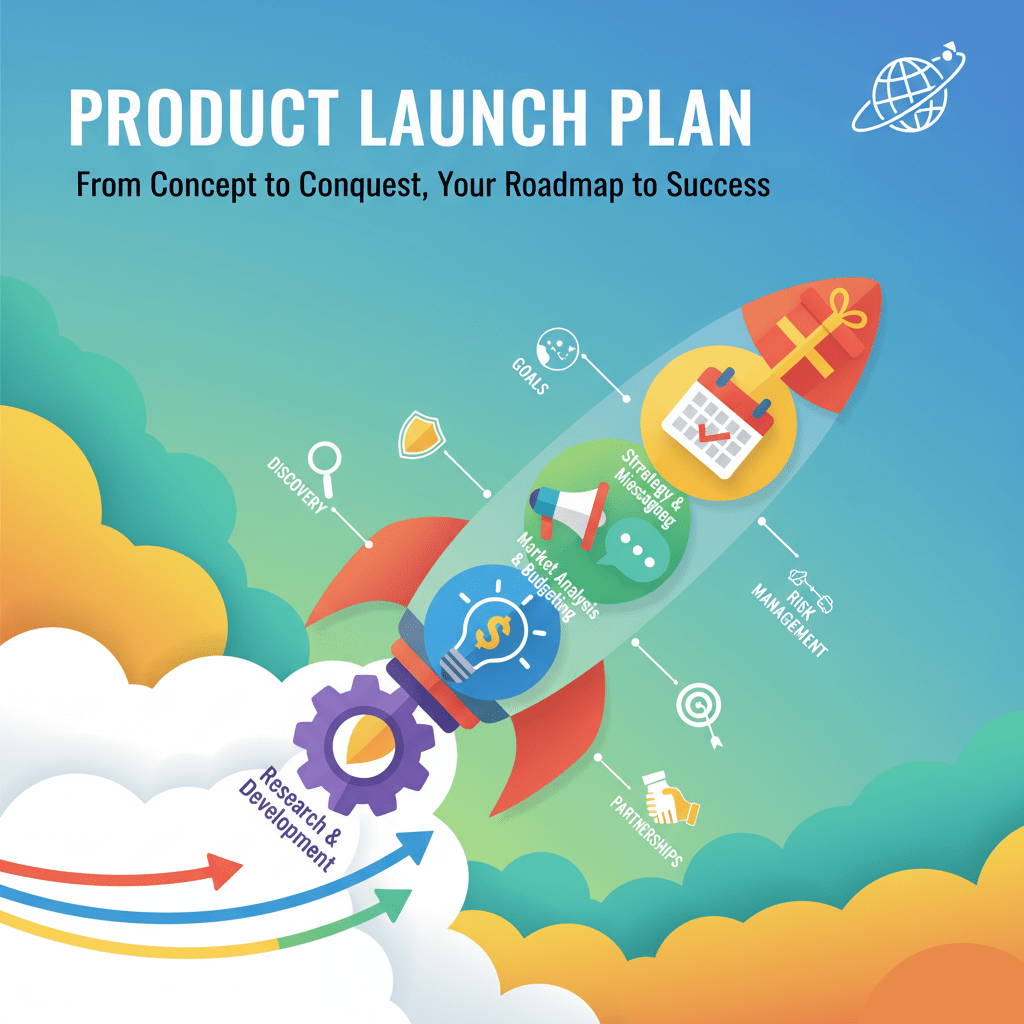
We will break down this complex process into three manageable 30-day phases. This isn’t just a simple to-do list; it’s a comprehensive go-to-market strategy template designed for action.
- Phase 1 (Day 1-30): The Foundation. This is the deep-work phase. We’ll focus on research, positioning, and crafting the core message that will define your entire launch.
- Phase 2 (Day 31-60): The Hype Machine. This is where we build an audience before we have anything to sell. We’ll create content, build a landing page, and, most importantly, create a viral waitlist that builds momentum on its own.
- Phase 3 (Day 61-90): The Launch & The Loop. This is go-time. We execute the launch, support our first customers, and immediately implement a post-launch strategy to turn those first buyers into a powerful, self-sustaining referral engine.
This 3-month launch plan is intense, but it works. It’s designed to build momentum systematically, so that on launch day, you’re not hoping for customers—you’re managing an influx of them.
Let’s begin.
Phase 1 (Day 1-30): The Foundation & The Message
You cannot build a strong house on a weak foundation. The first 30 days are not about marketing; they are about strategy. Rushing this step is the single most common reason launches fail. You must understand who you’re selling to and why they should care before you write a single line of ad copy.
Week 1-2: Deep-Dive Market Research
You might think you know your customer. You may be wrong. “Gut feeling” is not a strategy. You need data.
1. Competitor Analysis (The Spy Work): First, you need to know the landscape. Make a list of 5-10 direct and indirect competitors.
- Direct Competitors: They sell a similar product to a similar audience (e.g., Nike vs. Adidas).
- Indirect Competitors: They solve the same problem but with a different solution (e.g., for “boredom,” Netflix competes with TikTok, a book, and a board game).
Now, become a detective.
- Analyze Their Messaging: What is their main headline? What benefits do they promise? Are they competing on price, features, or service?
- Read Their Reviews: This is a goldmine. Go to G2, Capterra, Amazon, or Reddit. Find the 1-star and 3-star reviews. What are people complaining about? These are your opportunities. If everyone complains, “Competitor X is too complicated,” your marketing message becomes “The simple, 5-minute solution.”
- Map Their Funnel: Sign up for their email list. Buy their product if you can. See their onboarding. What do they do well? What feels clumsy?
2. Customer Interviews (The “Jobs-to-be-Done” Framework): Surveys are fine, but they’re limited. You need to talk to people. Identify 10-15 individuals who represent your target audience and conduct a 30-minute conversation with each of them.
Do not ask, “Would you buy my product?” They will lie to be nice.
Instead, use the “Jobs-to-be-Done” (JTBD) framework. People “hire” products to do a “job.” A person doesn’t buy a drill; they “hire” it to create a quarter-inch hole.
Ask questions about their past behavior:
- “Tell me about the last time you tried to [solve the problem your product solves].”
- “What was the hardest part of that?”
- “What, if anything, have you tried to use to solve this? What did you like or dislike?”
- “If you could wave a magic wand and have the perfect solution, what would it do?”
Listen for their exact words. The phrases they use to describe their pain are the same phrases you will use in your marketing.
Week 3: Defining Your Ideal Customer Profile (ICP) & Personas
After your research, you can stop guessing. You now have data. It’s time to build your customer avatars.
- Ideal Customer Profile (ICP): This refers to a specific company (for B2B) or a target demographic (for B2C) that represents the perfect customer. It’s a logical, fact-based description.
- B2B Example: “SaaS companies in North America with 50-200 employees, using HubSpot, who have a dedicated content marketing manager.”
- B2C Example: “Millennial parents (28-40) in urban areas, with a household income over $100k, who shop at Whole Foods and follow parenting blogs.”
- Buyer Persona: This refers to a specific person. It’s a semi-fictional story that brings the ICP to life. Give them a name, a job title, goals, and—most importantly—pain points.
- Example: “Marketing Mary. She’s 34, a Marketing Manager at a mid-size SaaS company. She’s overwhelmed, working 50 hours a week. Her pain is that she can’t prove the ROI of her content. She’s afraid of looking bad in front of her boss. Her goal is to find a tool that creates simple, beautiful reports so she can finally get the credit she deserves.”
You will write all your marketing copy directly to “Marketing Mary.”
Week 4: Crafting Your Core Messaging & Positioning
This is the climax of Phase 1. You’re taking all your research and forging it into a sharp spear.
1. The Positioning Statement: This is an internal document that defines your place in the market. It’s your north star. The classic template is:
- For: [Your Ideal Customer Profile]
- Who: [Have this specific pain point/need]
- Our Product is a: [Product category]
- That provides: [The single most compelling benefit]
- Unlike: [The primary competitor/alternative]
- Our Product: [Your key differentiator/secret sauce]
Example: “For Marketing Mary, who struggles to prove the value of her work, our product is a reporting dashboard that provides beautiful, one-click ROI reports. Unlike a complex BI tool, our product sets up in 5 minutes and requires no technical skill.”
2. The Unique Selling Proposition (USP) / Value Proposition: This is the external, customer-facing version of your positioning. It must be simple, straightforward, and benefit-driven. It answers the question: “What’s in it for me?”
A common mistake is leading with features.
- Feature (Bad): “We have a 256-bit encrypted database.”
- Benefit (Good): “Keep your client data 100% secure and private.”
A great USP often combines the benefit with the solution.
- Slack: “Be more productive at work with less effort.”
- Stripe: “Payments infrastructure for the internet.”
Spend this entire week writing and re-writing your headline. Test it on your mom, your friends, and your target customers. If they don’t “get it” in 5 seconds, it’s not simple enough. By Day 30, you must have this message locked in.
Phase 2 (Day 31-60): The Hype Machine & The Viral Waitlist
Welcome to Month 2. The foundation is set. You know who you’re talking to and what you’re going to say. Now, it’s time to find them and build an audience.
The goal of this phase is not to sell. The goal is to build a “launch list”—a dedicated group of people (your Ideal Customer Profile, or ICP) who are waiting for you to launch. This is the core of your launch marketing plan.
Week 5-6: Content Strategy & Lead Magnet Creation
You need a “watering hole” for your ICP. You need to give them a reason to pay attention to you before you ask for a sale. This is done through value-first content.
1. Choose Your “Pillar” Channel: Don’t try to be everywhere. You’ll burn out. Pick ONE channel where your ICP (Marketing Mary) already spends her time.
- If she’s a B2B professional, it could be LinkedIn articles and a blog.
- If she’s a crafter, it could be Instagram Reels and Pinterest.
- If she’s a developer, it could be on Reddit (r/devops) and Twitter.
Commit to this channel for the next 30 days.
2. Create a Lead Magnet: You need to trade value for an email address. An email list is the single most valuable asset for a product launch. A “Sign up for our newsletter” box is weak. You need an irresistible offer.
This lead magnet must be a “quick win” that solves a small piece of the larger problem your product solves.
- If your product is a project management tool, your lead magnet could be “The 10-Point Checklist for a Flawless Project Kick-off.”
- If your product is a fitness app: “The 5-Day No-Equipment Home Workout Plan.”
- If your product is a financial dashboard: “The Simple 1-Page Budgeting Spreadsheet.”
This should take you no more than a few days to create. It’s a simple PDF, spreadsheet, or 5-minute video.
3. Write “Shoulder” Content: Now, create 4-8 pieces of content (blog posts, social media threads, videos) that all lead to your lead magnet. This content should address the pain points you discovered in Week 1.
- Title Example: “5 Reasons Your Projects Always Go Over Budget (And How to Fix Them)”
- CTA at the end: “If you found this helpful, grab my free 10-Point Project Kick-off Checklist to start your next project right.”
Week 7: Building the Launch Infrastructure
You need a simple technical setup to capture these leads.
- Email Service Provider (ESP): Get an account with Mailchimp, ConvertKit, Sendinblue, or a similar service. This is where you’ll store your list and send your launch emails.
- A Simple Landing Page: This is not your whole website. It’s a single page with one job: convert visitors into email subscribers. It should have:
- Your powerful new USP/headline.
- A brief description of the benefit of the lead magnet.
- A box to enter an email address.
- That’s it. No “About” page, no “Contact” section, and no distractions.
Week 8: The Secret Weapon: The Viral Waitlist
This is where we separate an average launch from a massive one.
You can collect emails on your landing page. You could build a list of a few hundred people. That’s fine.
Or… you could turn every single new subscriber into a salesperson for your brand.
You need to create a viral waitlist. The psychology is simple: you’re not just offering a future product; you’re offering status and rewards to those who join early and share. This is a critical part of the new product development process—validating demand before you go live.
This is where a tool like Viral Loops becomes essential. Trying to track referrals manually with spreadsheets is a nightmare. A platform designed for this automates the entire process.
Here’s the plan: You’re going to use the Viral Loops Milestone Referral template.
How It Works: Instead of a “Thank You” page after someone signs up, they’re redirected to a “Waitlist” page. This page shows them:
- Their Position in Line: (e.g., “You are #753 on the waitlist.”)
- Their Unique Referral Link: (This is the magic part.)
- The Rewards (The Milestones): This is the game. You’re giving them a reason to share their link.
Example Milestone Setup:
- Sign Up: Get on the early-access list.
- Refer 3 Friends: Get a free “Advanced Tips” PDF (a second, more valuable lead magnet).
- Refer 5 Friends: Get a 25% discount on launch day.
- Refer 10 Friends: Get the 25% discount + a free company t-shirt.
- Refer 20 Friends: Get 50% off and the t-shirt.
This system is potent. It taps into core human desires: gamification, status, and free stuff. Your first 100 subscribers, whom you acquired through your content, will now help you attract your next 500. Those 500 will work to bring you your next 2,000.
Your only job from Day 31 to Day 60 is to drive traffic (from your blog, social media, paid ads, or guest posts) to your single waitlist landing page. Every piece of content, every social media post, ends with one Call to Action: “Join the waitlist.”
By Day 60, you’re not launching to a cold audience. You’re launching to a warm, massive, and highly engaged list of people who competed to be there.
Phase 3 (Day 61-90): The Launch & The Growth Loop
This is it—the final 30 days. The audience is built. The hype is real. Your waitlist is buzzing. Now it’s time to execute the launch and, just as importantly, plan for what happens after launch day.
A common mistake is thinking the launch is the finish line. The launch is the starting line.
Week 9 (Day 61-67): The “Runway” Sequence
You can’t just be silent for 30 days and then email your list “WE’RE LIVE!” You have to warm them up. This is your pre-launch checklist. You’ll write a 3-5 email “runway sequence” to build maximum anticipation.
Your waitlist is already segmented. You have regular subscribers, and thanks to your viral milestone campaign, you have “VIPs” who referred their friends. You can even message them differently.
- Email 1 (7 days before launch): “The Big Announcement”
- Subject: It’s almost time.
- Content: Officially announce your launch date and time. Re-state the core problem and how your product solves it. Remind them why they joined the list.
- Email 2 (5 days before launch): “The ‘Why’ Story”
- Subject: Why I built this…
- Content: This is your founder’s story. Be personal. Why did you create this product? What was your personal struggle? This builds a human connection. People buy from people.
- Email 3 (3 days before launch): “The ‘How’ (Product Tour)”
- Subject: A sneak peek inside [Product Name]
- Content: Show, don’t just tell. Include a 2-minute video, a few GIFs, or a “behind-the-scenes” look at the product in action. Focus on the #1 “magic moment” or benefit.
- Email 4 (1 day before launch): “The Final Reminder”
- Subject: We’re launching tomorrow.
- Content: Simple, short, and urgent. “This is it. Tomorrow at 10 AM EST, [Product Name] will be available. As a waitlist member, you get first access and your special discount. Be ready.”
Week 10 (Day 68-75): LAUNCH WEEK
This is the most critical week of the entire product launch timeline. It’s a coordinated press of the “go” button.
Launch Day (e.g., Day 70):
- 8:00 AM: Final check. Is the website live? Is the payment processor working? Are the discount codes active?
- 10:00 AM:Send the “We Are Live!” email. This email is your primary sales tool.
- Clear, benefit-driven headline.
- Reiterate the special offer for the launch list (their discount).
- A single, obvious, bold Call-to-Action button: “Get [Product Name] Now.”
- 10:05 AM: Announce the launch on all your social channels. “It’s here! After months of work, [Product Name] is live. Link in bio to get it.”
- All Day: Monitor everything. Be hyper-responsive to customer service emails, social media DMs, and on-site chat. The first customer experience is everything.
Launch Week (Day 71-75): The Follow-Up. Your work is not done.
- Day 71 (Launch + 24 Hours): “Social Proof” Email.
- Subject: Look what people are saying…
- Content: Gather any early wins. Screenshot positive tweets, emails, or community comments. “Wow! The response blows us away. Here’s what [Customer Name] already said…” This builds momentum and FOMO (Fear of Missing Out).
- Day 73 (Launch + 3 Days): “FAQ / Overcome Objections” Email.
- Subject: Got questions? You’re not alone.
- Content: Answer the top 3-5 questions you’ve been getting. (e.g., “Does it integrate with X?” “What’s the refund policy?” “Is it hard to set up?”). Be transparent.
- Day 75 (Launch + 5 Days): “The ‘Offer Ending’ Email”
- Subject: FINAL NOTICE: Your 25% launch discount ends tonight.
- Content: This will be your highest-grossing email. Urgency is the most powerful motivator in marketing. Be clear: the special launch discount is ending. This is the last chance.
Week 11 (Day 76-83): The Feedback & Support Loop
You have your first customers. Congratulations! Now, the real work begins. The post-launch strategy is about turning these first 100 people into 1,000.
Your top priority is to make these first users wildly successful.
- Onboarding: Do you have a good welcome email? A setup guide? A video tutorial? Make it impossible for them to fail.
- Proactive Support: Don’t wait for them to ask for help. Send a personal email 3 days after their purchase: “Hi [Name], just checking in. Were you able to get set up? Is there anything I can help you with personally?”
- Gather Testimonials: As soon as you get a positive reply, ask for a testimonial. “That’s so great to hear! Would you be open to writing a sentence or two we could feature on our site? It would mean the world to us.”
Week 12 (Day 84-90): Activating Your First Advocates
Remember those first 100-1,000 customers you just worked so hard to get? They are your new marketing team.
You have just spent a considerable amount of time and money acquiring them. Now, it’s time to get your second customer. And the cheapest way to do that is to have your first customer bring them in.
This is where we introduce the second part of our viral strategy. We’re moving from a pre-launch waitlist to a post-purchase referral program.
This is where you’d use a different tool from the Viral Loops arsenal: the Refer-a-Friend template.
How It Works: This is the classic, proven “Give $10, Get $10” model.
- The Trigger: You can trigger this automatically. The best time to ask for a referral is immediately after a “success event.”
- Immediately after they make a purchase (on the “Thank You” page).
- Right after they give you a positive testimonial.
- Right after they complete a key action in your software.
- The Offer: You give your new, happy customer a reason to share. The key is a two-sided incentive.
- The Advocate (Your Customer) Gets: A reward. This could be $20 cash, a $20 Amazon card, or $20 in credit toward their next purchase.
- The Friend (The New Lead) Gets: An incentive. This is usually a discount, like $20 off their first purchase.
- The Loop:
- Your customer, “Sarah,” loves your product.
- You send her an email: “Love [Our Product]? Share it with a friend! You’ll get $20, and they’ll get $20 off.”
- Sarah shares her unique link with her friend, “Mark.”
- Mark signs up and buys, getting $20 off.
- Sarah automatically gets a $20 reward.
- Now Mark is a customer, and he receives an email inviting him to the referral program.
This is how companies like Dropbox, Uber, and Harry’s grew exponentially. They didn’t just have a product; they had a growth loop built into their product. Your product launching plan must include this from day one.
By Day 90, you haven’t just “launched.” You have:
- Validated your product with real, paying customers.
- Gathered critical feedback and testimonials.
- Built a self-sustaining referral engine that continuously brings in new, high-quality leads at a low cost.
Conclusion: Your Launch Is Just the Beginning
This 90-day product launching plan is a marathon, not a sprint. It’s a front-loaded, intense process that demands discipline and a focus on the customer.
But the alternative is launching into silence. The alternative is spending months building something nobody wants or knows about.
Let’s recap the 3-month journey:
- Month 1: The Foundation. You stopped guessing and started knowing. You defined your customer, dug into their pains, and crafted a message that resonates with them.
- Month 2: The Hype. You stopped building in secret and started building an audience. You created value-first content and used a Viral Loops milestone campaign to turn a small waitlist into a massive, engaged community.
- Month 3: The Launch & The Loop. You executed a professional, high-impact launch. More importantly, you immediately turned your first buyers into brand advocates by using a refer-a-friend program, laying the foundation for long-term, sustainable growth.
This is not a theoretical set of product launch steps. This is a practical, actionable blueprint. The work is hard, but the plan is simple.
Your product deserves to be seen. Now, make it happen.
Frequently Asked Questions (FAQs)
Q: What if my product development isn’t finished in 90 days?
This is a common and important question. This 90-day launch plan can and should run in parallel with the final stages of your new product development process. You don’t need a finished product to start Phase 1 (Research) or Phase 2 (Audience Building). In fact, it’s better to build your waitlist while you’re still in development. The feedback you get from your waitlist can help you prioritize the final features for launch.
Q: What is the biggest mistake people make in a product launch?
The single biggest mistake is starting marketing on launch day. This is the “build it and they will come” myth. If you don’t spend Phase 2 building an audience, you will have no one to launch to. Your launch day will be met with silence. The launch event marks the culmination of your marketing campaign, not its beginning.
Q: Do I really need a tool like Viral Loops? Can’t I just build a waitlist myself?
You can build a simple landing page and collect emails in a spreadsheet. But you will not be creating a viral waitlist. The power of a tool like Viral Loops lies in automating the referral loop. It generates unique links, tracks who referred whom, and automatically delivers the milestone rewards. Trying to manage this manually for thousands of people is a technical and logistical nightmare that will divert your attention from your primary goal.
Q: What’s the difference between a go-to-market strategy and a product launch plan?
Think of it this way: The go-to-market strategy (GTM) is the entire, high-level map. It includes who your customer is, your pricing model, your sales strategy, and your product positioning. The product launching plan (like this 90-day plan) is the actionable, timed blueprint for the first part of that GTM strategy. It’s the specific, step-by-step execution to introduce the product to the market.
Q: How much should I budget for this 3-month launch plan?
This is highly variable. Your costs can include:
- Tools: Email provider, landing page builder, and a referral platform like Viral Loops.
- Content: Any costs for design, video editing, etc. (though you can bootstrap this).
- Advertising (Optional): You can supercharge your waitlist in Phase 2 by running small, targeted ads to your lead magnet. Even $10 to $20 a day can make a significant difference. You can execute this plan on a shoestring budget, but investing in the right tools and a small ad budget will dramatically amplify your results.
Q: My product is for a niche market. Will this plan still work?
Absolutely. In fact, it works better for niche markets. A niche market means your ICP is very specific. This makes Phase 1 (Research) easier. It makes Phase 2 (Content) more focused because you know exactly where your niche audience hangs out online. A viral waitlist in a small, tight-knit community can spread even faster because its members are all familiar with one another. This plan is designed for precision, not just volume.