“Master Building a Tiered Rewards Program to gamify customer loyalty, motivate referrals for status, boost lifetime value, and automate growth with smart incentives.”
Your customers are the lifeblood of your business. You know this. But here’s a tricky question: what are you doing to keep them?
In a world where a new competitor is just a click away, loyalty is fragile. Worse yet, acquiring a new customer is anywhere from 5 to 25 times more expensive than retaining an existing one. We spend all this money to get people in the door, only to watch them walk out the back.
But what if there was a better way? What if you could turn your customers from one-time buyers into lifelong fans? What if you could motivate them not only to stay, but also to bring their friends?
This isn’t a fantasy. It’s gamification.
Welcome to the ultimate guide on building a tiered rewards program. This isn’t just about giving away random discounts. This is about creating a game that your customers want to play. A game where they level up, earn status, and get cool stuff. A game that makes them feel valued, engaged, and excited to be part of your brand.
In this deep dive, we’re going to cover everything. We’ll explore the psychology of why this works, how to structure your tiers, what rewards to offer, and how to promote it. Finally, we’ll talk about the single biggest pitfall—manual management—and how to avoid it.
Let’s get started.
The “Why”: What is Customer Gamification and Why Does It Work?
Before we start building, we need to understand the foundation. What is gamification in marketing?
At its core, gamification involves applying game mechanics—such as points, badges, levels, and leaderboards—to non-game contexts. In this case, your marketing.
Think about the last time you couldn’t put down a video game. Why was it so addictive? You probably had:
- A clear goal (save the princess, get the high score).
- Instant feedback (you get points, you hear a “ding!”).
- A sense of progression (you leveled up).
- A feeling of status (you unlocked a rare item).
Your brain loves this stuff. Every time you achieve a small goal, you get a tiny hit of dopamine, the “feel-good” chemical. It’s a powerful feedback loop.
A tiered loyalty program taps into this same psychology. It’s a customer gamification system that transforms the boring act of “buying stuff” into an exciting journey of “leveling up.”
The Business Benefits of Playing Games
This isn’t just fun and games; it’s innovative business. A well-designed tiered program can have a direct impact on your bottom line.
1. It Skyrockets Customer Engagement
A static, “buy 10, get one free” punch card is boring. It doesn’t engage anyone. A tiered system, on the other hand, gives customers a reason to interact with your brand even when they are not making a purchase. They might log in to check their points, see how close they are to the next tier, or refer a friend to get a quick bonus. This customer engagement strategy keeps your brand top-of-mind.
2. It Motivates Your Top Advocates (The 80/20 Rule)
The Pareto Principle is alive and well in business: roughly 80% of your revenue comes from 20% of your customers. These are your superstars. A tiered program lets you officially recognize them. By creating VIP program ideas and exclusive top tiers, you’re not just rewarding them; you’re giving them a sense of status. You’re making them feel seen. This motivates them to keep spending and, more importantly, keep advocating for you.
3. It Boosts Customer Lifetime Value (CLV)
Gamification builds habits. As customers invest time and effort into leveling up, they become more committed to your brand. They experience “loss aversion”—they don’t want to lose their “Gold” status! This makes them stick around longer and buy more frequently, directly increasing their CLV.
4. It Drives High-Quality Referrals
This is where it gets really powerful. You can tie your tiers directly to referrals. Spending money only gets you so far, but referral program rewards are the key to unlocking the top tiers. This creates a robust incentive program structure. Customers aren’t just referring friends to get a one-off $5 coupon; they’re doing it to achieve “Platinum” status. This turns your entire customer base into a motivated, game-playing sales force.
The Foundation: How to Plan Your Tiered Rewards Program
Okay, you’re sold on the “why.” Now for the “how.” You can’t just slap “Bronze, Silver, Gold” on your website and call it a day. A successful program requires a solid plan.
Step 1: Define Your Goals (And Be Specific!)
First things first: what are you trying to achieve? “More loyalty” is not a goal. It’s a wish. You need specific, measurable, achievable, relevant, and time-bound (SMART) goals.
Your incentive program structure should be built to serve these goals.
- Bad Goal: “We want more referrals.”
- Good Goal: “We want to increase our customer referral rate by 25% in the next six months.”
- Bad Goal: “We want higher engagement.”
- Good Goal: “We want to increase our repeat purchase frequency from 1.8 to 2.5 by the end of the year.”
- Bad Goal: “We want a bigger email list.”
- Good Goal: “We want to capture 5,000 new email subscribers through the rewards program in Q3.”
Why is this so important? Because your goals will determine everything else. If your main goal is referrals, you’ll make “referring a friend” the most valuable, point-heavy action. If your goal is repeat purchases, you’ll focus on purchase-frequency bonuses.
Step 2: Know Your Audience (What Do They Actually Want?)
A 10% discount is a great reward. But what if your audience consists of high-net-worth individuals who value exclusivity and access more highly than a small discount? What if your audience is made up of eco-conscious consumers who would prefer you plant a tree in their name?
Stop guessing. Ask them!
- Survey Your Customers: Send a simple survey to gather feedback. “If we created a VIP program, what kinds of perks would you be most excited about?” Give them options: discounts, free shipping, early access, exclusive products, etc.
- Analyze Purchase Data: Who are your top 20% of customers? What do they buy? How often? This helps you build a persona for your “ideal” advocate.
- Look at the Competition: What are other brands in your space doing? More importantly, what are the complaints about their programs? Their points expire too fast, or the rewards are boring. This is your chance to do better.
Your rewards program is a product in its own right. Just like any product, you need to understand your target audience.
Step 3: Choose Your “Currency” (How Do People Play?)
Your customers need a way to keep track of the score. This “currency” is the central mechanic of your game. There are three main models.
1. The Points-Based Model:
This is the classic. Customers earn points for actions.
- $1 spent = 1 point
- Write a review = 50 points
- Refer a friend = 500 points
Users then redeem these points for rewards. It’s simple, straightforward, and easy to understand. The tiers can be based on the number of points earned in a year (e.g., 0-499 points = Bronze, 500-1999 = Silver, 2000+ = Gold).
2. The Milestone-Based Model (Perfect for Referrals):
This model is less about accumulating points and more about completing specific, high-value actions. This is the heart of milestone rewards.
- Tier 1 (Advocate): Refer 1 Friend.
- Tier 2 (Ambassador): Refer 5 Friends.
- Tier 3 (Legend): Refer 15 Friends.
This structure is incredibly effective for referral programs because the goal is crystal clear. The user isn’t performing complex math; they’re simply focused on reaching the following number. Dropbox’s famous “Get More Space” referral program was a perfect example of this.
3. The Spend-Based Model:
This is the most straightforward. Your tier is based on your lifetime (or annual) spending.
- Tier 1 (Insider): Spend $0 – $249
- Tier 2 (Select): Spend $250 – $999
- Tier 3 (VIP): Spend $1000+
This model is great for rewarding your big spenders, but it can alienate customers who are great advocates (lots of referrals) but don’t spend a lot themselves.
The Best Approach? A Hybrid.
The most powerful programs combine these.
- Use a milestone-based system for referrals (Refer three friends to get to Silver).
- Use a points-based system for other actions (reviews, social shares).
- Use a spend-based system as a secondary way to level up (Refer three friends OR spend $500 to get to Silver).
This hybrid model gives your customers multiple paths to victory, appealing to different types of users—the Spender, the Sharer, and the Super-Fan.
Step 4: Name and Brand Your Program
Please, do not call your program “The Rewards Program.”
This is a critical step in customer gamification. Your program needs an identity. It needs to feel like an exclusive club, not a boring accounting ledger.
- Sephora doesn’t have a “rewards program.” They have the “Beauty Insider” program.
- Starbucks has “Starbucks Rewards.” (Simple, but powerfully branded).
- Lululemon has its “Lululemon Essential” membership.
Your program’s name should reflect your brand’s voice and the program’s value.
- Are you playful? “The [Brand] Guild” or “The Fun Zone.”
- Are you exclusive? “The Inner Circle” or “The [Brand] Collective.”
- Are you a community? “The [Brand] Crew” or “The Ambassadors.”
Design a logo for it. Create a dedicated, beautiful landing page. Make it look and feel like a core part of your brand, not an afterthought.
Architecting the Tiers: Your Incentive Program Structure
This is the heart of building a tiered rewards program. How you structure the tiers will make or break the entire “game.”
The “Rule of Three” (And When to Break It)
How many tiers should you have? For 90% of businesses, the answer is three. Sometimes four. Rarely five or more.
- Too Few (1-2 Tiers): Not a game. There’s no journey, no sense of progression.
- Too Many (5+ Tiers): Too confusing. The top tiers seem impossibly far away, which kills motivation before it even starts.
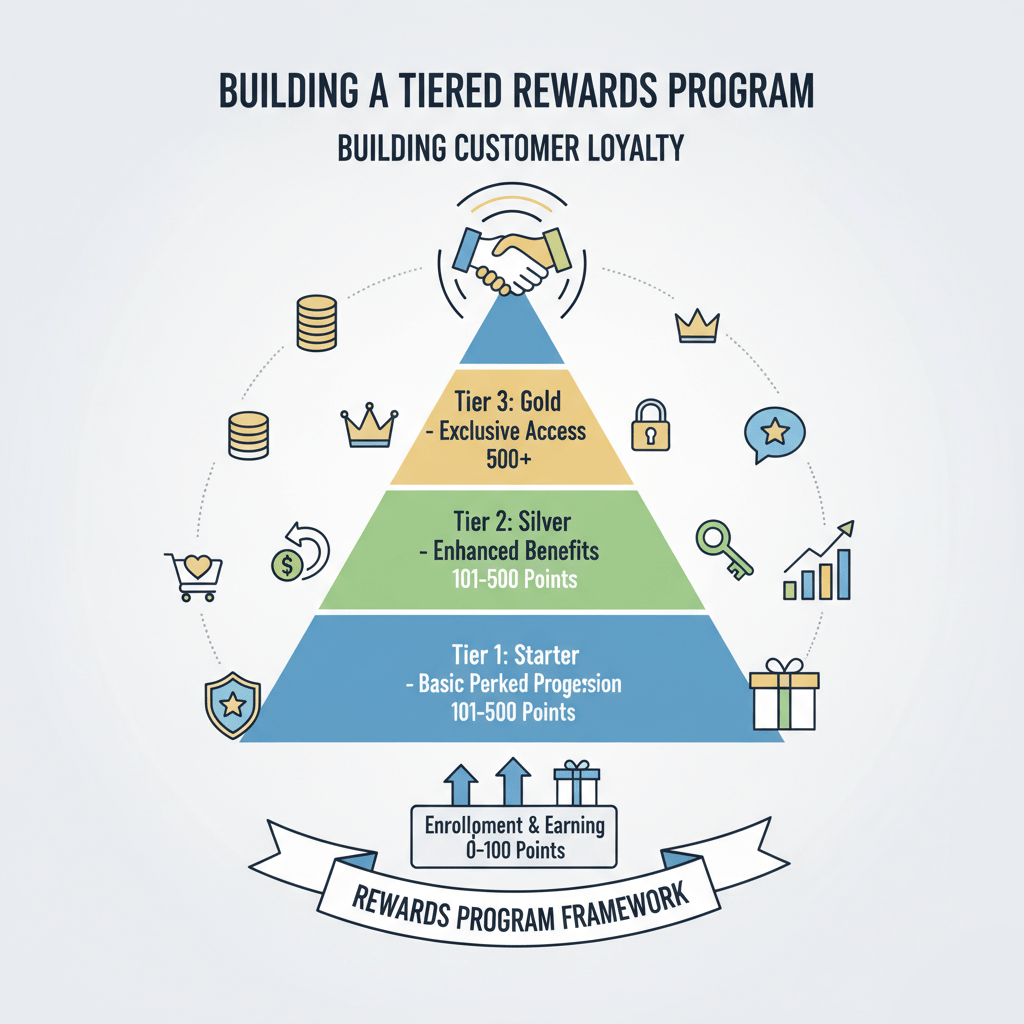
A 3-tier structure is the sweet spot. It creates a clear psychological path:
- Tier 1: The “Welcome” Mat (e.g., Bronze, Insider, Member)
- Goal: Get them in the door.
- Entry: Should be easy. (e.g., free to join, make one purchase, or refer one friend).
- Psychology: This gives the user an immediate sense of belonging. They are “in the game.”
- Tier 2: The “Habit” Level (e.g., Silver, Advocate, Select)
- Goal: Build loyalty and encourage key behaviors.
- Entry requires real, yet achievable, effort. This is where your average engaged customer should land.
- Psychology: This is the “striving” tier. Users here feel recognized and are motivated to strive for excellence.
- Tier 3: The “Aspirational” Level (e.g., Gold, VIP, Ambassador)
- Goal: Reward and activate your superstars.
- Entry: Should be difficult and exclusive. This tier is for your top 10-20% of customers.
- Psychology: This is all about status. The rewards here should be less about saving money and more about access and exclusivity.
You can also add a secret “Tier 4” (e.g., Platinum, Diamond, Inner Circle) that is invite-only. This creates massive FOMO (Fear Of Missing Out) and gives your absolute best advocates a goal so exclusive they can’t even see it.
Setting the Thresholds: The “Achievable but Aspirational” Balance
How do users move from one tier to the next? This is the most critical calculation you’ll make.
You need to analyze your data.
- Look at your customer list.
- Find the “natural” breaks. For example, pull a report of “annual customer spend.”
- You might see a massive group of customers (80%) spend between $50 and $150.
- A smaller group (15%) spends between $150 and $500.
- And a tiny group (5%) spends $ 500 or more.
- Boom. Those are your tier thresholds.
- Tier 1 (Bronze): Sign up or spend $1+.
- Tier 2 (Silver): Spend $150 in a year.
- Tier 3 (Gold): Spend $500 in a year.
Don’t pull these numbers out of thin air! If you set the “Gold” tier at $5,000 but your best customer only spends $800, your game is impossible, and no one will play.
The same logic applies to referrals.
- Look at your data. How many customers have referred at least one person? Let’s say it’s 20%.
- How many have referred 3+ people? Let’s say it’s 5%.
- How many have referred 10+ people? Let’s say it’s 1%.
- These are your milestone rewards.
- Tier 1 (Bronze): Refer 1 Friend. (Achievable for many)
- Tier 2 (Silver): Refer 3 Friends. (Your engaged “sweet spot”)
- Tier 3 (Gold): Refer 10 Friends. (Aspirational, but possible)
Progress Bars Are Non-Negotiable
This is a core part of customer gamification. A user must be able to see their progress at all times.
Don’t just have a page that says “You are a Silver Member.” That’s static.
Have a dashboard that says:
“You are a Silver Member!
You are only $42.50 (or two more referrals) away from reaching Gold!”
[ ||||||||||||||||||—– ] 85%
That progress bar is pure psychological magic. It’s a “nearly-finished task,” which our brains are hardwired to want to complete. It’s the single most powerful motivator you can build into your program.
The Fun Part: What Rewards to Offer (Tier-by-Tier)
The structure is the skeleton. The rewards are the lifeblood. A great incentive program structure needs great incentives.
Your rewards must do two things:
- Provide genuine value.
- Reinforce the status of the tier.
This means the rewards must get significantly better at each level. The jump from Bronze to Silver should feel good. The jump from Silver to Gold should feel amazing.
Let’s break down the types of rewards and how to apply them.
Reward Categories
1. Transactional Rewards (The “Hard” Benefits)
These are tangible, monetary rewards. They are great for the lower tiers, offering clear and instant value.
- Discounts ($ off or % off)
- Store credit / Cash back (e.g., “Get a $10 coupon for every 500 points”)
- Free shipping (This is a massive motivator. Don’t underestimate it.)
- Free products or samples
- Birthday bonuses (e.g., 200 bonus points)
2. Experiential & Status Rewards (The “Soft” Benefits)
These often cost you very little (or nothing) but have a high perceived value. They are the key to making your top tiers feel exclusive.
- Early access to new products
- Early access to sales (e.g., “VIPs shop the Black Friday sale 24 hours early”)
- Exclusive member-only content (tutorials, webinars, behind-the-scenes)
- Invitations to private events (online or offline)
- Dedicated VIP customer support (a “skip-the-line” email or phone number)
- Longer return windows
- Public recognition (badges, shout-outs, a “VIP” tag on their community profile)
A Sample Tiered Reward Structure
Let’s put it all together. Here is a sample tiered loyalty program structure for an e-commerce brand, built using the hybrid model (actions, referrals, and spend).
Tier 1: “Insider”
- How to Enter: Free to join, just create an account.
- The goal is to get them to make their first purchase and referral.
- Rewards:
- Welcome Bonus: 10% off your first order.
- Points: Earn 1 point for every $1 spent.
- Birthday Gift: 100 bonus points.
- Referral Bonus: Get $5 (or 100 points) for your first successful referral.
- Community Access: Access to the “Insider” community forum.
Tier 2: “Advocate”
- How to Enter: Refer 3 Friends OR Spend $300 in a year.
- The goal is to turn them into a repeat customer and consistent referrer.
- Rewards:
- All “Insider” Benefits, PLUS…
- Points Multiplier: Earn 1.25 points for every $1 spent.
- Shipping: Free standard shipping on all orders over $25.
- Tier Achievement Bonus: $10 store credit (or 200 points) instantly upon unlocking this tier.
- Referral Bonus: Get $10 (or 200 points) for every successful referral.
- Milestone Reward: A gift (e.g., free full-size product) after your 5th purchase of the year.
- Access: Early access to new product drops.
Tier 3: “VIP”
- How to Enter: Refer 10 Friends OR Spend $1,000 in a year.
- The Goal: Reward their superstar status and lock in their loyalty for life.
- Rewards:
- All “Advocate” Benefits, PLUS…
- Points Multiplier: Earn 1.5 points for every $1 spent.
- Shipping: Free expedited shipping on ALL orders.
- Tier Achievement Bonus: $50 store credit (or 1,000 points) instantly.
- Anniversary Gift: A deluxe, exclusive free product every year you’re a VIP.
- Access: Early access to all sales (e.g., 24-hour head start).
- Status: A dedicated VIP customer service email. No waiting in line.
- Exclusivity: An invitation to an annual “State of the Brand” webinar with the CEO/Founder.
See the difference? The “Insider” reward is a simple discount. The “VIP” reward is access to the CEO. One saves you money; the other gives you status. Both are powerful, but they motivate different people in different ways. This incentive program structure covers all the bases.
Launch & Promotion: Telling the World
You built it. It’s beautiful. The tiers are balanced, the rewards are tremendous. Now… how do you get people to join?
Building the program is only half the battle. Your launch and promotion strategy is the other half.
1. Create a Killer Landing Page
This is your program’s headquarters. It needs to be clear, engaging, and visually appealing.
- The Name: “Welcome to The [Brand] Collective”
- The Value Prop: “Get rewarded for being you. Earn points, get free stuff, and unlock exclusive access.”
- How it Works (Visually): A simple 3-step graphic. 1. Join. 2. Earn. 3. Redeem.
- The Tiers: A beautiful side-by-side comparison chart. This is a must.
- The Rewards: Showcase your most tremendous rewards. “Free Shipping,” “Early Access,” “VIP Support.”
- The Big CTA: “Join Now for Free”
- The “Progress Bar”: For logged-in users, this page becomes their dashboard.
2. Announce It with a “Big Bang”
Launch this program like you’d launch a new flagship product.
- Email Campaign: This is your #1 channel.
- Email 1 (Teaser): “Something new is coming… and you’re going to love it.”
- Email 2 (Launch): “It’s Here! Introducing The [Brand] Collective. See Your New Status.”
- Email 3 (Follow-up): “You’re already on your way. See how to earn your first reward.”
- On-Site Promotion:
- Homepage Banner: A big, beautiful banner announcing the program.
- Pop-up: A non-intrusive pop-up for new visitors. “Join our rewards program and get 10% off today!”
- Account Page: Automatically enroll all existing customers and show them their (new) status. This is key. Don’t make them sign up again.
- Social Media Campaign:
- Run a launch contest. “Join our new rewards program this week for a chance to win 10,000 bonus points!”
- Create short videos or Instagram Stories explaining how it works.
- Update your link-in-bio to direct users to the program landing page.
3. Integrate It. Everywhere.
Your program shouldn’t be a hidden link in your website’s footer. It needs to be part of the entire customer journey.
- Transactional Emails: Add a “Program Status” block to your order confirmation and shipping emails. “Thanks for your order! You just earned 85 points. You’re only 115 points away from ‘Advocate’!”
- Post-Purchase Page: Your “Thank You” page after a purchase is prime real estate. “Success! You earned 120 points. Refer a friend right now and get 200 more!”
- Product Pages: Add a small note: “Buy this and earn 75 points.”
The key is constant, helpful reinforcement. You’re always showing the user the “next step” in the game.
The Unspoken Challenge: Why Manual Management Is a Nightmare
At this point, you might be thinking, “This sounds amazing. I’ll just build a spreadsheet to track all this.”
Stop. Right. There.
This is the single biggest mistake that kills 99% of ambitious rewards programs.
Let’s paint a picture of what “manual management” actually looks like.
- A customer, Sarah, refers her friend, Mark.
- Mark signs up using her link. You get an email.
- You open your “Referral Tracking” Google Sheet.
- You add a line for Sarah and a line for Mark.
- Mark makes a purchase 10 days after the initial purchase. You get a Shopify notification.
- You go back to the spreadsheet. You mark Mark’s purchase as “complete.”
- You check Sarah’s status. “Ah, this is her 3rd referral. She’s supposed to be ‘Silver’ now.”
- You go to your “Customer Tiers” spreadsheet. You change Sarah’s status from “Bronze” to “Silver.”
- You go to your coupon generator. You create a custom $10 “Advocate” bonus coupon.
- You open your email. You write a “Congrats, you’re now Silver!” email, paste in the coupon, and send it.
- You go back to your spreadsheet and mark “Reward Sent.”
That… was… one referral.
Now, multiply that by 1,000 customers. By 10,000. It’s not just a nightmare; it is physically impossible.
- What happens when you go on vacation? The program stops.
- What happens when you forget? A customer gets angry.
- What’s the biggest problem? There is NO instant gratification.
Gamification dies without instant feedback. If Sarah refers a friend, she doesn’t want an email three days later. She wants to see her points now. She wants the “Congratulations!” pop-up now. She wants her dopamine hit now.
A manual system is slow, full of human error, and completely unscalable. It ruins the “game” and turns your exciting program into a clunky, untrustworthy chore.
The Solution: Automate Your Growth with Viral Loops
This is where you stop being a spreadsheet admin and start being a growth strategist.
The problem you’re facing is not a “loyalty” problem. It’s a “technology” problem. You need a platform that acts as the “game engine” for your program, running all the rules, tracking the points, and delivering the rewards automatically.
This is precisely what Viral Loops was built to do.
Viral Loops isn’t just a simple referral tool. It’s a comprehensive platform explicitly designed to build and automate sophisticated, gamified programs, including the exact tiered rewards program we’ve been planning.
Here is how it solves every single problem of manual management:
1. Automatic Tier Upgrades
This is the magic. You set up your tiers inside Viral Loops just once. “Bronze = 0 Referrals,” “Silver = 3 Referrals,” “Gold = 10 Referrals.”
When a user’s third referral is successful, Viral Loops instantly and automatically moves them from the Bronze tier to the Silver tier. You don’t lift a finger. The user gets an instant notification. The game feels real, responsive, and fair.
2. Real-Time Tracking (Goodbye, Spreadsheets)
Viral Loops tracks everything, including clicks, sign-ups, referrals, and even purchases (by connecting to your e-commerce store). Your dashboard shows you exactly who your top advocates are, how many referrals they’re driving, and what tiers they’re in. It’s your program’s command center.
3. Instant Reward Fulfillment
Remember that core dopamine loop? Viral Loops closes it for you.
- When a user reaches a milestone reward (such as “Refer 5 Friends”), the platform automatically sends the reward you specified.
- It can send an email with a unique coupon code.
- It can integrate with your other tools via webhooks.
- It can show a pop-up right in the user’s dashboard.
The user takes an action, and they get their reward. Instantly. This is the foundation of effective gamification.
4. Build a Program That Fits You
Viral Loops isn’t a rigid, one-size-fits-all box. You can use its templates (like the “Milestone Referral Program”) to get started in minutes. You can build a program based on referrals, or combine it with other actions. It gives you the power to make the exact incentive program structure you dreamed up, without needing a team of developers.
Instead of spending 40 hours a week managing spreadsheets, you can spend one hour a week reviewing your Viral Loops dashboard and thinking of new, creative rewards to make your program even better.
You get to focus on the “game,” not the “admin.”
Your Next Level: Stop Thinking, Start Building
We’ve covered a lot. But the core idea is simple.
Your customers want to be engaged. They want to feel special. They want a reason to choose you over the competition. A simple, transactional “buy our stuff” relationship isn’t enough anymore.
It’s time to give them something more.
By building a tiered rewards program, you’re doing more than just creating a new marketing channel; you’re also fostering a sense of loyalty among your customers. You’re building a community. You’re creating a “game” that makes loyalty fun, visible, and rewarding. You’re giving your best customers a ladder to climb and a status to achieve.
It’s the most powerful customer engagement strategy you’re not using yet.
So, sketch out your tiers. Dream up your rewards. Then, use a tool like Viral Loops to do the heavy lifting, so you can sit back and watch your players—and your business—level up.
Frequently Asked Questions (FAQs)
1. How do I stop people from cheating in my tiered program?
This is a valid concern. The most common “cheating” is self-referral (using fake emails). A platform like Viral Loops, which is a good platform, has built-in fraud detection. It can track IP addresses and use email verification to flag and block suspicious signups. You can also set rules, like “a referral only counts after they make their first purchase,” which makes it much harder to game the system.
2. What’s the real difference between a tiered program and a simple referral program?
A simple referral program is transactional: “Give $10, Get $10.” It’s a one-time event. A tiered referral program is a relationship. It’s a long-term journey. It rewards the habit of referring, not just the single action. The rewards improve over time, which motivates advocates to continue referring, rather than stopping after the first one.
3. Should my tiers be based on spending (loyalty) or referrals (advocacy)?
The best answer? Both. However, if you must choose, start with what your business needs most. If you need new customers, build a referral-based program. To increase repeat purchases, consider creating a spend-based program. The most powerful customer loyalty gamification systems, however, find a way to combine them—letting users level up by either spending a significant amount or referring a large number of people.
4. What if my budget for rewards is small?
This is the beauty of VIP program ideas! The best rewards are often free for you. “Early access to sales” costs $0. “A 24-hour head-start on new products” costs $0. “A dedicated VIP support email” costs very little. “Public recognition” (like a “VIP” badge on their community profile) is free and incredibly motivating. Don’t think you need to give away huge discounts; status and access are often more powerful.
5. How long does it take to see results from a tiered program?
You will see initial results (signups, engagement) from your “Big Bang” launch within the first week. But a tiered program is a long-term strategy. The real goal is to impact metrics like Customer Lifetime Value (CLV) and repeat purchase rate, which can take 6-12 months to show a significant, measurable trend. This isn’t a one-shot campaign; it’s a new, permanent part of your business.