“Learn how to Choose Referral Program Rewards beyond cash; use creative non-cash incentives like swag, exclusive access, or feature unlocks to build true loyalty and status.”
Let’s face it. Your customers are bombarded. Every day, they see the same, tired referral offer: “Give $10, Get $10.”
It’s not bad. It’s just… boring. It’s transactional. It may get a click, but it doesn’t do anything to build a relationship. A $10 credit is spent and forgotten. It doesn’t create an advocate. It doesn’t foster loyalty. It just pays an invoice.
Your biggest fans —the people who genuinely love your product — are not motivated by a few dollars. They are motivated by their connection to your brand, their desire to share something great with their friends, and the feeling of being an insider.
So, why are you offering them a reward that feels so impersonal?
The most successful referral programs understand this. They lean into non-cash incentives and creative referral rewards that make the referrer feel special, valued, and part of a community. These programs turn customers into genuine, passionate advocates. The reward itself becomes a story, a status symbol, or a helpful tool—far more memorable than a digital gift card.
However, this raises a significant question: how to choose referral program rewards that actually work? How do you find the right incentive that motivates referrals without just feeling like a cheap bribe?
It starts by shifting your perspective. Stop thinking about “paying” for a lead. Start thinking about “thanking” a fan. The reward should be an extension of your brand’s value. It should be something your customers actually want but might not be able to get anywhere else.
We’ve gathered 15 creative referral reward ideas designed to spark inspiration and help you build a program that people will actually talk about.
15 Creative Referral Reward Ideas (That Aren’t Cash)
1. Exclusive Early Access to New Features
- What it is: Give your referrers a “beta” or “insider” status that lets them try new products, features, or updates before anyone else. This is a digital “skip the line” pass.
- Why it works: This is pure psychological gold. It taps directly into the desire for status and exclusivity. People love feeling like they’re “in the know” or part of an inner circle. It makes them feel valued by the brand, transforming them from a simple user into a “power user” or a “brand advisor.” They get to see the “kitchen” before the “meal” is served to the public.
- Best for: SaaS companies, mobile apps, software, and gaming.
- Why it’s better than cash: A $10 reward is a one-time transaction. Early access is an ongoing status. It makes the customer feel important and builds a two-way street. You’re not just rewarding them; you’re inviting their feedback, which can be invaluable for product development. This reward costs you virtually nothing in hard dollars but delivers immense perceived value.
2. High-Quality, Exclusive Branded Swag
- What it is: We are not talking about a cheap pen or a flimsy t-shirt with a giant logo. We’re talking about premium items people would actually want to own. Consider a Yeti-style insulated mug, a high-end Moleskine notebook, a stylish hoodie crafted from premium fabric, or a high-tech accessory like a branded portable charger.
- Why it works: Good swag serves as a tangible reminder. When someone uses your branded mug in an office meeting or wears your hoodie, it serves as a visible status symbol. It says, “I’m part of this club.” It also doubles as real-world marketing. A great piece of swag is a “social object”—something that starts a conversation.
- Best for: Brands with a strong community, e-commerce, B2B, and subscription boxes.
- Why it’s better than cash: A $25 gift card is invisible. A $25 premium jacket is a walking billboard. The perceived value of a high-quality physical item is often much higher than its actual cost. It’s a tangible “thank you” that lives in your customer’s world, reminding them of your brand every time they use it.
3. A “Members-Only” VIP Content Library
- What it is: Create a gated section of your website or platform accessible only to top referrers. Fill it with premium content, such as advanced guides, downloadable templates, full-length interviews with industry experts, or recordings of past webinars.
- Why it works: This reward provides tangible, ongoing utility. It directly relates to the value your brand already provides. If a customer loves your service for its industry insights, providing them with even more insights is a perfect reward. It reinforces their decision to be your customer and rewards their advocacy with tools to make them even better at their job.
- Best for: B2B, SaaS, educational platforms, consulting, and media companies.
- Why it’s better than cash: Cash is spent on groceries. Exclusive content helps your customer get a promotion, solve a significant problem, or learn a new skill. The value is directly tied to their professional or personal growth, creating a much deeper, more positive brand association.
4. Tiered Status Levels (Gamify Your Program)
- What it is: This is a classic tiered referral program. Instead of a single reward, you create levels.
- Refer 1 Friend: Get a “Bronze” badge and a 5% discount.
- Refer 3 Friends: Get a “Silver” badge, the premium swag box, and early access.
- Refer 10 Friends: Get a “Gold” badge, a 1-on-1 strategy call, and a permanent “Gold” icon by your name in the community.
- Why it works: This is straight from the video game playbook. It uses gamification to motivate continuous sharing. People are naturally driven to “complete the set” or “reach the next level.” It identifies and massively rewards your “super-advocates”—the 1% of users who can drive 50% of your referrals.
- Best suited for: Any business, particularly SaaS, e-commerce, and community platforms.
- Why it’s better than cash: A flat-rate cash reward has no momentum. If you refer a friend, you get $10. The story ends. A tiered system creates a journey. It gives your advocates a goal to shoot for and publicly recognizes their efforts, which is often a more powerful motivator than a small cash bump.
5. A Free Service Upgrade or Feature Unlock
- What it is: For a limited time (or permanently!), upgrade your referrer to the next plan up. If you have a “Pro” plan, give them three months for free. If your app has add-on features (like “Advanced Analytics”), unlock one for them.
- Why it works: This is the ultimate “try before you buy” and a core principle of customer loyalty rewards. The best reward for loving a product is more of the product. It costs you very little (marginal server cost, perhaps) but has a high, clear-to-understand dollar value for the customer. Even better, they might get hooked on the premium features and remain a paying customer on that tier forever.
- Best for: SaaS, subscription services, freemium apps.
- Why it’s better than cash: Giving $20 cash is a cost. Giving a $20/month feature for free is an investment. It re-engages the customer with your product, deepens their usage, and increases their dependency on your tool, making them less likely to churn and more likely to refer others.
6. A Donation to Charity in Their Name
- What it is: Instead of rewarding the customer, you reward a cause they care about. “Refer a friend, and we’ll donate $50 to [Charity Name] in your name.” You can select a single charity aligned with your brand values (e.g., an environmental brand that donates to 1% for the Planet) or allow the user to choose from a pre-vetted list.
- Why it works: This taps into altruism, which can be a more powerful motivator than personal gain. People love to share, but sometimes they feel “greedy” asking their friends to sign up so they can get a kickback. This model reframes sharing as a selfless act. The referrer gets to be a hero, helping their friend and helping a good cause.
- Best for: Brands with a strong social mission, non-profits, B-Corps, and e-commerce.
- Why it’s better than cash: It builds an emotional connection. It shows that your brand’s values align with theirs. This kind of shared-purpose marketing builds a “tribe” around your brand, not just a customer base. You’re not buying a referral; you’re partnering for a good cause.
7. A “Mystery Box” or Surprise Gift
- What it is: Don’t tell them precisely what they’ll get. Just promise a “Referrer’s Surprise Box” or a “Thank-You Gift” with a perceived value (e.g., “a $50+ value”). This could be a mix of swag, partner products, a gift card, and a handwritten note.
- Why it works: This leverages the psychology of curiosity and anticipation, a powerful element of gamification. The “what if” is often more exciting than a known quantity. It creates a moment of delight and surprise when the box arrives, which is highly “shareable” on social media (think “unboxing”).
- Best for: E-commerce, subscription boxes, and lifestyle brands.
- Why it’s better than cash: A $25 gift card is predictable. A $25 mystery box is an experience. It creates a memorable moment and a story. The user is likely to feel a much stronger positive emotion from the surprise than they would from a simple, expected digital credit.
8. Exclusive Invites to a Private Community
- What it is: Create a private Slack channel, Discord server, or “inner circle” Facebook group. This community is not intended for all customers; it is designed for your top advocates, power users, and referrers. The brand’s CEO, product managers, and marketing leads should be active in it.
- Why it works: This is another powerful status and access play. It provides two things:
- Access to Peers: Your best customers have the opportunity to network with one another.
- Access to You: They gain a direct line to your team, bypassing the standard support channel.
- Best for: B2B, SaaS, high-end consulting, and creator/education brands.
- Why it’s better than cash: You can’t buy access. This reward makes your advocates feel like true partners. They are part of the “inner sanctum.” This is one of the most effective non-cash incentives for building a loyal, vocal community that will defend and promote your brand for years to come.
9. A Personalized, High-Touch Thank You
- What it is: This is all about human connection. It could be a personalized, 30-second video from the CEO sent via email. It could be a beautifully designed, handwritten thank-you card sent in the mail. It could even be a 15-minute “virtual coffee” call with their account manager.
- Why it works: In a world of automation, personalization is the ultimate premium. It cuts through the noise. Getting a personal video or note makes the customer feel seen and genuinely appreciated. It’s so rare that it’s incredibly memorable and often gets shared publicly on platforms like LinkedIn or Twitter.
- Best for: B2B, high-LTV (Lifetime Value) products, consulting, and premium services.
- Why it’s better than cash: Cash is impersonal. A personal video is the most personal reward you can give. It’s not scalable to do for every customer, which is precisely why it works so well as a high-tier referral reward. It shows you’re willing to give your most valuable asset: your time.
10. Free Tickets to Your Events (Virtual or IRL)
- What it is: If you host an annual conference, industry workshops, or even paid webinars, give your top referrers a free pass. This could be a digital-access pass or, for your absolute top advocates, an all-access physical ticket.
- Why it works: This approach combines high perceived value (tickets can cost hundreds or thousands of dollars) with community engagement and educational benefits. The referrer gets to learn, network, and engage with your brand on a deeper level.
- Best for: B2B, SaaS, education, and event-based companies.
- Why it’s better than cash: A $500 ticket has a much higher perceived value than $500 cash, especially if it’s an industry-leading event. The cost to you is often just one “seat,” but the value to the attendee is immense. It also brings together your best advocates in a room (virtual or otherwise), which strengthens your community.
11. Feature Them in Your Content
- What it is: Turn the spotlight on your advocate. Offer to feature them, their story, or their business in a “Customer Spotlight” on your blog, a case study, or a “shout-out” in your email newsletter.
- Why it works: This is an incredible incentive, especially for B2B. You’re offering them free marketing. A feature on your blog (especially if it has high traffic) can drive real business to them. It’s a social-proof-powered reward that provides an ego boost and tangible business value.
- Best for: B2B, consulting, agencies, and service-based businesses.
- Why it’s better than cash: A $100 reward is nice. A blog feature that sends them three new clients is transformative. This is a true win-win. You get a great, authentic piece of content (a customer success story), and they get valuable exposure.
12. A Free Month of Service (or Subscription Extension)
- What it is: Simple and effective. “Refer a friend, get your next month free.”
- Why it works: It’s directly tied to your product’s value. The customer already pays for your service, so they clearly value it. Offering it for free is a no-brainer. It’s easy to understand, easy to automate, and highly motivating. It’s one of the best customer reward ideas for retention.
- Best for: Subscription boxes, SaaS, streaming services, and any recurring-revenue business.
- Why it’s better than cash: This reward directly reinforces product loyalty. Instead of giving them money they spend elsewhere, you’re encouraging them to stick with your service for another month. This helps lower churn, and the “cost” to you is your margin, not the full retail price of the subscription.
13. A Service-Based Reward
- What it is: Offer your time and expertise. This could be a “Free 30-Minute Strategy Consultation,” a “Free Website Audit,” or “Pro Onboarding Support,” where one of your experts helps them set up their account perfectly.
- Why it works: This is a high-value, low-cost (for you) reward. You are the expert in your field. Giving away 30 minutes of your time might cost you very little, but the value of that targeted advice to your customer could be enormous.
- Best for: Agencies, consultants, freelancers, and complex B2B SaaS.
- Why it’s better than cash: This reward does double duty. It serves as both a thank-you and an upsell/retention tool. By providing your customers with 30 minutes of expert advice, you demonstrate the exact value of your premium services, making them more likely to upgrade or purchase more from you in the future.
14. A Co-Branded Reward with a Partner
- What it is: Team up with a complementary, non-competing brand and offer their product as a reward if you sell high-end coffee, partner with a brand that makes premium mugs. If you’re a project management tool, partner with a time-tracking app.
- Why it works: This provides “surprise and delight” value from an unexpected angle. Your customer gets to discover a new, incredible product. It also strengthens your B2B relationships and opens up opportunities for cross-promotion.
- Best for: E-commerce, lifestyle brands, and SaaS.
- Why it’s better than cash: It introduces novelty. Your customer might not need a $20 discount, but a free 6-month subscription to a cool app they’ve heard of? That’s a fantastic perk. The cost is often split or negotiated between you and your partner, making it a cost-effective way to offer high-value, unique customer gifts.
15. A Points-Based “Loyalty Store”
- What it is: Don’t limit yourself to one reward. Create a simple points system. 1 successful referral = 100 points. Then, build a “rewards store” where advocates can redeem their points.
- 50 points: Sticker pack
- 100 points: $10 donation
- 300 points: Premium t-shirt
- 1,000 points: One month free
- Why it works: This is the ultimate in flexibility and one of the best referral program best practices. It combines gamification (like a tiered program) with personal choice. Users can save up for a big-ticket item they really want or spend their points immediately on smaller perks.
- Best for: Brands with a large, diverse user base (e-commerce, SaaS).
- Why it’s better than cash: It gives the customer agency. Instead of deciding for them what they want, you’re letting them make the choice. This makes the reward feel more personal and earned. The “point” currency also psychologically separates the action (referred to) from its cash value, making it feel more like a game and less like a job.
How to Choose the Right Referral Program Rewards for Your Brand
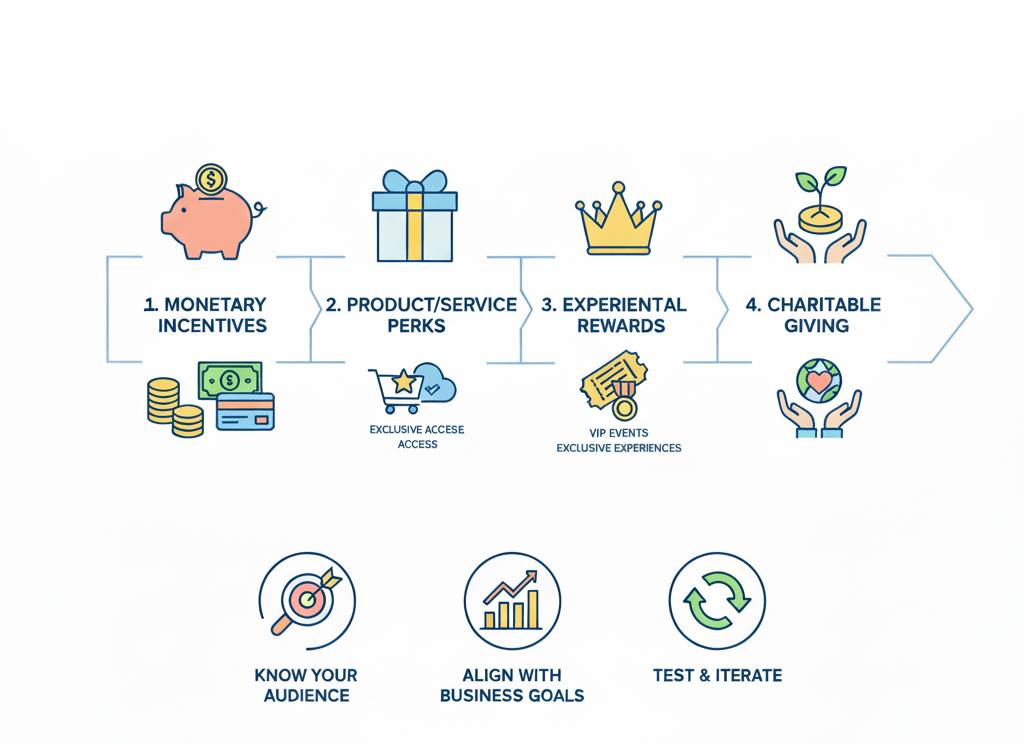
This list is packed with ideas, but the worst thing you can do is just pick one at random. The success of your program hinges on matching the reward to your audience and your brand. The main keyword, how to choose referral program rewards, comes down to a few core principles.
1. Know Your Audience (KYA)
You must understand what motivates your specific customers.
- For a B2B SaaS: A B2B marketing manager is motivated by efficiency, education, and career growth. A “30-minute strategy call” or “exclusive content” is far more valuable to them than a $15 Starbucks card.
- For an E-commerce brand: A shopper is motivated by discounts, free products, and status. A “Mystery Box” or “premium swag” is exciting.
- How to find out? Just ask! Send a one-question survey to your 50 best customers: “If you were to refer a friend, which of these ‘thank you’ gifts would you prefer?”
2. Align with Your Product and Brand Value
The reward must feel like it comes from you.
- If your brand is a luxury e-commerce store, your reward should feel luxurious. A cheap t-shirt would damage your brand. A co-branded reward with another luxury brand, however, would be perfect.
- If your brand is a budget-friendly tool, your reward should be practical. A free month of service or a feature upgrade is a perfect fit.
- The reward is a messaging tool. Ensure it conveys the right message.
3. Balance Perceived Value vs. Actual Cost
The best rewards have a high perceived value and a low actual cost.
- Low Perceived Value, High Cost: $50 cash. (Cost: $50. Perceived Value: $50).
- High Perceived Value, Low Cost: A 30-minute consultation. (Cost: 30 minutes of your time. Perceived Value: $150+).
- High Perceived Value, Low Cost: A feature unlock. (Cost: ~$0. Perceived Value: $20/month.
Non-cash incentives are your best friend in this situation. They allow you to be incredibly generous without breaking your Customer Acquisition Cost (CAC) model.
4. Make it Memorable and Shareable
The reward itself should be a marketing tool. A $10 credit is not shareable. No one tweets, “I just got $10 from X company.”
But they absolutely will tweet:
- “Whoa! Check out this awesome jacket [Brand X] sent me for referring a friend!” (Swag)
- “Got to be in the beta for [Brand X]’s new feature. It’s a game-changer.” (Early Access)
- “Such a cool move. [Brand X] just donated $100 to [My Favorite Charity] in my name.” (Charity)
Choose a reward that creates a story.
The Challenge: Managing Creative Rewards Isn’t Easy
So, you’re inspired. You’re ready to build a multi-level, tiered referral program that gives out exclusive swag, unlocks early access, and manages a points store.
Then, reality hits.
How do you actually track this?
How do you keep track of who has referred three friends versus five friends? How do you automatically send the right-sized t-shirt? How do you “unlock” a specific piece of content for one user but not another?
This is the exact reason most companies fall back on “Give $10, Get $10.” It’s simple. But “simple” is not “effective.”
Managing creative, non-cash, and tiered referral programs can be a logistical nightmare if done manually. You’ll spend more time in spreadsheets than you will engaging your new customers. This complexity is what stops creative programs before they ever start.
The Solution: A System Built for Creativity
This is precisely where a flexible, powerful referral platform becomes essential. You need a system that was built to handle this exact complexity.
This is where Viral Loops comes in.
Viral Loops is designed to empower ambitious brands. It’s not just another “give a discount” tool. It’s a complete referral automation engine that lets you build the program you’re dreaming of, without the logistical headache.
With Viral Loops, you can:
- Launch Tiered & Milestone Programs: Easily set up different rewards for 1, 3, 5, or 10 referrals. The system tracks everyone’s progress automatically and fulfills the rewards as they’re earned.
- Automate Diverse Rewards: Whether it’s a unique link to exclusive content, a coupon code for a swag store, or an automated email, Viral Loops can handle it.
- Integrate with Your Stack: It connects to the tools you already use, so you can automatically add referrers to a “VIP” email list, tag them in your CRM, or grant them access to a specific feature.
- Manage Fulfillment: Stop living in spreadsheets. You get a clean dashboard that shows you exactly who earned what, so you can fulfill swag and physical gifts without the chaos.
Stop letting logistics limit your creativity. Your customers deserve a “thank you” that’s as unique as your brand. Viral Loops provides the flexible, automated system you need to make it happen.
Frequently Asked Questions (FAQs)
Q1: What’s better: cash rewards or non-cash incentives?
There’s no single correct answer, but it depends on your goal.
- Cash (or gift cards) is highly transactional. It’s an excellent motivator for acquisition and works well when you just need to get new users in the door. The downside is that it attracts “mercenaries” who may not be loyal to your brand.
- Non-cash incentives (like swag, early access, or status) are relational. They are far better for building long-term loyalty and fostering a sense of community. They reward your fans in a way that feels special and reinforces their connection to your brand, making them more likely to stay loyal and refer others in the future.
A popular strategy is to use a dual-sided incentive: offer the new customer a cash-like discount (e.g., “15% off your first order”) and give the referrer a non-cash, status-based reward.
Q2: How much should I spend on a referral reward?
The golden rule is to base it on your Customer Lifetime Value (LTV) and Customer Acquisition Cost (CAC).
Your referral reward must be significantly less than your LTV. For example, if your average customer is worth $500 to you over their lifetime, a $25 or $50 reward is a fantastic investment.
Ideally, your referral reward cost should also be lower than your regular CAC. If you typically spend $100 on ads to acquire one new customer, offering a $50 reward for a referral is a 50% discount on your acquisition costs. This is where non-cash rewards are so powerful—a $10-cost t-shirt might have a $40 perceived value, making your CAC look even better.
Q3: What is a tiered referral program, and why does it work so well?
A tiered referral program is a system where the rewards get better as a person refers more people.
- Example:
- 1 Referral: Free sticker pack
- 3 Referrals: Brand t-shirt
- 10 Referrals: Free hoodie + 1 month of service
This model is incredibly effective because it uses gamification. It gives your “super-advocates” (the small group of fans who will drive the most growth) a clear goal to aim for. A single $10 reward offers no incentive to refer a second person. A tiered program constantly provides a better incentive, motivating your most loyal fans to continue sharing.
Q4: How do I promote my new creative referral program?
Don’t just “build it and they will come.” You must promote your program just as you promote your product.
- Email Your Best Customers: Your first step should be to personally email your most loyal customers and invite them to your “exclusive” new program.
- Post-Purchase Emails: Add a P.S. to your “order confirmation” or “welcome” emails. This is a moment of high engagement.
- In-App / On-Site: Display a clear, easy-to-find banner or link in your app’s dashboard or the user account page of your website.
- Email Signatures: Add a simple link to your program in your company’s email signatures.
Q5: Should I reward both the referrer and the new customer?
This is called a dual-sided incentive, and in most cases, it’s one of the top referral program best practices. Think about the psychology:
- If you only reward the referrer, their friend has no incentive to sign up. The referrer might even feel “dirty” for trying to “sell” their friend.
- If you only reward the new friend, the referrer has no motivation to share.
By rewarding both, you create a perfect win-win-win:
- The Referrer gets a “thank you” (e.g., premium swag).
- The new customer receives an incentive to join (e.g., 20% off).
- You get a new, high-quality customer at a low CAC.