“Unpack the core differences between core referral vs. loyalty programs: Loyalty drives retention, while referral programs power acquisition through advocacy and viral growth.”
You’ve built a great product. You’ve made your first sales. Customers seem happy.
Now what?
You’re standing at a critical fork in the road, a place every business owner, eCommerce manager, and marketer eventually finds themselves. You have two primary paths for growth:
- Acquisition: Getting more new customers.
- Retention: Maximizing Value from Your Existing Customers.
The problem is, your resources are finite. You can’t do everything at once. You hear people buzzing about “customer marketing,” “rewards programs,” and “brand advocacy.” Two terms, in particular, keep popping up: referral programs and loyalty programs.
They sound similar, don’t they? Both involve giving rewards to customers. Both are critical customer marketing strategies. And both are often confused for one another.
But here’s the hard truth: They are not the same thing.
Choosing the wrong one—or running the right one at the wrong time—is like using a hammer to turn a screw. It’s an expensive, frustrating waste of effort.
This guide provides a comprehensive breakdown of the key differences between referral and loyalty programs. We will delve into the details of each program, including its core objectives, psychological triggers, and key performance indicators.
By the end, you won’t just know the difference. You’ll have a clear framework to decide which growth engine your business needs to build right now.
What is a Loyalty Program? The Art of Keeping Customers Close
Let’s start with the one you’re most familiar with.
A loyalty program, at its core, is a customer retention strategy.
Its only job is to reward existing customers for their repeat behavior. It identifies your current customer base and provides them with a compelling reason to stick around and make their next purchase with you, rather than with your competitor.
Think about your own wallet. You likely have a Starbucks card (digital or physical), an airline frequent flyer number, or a rewards card from a grocery store.
Why?
Because these brands have made a simple yet powerful calculation: it is 5 to 25 times more expensive to acquire a new customer than to retain a current one.
A loyalty program is a defensive strategy. It’s about building a fortress around the customer base you’ve already invested in acquiring. It’s about increasing Customer Lifetime Value (CLV) and reducing churn.
The Psychology: Why Loyalty Programs Work
Loyalty programs tap into deep-seated human psychology:
- Reciprocity: “You give me points, I feel a slight obligation to ‘repay’ you with my continued business.”
- Gamification: Humans love games. We love to “level up,” complete “challenges,” and see our “score” (point balance) increase. It makes shopping feel less like a transaction and more like progress.
- Status & Exclusivity: Tiered programs, which we’ll cover next, tap into our desire for status. Being a “Gold Member” feels good. It makes us feel recognized and special.
- The Endowed Progress Effect: This is a fascinating one. Studies show that people are more likely to complete a task if they are given an artificial head-start. This is why your coffee shop’s “buy 10, get one free” punch card comes with the first punch already done. A loyalty program that starts you with 100 “bonus points” makes you feel like you’re already on your way, increasing your likelihood of pursuing the goal.
The Most Common Types of Loyalty Programs
Not all loyalty programs are created equal. They generally fall into a few key categories, each designed for a different business model.
1. The Points-Based Program
This is the classic. “Spend a dollar, get a point.” Customers accumulate points with each purchase, which they can then redeem for discounts, free products, or other rewards.
- How it works: Simple and direct. It’s easy for customers to understand the “earn/burn” ratio.
- Best for: Businesses with high-frequency, low-cost purchases. Think coffee shops (Starbucks Rewards), cosmetics (ULTAmate Rewards), and drugstores (Walgreens).
- Example: The Starbucks Rewards program is a masterclass. You earn “Stars” for every dollar spent. These Stars unlock different reward tiers (a free syrup shot, a free drink, a bag of coffee). This structure encourages frequent, small purchases, driving daily traffic.
2. The Tiered Program
This is the “gamified” model. Customers unlock new “tiers” of status and benefits as they spend more. This is less about a single reward and more about achieving an elevated, long-term status with the brand.
- How it works: Everyone starts at “Bronze.” Spend $X, and you move to “Silver.” Spend $Y, you’re “Gold.” Each tier unlocks better perks, like free shipping, early access to sales, or a personal concierge.
- Best for: Businesses where “status” and “experience” matter as much as price. Think airlines (Frequent Flyer Tiers), hotels (Marriott Bonvoy), and high-end retail (Sephora’s VIB/Rouge).
- Example: Sephora’s Beauty Insider program is legendary. It has three tiers: Insider (free to join), VIB (spend $350/year), and Rouge (spend $1,000/year). The rewards for Rouge members (like first access to new products, exclusive events) create a powerful sense of FOMO (Fear of Missing Out) and exclusivity that drives customers to spend more just to reach or maintain that status.
3. The Paid / VIP Program
This is the “put your money where your mouth is” model. Instead of earning their way in, customers pay an upfront (often annual) fee to join an exclusive club.
- How it works: Customers pay a fee in exchange for a robust set of instant, always-on benefits.
- Best for: Businesses that can offer an overwhelmingly strong value proposition, usually centered on convenience or cost savings.
- Example: Amazon Prime is the undisputed king. You pay an annual fee. In return, you get “free” two-day shipping, a streaming service, and a dozen other perks. The genius? Once you’ve paid the fee, you’re psychologically driven to “get your money’s worth.” This means you’ll always check Amazon first for any purchase, absolutely crushing competitor consideration and maximizing your CLV for Amazon.
4. The Value-Based Program
This model connects with customers on a shared ideal, not just a transaction. The “reward” is the good feeling of contributing to a cause.
- How it works: A portion of your purchase or membership fee is donated to a specific charity or cause the brand champions.
- Best for: Mission-driven brands with a clearly defined customer base that shares their values.
- Example: Patagonia builds loyalty not with points, but with purpose. Their “1% for the Planet” commitment and product repair programs make customers feel like partners in a mission, not just consumers. This non-transactional loyalty is extreme and rigid, making it difficult for competitors to break.
How Do You Measure the Success of a Loyalty Program?
A loyalty program lives and dies by its ability to change customer behavior. You’re not just giving away free stuff. You’re investing in retention.
To see if that investment is paying off, you must track these key metrics:
- Customer Retention Rate (CRR): The most important one. What percentage of your customers from last year (or last quarter) are still buying from you this year? Your loyalty program’s goal is to increase this number.
- Repeat Purchase Rate (RPR): What percentage of your customers have made more than one purchase? A good loyalty program actively encourages repeat purchases, such as the second, third, and tenth.
- Customer Lifetime Value (CLV): How much total revenue, on average, does a single customer generate for you over their entire relationship with your brand? A loyalty program is designed to increase this number.
- Churn Rate: The opposite of retention. How many customers are you losing in a given period? Your program should act as a plug, slowing this “leaky bucket.”
- Redemption Rate: Are People Actually Using the Rewards? A low redemption rate might sound good (less cost), but it’s a terrible sign. It means your rewards aren’t compelling and your program isn’t engaging. A high redemption rate indicates that customers are engaged and perceive value.
The takeaway is simple: A loyalty program is a retention engine. Its goal is to take the customers you have and make them more valuable.
What is a Referral Program? The Science of Scalable Word-of-Mouth
Now, let’s pivot.
If a loyalty program is defense, a referral program is pure offense.
A referral program, at its core, is a customer acquisition strategy.
Its only job is to systematically motivate, empower, and reward your existing customers for telling their friends about you. It’s not about rewarding them for their own repeat purchases. It’s about rewarding them for bringing you new customers.
This is a brand advocacy program. It’s about turning your happiest customers into a scalable, high-trust marketing channel.
Why does this matter so much?
Because we live in an age of overwhelming noise, we are bombarded by thousands of ads every day. We’ve developed “banner blindness,” and our trust in traditional advertising is at an all-time low.
But who do we trust?
Our friends.
Nielsen data consistently shows that 92% of consumers trust recommendations from friends and family more than any other form of advertising. A referral from a friend cuts through the noise like nothing else.
A referral program is your machine for manufacturing those trusted recommendations.
The Psychology: Why Referral Programs Work
Referral programs work because they create a perfect trifecta of motivation that benefits everyone involved:
- For the Advocate (Your Current Customer):
- Tangible Reward: This is the obvious one. “Get $20.” It’s a clear, transactional incentive.
- Social Currency: This is the real magic. When I tell a friend about a superb new service, I appear smart, savvy, and well-informed. I’m not just sharing; I’m gifting them access to something great.
- Altruism: I genuinely want my friend to solve a problem. If I found a great tool that saves me 10 hours a week, I want to share it with my colleague who has the same problem. The reward is just a bonus.
- For the Friend (The New Customer):
- Social Proof: “If my friend Sarah trusts this brand, I can trust them too.” It instantly overcomes the initial hurdle of skepticism that all new brands face.
- Incentive: The friend often receives a reward as well (“Give $20, Get $20”). This makes it a no-brainer. They’re not just “being sold to”; they’re being given a discount.
- For the Business (You):
- Lower Customer Acquisition Cost (CAC): You’re not paying for clicks or impressions. You’re only paying for a successful conversion.
- Higher Conversion Rate: That “social proof” element means referred-in customers convert at a much higher rate than cold traffic.
- Better Customers: Referred customers often have a higher CLV and lower churn rate than customers acquired through other channels. Why? Because they were a good fit from the start, “pre-qualified” by their friend.
The Most Common Types of Referral Programs
The structure of a referral program is critical. The right incentive model can mean the difference between explosive growth and a program that no one uses.
1. The Dual-Sided (or Two-Sided) Incentive
This is the gold standard for most businesses, particularly those in eCommerce. It’s the classic “Give $X, Get $X” model.
- How it works: The Advocate (a current customer) receives a reward, and the Friend (a new customer) gets a reward.
- Best for: eCommerce, subscription boxes, consumer apps.
- Example: The Uber and Airbnb referral programs are legendary. “Give your friend $10 off their first ride, and you get $10 after they take it.” This structure is brilliant. It reframes the Advocate’s action from “selling” to “gifting.” You’re not spamming your friends; you’re giving them a free ride. This removes all social friction and makes sharing feel good.
2. The One-Sided Incentive (Advocate Only)
This model rewards only the existing customer for spreading the word. The new customer gets nothing (other than a great new product, of course).
- How it works: “Refer a friend, and YOU get $50.”
- Best suited for: High-trust, high-cost B2B services or SaaS solutions. In these cases, the service’s value speaks for itself, and offering a discount to the new business might devalue the brand. The reward is a “thank you” to the Advocate for making the introduction.
- Example: A high-end financial advisor might offer a $100 gift card to a client who refers a new one. The new client isn’t seeking a discount; they’re looking for expert financial management.
3. The Milestone Program
This is the gamified referral model. It relies on setting specific targets, or “milestones,” for your customers to achieve.
The key distinction here is that a milestone reward is a one-time event. It occurs in addition to or independently of your standard referral rewards. It creates a “ladder” of prizes that encourages customers to push for just “one more referral” to unlock the next level.
- How it works: You set a specific goal. When the customer hits it, they unlock a unique prize.
- “Refer 5 friends, unlock a 5% off coupon.”
- “Refer 10 friends, unlock a 10% off coupon.”
- “Refer 25 friends, unlock three months of free service.”
- Best for: Pre-launch campaigns, building hype, and activating true “superfans” who want to win exclusive swag or status.
- Example: The Harry’s Shave Club pre-launch is the gold standard in this case. They didn’t just give cash. They created a ladder: Refer 5 friends for free shave cream, refer 10 for a razor, refer 25 for a premium shave set, and refer 50 for a year of free shaving. This gamification turned advocacy into a challenge to be beaten.
4. The Tiered Reward Structure
Many people confuse Tiers with Milestones, but they function very differently. While Milestones are one-off prizes, a Tiered structure changes the value of the recurring reward itself.
In this model, the “per referral” reward improves as the Advocate demonstrates their value. It incentivizes volume by making the Advocate’s time more valuable the more they refer.
- How it works: The Advocate advances through levels based on their total number of successful referrals.
- Tier 1 (0-5 referrals): You earn a $5 coupon for every friend you refer.
- Tier 2 (6-20 referrals): You’ve reached the next level. Now, you earn a $10 coupon for every friend you refer.
- Tier 3 (20+ referrals): You are a VIP. You now earn 25% commission on every friend you refer.
- Best for: Affiliate programs, influencer marketing, or businesses with high-value “power users” who can drive significant volume.
Example: Many SaaS (Software as a Service) partner programs utilize this approach. They might offer a 15% commission to standard partners, but if you drive more than 100 sales a year, your commission rate bumps up to 30% for every sale moving forward. It aligns the reward with the quality and performance of the partner.
5. The Contest or Giveaway
This is a short-term, high-intensity campaign designed to generate a massive burst of leads and social shares in a short period.
- How it works: “Refer friends to enter our contest. Every friend who signs up gives you one more entry to win a $1,00S_ITEM ITEM.”
- Best for: Product launches, seasonal promotions, or building a pre-launch email list.
- Example: Many newsletters (like The Hustle or Morning Brew) grew this way. Their referral program wasn’t just “share this”; it was “Refer five friends and get our exclusive ‘investing 101’ guide.” They made advocacy a game of unlocking exclusive content.
How Do You Measure the Success of a Referral Program?
A referral program is an acquisition engine. Therefore, its metrics are primarily focused on new customer growth. Tracking “repeat purchases” here is the wrong move.
Here’s what you must track:
- Participation Rate (or Advocate Rate): Of your total customers, what percentage have ever attempted to refer a friend? This indicates whether your program is visible and compelling.
- Share Rate (or Invite Rate): Of those who participate, how many are actually sending out invites? This measures the “sharing friction.” Is it easy to do?
- Referral Conversion Rate: This is critical. Of all the invitations sent, how many converted into a new, paying customer? This indicates whether your dual-sided offer is compelling.
- K-Factor (The Virality Metric): This is the holy grail. The K-factor measures the “virality” of your product. A simple calculation is:
K = (Number of invites sent per user) x (Conversion rate of those invites)- If K < 1, your program is growing, but not virally (e.g., 100 users invite 50 new ones).
- If K > 1, you’ve achieved viral growth (e.g., 100 users invite 110 new ones). This is the goal.
- Customer Acquisition Cost (CAC) from Referrals: Calculate this by dividing the total cost of your referral rewards by the number of new customers you acquired. Compare this to the CAC of your other channels (like Facebook Ads). A successful referral program will have a dramatically lower CAC.
The takeaway is simple: A referral program is an acquisition engine. Its goal is to turn one customer into two, at the lowest possible cost.
Referral vs. Loyalty Program: A Side-by-Side Takedown
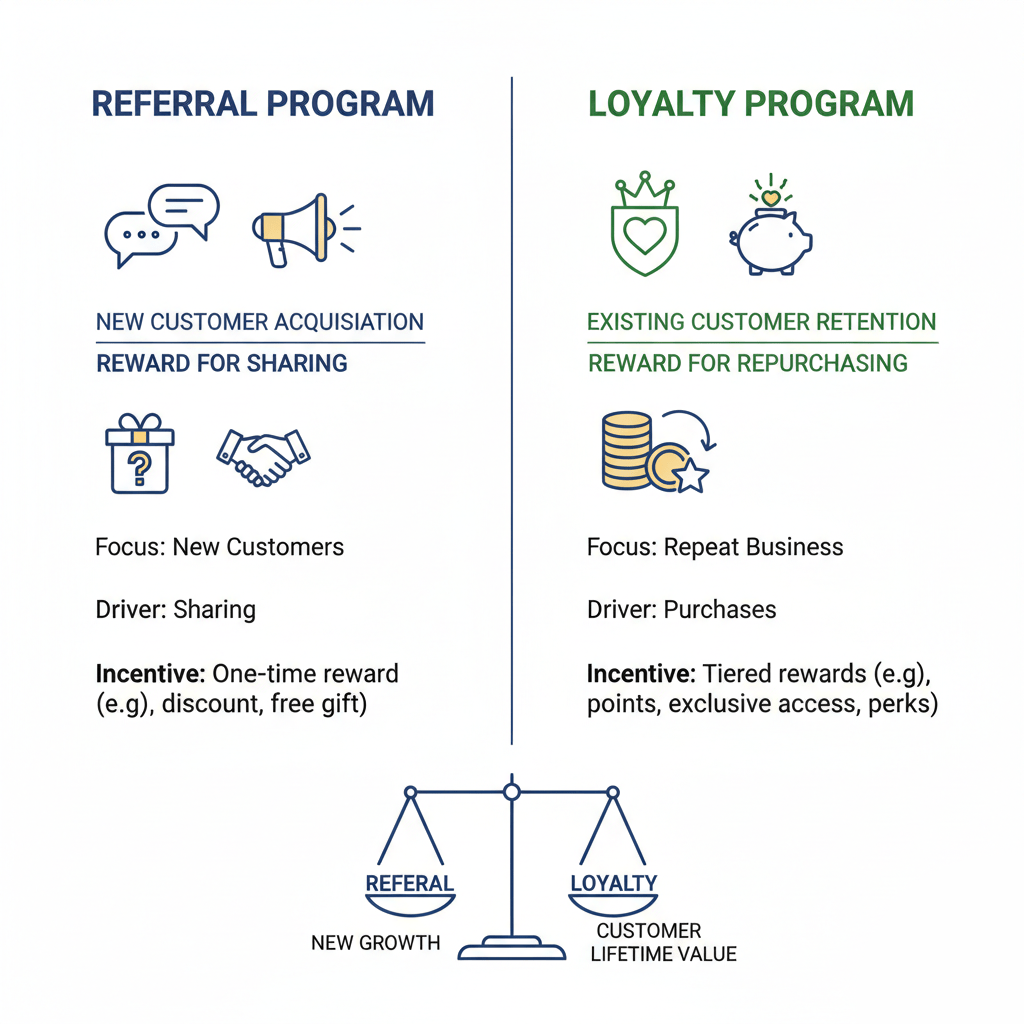
We’ve explored them individually. Now, let’s put them in the ring, side-by-side. The fundamental referral vs. loyalty program differences come down to one core question:
Are you trying to make your customers BUY AGAIN (Loyalty) or TALK & SHARE (Referral)?
Everything else—the rewards, the metrics, the psychology—flows from that single distinction.
Here is a direct comparison table to make the differences crystal clear.
| Feature | Loyalty Program | Referral Program |
| Primary Goal | Customer Retention | Customer Acquisition |
| Core Question | “How do we get this customer to buy again?” | “How do we get this customer to bring a new customer?” |
| Target Action | Rewards Repeat Purchases | Rewards Successful Advocacy (sharing + conversion) |
| Target Audience | The Existing Customer | The Existing Customer’s Network & Friends |
| Typical Reward | Points, discounts, tiers, cash back, and free shipping. | Cash, store credit (often dual-sided: “Give $10, Get $10”). |
| Reward Trigger | When the customer makes a purchase. | When the customer’s friend makes a purchase. |
| Business Value | Increases Customer Lifetime Value (CLV) | Lowers Customer Acquisition Cost (CAC) |
| Key Metrics | Retention Rate, Churn Rate, CLV, Repeat Purchase Rate. | K-Factor, Participation Rate, Conversion Rate, CAC. |
| Analogy | A defensive fortress. Keeps your valuable customers safe from competitors. | An offensive army. Goes out to conquer new territory and bring back new customers. |
Why This Distinction is a “Make or Break” for Your Business
It’s tempting to think, “Why not just mix them? I’ll give customers ‘points’ for referring friends.”
This is a critical mistake.
Here’s why: You are blurring the lines and failing at both goals.
- Case 1: The Failed Loyalty Program: Imagine you run a coffee shop. You give a customer 100 points for referring a friend. They redeem those points for a free coffee and never come back. You paid for a “referral” but didn’t build any “loyalty.” You just gave away a free coffee, and the new customer has no incentive to refer. You’ve created a one-time transaction, not a growth loop.
- Case 2: The Failed Referral Program: You run an online store. Your loyalty program gives 10 points per dollar spent. You add a “bonus” where members can “get 20 points” for a referral.
Your customers are trained to think in terms of “buy, get points.” They see “20 points” (worth, say, $0.20) and think, “That’s not worth the social risk of annoying my friends.” The incentive is completely misaligned with the action. The reward for buying (a simple, low-friction act) differs from the reward for advocating (a high-friction, socially risky act).
You must respect the distinction between customer loyalty and customer referral divide. They are two different tools for two different jobs.
The Big Decision: Should I Use a Referral or Loyalty Program?
Which one is right for you, right now?
The answer depends almost entirely on one thing: Your business’s current stage of growth.
Let’s break it down into three common scenarios.
Scenario 1: The Early-Stage Startup / New Product Launch
Your Situation:
You just launched. Your biggest problem isn’t churn; it’s obscurity. No one knows who you are. You might have 10, 100, or maybe 1,000 early customers who are passionate about your product. You are spending a fortune on ads (high CAC) just to get people to your site.
Your Primary Goal: ACQUISITION.
Your Solution: A Referral Program.
Why it’s a no-brainer:
Stop. Do not even think about a loyalty program.
You have no “loyalty” to reward yet. A loyalty program for a business with 100 customers is like building a 10-story parking garage for a single bicycle.
Your 100 passionate users are your single greatest, untapped marketing asset. You don’t need them to buy again (they will anyway); you need them to tell their friends.
Your focus must be 100% on fueling the acquisition fire. A referral program (like the “milestone” program Dropbox used) is the most capital-efficient way to build social proof and leverage your tiny, passionate base to find the following 10,000 users.
Scenario 2: The Established eCommerce Store (Growth Stage)
Your Situation:
You’re 2-3 years in. Sales are steady. You have a solid customer list (10,000+). But you’re hitting a plateau. Your ad costs are rising. You’re seeing intense competition. Your business has a “leaky bucket” problem—you’re acquiring 1,000 new customers a month, but you’re losing 800.
Your Primary Goal: FIX THE LEAKY BUCKET (Retention).
Your Solution: A Loyalty Program.
Why is it the priority:
You have an acquisition engine (ads, SEO), but it’s becoming inefficient. Why? Because you’re paying to acquire a customer, only to have them leave after making just one purchase. You are reacquiring the same customers repeatedly.
It’s time to build the fortress.
Implement a loyalty program (a simple points or tiered system) to fix the leak. Give your existing 10,000+ customers a reason to make that second and third purchase. This will immediately increase your Customer Lifetime Value (CLV).
Once your CLV is higher, something magic happens: You can now afford to spend more on acquisition. You’ve resolved the retention problem, and now you are in a healthy position to introduce a referral program, opening up a new, more cost-effective acquisition channel.
Scenario 3: The Mature Business / Market Leader (Scale Stage)
Your Situation:
You are a dominant player (like Starbucks, Amazon, or Sephora). You have a massive, stable customer base. Your market is somewhat saturated, making it challenging to generate new growth. Your brand is a core part of your customers’ lives.
Your Primary Goal: MAXIMIZE CLV & ACTIVATE ADVOCATES.
Your Solution: Both programs are deeply integrated.
Why they work together:
At this stage, you don’t have a choice. You do both. Your loyalty program is a core part of your product (think Starbucks Rewards). It’s a powerful retention tool.
Your referral program is now integrated into your loyalty program. You’ve already identified your “superfans” (your “Gold” and “VIB Rouge” members). These are the perfect people to make referrals.
You can now create a unified brand advocacy program.
- Loyalty (the base): “Earn points for every purchase.”
- Referral (the accelerator): “Are you a Gold Member? Get 500 bonus points [Loyalty Reward] when you refer a friend who makes their first purchase [Referral Action].”
Here, the programs work in harmony. The loyalty program identifies the advocate, and the referral program activates them, feeding the new customer right back into the top of the loyalty program funnel.
Why Viral Loops is Your Unfair Advantage for Customer Acquisition
We’ve established an apparent fact: For 90% of businesses—from pre-launch startups to growth-stage companies—the most pressing and urgent need is customer acquisition.
Retention is vital. But you can’t retain what you don’t have.
The single biggest lever you can pull for scalable, low-cost, high-trust acquisition is a referral program.
But here’s the problem: many businesses try this. They code a simple “share this link” page, offer a weak “10% off” coupon, and then watch as nothing happens. They conclude, “Referral marketing doesn’t work for me.”
They are wrong. Their tooling failed them.
This is precisely where Viral Loops comes in.
Viral Loops isn’t just a “referral tool.” It is a dedicated growth engine, engineered from the ground up to do one thing perfectly: turn your existing customers into your most powerful and scalable acquisition channel.
While loyalty platforms try to be a jack-of-all-trades (managing points, email, SMS, and retention), they are masters of none. Their referral “modules” are almost always a weak, underpowered afterthought.
Viral Loops is a specialist. We are built for marketers, founders, and growth leaders whose primary goal is growth.
Here’s how Viral Loops solves the problems that make other referral programs fail:
1. We’re Built on Proven, Battle-Tested Templates
You don’t have to guess what works. We provide you with a playbook. Our platform is built around the exact templates and viral mechanics used by the most successful referral programs in history.
- Want to run a pre-launch hype campaign like Dropbox? Use our Startup Prelaunch Template.
- Want to run an eCommerce “Give $10, Get $10” program like Airbnb or Uber? Use our Milestone Referral Template.
- Want to run a high-intensity giveaway or contest? Use our Tempting Giveaway Template.
You’re not starting from scratch. You’re starting from a proven, successful model.
2. We are Engineered for a Frictionless Sharing Experience
The #1 reason referral programs fail is friction. If it’s hard to find, hard to understand, or hard to share, no one will do it.
ViralLoops obsesses over this. We provide a seamless experience:
- A beautiful, simple widget that integrates right into your app or site.
- A unique referral link for every single user.
- Pre-written, optimized share messages for email, Facebook, Messenger, and WhatsApp, so your advocates don’t even have to think. They just click “share.”
- Automatic reward fulfillment and fraud detection.
3. We Focus on the Right Metrics: Virality
Our entire platform is built to help you track and improve the metrics that actually matter for acquisition: K-Factor, Participation Rate, and Conversion Rate.
Our dashboard shows you exactly who your top advocates are, where your new customers are coming from, and how “viral” your campaign is. We transform referral marketing from a “hope and pray” strategy into a predictable and measurable growth channel.
Your Next Move: Choose Your Engine
You now see the “referral vs. loyalty program differences” with perfect clarity.
A loyalty program is a retention engine. It’s a fortress. It’s about playing defense and maximizing the value of the customers you already have.
A referral program is an acquisition engine. It’s an army. It’s about playing offense and conquering new territory.
So, look at your business. What is your single most significant problem today?
- If you’re a mature, established brand with a high churn rate, you need to plug the leaks. Start with a loyalty program.
- If you are a startup, a new product, or a growth-stage brand with rising ad costs and a desperate need for new customers… the choice is obvious.
You don’t need to “reward loyalty.” You need to ignite growth.
Don’t settle for a business that customers like. Build a business that customers share.
Frequently Asked Questions (FAQs)
Q: What is the main difference between a customer loyalty program and a customer referral program?
A: The primary goal. A loyalty program’s goal is retention (rewarding existing customers for their own repeat purchases). A referral program’s goal is acquisition (rewarding existing customers for bringing in new customers).
Q: Are referral programs just a type of loyalty program?
A: No, and this is a common, costly mistake. They are two distinct strategies. A loyalty program rewards an inward action (you buy again). A referral program rewards an outward action (you tell a friend). Mixing their rewards and goals leads to a program that fails at both.
Q: What are the best rewards for a referral program?
A: Dual-sided rewards are almost always the most effective. “Give $20, Get $20.” This transforms the advocate from a “salesperson” into a “gift-giver,” thereby removing the social friction associated with sharing. The reward itself should be tangible: cash (via PayPal), store credit (which is even better, as it drives future purchases), or exclusive access to features.
Q: What are the best rewards for a loyalty program?
A: The rewards should encourage the next purchase. Points-to-discount systems (“100 points = $10 off”) are a practical and straightforward approach. Tiered perks (like “free shipping for Gold members”) are excellent for making customers feel special and locking them into your ecosystem.
Q: How do I measure the success of my loyalty program?
A: You measure it as a retention tool. Your key metrics are Customer Retention Rate (are customers staying longer?), Repeat Purchase Rate (are they buying more often?), and Customer Lifetime Value (CLV) (are they spending more over time?).