“Stop renting ads. Discover how to build a community around a product using viral referral loops that lower CAC and scale your brand fast.”
The internet is noisy. It is crowded. Every day, thousands of new products launch, screaming for attention. They buy ads, flood social media feeds, and send cold emails that often end up in spam. Most of these products fail. They fail not because the product is bad, but because they are shouting into a void. They are trying to build an audience when they should be focusing on creating a community around their product.
There is a massive difference between an audience and a community. An audience listens; a community talks to each other. An audience is passive; a community is active. An audience buys; a community advocates.
If you look at the most successful brands of the last decade—think Notion, Glossier, or even early Slack—they didn’t just sell software or makeup. They sold belongings. They built a tribe. And the most potent tool they used to build that tribe wasn’t a Super Bowl ad. It was a referral program.
However, this is where most people go wrong. They think a referral program is just a transaction. “Give us a friend’s email, get five dollars.” That is not community building. That is bribery. To build a genuine user community, you must treat referrals as a strategic entry point into your inner circle.
This guide will walk you through exactly how to do that. We will examine the psychology of sharing, the mechanics of customer relationship marketing, and how to convert casual buyers into dedicated brand evangelists.
The Shift: From Audiences to Brand Communities
Before we dive into the tactics, we need to understand the strategy. Why is brand community building the most defensive moat you can dig around your business?
In the past, marketing was a linear process. You paid for distribution, acquired a customer, and hoped they bought again. Today, the cost of obtaining a customer (CAC) is skyrocketing. Ad blockers are everywhere. Privacy laws, such as GDPR, and iOS updates have made targeting more challenging. The old playbook is broken.
Community is the new playbook. When you build a community, you stop renting attention from Facebook or Google. You own the attention. You create a self-sustaining ecosystem where customers help other customers, where users create content for you, and where your best buyers bring in more buyers.
This is the essence of product-led growth. The product isn’t just a tool; it is the center of a conversation.
The Role of Trust
Trust is the currency of community. People trust their friends more than they trust brands. In fact, they trust strangers on the internet (reviews) more than they trust brands. When a user refers a friend, they are transferring their trust to you. They are putting their reputation on the line.
If you understand this, you realize that a referral isn’t just a lead generation source. It is a vote of confidence. It is a user saying, “I belong to this tribe, and I think you should too.”
The Psychology of the Share: Why We Refer
To master customer engagement strategies, it is essential to understand human behavior. Why do we share things? Why do we tell our friends about a new pair of shoes or a productivity app?
It usually boils down to three psychological triggers:
1. Social Capital
We share things that make us look bright, cool, or in the know. Being the first person in a friend group to discover a great new product can boost your social status. When designing your referral program, ensure the referrer appears as a hero, not a salesperson.
2. Altruism
We genuinely want to help our friends. If you find a solution to a painful problem, you want your friends to benefit from that solution too. A referral program that emphasizes “helping a friend” over “getting a reward” often builds a stronger, more authentic community.
3. Reciprocity
If a brand treats us well, we want to reciprocate in kind. This is the core of customer loyalty. If you delight your users, they will naturally feel an obligation to help you grow.
The Referral as an Invitation, Not a Transaction
This is the most critical part of this guide. To build a community around a product, you must stop viewing referrals as a transactional exchange.
Most companies do this: “Invite a friend, get $10 credit.”
This is fine for e-commerce, but it’s weak for community building. It attracts mercenary customers who are only there for the discount. Once the discounts stop, they leave.
To build a word-of-mouth community, you need to frame referrals as invitations.
Think about how exclusive clubs work. You cannot simply walk in; a member must invite you. This creates scarcity and value. When a customer invites a friend, they aren’t just giving them a discount code; they are giving them access.
The “Velvet Rope” Strategy
Consider giving your best customers a specific number of “invites” rather than an unlimited referral link. This changes the dynamic entirely.
- Unlimited Links: “Spam this everywhere to get cash.”
- Limited Invites: “Choose three friends who you think would really love this.”
The second approach creates a curated community. It ensures that new members are a good fit because your existing members have vetted them. This is a high-quality design for a brand advocacy program.
Identifying Your “First 10” and Scaling to 100
You cannot build a community for everyone at once. You have to start small. You need your “First 10″—the seed members who will set the tone for everyone else.
Who are these people?
- They are the ones opening every email.
- They are using your product daily.
- They are already tagging you on Twitter or Instagram without being asked.
These are your potential brand evangelists. You need to reach out to them personally. Do not automate this. Send them an email from the founder.
Say something like:
“Hey, we noticed you’ve been with us since the beta. We are launching a new inner-circle community program and want you to be a founding member. You’ll get early access to features and the ability to gift free months to 5 friends.”
By doing this, you are validating their status. You are telling them, “You are not just a user; you are a partner.”
Designing the Incentive Structure for Community
If cash is the wrong incentive for community building, what is the right one?
To turn customers into fans, you need incentives that pull them deeper into the product and the culture.
1. Access Over Cash
Give successful referrers access to things money can’t buy.
- A private Slack channel with the founders.
- Beta access to new features.
- Voting rights on the product roadmap.
This creates a sense of ownership. When users feel like they own a piece of the brand, they will fight for it.
2. Status Rewards
Gamify the experience. Create tiers.
- Bronze: Referred one friend. Get a badge on your profile.
- Silver: Referred five friends. Acquire a limited-edition piece of merchandise (swag is powerful for community identity).
- Gold: Referred 10 friends. Get featured on the company blog or newsletter.
People love recognition. Highlighting your top advocates makes them feel seen and encourages others to step up.
3. Shared Value (The Double-Sided Reward)
Always reward both the referrer and the invited friend. If you only reward the referrer, they look selfish. If you reward both, it becomes a shared gift. “I get a free month, and I got you a free month too.” This strengthens the bond between the two friends, which in turn strengthens their bond with your brand.
The Feedback Loop: Listening to the Tribe
A community is a two-way street. You cannot simply talk at them; you must listen to them.
Your referral program should be a source of data. Look at who is referring to whom.
- Are your best referrers coming from a specific industry?
- Do referred customers stay longer than customers from Facebook ads? (Spoiler: They almost always do).
Use this data to refine your product. If you see that your community loves a specific feature, double down on it. Ask your top referrers for feedback.
“Hey, you’ve brought in 10 amazing new users. We want to know—what is the one thing we could change to make the product better for you?”
When they see you implementing their feedback, their loyalty will skyrocket. They will tell their friends, “They actually listen to us.” That is the most powerful marketing message in the world.
Content and Rituals: The Glue of the Community
Referrals bring people in, but what keeps them coming back? You need rituals.
Every strong community has rituals.
- Morning Brew has a ritual of reading the email every morning.
- Peloton has a ritual of shout-outs during rides.
Create rituals for your referral program. Perhaps every Friday, you could shout out the “Advocate of the Week” on social media. You could send a handwritten note to someone when they reach a milestone.
Content also plays a huge role. Equip your advocates with content they want to share. Don’t just give them a link. Give them:
- Interesting data reports.
- Funny memes relevant to your niche.
- Educational guides.
When they share this content, they are adding value to their network. The referral link is in the footer, not the page’s primary focus. This is a subtle yet practical approach to customer relationship marketing.
Product-Led Growth: When the Product Does the Talking
In a product-led growth (PLG) model, the referral mechanism should be integrated into the user experience. It shouldn’t be hidden in a “settings” tab.
Think about Dropbox. The referral wasn’t a banner ad; it was the way you got more space to store your files. It was essential for the product’s use.
Think about Loom or Zoom. To use the product, you often have to send a link to someone else. That link is a passive referral.
Ask yourself: How can I make sharing my product a natural part of its use?
- Can users collaborate on projects?
- Can they share a “read-only” view of their dashboard?
- Can they challenge a friend?
When the product naturally bridges the gap between two people, a community forms organically.
From Advocate to Evangelist: The Ladder of Engagement
Not all community members are equal. You need to view your community as a ladder.
- The Lurker: They read/use but don’t interact.
- The User: They interact and pay, but don’t share.
- The Advocate: They share when asked or incentivized.
- The Evangelist: They share without being asked. They defend the brand in the comment sections. They wear the t-shirt.
Your goal is to move people up the ladder.
- Move Lurkers to Users by offering a great onboarding experience.
- Move Users to Advocates by introducing the referral program at the “moment of delight” (right after they achieve a success in your app).
- Transform Advocates into Evangelists by recognizing them, granting them VIP status, and fostering a personal relationship.
Common Pitfalls in Community Referral Programs
Even with good intentions, brands fail. Here is what to avoid:
1. Making it too hard.
If I have to fill out a form, copy a code, log in, and jump through hoops, I won’t refer. It needs to be one click.
2. Being Stingy.
If the reward isn’t valuable to the user, don’t bother. A 5% discount on a $10 item is an insult. It’s better to offer social recognition than a tiny monetary reward.
3. Forgetting the “Why”.
Don’t just say “Invite friends.” Say “Invite friends to build better habits together” or “Invite your team so you can collaborate in real-time.” Give them a reason that benefits the relationship, not just the wallet.
4. Silence.
If someone refers a friend, acknowledge it immediately. Send a notification. “You’re awesome! Sarah just joined because of you.” If you remain silent, the behavior will extinguish.
Measuring Community Health
How do you know if it’s working? Do not just look at revenue. Look at community health metrics.
- Participation Rate: What percentage of your users have made at least one referral?
- K-Factor: How many new users does each existing user bring in?
- NPS (Net Promoter Score): Are your users happy enough to recommend you?
- Retention of Referred Users: Do individuals who join through referrals tend to stay with the organization longer?
If your referral program attracts a large number of people who churn in the first month, you don’t have a community-building machine; you have a leaky bucket.
Building Consistency
Building a community is a marathon. You cannot launch a referral program, run it for a month, and turn it off. It needs to be an “always-on” engine.
You must constantly remind users that the program exists, but do so in a manner that is contextually relevant and effective. Don’t blast the same email every week.
- Put a reminder in their monthly invoice.
- Add a subtle link in your email signature.
- Trigger a prompt after they leave a 5-star review.
Consistency builds habit. Eventually, referring becomes second nature.
The Role of Transparency
Communities thrive on transparency. Be open about your goals. Tell your users, “We are trying to grow so we can hire more developers and build the features you asked for. You can help us get there.”
When you involve users as partners in your mission, they feel invested in the outcome. They aren’t just helping you get rich; they are helping build a better tool for themselves.
Detailed Breakdown: Strategies for Specific Product Types
To provide you with even more value, let’s examine how this applies to various types of businesses. The way you build community differs when selling a SaaS tool versus a physical product.
For SaaS Companies (B2B)
In B2B, community is about professional development and peer support.
- The Goal: Make your user look like a genius at their job.
- The Referral Incentive: “Invite a colleague, unlock a premium template pack.” or “Invite three friends to our exclusive ‘Leaders in Tech’ mastermind webinar.”
- Community Tactic: Create a Slack or Discord group where users can ask each other technical questions. Your product becomes the common language they speak.
- Why it works: B2B buyers trust peers. If a CTO recommends a tool to another CTO, that deal is closed. You want to facilitate that conversation.
For D2C Brands (B2C)
In D2C (Direct-to-Consumer), community is centered around identity and lifestyle.
- The goal is to make the user feel like part of an exclusive club or movement.
- The Referral Incentive: “Give $20, Get $20” is standard, but “Invite a friend, and you both get a limited edition branded tote bag” is better for the community.
- Community Tactic: User-Generated Content (UGC). Encourage users to post photos with the product. Repost them. Make them the stars of your marketing.
- Why it works: People buy things that reinforce their self-image. If your brand represents “sustainable living” or “high performance,” wearing your brand signals that to the world.
For Content Creators / Newsletters
Here, the product is the community.
- The goal is to grow the readership while maintaining quality.
- The Referral Incentive: Swag and status. Stickers, mugs, hoodies.
- Community Tactic: The “Sunday Shoutout.” Highlight a reader of the week.
- Why it works: Readers of niche newsletters often feel like they know the writer. They want to support the creator. The referral program gives them a tangible way to do that.
The “Insider” Effect
One of the most potent psychological levers in community building is the Insider Effect. People love knowing things others don’t.
You can use your referral program to create this.
- Create a “Beta Testers” group.
- Entry requirement: You must have referred three active users.
- Benefit: You get to see features 3 months before the public.
This turns your referral program into a gatekeeper for status. Suddenly, people aren’t just referring to get a discount; they are referring because they want to be on the inside. They want to be the ones telling the public, “I’ve been using this new feature for months, it’s great.”
This group becomes your product advisory council. They are your staunchest defenders. When a bug happens (and it will), these are the people who will say, “Chill out, everyone, the team is working on it.” They protect the brand because they feel part of the team.
Navigating the “Valley of Death”
Every community hits a plateau. You launch, everyone is excited, referrals pour in… and then silence. This is the Valley of Death.
How do you bridge it?
1. Refresh the Rewards:
If you have been offering the same t-shirt for two years, everyone who wants it already has it. Change the rewards seasonally. Keep it fresh.
2. Launch Seasonal Challenges:
“Referral October.” Create a leaderboard for a specific month with a massive grand prize (e.g., a trip to your HQ, a MacBook, a lifetime subscription). This injects new energy into the system.
3. Reactivate Dormant Referrers:
Identify users who referred people a year ago but stopped. Send them a specific email: “We miss your energy. We’ve added X, Y, and Z features since you last shared with us. Here is a special link to gift your friends a double trial period.”
The Ethics of Community Building
Finally, a word on ethics. You are dealing with people’s relationships. Never abuse that trust.
- Privacy First: Be transparent about how you use data.
- No Spam: Prevent users from spamming their entire contact book with a single click. It annoys the recipients and hurts your brand reputation. Practical referral tools (like Viral Loops) have safeguards in place to prevent this.
- Delight, Don’t Deceive: Ensure the friend receiving the invite actually gets value. If the “free trial” requires a credit card and is hard to cancel, you will destroy the trust between the referrer and the friend.
Building a community is about playing the long game. It is about sacrificing short-term revenue for long-term loyalty. It is about understanding that a customer who loves you is worth infinitely more than a customer who just bought from you.
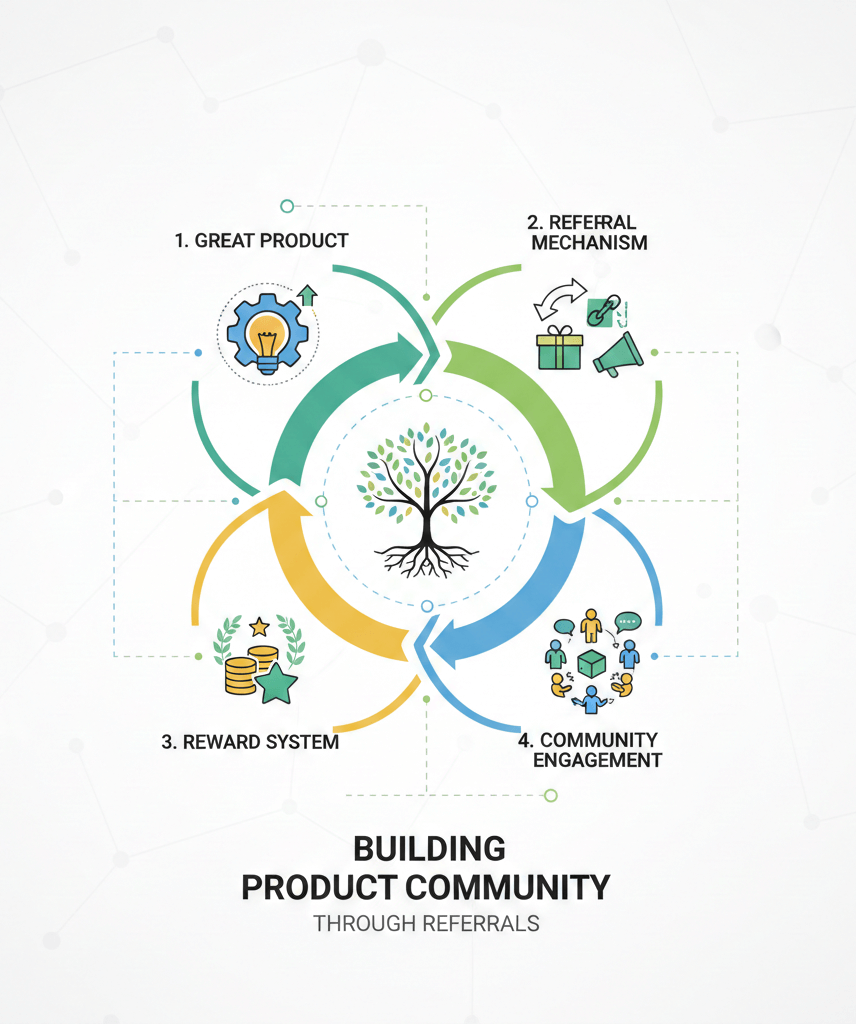
By weaving a thoughtful referral strategy into your product’s DNA, you create a self-reinforcing loop. Users join, they love the product, they invite friends, the community grows, the product improves, and the cycle continues.
It starts with a great product. It grows with a great referral program. And it sustains with a genuine commitment to your users.
Ready to build your tribe?
You have the strategy. Now you need the tool. Viral Loops is designed to remove the friction from community building. Whether you are a small startup or a global enterprise, Viral Loops gives you the power to launch a world-class referral program in minutes, not months.
Conclusion: Orchestrating the Movement with Viral Loops
We have discussed the psychology, the strategy, and the tactics. To build a community around a product, you need to turn customers into partners. You need to leverage trust. You need to reward advocacy with status and access.
But executing this manually is a nightmare. Tracking who referred whom, issuing rewards, managing tiers, and sending automated emails—doing so with spreadsheets is impossible.
This is where Viral Loops comes into play.
Viral Loops is not just a referral tool; it is a community-building engine. It is the platform that allows you to operationalize everything we just discussed.
- Do you want to create a Milestone Campaign where users unlock swag and badges as they refer more friends? Viral Loops has a template for that.
- Do you want a Newsletter Referral system like Morning Brew to grow your content audience? Viral Loops powers that.
- Do you need a Startup Pre-launch list to build hype before you even have a product? Viral Loops is the industry standard.
Viral Loops handles the heavy lifting. It provides widgets, tracking, fraud detection, and reward management. It integrates seamlessly with your existing tech stack.
By using Viral Loops, you free yourself from the mechanics, allowing you to focus on the human side—talking to your members, listening to feedback, and nurturing the relationships. It gives you the infrastructure to identify your most passionate advocates and build a thriving community on their foundation.
Don’t just build a customer base; build a loyal one. Build a movement. Let your users help grow your brand.
FAQs
1. What is the difference between a loyalty program and a community referral program?
A loyalty program usually rewards personal purchases (buy 10, get one free). It focuses on retention. A referral program rewards bringing in new people. It focuses on growth and advocacy. The best strategies combine both to build a strong user community.
2. How do I start a community if I have zero customers?
Start with a pre-launch campaign. Create a landing page explaining your mission and product vision. Incentivize early sign-ups to invite friends and move up the waitlist or gain early access. This builds a “hype community” before the product even exists.
3. Should I pay cash for referrals?
Generally, no. For brand community building, cash creates a transactional relationship. It’s better to offer credits, free products, exclusive content, or premium status. These rewards strengthen the emotional connection to the brand. Cash is easily forgotten; experiences and status are remembered.
4. What if my product is “boring”? Can I still build a community?
Yes. There are communities for everything from accounting software to lawn care. The key is to focus on the problem you solve, not the product features. Build a community around the profession or the lifestyle of your users. Help them become better at what they do, and they will rally around you.
5. How long does it take to build a community using referrals?
It is not an overnight fix. You might see a spike in sign-ups early on, but true community feeling takes months of consistent engagement, listening, and rewarding. Think in quarters and years, not weeks.
6. What is the most vital metric to track?
While the number of referrals is essential, the Participation Rate is often more telling for community health. It tells you what percentage of your user base cares enough to advocate for you. A high participation rate indicates strong product-market fit and high user love.