“Learn how to market an Online Course and sell out seats with 10 proven strategies, including lead magnets, webinar funnels, and automated student referral programs.”
You did it. You poured months, maybe even years, of your blood, sweat, and expertise into creating the ultimate online course. The modules are pristine. The videos are edited. The worksheets are works of art. You hit “publish,” and… crickets.
This is the cold, hard truth every course creator faces: Your course will not sell itself.
The “build it and they will come” philosophy is a myth. In today’s crowded digital world, you must be more than just an expert or a teacher; you must become a marketer.
However, let us be clear. Marketing is not about being pushy, slimy, or inauthentic. It’s about connection. It’s about finding the right people who desperately need the transformation you offer and proving to them that you are the one to help them get there.
You don’t need a massive budget or a marketing degree. You just need a plan.
This is your guide on how to market an online course. We aren’t talking about “fluffy” theory. We are breaking down ten proven, actionable strategies that you can start implementing today. From building your foundation to creating a viral loop of new students, this is your new online course marketing plan.
Let’s get those seats filled.
1. Start with a High-Value Lead Magnet (The Foundation)
Before you can ask for a $500 sale, you need to earn a click. Before you earn a click, you need to earn their trust. The most effective way to achieve this is with a lead magnet.
What is a lead magnet?
A lead magnet is a free, valuable piece of content that you offer in exchange for someone’s email address. It’s the first, most crucial step in your digital product marketing journey.
This is not just a “sign up for my newsletter” button. Nobody wants more email. They want solutions.
A good lead magnet solves one specific, high-stakes problem for your ideal student. It gives them a “quick win” and instantly positions you as an authority who can help them.
Examples of Great Lead Magnets for a Course:
- Course Topic: The Ultimate Sourdough Masterclass
- Bad Lead Magnet: “Sourdough Tips Newsletter”
- Great Lead Magnet: “The 5-Day Sourdough Starter Challenge: Go From Flour to Bubbly Starter (Even if You’ve Failed Before)”
- Course Topic: The Freelance Copywriter’s Toolkit
- Bad Lead Magnet: “My Writing Portfolio”
- Great Lead Magnet: “The 10-Point Checklist for a $1,000 Homepage (Plus 3 Email Templates to Pitch It)”
- Course Topic: The Beginner’s Guide to Real Estate Investing
- Bad Lead Magnet: “Real Estate News”
- Great Lead Magnet: “The ‘Deal or No Deal’ Calculator: A Simple Spreadsheet to Analyze Any Rental Property in 5 Minutes”
Why this works:
The great lead magnets promise a specific, tangible outcome. They are the first step of the larger journey your main course provides. You give them a taste of the transformation, which makes them hungry for the whole meal. This simple exchange—their email for your expertise—is the foundation of your entire marketing funnel. It’s how you begin the conversation. Without a lead magnet, you’re just a stranger shouting on the internet. With one, you’re a helpful guide.
2. Build and Nurture Your Email List (Your #1 Asset)
Getting that email address from your lead magnet is just the beginning. Now, the real work starts: nurturing.
Your email list is the single most important asset you will ever build for your business. It’s more valuable than your social media following, your YouTube subscribers, or your ad budget.
Why? Because you own it.
Instagram could shut down your account tomorrow. Google’s algorithm could change and wipe out your traffic. But your email list is a direct, unfiltered line of communication to your most qualified leads. This is where you will make the vast majority of your course sales.
But you can’t just collect emails and then slam them with a “BUY MY COURSE” email six months later. You’ll get unsubscribes, or worse, be marked as spam.
You must build a relationship. You do this with two key components:
1. The Welcome Sequence:
This is an automated series of 5-7 emails that every new subscriber gets immediately after downloading your lead magnet. This is your “first date.”
- Email 1: Deliver the Goods. “Here’s your freebie! Welcome to the community.”
- Email 2: Your Story. Who are you? Why are you passionate about this topic? Show the human behind the brand.
- Email 3: The “Aha!” Moment. Share a powerful, actionable tip or a mindset shift that relates to your course. Provide more value.
- Email 4: A Case Study or Testimonial. Show them what’s possible. “Meet Jane, she was exactly where you are now…”
- Email 5: The Soft Pitch. “You loved the free checklist, but that’s just the tip of the iceberg. If you’re ready for the full transformation, my main course is where you’ll find it.”
2. Regular Nurturing (Weekly Emails):
After the welcome sequence, you can’t go silent. You need to show up in their inbox consistently (once a week is great) with value. Share stories, new insights, tips, answer common questions, and link to your blog posts or videos. Follow the “Give, Give, Give, Ask” rule. Provide value 80% of the time. Then, when it’s time for your course launch strategy, you have a warm, engaged audience that trusts you and is waiting to buy from you.
3. Harness the Power of Content Marketing & SEO
Content marketing is the engine that will feed your lead magnet and email list for years to come. It’s the ultimate “long game” for educational marketing.
What is it?
It’s the act of creating and distributing free, valuable, and relevant content—like blog posts, YouTube videos, or podcast episodes—to attract your ideal student.
The goal isn’t to sell your course in the content. The goal is to answer the questions your potential students are typing into Google and YouTube.
Think about it. Your ideal student is on Google right now searching for things like:
- “Why does my sourdough starter keep dying?”
- How to find my first freelance writing client”
- “Is rental property a good investment in 2025?”
Your job is to be the answer.
Here’s the plan:
- Find Your Keywords: Use a free tool like Google Keyword Planner or just Google’s autosuggest to see what people are searching for.
- Create “Pillar” Content: Don’t write a short, 300-word post. Write the definitive 2,000-word guide. Create the best 15-minute YouTube video on the topic. Go deep.
- Optimize for SEO: Use your target keyword in your title, headings, and throughout your content. This tells Google what your content is about.
- The All-Important CTA: Every single piece of content you create should have one primary call-to-action (CTA): to download your lead magnet.
This creates a beautiful, sustainable system:
- A person searches for a problem on Google.
- They find your high-value blog post (you’ve built authority).
- In the post, you offer your even more valuable lead magnet.
- They sign up and are added to your email list.
- Your welcome sequence nurtures them and eventually sells your course.
This is how you get students for your online course while you sleep. It takes time to build, but a single, well-ranking blog post can generate hundreds of qualified leads every month for free.
4. Engage & Sell with Social Media (Organic and Paid)
If content marketing is your long-term engine, social media is your short-term engagement hub. This is where you build a community and humanize your brand.
But most creators get it wrong. They just post links to their course and wonder why no one engages.
You must provide native value on the platform itself.
The Organic Strategy:
- Pick Your Platform: Don’t try to be on TikTok, Instagram, Facebook, LinkedIn, and X simultaneously. You’ll burn out. Where does your ideal student live online? Select one or two platforms and delve in-depth.
- Give, Don’t Just Take: Use the 80/20 rule. 80% of your content should be valuable, educational, or entertaining (e.g., tips, quick wins, behind-the-scenes insights, student successes). Only 20% should be promotional.
- Embrace Short-Form Video: Reels, TikToks, and YouTube Shorts are the most powerful tools for organic reach right now. Create quick, 15-30 second videos that teach a straightforward concept or bust one myth.
- Engage with People: The “social” aspect of social media is key. Reply to comments. Answer DMs. Ask questions. Build real relationships. Your DMs are one of the best places to understand your audience’s pain points and gently guide them to your lead magnet.
The Paid Strategy (Facebook & Instagram Ads):
This is how you pour gasoline on the fire. Organic is great, but it can be a slow process. Paid ads give you speed and scale.
Don’t start by running ads directly to your expensive course. That’s like proposing marriage on the first date.
Instead, run ads to your lead magnet.
- The Funnel: Ad -> Lead Magnet Opt-in Page -> Thank You Page
- Your Goal: Your sole objective is to acquire a new, qualified email subscriber at the lowest possible cost.
- Retargeting: This is where the magic happens. You can (and should) run a second set of ads only to people who are on your email list or have visited your website. These “warm” leads are significantly more likely to make a purchase. You can show them ads featuring student testimonials or a special, time-sensitive bonus for your course.
Social media, used correctly, is a powerful tool for both building a warm community (organic) and predictably filling your funnel (paid).
5. Master Webinar Marketing (The “Live” Conversion Event)
When it comes to a course launch strategy, nothing beats the power of a live webinar.
What is a webinar?
It’s a free, 60-90-minute live online presentation where you teach one powerful part of your course’s topic. Ultimately, you transition into a pitch for your whole course.
Why this works:
A webinar is a high-commitment, high-value event. Someone who signs up and carves out 90 minutes of their day to learn from you is a highly qualified lead. You have their undivided attention. This format allows you to:
- Build Massive Authority: You get to prove you’re an expert by actually teaching.
- Deliver Real Value: They walk away with an “aha!” moment, building trust and reciprocity.
- Handle Objections Live: Through the chat and a live Q&A, you can answer every “what if” and “but” they throw at you.
- Create Urgency: Offer a special incentive that is only available to live attendees (e.g., a fast-action bonus or a one-time discount).
The Perfect Webinar Structure:
- The Intro (10-15 mins): Hook them. Please introduce yourself and share your story (how you earned the right to teach this subject). Set the expectations for what they will learn.
- The Core Content (40-50 mins): This is the heart. Don’t just teach random tips. Teach your “framework.” A good structure is “The 3 Secrets to…” or “The 5-Step Method for…” Your content should shatter their limiting beliefs and present your new approach as the only way to achieve the results they want.
- The Transition (5 mins): This is key. It should be smooth, not jarring. “We’ve covered a lot in 50 minutes, and you now have the framework. However, you have two choices: you can take what you learned today and try to figure it all out yourself, or you can get the proven system, including templates, a community, and my personal support, to get there in a fraction of the time. For those of you who want the fast track, I’d like to introduce…”
- The Pitch (15 mins): This is where you sell your online course. Clearly display the modules, bonuses (stack the value!), price, guarantee, and time-sensitive offer.
- The Live Q&A (15+ minutes): This is where you make the majority of your sales. Answer every question with transparency and confidence.
Promote your webinar to your email list and social media for two weeks. The influx of sales and energy from a live webinar is one of the most effective ways to sell online courses.
6. Launch a Free Challenge (Builds Hype and Community)
A free challenge is like a webinar on steroids. It’s an explosive course launch strategy that prioritizes community and results before you ever ask for the sale.
What is it?
A free 3, 5, or 7-day “challenge” where you guide participants to achieve one specific, tangible result. You typically host it in a pop-up Facebook Group, a Discord server, or a private Circle community.
Example:
- Course: The Podcast Pro
- Challenge: “The 5-Day Podcast Launch Challenge.”
- Day 1: Find Your Niche & Name
- Day 2: Create Your Cover Art (with a free tool)
- Day 3: Record & Edit Your 30-Second Trailer
- Day 4: Get Your Show Approved on Apple & Spotify
- Day 5: Launch Day! (Followed by a celebration & pitch for the course)
Why this works:
- Incredible Hype: A challenge is an event. It has a start and end date, creating massive urgency and FOMO (Fear Of Missing Out).
- Psychology of Commitment: By showing up and doing the “work” for 5 days, participants are mentally and emotionally invested.
- Community Bonding: The private group becomes a hub of activity. People share their wins, ask questions, and cheer each other on. They build a bond with you and each other.
- Proof of Concept: You give them a result for free. You help them launch their trailer. They are thrilled. You’ve proven your method works.
- The Perfect Upsell: When you pitch your full course on the final day, it’s the most natural upsell in the world. “You see what we did in just 5 days? Now, imagine what we could accomplish in six weeks. The challenge was the ‘what,’ the course is the ‘how’ to do it profitably and sustainably.”
A challenge is more work than a webinar, but the conversion rates are often significantly higher because you’ve already massively proven your value.
7. Leverage Social Proof and Testimonials (Build Trust)
You can tell people your course is amazing all day long. They won’t believe you. But the instant a fellow student says your course is fantastic, it’s gospel.
Social proof is the single most powerful conversion tool in your arsenal. It is the antidote to risk. It silences the “what if this doesn’t work for me?” doubt in a prospect’s mind.
You need to be a systematic collector of social proof.
Types of Social Proof to Get:
- Specific Testimonials (The Best): “This course was great!” is useless. “I used the email template from Module 4 and landed my first $3,000 client in 10 days” is a sales-generating machine.
- Video Testimonials: A 60-second video from a satisfied student is 10 times more powerful than text.
- Case Studies: A “before-and-after” story. “When Sarah joined, she was making $500/month. We helped her build a system, and 3 months later she had her first $10k month.”
- Screenshots: Did a student post a win in your community? Did they send you an excited DM? Screenshot it (and ask for permission first!) and share it.
- Quantitative Proof: “Join 5,000+ students…” or “Featured in Forbes…”
How to Get It:
Don’t just hope for it. Ask for it.
- Automate Your Ask: Set up an automated email that goes out 3-4 weeks after a student finishes your course.
- Ask the Right Questions: Don’t ask “Did you like the course?” Ask these two questions:
- “What was the single biggest hesitation or doubt you had before you joined?” (This gives you your prospect’s exact objections.)
- “What is the single most specific, tangible result you’ve gotten since taking the course?” (This gives you the gold.)
- Incentivize (Gently): “Send us a 1-minute video testimonial and get a $25 Amazon gift card.” It’s a small price to pay for an asset that will generate thousands of dollars.
Once you have this social proof, display it everywhere: on your sales page, in your emails, on your social media, and in your ads. Let your students sell your course for you.
8. Run a Strategic Affiliate Program (Sales on Commission)
This strategy is all about leverage. You can only reach so many people on your own. What if you could get other people —those who already have the trust of your ideal audience —to sell your course for you?
That’s affiliate marketing for courses.
What is it?
An affiliate program is an arrangement where you pay a commission (typically 30-50%) to “affiliates” for every sale they generate through their unique tracking link.
Who are affiliates?
There are other creators, bloggers, YouTubers, or business owners in your niche who aren’t direct competitors.
- Example: If you sell a “YouTube for Beginners” course, a great affiliate would be someone who sells a “Video Editing 101” course. Your audiences are a perfect match.
Why this works:
- Pay for Performance: You pay nothing up front. You only pay a commission after you’ve made a sale. It’s pure profit.
- Leveraged Trust: Your affiliate promotes your course to their email list. Their audience already knows, likes, and trusts them. This “borrowed” trust makes their recommendation incredibly powerful.
- Scalable Reach: You can’t be everywhere. However, you can have 50 affiliates promoting your course to their unique audiences, thereby massively expanding your reach.
How to Do It Right:
- Set Your Commission: Be generous. A rate of 40-50% is standard and very attractive. Remember, you’re getting a brand new customer and their email address for free. You can sell them other products later.
- Find Good Partners: Make a “dream 100” list of people in your space. Reach out personally. Don’t mass-email.
- Make It EASY: This is the most crucial part. Create an “Affiliate Pack” for them. Give them:
- Email swipe copy (emails they can just copy, paste, and send)
- Social media graphics and captions
- Their unique link
- Precise details on when they get paid.
Tools like ThriveCart, SamCart, or dedicated affiliate platforms make managing this entire process simple. It’s one of the best ways to scale your sales beyond your own launch efforts.
9. Create a Student Referral Program (Word-of-Mouth on Autopilot)
This is one of the most overlooked strategies, and it’s pure genius. It’s similar to an affiliate program, but it’s internal. It’s designed to transform your own happy students into your most potent and authentic sales force.
Think about it: Who is the most qualified person to recommend your course? Someone who just finished it and loved it.
A student referral program formalizes, incentivizes, and automates this process. You stop hoping for word of mouth and start manufacturing it.
Why it’s Different (and Better) than an Affiliate Program:
An affiliate is a marketer. A student is a friend. A recommendation from a friend who “was just in your shoes” carries an entirely different weight. It’s the highest form of social proof.
The Problem: Most creators don’t have a system for this. A student loves the course, tells a friend, and that’s it. There’s no tracking, no reward, no incentive to do it again.
How to Build a World-Class Referral Program:
You need a system that makes it simple for students to share and automatically rewards them for it. This is precisely where a platform like Viral Loops shines.
Viral Loops is explicitly designed to create these kinds of viral, word-of-mouth campaigns, and their refer-a-friend templates are perfect for course creators.
10. Create a “Tripwire” or Low-Ticket Offer (Builds a Buyer List)
This is an advanced but compelling strategy for your digital product marketing funnel.
We talked about a free lead magnet. A “tripwire” (also called a “low-ticket offer” or “self-liquidating offer”) is the next logical step.
What is it?
It’s an irresistible, high-value, low-cost product (typically $7 – $47) that you offer to someone immediately after they sign up for your free lead magnet.
Example:
- Lead Magnet: “Free Sourdough Starter Checklist”
- (On the ‘Thank You’ Page)“Your checklist is on its way! But wait… want my secret $9 ‘Perfect Starter Toolkit’?”
- The Tripwire Offer ($9): This toolkit could include:
- Your personal starter feeding schedule
- A video troubleshooting guide (“Why isn’t it bubbly?”)
- A list of the three best-kept-secret tools for under $20
Why this works:
- It Converts a “Freebie Seeker” into a “Customer.” The single hardest conversion to make is from $0 to $1. Once someone has paid you any amount of money, they are psychologically 10-20x more likely to buy from you again (like your big course). You’ve broken the buyer-seller barrier.
- It Liquidates Your Ad Spend. This is the “self-liquidating” part. Let’s say you spend $100 on Facebook ads and get 100 new email subscribers (a $1 cost per lead). If just 11 of those people buy your $9 tripwire, you’ve made $99. You just got 100 new leads and 11 new customers… for free.
- It Scales Your Business. This is how you run ads profitably. You’re no longer spending money on ads; you’re investing money to acquire customers and build your list at a break-even (or profitable) rate.
The tripwire must offer massive value and be a “no-brainer” extension of the lead magnet. It’s the perfect small purchase to build trust and fund your ad budget, allowing you to grow your list and sell your main course on the backend.
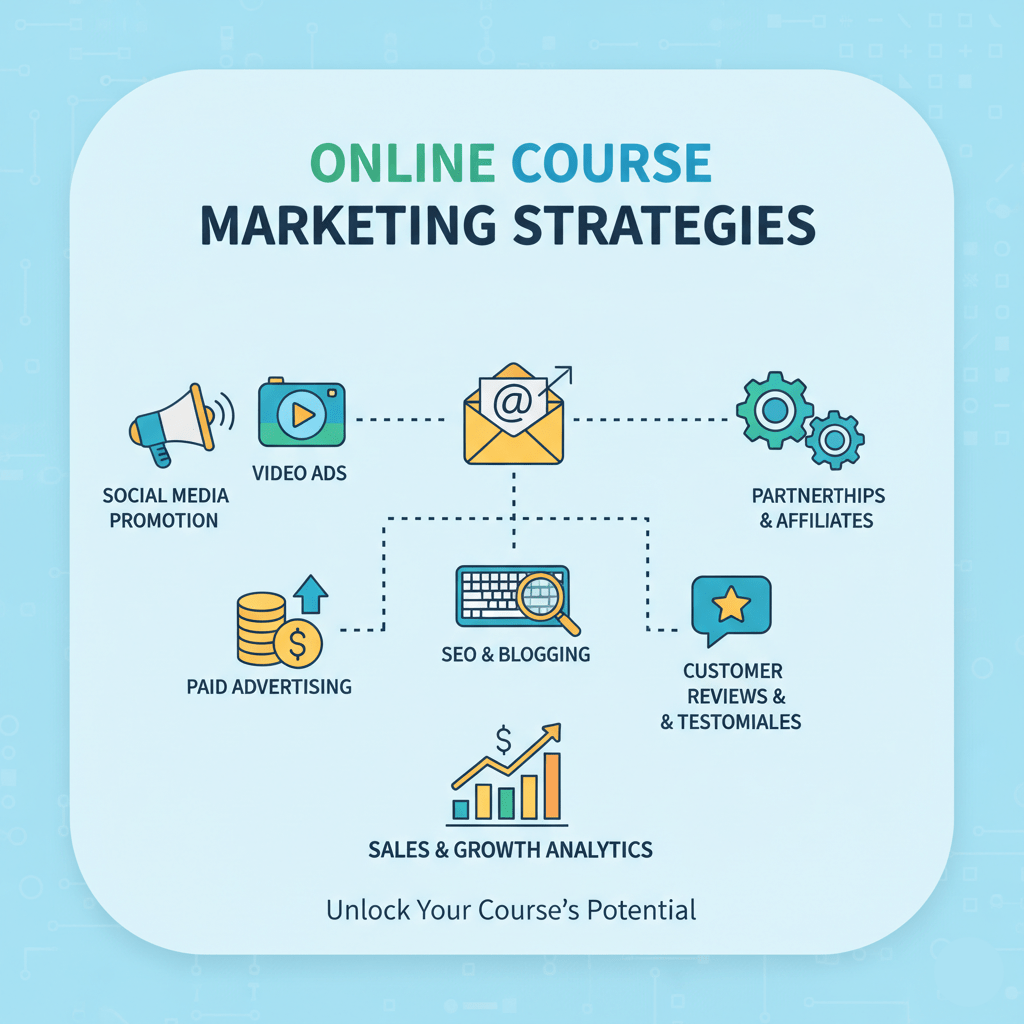
Putting It All Together: Your Marketing Machine
You don’t have to do all ten of these at once. You’d go crazy. But you can see how they fit together to create an unstoppable marketing system.
- Phase 1: Build Your Audience.
- You create Content/SEO (Strategy 3) and run Social Media Ads (Strategy 4) to drive traffic.
- Traffic lands on your Lead Magnet (Strategy 1).
- Subscribers are nurtured by your Email List (Strategy 2) and sold your Tripwire (Strategy 10).
- Phase 2: Launch & Convert.
- You promote a Webinar (Strategy 5) or Free Challenge (Strategy 6) to your email list to get a significant spike in sales.
- Your sales page is covered in powerful Social Proof (Strategy 7) to seal the deal.
- Phase 3: Scale & Automate.
- You invite other creators to your Affiliate Program (Strategy 8) to drive significant, new traffic.
- You invite all your new students to your Student Referral Program (Strategy 9) to create a viral, word-of-mouth loop.
Marketing an online course isn’t one single action. It’s a series of innovative, connected strategies. Start with one. Master Your Lead Magnet and Email List. Then, add your next layer. You’ve built a world-class course. Now it’s time to make the machine that gets it to the people who need it most.
Frequently Asked Questions (FAQs)
Q1: How much should I spend on marketing my online course?
This depends entirely on your stage. When you’re just starting, you can spend $0 in cash and 100% in “sweat equity.” Focus on strategies 1, 2, 3, and 7 (Lead Magnet, Email List, Content Marketing, and Social Proof). Your first 10 students will likely come from your personal network and the content you create. Once you have a proven, converting offer, you can move on to paid strategies, such as Facebook Ads (Strategy 4), or start a referral program (Strategy 9).
Q2: What’s the fastest way to get my first 10 students?
The fastest way is to sell to your “warmest” audience personally. This means:
- Make a list of 50 people in your personal/professional network who could be ideal students. Email them individually.
- Host a miniature, live “beta” version of your course for a 50% discount in exchange for a detailed testimonial.
- If you have a small social media following, host a “5-Day Free Challenge” (Strategy 6). This builds intense hype and is a proven way to get your first wave of founding members.
Q3: Should I focus on an “evergreen” funnel or a “live launch”?
Always start with live launches. A live launch (using Strategy 5 or 6) is where you “open the cart” and “close the cart” on specific dates. This does two things:
- It creates a massive sense of urgency, which drives sales.
- You get real-time feedback from your audience. You hear their objections and questions live, which helps you make your marketing and your course ten times better.
Once you have run 2-3 successful live launches and proven your sales process works (with testimonials), you can automate it into an “evergreen” funnel.
Q4: Why is a student referral program (Strategy 9) better than just asking for testimonials (Strategy 7)?
They serve two different, vital purposes.
- A testimonial is passive social proof. It’s a quote on your sales page that a prospect reads. It builds trust.
- A referral program is active marketing. It’s a system that incentivizes your happy students to become a sales force. It gives them a reason (the reward) and a tool (the unique link) to seek out new students for you actively.
You absolutely need both. Testimonials convince prospects; referral programs create new ones.
Q5: How many of these strategies do I really need?
You don’t need all ten. But you do need a system. A great starting “stack” is:
- Lead Magnet (to capture leads)
- Email List (to nurture leads)
- A Conversion Event (like a Webinar or Challenge)
- Social Proof (to build trust)
- A Referral Program (to scale)
If you can effectively implement those five strategies together, you will have a highly profitable and scalable online course business.