
Referral management software enables SaaS companies to build and automate programs where existing users bring in new ones.
Word-of-mouth marketing has always been one of the most efficient acquisition channels in SaaS. According to Nielsen’s Global Trust in Advertising report, 92% of consumers trust recommendations from friends and family above all other forms of advertising.
The challenge is turning that trust into something repeatable and measurable. That’s what referral program software is built to do.
Viral Loops is one of the most SaaS-friendly options in the referral marketing software category. It offers pre-built campaign templates, no-code setup, and all the integrations that product-led teams need.
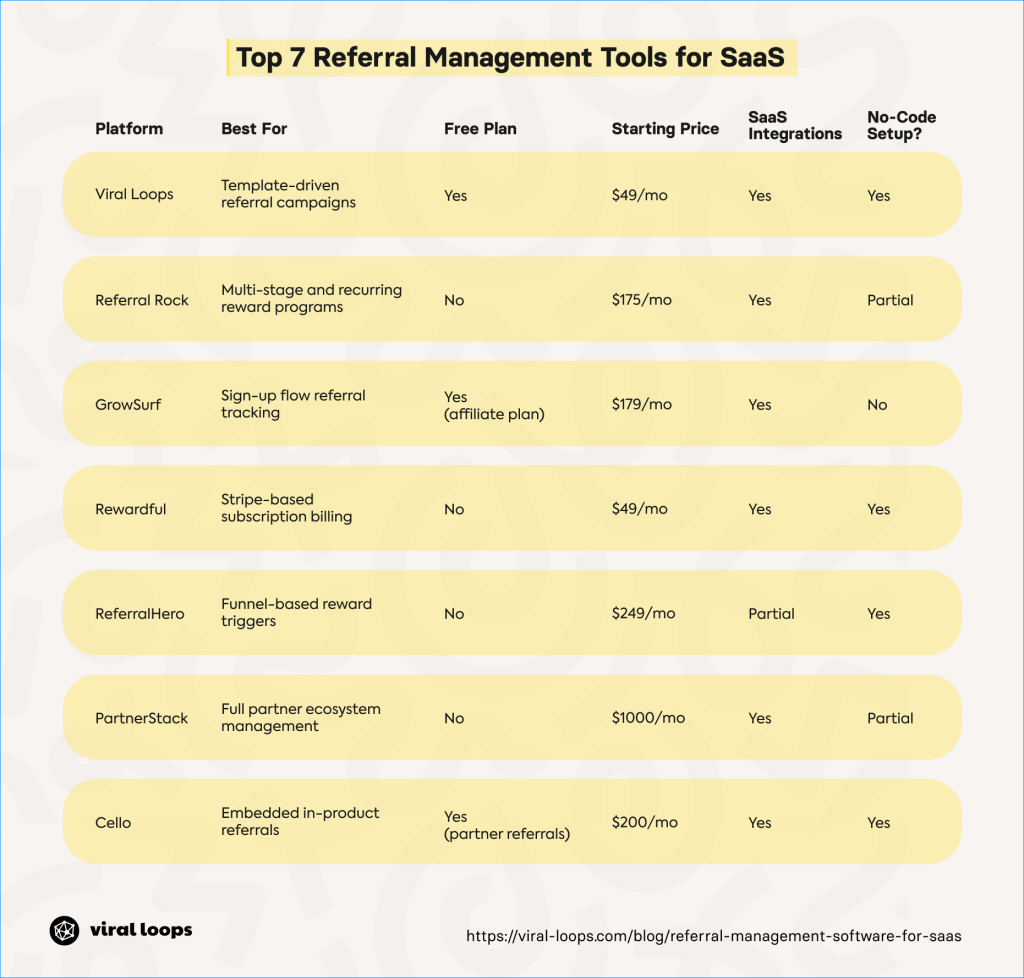
Below is a breakdown of the best referral management platforms for SaaS and their most essential features.
Disclosure: This article was created by Viral Loops and may reference its own products and services. The content reflects the author’s perspective and is based on publicly available information, accurate as of June, 2026. Companies and tools are listed for informational purposes only and are not ranked or endorsed unless explicitly stated.
Best referral management software options for SaaS
The referral software market is crowded with options like ReferralCandy, Mention Me, and Friendbuy (see our breakdown of Friendbuy alternatives), and most platforms market themselves as SaaS-ready.
In practice, the differences come down to how well each tool fits your go-to-market motion, your tech stack, and how much engineering lift you’re willing to take on.
The platforms below represent the strongest options available for SaaS teams today, evaluated on their integration capabilities, campaign flexibility, ease of setup, and pricing.
Here’s a closer look at what each one offers and who it’s best for.
1. Viral Loops
Viral Loops is a template-driven referral marketing platform built for teams that want to launch their program without custom development.
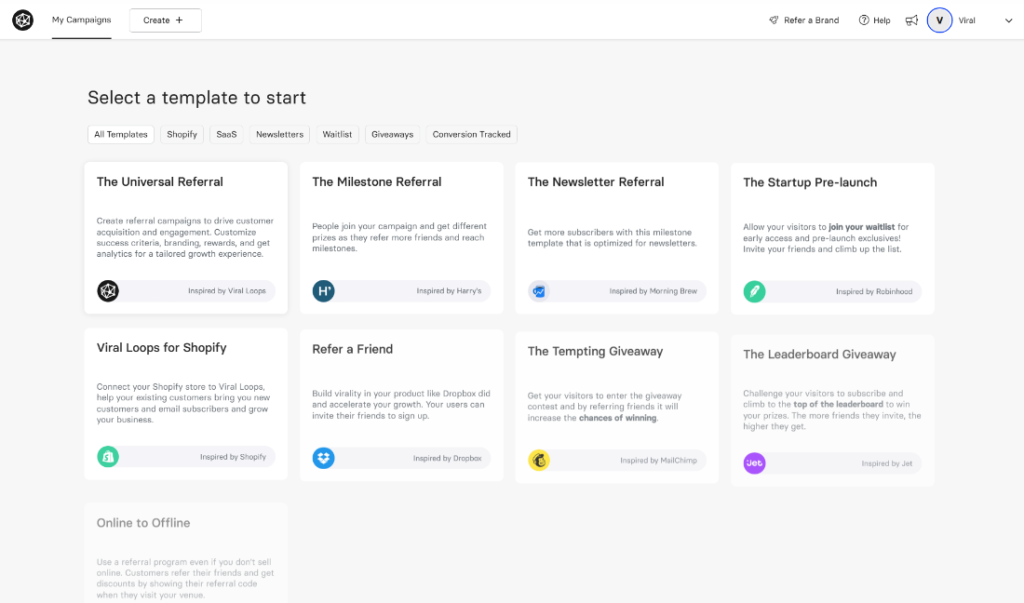
You can work with campaign templates that have already been tested at scale, configure them through a no-code wizard, and integrate them directly into your product or landing page.
Viral Loops supports two-way referral programs for SaaS teams with relevant features at different stages of a SaaS product’s growth, such as:
- Milestone-based reward structures that incentivize users based on referral actions or progress
- Pre-launch waitlists to build anticipation and acquire early users before launch day
- API access for custom integrations with your tech stack
- Automatic reward fulfillment with Stripe and Tremendous (we’ve got an official partnership with them)
- AI campaign installer, making it easy for you to launch a SaaS referral program without tech skills
- Model context protocol (MCP) server, allowing AI assistants to connect with Viral Loops to pull campaign, participant, and analytics data.
Our platform has enabled over 142,000 referral programs so far and generated more than 61 million leads since 2016.
Key features:
- Pre-built campaign templates modeled on proven referral programs (Harry’s, Robinhood, Morning Brew, Dropbox)
- No-code campaign wizard with widget customization and CSS control
- Conversion tracking across the full customer journey, including post-signup actions
- Milestone and tiered reward options for progressive incentives
- Leaderboard gamification for giveaway and waitlist campaigns
- Embeddable referral widgets with full CSS customization
- Real-time campaign dashboard with participant-level referral and reward tracking
- Integrations with HubSpot, Mailchimp, Stripe, Segment, Zapier, and more
- API and JavaScript SDK access for developer customization
- AI-powered fraud detection and automated reward management on higher tiers
Pricing:
Free 14-day trial available. Paid plans start at $49/month and scale with participant volume and features.
Pros:
Here’s what people who’ve used Viral Loops have to say on third-party review sites like G2, Capterra, and Trustpilot:
- Fast setup with proven templates: Reviewers point to the ability to launch a referral campaign in under an hour. They used templates modeled on programs that already worked for other companies, with professional-looking widgets that don’t require a designer.
- Reliable CRM integration: Smooth HubSpot integration alongside solid customization options, which make the platform easy to set up as a referral tool.
- Clear, real-time campaign visibility: The real-time dashboard makes it easy to see exactly what’s happening with a campaign as it runs.
Cons:
Users recommend improvement in the areas below:
- Slow start before results show: A reviewer noted that the software is solid, but it takes time to start seeing real results from a campaign.
- Costs scale quickly with participant volume: One reviewer flagged that running a high-volume campaign can be expensive, citing the costs of maintaining their 100k mailing list.
Best for:
SaaS teams at the startup or growth stage that want to launch referral campaigns quickly without developer involvement, and need templates that map to real product-led growth strategies rather than generic refer-a-friend flows.
2. Referral Rock
Referral Rock is a referral and affiliate marketing management platform built for more complex reward structures. It supports advanced reward management, automated payouts, and integration with CRMs and other tools.
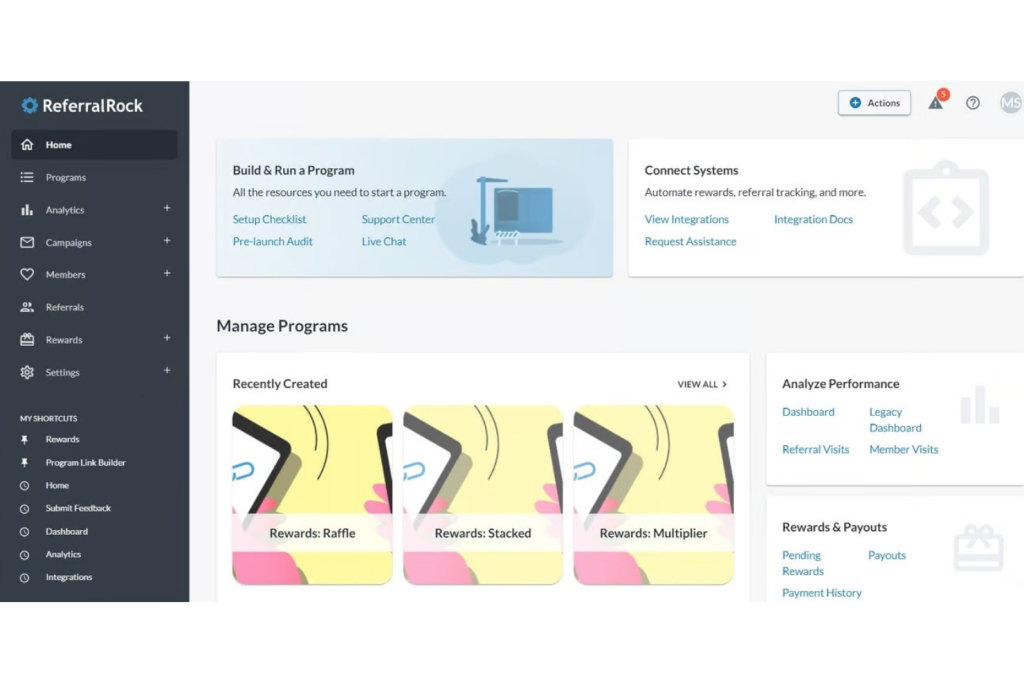
What sets it apart for SaaS is its flexibility with multi-step and recurring rewards. This is useful when your pricing model involves ongoing subscriptions rather than a single purchase.
The platform supports multi-stage referral lifecycles with hosted member portals, and it’s built to trigger rewards at any stage, from lead submission to deal close.
Key features:
- Stand-alone member portal for program participants
- Customer referral, affiliate, and brand ambassador programs in one platform
- Multi-step, tiered, time-based, and recurring reward structures
- Automated payout fulfillment, including gift cards, coupons, and cash
- 50+ native integrations, including HubSpot, Salesforce, and Mailchimp
Pricing:
Starts at $175-$200 per month, depending on the number of users.
Pros:
Here’s what people who’ve used Referral Rock have to say on third-party review sites:
- Fast, intuitive setup for non-technical teams: A reviewer noted the platform is easy to set up, even without technical experience.
- Strong HubSpot integration with useful analytics: One reviewer pointed to the tracking and analytics features as genuinely useful for optimizing campaign performance.
- Hands-on technical support during onboarding: A reviewer highlighted the platform’s account management and technical support as a standout. It was the best they’ve experienced across multiple SaaS tools over the years.
Cons:
Users recommend improvement in the areas below:
- Limited customization for advanced setups: A reviewer noted that while the platform is intuitive for everyday use, more advanced customization like design tweaks or complex reward logic requires extra learning or support help.
- Outdated interface design: One reviewer pointed out that the interface looks a bit dated, even though it functions well day-to-day.
Best for:
SaaS companies running multi-stage or recurring referral programs, or teams that want to manage both customer referrals and affiliate partnerships from a single platform.
3. GrowSurf
GrowSurf is a referral platform built specifically for B2B and B2C tech companies, with a strong focus on minimizing engineering involvement.
It automatically generates a unique referral link for each user, so marketing and product teams can launch their referral or affiliate program on their own.
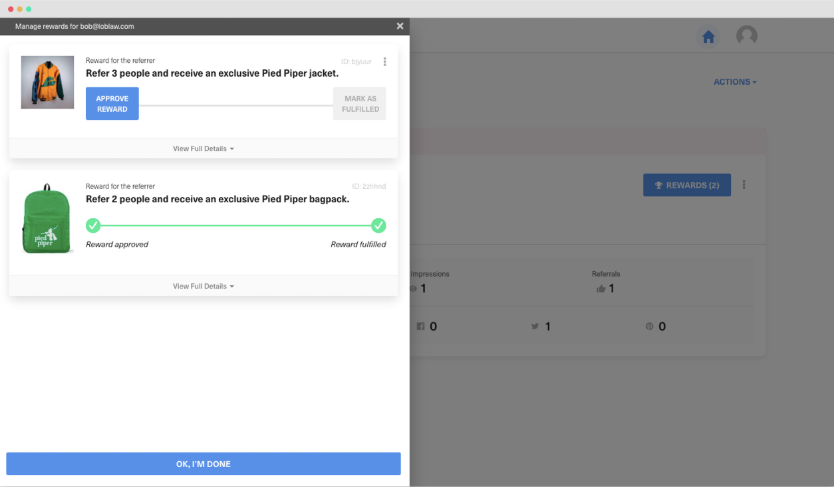
What sets GrowSurf apart is that it plugs into your existing sign-up flow without requiring a separate referral experience. It works in the background and tracks active referrals in real time.
Key features:
- Automatic referral link generation tied to your existing sign-up flow
- Real-time referral tracking that runs in the background
- Automated rewards, like gift cards, cash payouts, and account credits
- One-line embed code for adding referral elements to your site
- Integrations with CRM, billing platforms, and product event data
Pricing:
Starts at $179 a month for referral programs. Affiliate programs have a free plan.
Pros:
Here’s what users on G2 and Capterra like about this tool:
- Fast, low-lift setup: Implementation is quick and developer-friendly, with one reviewer getting fully set up in under a week thanks to strong documentation and integrations.
- Responsive, hands-on support: Support is frequently described as fast and reliable, with same-day responses even for smaller accounts.
- Scales without heavy engineering: Even on the Starter Plan, the platform offers enough flexibility to build a working referral program that drives real leads without ongoing developer involvement.
Cons:
They don’t appreciate the following:
- Manual reward approval workflow: Approving and disbursing referrals is a manual process within the app, with no option to bulk-approve via CSV.
- Limited campaign management UX: The interface for managing campaign assets and setup isn’t very intuitive.
Best for:
B2B and B2C SaaS companies that already have a sign-up flow in place and want referral tracking layered in with minimal disruption to the existing product infrastructure.
4. Rewardful
Rewardful is an affiliate and referral tracking platform built specifically around subscription billing.
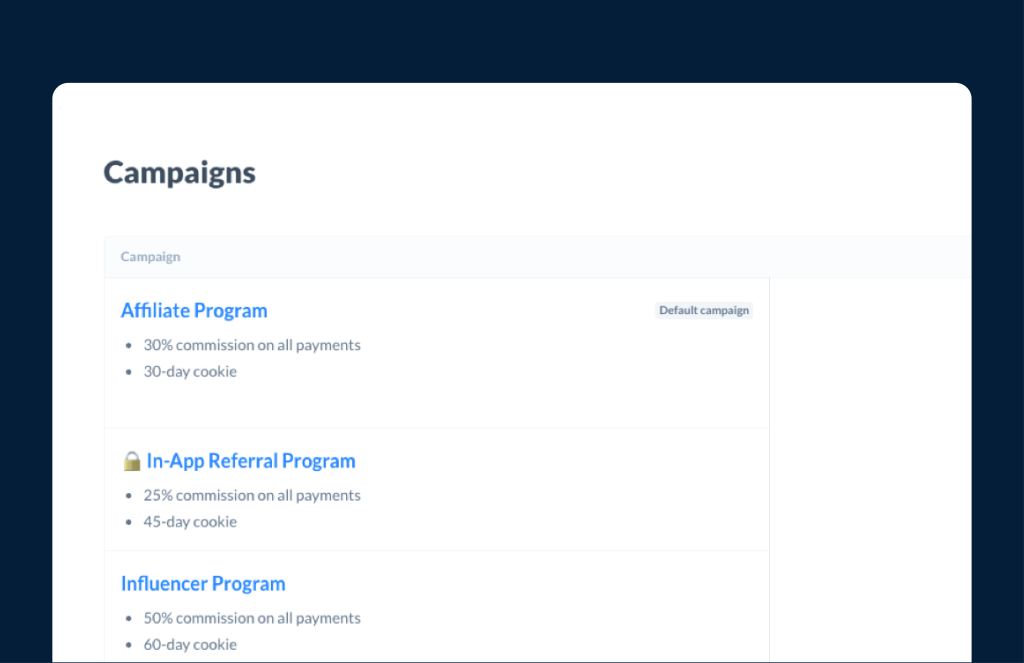
It connects directly with your payment processor, such as Stripe, and rewards affiliates whenever a customer signs up or makes a payment. That tight Stripe integration is the main reason it shows up so often in SaaS comparisons.
What makes it a solid fit for subscription businesses is how it handles billing changes automatically. Rewardful adjusts commissions for downgrades, upgrades, free trials, cancellations, and refunds without manual intervention.
Key features:
- Two-way Stripe sync for tracking signups and payments
- Automatic commission adjustments for upgrades, downgrades, trials, and refunds
- Branded affiliate portals with instant access to links and codes
- Mass payouts via PayPal or Wise
- White-labeling through Rewardful’s API
Pricing:
Plans include a 14-day free trial and range from $49 to $149+ a month.
Pros:
Here’s what users on G2 and Capterra like about this tool:
- Quick, low-friction Stripe setup: Reviewers describe getting up and running within about a week, with a smooth integration even for custom-built systems.
- Responsive support team: Several reviewers say that support is fast and genuinely helpful, with one noting consistent quick responses through chat.
- Affordable with all the core features needed: One reviewer running an affiliate program for a SaaS membership business called it the most complete tool they tried at a fair price.
Cons:
Users don’t appreciate the following:
- No spam or fraud detection for affiliates: A reviewer noted there’s no easy way to flag affiliates signing up with multiple emails to game the program.
- Pricing scales with volume regardless of feature usage: One reviewer flagged that pricing increases based on transaction volume even when not using Rewardful’s payout features.
Best for:
SaaS companies on Stripe that want affiliate or referral tracking built around subscription billing, without paying transaction fees on payouts.
5. ReferralHero
ReferralHero works across various types of programs. For ambassador programs, it automates communications and performance tracking as customers become long-term brand advocates.
For referral growth campaigns, conversions can be defined as signups, trials, or paid subscriptions.
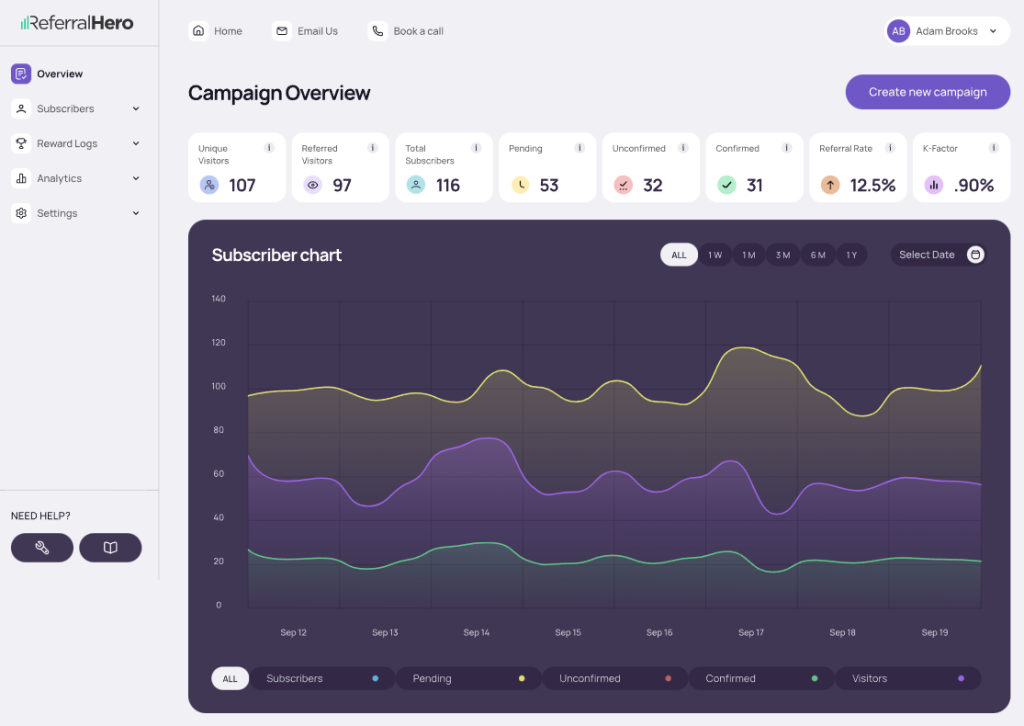
What stands out for SaaS teams is the flexibility around when a referral counts. Rewards can be triggered on any unique event, such as upon signup or when the first payment is made. This lets you align the program with your conversion funnel rather than rewarding signups that never convert.
Key features:
- Plug-and-play widgets or custom signup forms via API
- Reward triggers tied to signup, trial, or first payment
- Leaderboard and milestone features to keep participants engaged
- Built-in payouts, including bank transfers and 1099 tax reporting
- Done-for-you setup and management option
Pricing:
Plans start at $249 a month with a 7-day free trial.
Pros:
Here’s what users on Capterra like about this tool:
- Easy to implement with strong ongoing support: A reviewer whose team has used ReferralHero for over a year noted the platform was easy to set up, with support consistently helpful whenever questions came up.
- Fast results with minimal complexity: One reviewer said it helped grow their user base faster than expected while tracking results effortlessly.
- Patient, hands-on onboarding: A reviewer new to referral campaigns highlighted feeling confident launching their first campaign thanks to patient support.
Cons:
They don’t appreciate the following:
- Confusing reporting at first: A reviewer noted the reporting can be hard to follow when starting out, though it becomes simple once you’re used to it.
- Sudden, steep pricing increase: One reviewer flagged being upset after the price jumped by $180 overnight without warning.
Best for:
SaaS companies that want to tie rewards to specific funnel events like trial conversion or first payment, without having to build that logic themselves.
6. PartnerStack
PartnerStack is a partner relationship management platform built for B2B SaaS companies that want to run affiliate, referral, and reseller programs from one place.
Instead of treating these as separate workflows, it manages onboarding, payouts, and reporting for all three under a single system.
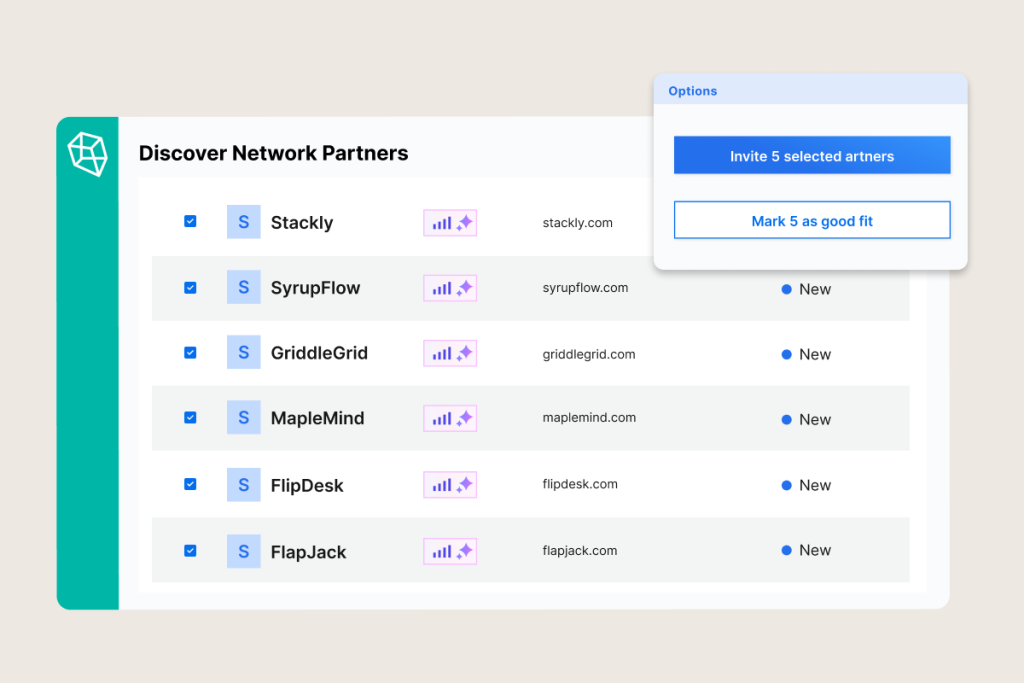
What sets it apart is the partner marketplace. Access to a pre-vetted network of SaaS-focused affiliates is considered PartnerStack’s standout feature.
It gives businesses a way to recruit qualified partners rather than only managing the ones they already have.
Key features:
- Unified management for affiliate, referral, and reseller programs
- Access to PartnerStack’s marketplace of SaaS-focused partners
- Automated partner onboarding, payouts, and compliance
- Real-time reporting and partner-level analytics
- Event-based emails and auto-triggered partner communications
Pricing:
Starts at $1,000 a month with annual plans.
Pros:
Here’s what users on G2 and Capterra like about this tool:
- Centralized dashboard for managing multiple programs: Reviewers highlight the dashboard as a one-stop shop for tracking performance, accessing assets, and managing the full partnership lifecycle.
- Strong marketplace for finding partners: One reviewer pointed to the marketplace as the standout feature, which can save weeks of manual outreach by sourcing relevant partners.
- Smooth onboarding and quick setup for new programs: A reviewer running an affiliate program noted being able to set it up quickly and start seeing results shortly after launch.
Cons:
They don’t appreciate the following:
- Cluttered, non-intuitive interface: Reviewers describe the UI as confusing at first with too many menus and options.
- Commission tracking issues: A reviewer flagged that referrals and commissions sometimes don’t update automatically.
Best for:
B2B SaaS companies with the budget and team to run a full partner ecosystem across affiliates, referrals, and resellers.
7. Cello
Cello is a B2B SaaS referral platform that embeds the entire referral experience directly into your product, rather than sending users to an external page.
It integrates the referral process with your current funnel, from share links to progress tracking, which reduces friction from your conversion flow and makes referrals a core product feature.
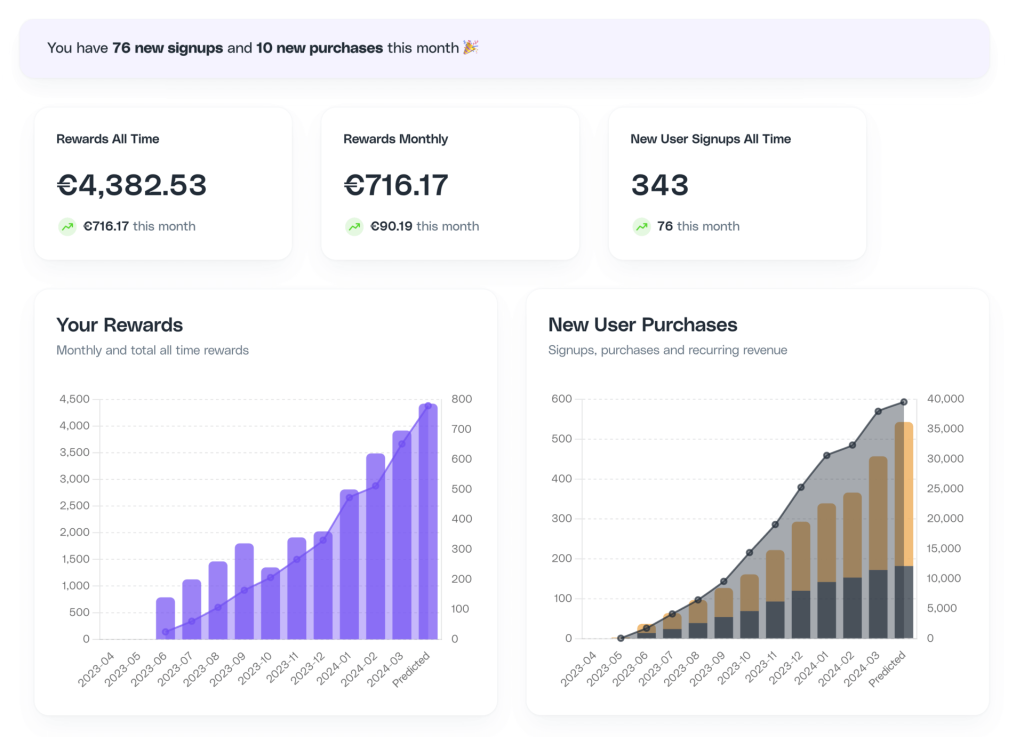
One of Cello’s strengths is removing much of the operational burden of handling referrals. Beyond tracking them, the platform automates payouts, customer verification, tax compliance, and fraud prevention.
Key features:
- Referral flow embedded directly into the product
- Automated payouts with built-in verification, tax, and compliance handling
- Recurring reward support for subscription-based pricing models
- Real-time performance tracking and ROI reporting
- Native integrations with CRM and RevOps tools, plus Stripe and other payment providers
Pricing:
Free plan available for partner referrals; paid plans start at $200 for both user and partner referrals.
Pros:
Here’s what users on G2 and Capterra like about this tool:
- Fast setup with minimal engineering: Reviewers consistently describe implementation as quick with very few development resources needed.
- Clean, intuitive interface: Several reviewers say Cello’s easy to use, both for internal teams managing the program and end users sharing referral links.
- Measurable impact on revenue: One reviewer reported an 11% increase in revenue growth alongside significantly lowered marketing expenses after integrating Cello.
Cons:
They don’t appreciate the following:
- Limited customization: A reviewer noted the platform isn’t fully customizable yet. Several features required Cello’s team to make backend changes.
- Lack of automation: Another reviewer pointed out that some backend processes still need to be done manually.
Best for:
B2B SaaS companies that want referrals embedded natively in-product, with payout and compliance infrastructure handled for them.
4 features to prioritize in SaaS referral management software
Not every referral platform is built with SaaS in mind, and the features that matter for an e-commerce referral program don’t always translate to a subscription business.
The four areas below are where the real differences between platforms show up, and where a poor fit creates the most friction down the line.
1. Referral tracking and attribution accuracy
Referral software typically tracks conversions through one of these three methods:
- Cookie-based tracking
- Unique referral links
- Coupon codes
Link-based tracking tends to be the most reliable for SaaS, since it doesn’t depend on cookies surviving across devices or sessions.
Coupon codes work well for influencer or affiliate-style referrals, but are easier to share outside the intended audience, which can dilute attribution accuracy.
For programs with longer funnels, look for a multi-touch attribution option that correctly credits the referral even if the new user signs up on one device and converts on another.
2. Reward structure flexibility
SaaS referral programs benefit from flexibility beyond a single fixed reward. Double-sided rewards, where both the referrer and the new customer get something, tend to outperform single-sided ones.
Tiered or milestone incentives keep engaged users referring repeatedly. These work especially well for SaaS, since the reward grows with genuine product usage rather than rewarding a single up-front action.
For subscription businesses with recurring commission structures, the referrer usually earns for as long as the customer stays subscribed. Here, it’s best to align the incentive with actual retained revenue rather than a one-time signup.
3. Integration depth with your SaaS stack
The most important integrations are with your billing and subscription platforms, such as Stripe, Shopify, or Chargebee, since they signal to the referral software when a referred user becomes a paying customer.
Beyond billing, integrations with your CRM and product analytics tools are also important because they tie referral data back into your broader customer record.
Native integrations also save your team from building and maintaining custom connections via Zapier or similar middleware tools. If these break unnoticed, your referral data stops syncing correctly and gets lost.
4. Analytics, reporting, and ROI measurement
Reporting should go beyond referral counts and show the metrics that determine whether the program is worth running.
Here are some that come to mind:
- Referred customer lifetime value compared to other channels
- Conversion rate by referral source
- Time to conversion
- Cost per acquired customer through referrals
The best platforms let you export this data or push it into a Business Intelligence tool, rather than locking it inside a closed dashboard.
Without this level of detail, it’s difficult to know whether a program is genuinely profitable or just generating activity.
How to evaluate and compare referral management platforms
Once you know which features matter, the next step is weighing them against your business needs. The right platform for you depends on how you sell products, price packages, and grow your revenue.
These three factors are what your decision usually comes down to:
- Self-serve launch speed vs. full-service customization: Some platforms get you live in days with templates and no-code setup, while others require more configuration but offer deeper customization once set up.
If you want to test the channel quickly, self-serve speed is more important. If you’re building a long-term program around specific reward logic, customization may be worth the slower start.
- Pricing model alignment with SaaS unit economics: Referral software pricing should make sense relative to what the program generates. A flat monthly fee can be a poor fit for an early-stage program still proving itself, while revenue-based pricing scales naturally as the program grows.
- B2B SaaS vs. B2C SaaS: B2C referral programs tend to prioritize volume and virality, while B2B programs need tighter attribution and CRM integration, since each referral represents a higher-value deal with a longer sales cycle.
What does referral management software typically cost for SaaS?
Pricing across this category varies widely, partly because vendors price against different things, such as participant volume, referral annual recurring revenue (ARR) generated, partner count, or a flat monthly rate regardless of scale.
Here’s a general breakdown of what to expect at each level.
Entry-level plans
These typically range from $29 to $49/month and suit early-stage SaaS companies testing whether a referral program is worth investing in further.
These plans usually cap participant volume, limit integrations, and restrict access to features like automated rewarding or white-labeling.
Viral Loops, Rewardful, and ReferralHero all have entry points within this range, with some offering free plans or trials to get started.
Mid-tier plans
Pricing here generally falls between $150 and $400 per month and removes most volume caps from entry-level tiers. At the same time, these plans have deeper integrations, multi-step or recurring reward logic, and better reporting.
GrowSurf and Referral Rock both price in this range, reflecting their focus on more developed referral programs rather than early testing.
Revenue-based pricing
This is a different model entirely, where the platform charges based on the referral ARR your program generates, rather than a flat fee.
Cello uses this approach, which lowers the financial risk of launching before the program has proven itself. However, it can become more expensive than a flat-rate plan once the program scales.
Enterprise and custom pricing
Platforms built for larger partner ecosystems or complex, multi-program needs come to mind here, such as PartnerStack and SaaSquatch.
These plans are quoted after a demo and often start in the five-figure annual range. They typically include dedicated support, custom service-level agreements, and advanced fraud or compliance handling.
Most SaaS companies find the right tier not by feature count alone, but by matching the pricing model to where the referral program sits in its lifecycle, from early testing to a proven, scaling channel.
What are the biggest difficulties when running a SaaS referral program?
Referral programs sound simple (as they should, to your customer) but are often complex to set up and manage.
The challenges generally fall into two categories: how the program is designed and how it’s operated day-to-day.
1. Program design difficulties
A referral program structure starts with figuring out who to reward and how much. Reward too generously, and you erode margins on customers who might have converted anyway. Reward too sparingly, and existing customers won’t bother.
Research supports why this balance matters: a study tracking 10,000 bank accounts over three years found that referred customers were 18% more likely to stay and generated 16% higher profits, yielding a roughly 60% return on referral costs.
Getting the reward structure wrong means missing out on that kind of return entirely.
2. Operational challenges
The other main challenge with referral programs is managing attribution and fraud. SaaS companies need to track referrals accurately across devices, sessions, and longer sales cycles. They also need to watch for self-referrals or fake accounts gaming the reward system.
On top of that, manually reconciling who gets paid, especially with recurring or tiered rewards, can become a lofty operational burden without the right software handling it automatically.
How to implement referral software in an existing SaaS product
Integrating referral software into your operations works best as a structured process.
Here’s how you can do it step by step.
Define program goals and metrics
Before touching any platform, decide what success looks like. Is it a conversion rate target, lower customer acquisition costs, or a specific referral ARR goal? Without this, it’s difficult to judge later whether the program is successful.
Configure the platform around your actual funnel
Set up tracking at the point that corresponds to your concrete conversion event, whether that’s sign-up, trial activation, or first payment.
Build out reward logic that fits your business model, whether that’s a one-time payout or a recurring commission tied to subscription revenue.
Connect it to your CRM and billing system
This step is often skipped, but it’s what makes referral data usable outside of the platform. Referral activity should flow into the CRM that your sales and marketing teams already use. Conversion events should sync with your billing platform so rewards are triggered accurately, without manual checks.
Test with a small group before a full launch
Running a limited pilot can pinpoint tracking issues or flaws in your reward logic before they affect your entire user base.
It also gives you actionable data to fine-tune messaging and reward amounts through A/B testing before rolling the program out more broadly.
Over to you!
Remember, choosing the right referral management software comes down to matching the platform to your business model, not picking the one with the longest list of features.
A B2C SaaS company optimizing for volume has different needs than a B2B company running longer sales cycles. In the same way, pricing models that work for one stage of growth can become a poor fit at another.
Viral Loops is a strong starting point for SaaS teams that want to launch quickly with proven templates and no-code setup, without locking themselves into a rigid, enterprise-heavy platform.
Start free with Viral Loops and launch a referral program built on the same templates that have already worked for thousands of SaaS companies.
![9 Best Referral Marketing Platforms [In-Depth Comparison]](https://viral-loops.com/blog/wp-content/uploads/2025/06/UPDATE-9-Best-Referral-Marketing-Platforms-In-Depth-Comparison.png)
![10 Best Referral Program Software Tools [2026]](https://viral-loops.com/blog/wp-content/uploads/2026/09/NEW-10-Best-Referral-Program-Software-Tools-2026.png)
![Best Viral Loops Alternatives in 2026 [Full Comparison]](https://viral-loops.com/blog/wp-content/uploads/2026/06/Best-Viral-Loops-Alternatives-in-2026-Full-Comparision-5.png)
![10 Best Referral Rock Alternatives: Full Comparison [2026]](https://viral-loops.com/blog/wp-content/uploads/2025/09/10-Best-Referral-Rock-Alternatives_-Full-Comparison-2026.png)