![10 Best Referral Program Software Tools [2026]](https://viral-loops.com/blog/wp-content/uploads/2026/09/NEW-10-Best-Referral-Program-Software-Tools-2026.png)
Dozens of referral program software solutions promise the same thing: more customers and less work. But once you start comparing them, it’s not as simple as that.
Picking the wrong tool typically means one of two things: missing the features you actually need or paying extra for them. No one wants that.
That’s why this guide covers what referral program software is, how it works, and how to choose the right one for your business.
This way, you won’t get stuck comparing seemingly similar platforms without knowing what to look for.
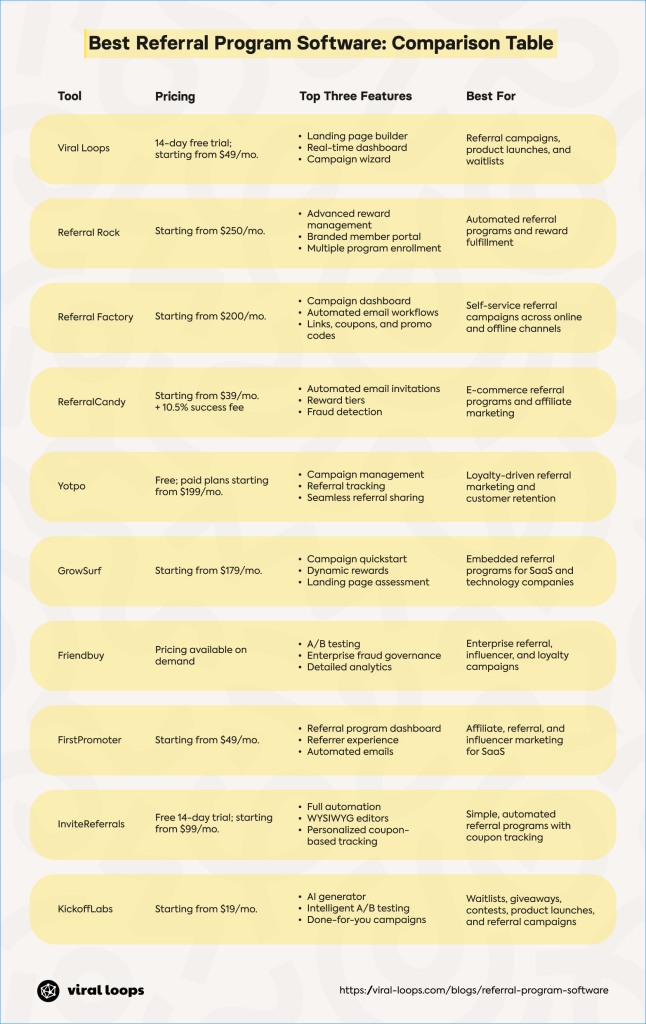
This table shows our ‘top ten’ referral tools in summary. We’ll look at them all in more detail in the rest of this article.
Disclosure: This article was created by Viral Loops and may reference its own products and services. The content reflects the author’s perspective and is based on publicly available information, accurate as of September 2026. Companies and tools are listed for informational purposes only and are not ranked or endorsed unless explicitly stated.
What is referral program software?
Referral program software is a category of digital tools that automates creating, managing, tracking, and rewarding customer referral campaigns.
It takes away the stress of managing word-of-mouth marketing programs in spreadsheets.
Instead, these tools handle everything you need to launch a referral program, from generating unique referral links to creating embeddable widgets or landing pages, offering multiple sharing options, tracking conversions, and automatically distributing rewards.
How does referral program software work?
First, you set up a referral campaign on the platform and embed the program in your product or website, or create a dedicated landing page for the experience.
Next, customers join the program and get a unique referral link or code. They then share this link or code with friends and family via email, text, or social media.
When invitees click the link and complete a target action (a sign-up, purchase, or providing contact information) the software’s tracking system attributes the conversion to the referrer using cookies or unique codes.
Once the action is verified, the referrer and/or the new customer receive their reward, such as discounts, cash, or credit.
Beyond the transaction, most referral program software logs actions by referrers and referred parties, flags fraudulent activity, and reports performance metrics, allowing businesses to measure ROI and optimize incentives over time.
10 Best referral program software platforms to consider
In this section, we will go over each referral program tool and explain its use cases. We’ll also discuss the different referral features it offers and its pros and cons.
1. Viral Loops
Viral Loops is a referral and affiliate marketing software solution that makes it easy for businesses to launch growth campaigns like refer-a-friend, waitlist, giveaway, and leaderboard contests using prebuilt templates.
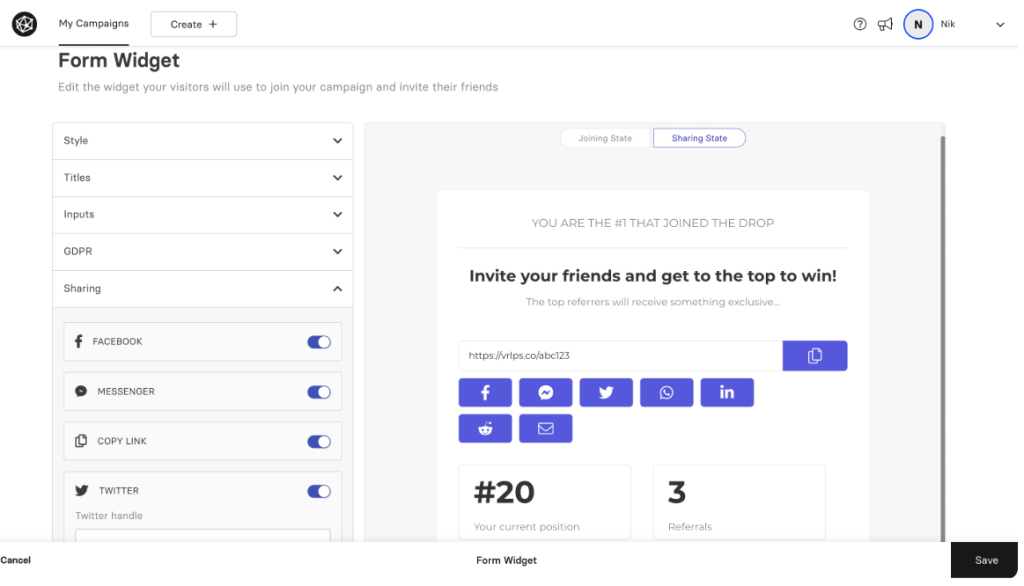
With our tool, you can run always-on referral campaigns for both long-term organic growth and one-time programs.
Growth programs here can be embedded within your product/website as widgets, or you can create a dedicated landing page for the campaign.
Tracking and attribution are automatic, so you don’t have to manually monitor who referred whom. Our integration with Stripe and Tremendous also helps automate reward fulfillment.
Viral Loops offers a no-code AI campaign installer and wizard to help you deploy programs without developer support. We integrate with many of the tools in your tech stack, like HubSpot CRM, Klaviyo, ActiveCampaign, Webhooks, Shopify, AWeber, Mixpanel, and Salesforce.
And if you have a specific feature or integration you’d like to see on your referral program?
Our hands-on concierge service partners directly with your team to design and build tailored referral workflows that blend seamlessly into your product experience.
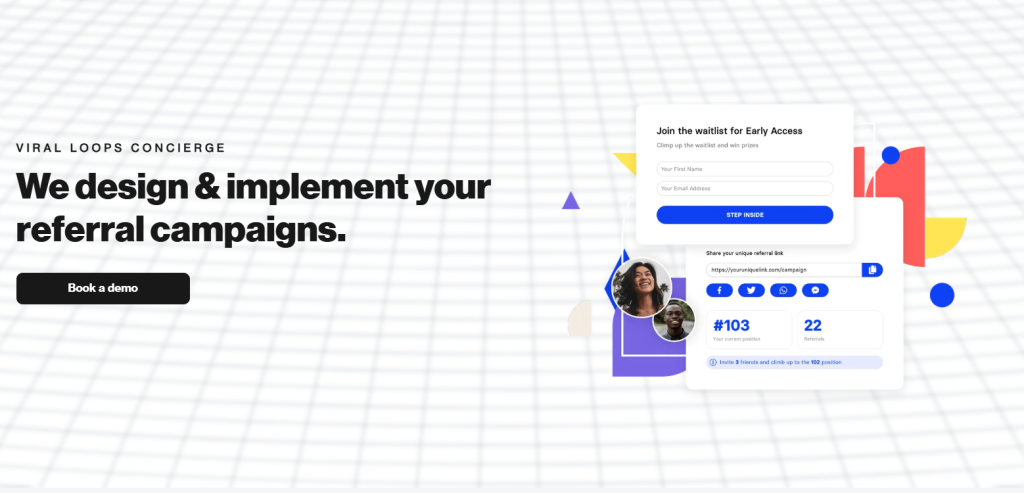
Whether it’s custom campaign logic or complex integrations, we take care of the heavy lifting, e.g., tracking, rewards automation, and UX optimization.
This way, you can focus entirely on scaling your core business.
Who it’s for:
B2B SaaS brands, newsletter creators, e-commerce brands, fintech businesses, and enterprise companies.
Key features:
- Landing page builder: Build dedicated referral landing pages to host your referral campaigns even without an existing website.
- Real-time dashboard: Breaks down campaign performance by channel, participants, and reward status, to help measure ROI.
- Campaign wizard: Included in every Viral Loops template to help set up campaigns, customize the details, and simplify launch.
Pricing:
Viral Loops has a 14-day free trial and four paid plans:
- Startup: $49/mo.
- Plus: $139/mo.
- Growing: $229/mo.
- Power: $399/mo.
Pros:
- Prompt support: “Customer support was fantastic — Prompt and able to support me through a technical issue on my end.”
- Easy setup and clean interface: “I’m using it to test a launch campaign for my new book, and the whole process has been really straightforward. The UI is clean and easy to navigate, which makes setting up and testing a campaign much less overwhelming.”
- Sufficient documentation: “There’s plenty of documentation and helpful resources available whenever needed.”
Cons:
- Limited customization in multiple languages: “We had an issue with multiple languages where one language would switch from campaign to campaign. Might be that only one [non-English] could be edited and it would change it for every campaign.”
2. Referral Rock
Referral Rock is a referral and advocacy platform that provides businesses with the tools needed to run automated referral campaigns.
It offers automated tracking, reward fulfillment, and CRM syncing across the customer life cycle.
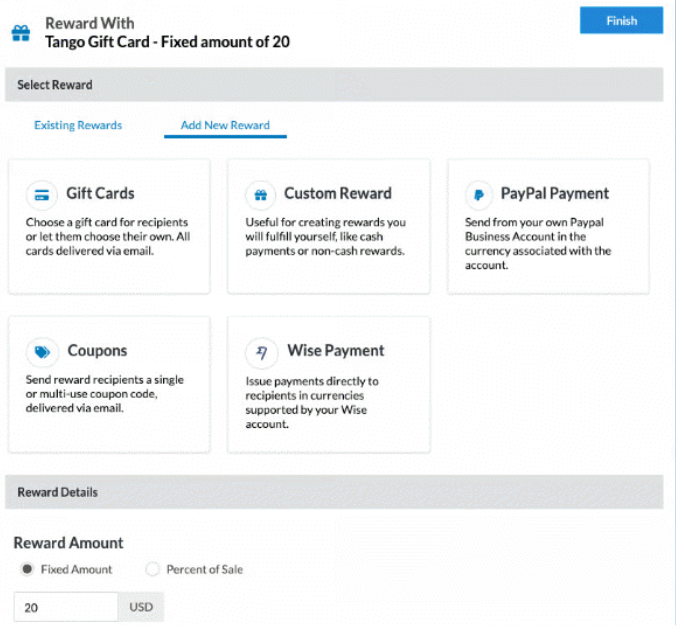
Referral Rock provides users with a dedicated onboarding specialist to customize the referral program to suit your business and launch it.
Here, you mainly define rules that guide your brand, and the Referral Rock team manages the referral program and reward fulfillment on your behalf.
Referral Rock includes a user hub where customers can manage and track their referrals, plus a custom landing page with the referrer’s name to personalize the experience.
Who it’s for:
Startups, service businesses, SaaS brands, e-commerce, or multi-location franchises.
Key features:
- Advanced reward management: Supports multiple reward options, including coupons, gift cards, cash, and custom incentives, with automated fulfillment.
- Branded member portal: A dedicated portal where referrers can find their share link, referral status, and reward balance.
- Cross-channel enrolment: Automatically enroll customers in a referral experience from either your e-commerce platform, CRM, sales team, or dedicated program QR codes.
Pricing:
- Operator Plan: $250/mo. with available add-ons to expand usage
- Enterprise options: Available on demand
Pros:
- Easy setup: Saves time by providing ready-made emails and landing pages that are easy to modify.
- Reliable automation: Integrates with HubSpot and runs in the background with minimal maintenance.
- Streamlined management: Makes it easy to customize programs, track performance, and automate rewards.
Cons:
- Advanced customization can be complex: Design tweaks and complex reward logic may require additional support.
- Basic UI design: The interface could be more visually polished.
- Slow results: Newly launched referral programs may take time to generate significant results.
3. Referral Factory
Referral Factory is affiliate and referral program software with built-in tracking that helps brands build, promote, track, and reward customer and affiliate referrals.
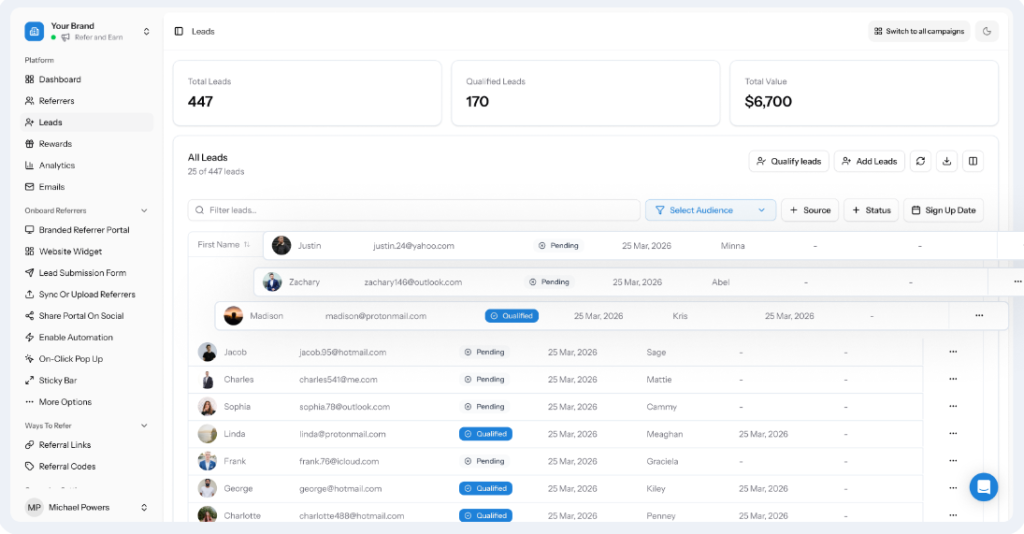
Referral Factory lets businesses launch referral campaigns across online and offline channels. Online experiences can be placed as pop-ups, widgets, or sticky bars on your website or landing pages, while offline participants can use promo codes to take part in the campaign.
When customers join, make a referral, convert, or qualify for a reward, Referral Factory can automatically send them relevant emails based on their activity.
Who it’s for:
Marketing teams (SMBs through to enterprises) that want referral software with a simple self-service setup.
Key features:
- Campaign dashboard: A dedicated hub that provides a detailed overview of campaign health and referral metrics to track referral activity.
- Automated email workflows: Send referral-specific emails to promote a referral program, remind referrers, notify teams, and update participants.
- Links, coupons, and promo codes: Let referrers use any of these ways to share and redeem referral offers across online, offline, checkout, and sales-assisted journeys.
Pricing:
- Monthly: $200/mo. for 20k users
- Pro: $400/mo. for 40k users
- Enterprise: $1,000/mo. for 100k+ users
Pros:
- Easy to use: User-friendly platform that’s simple to navigate.
- Responsive support: Quickly resolves questions and issues.
- Easy referral tracking: Makes it simple to monitor referrals and engagement.
Cons:
- Limited export size: Data exports are limited to 3,000 referrals at a time.
- Limited dashboard utility: Users don’t find the Referral Factory dashboard useful and mostly track performance within HubSpot and other attribution tools instead
- Limited update communication: Could improve communication around new features and UX updates.
4. ReferralCandy
ReferralCandy is an all-in-one affiliate and referral marketing tool for e-commerce businesses that automates referral rewards directly into the post-purchase flow.
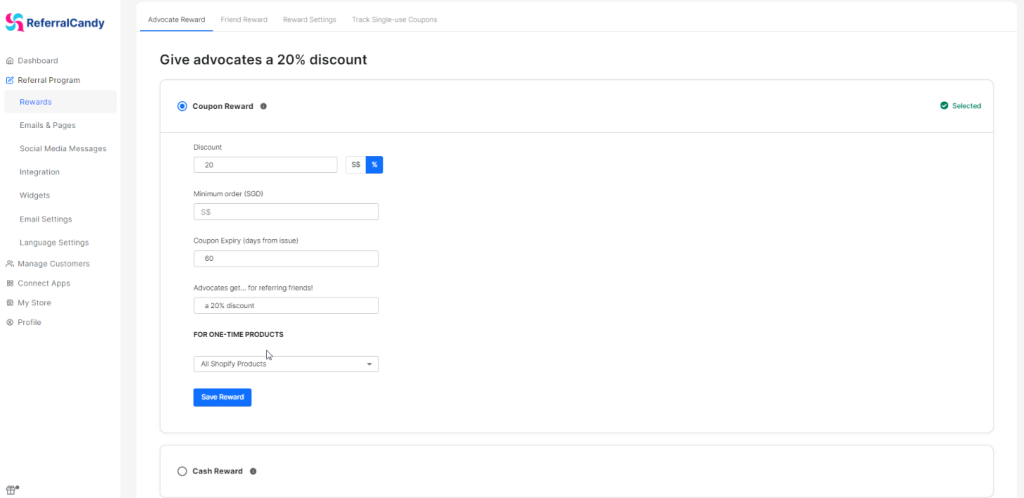
ReferralCandy simplifies setup by letting users install the app directly in their e-commerce platform, like Shopify, WooCommerce, Magento, or BigCommerce.
It provides automated tracking and clear ROI reporting, so users can see every referral, purchase, and payout in a single dashboard.
With integrations like Klaviyo, Google Analytics, or the Meta Pixel, you can also keep track of which channels drive sales.
Who it’s for:
Premium e-commerce stores with consistent monthly transaction volume.
Key features:
- Automated email invitation: Automatically send emails to customers triggered after a transaction or an order shipment.
- Reward tiers: Offer progressive incentives to referrers driving the most revenue.
- Fraud detection: Automatically flag self-referrals, velocity spikes from a single brand advocate, or codes leaking to scrapers.
Pricing:
- Basic: $39/mo. + 10.5% success fee
- Grow: $79/mo. + 3.5% success fee
- Scale: $249/mo. + 1.5% success fee
- Enterprise: $799/mo. + 0.25% success fee
Pros:
- Automated referral tracking: Tracks referrals, confirms qualifying purchases, and automatically issues rewards.
- Simple implementation: Easy to set up and get started.
- Easy promotion management: Simplifies managing promotions and provides strong customer support.
Cons:
- Unclear referral workflows: A flowchart or clearer visual guide would make it easier to understand workflows with different conditions.
- Account-related issues: The platform can sometimes stall due to account issues.
5. Yotpo
Yotpo is a customer retention suite for running loyalty and referral marketing campaigns, collecting reviews and UGC-style content, and improving your brand’s visibility in AI search.
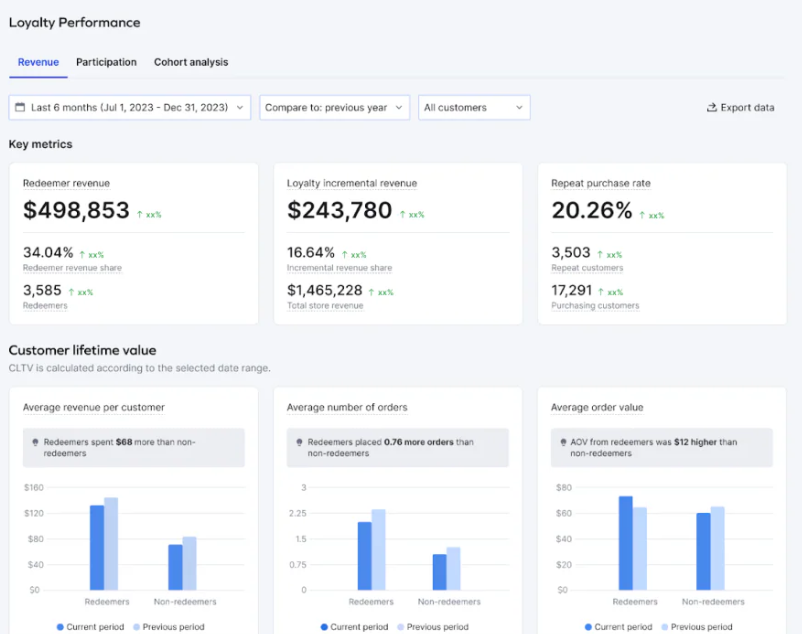
Yotpo integrates referral campaigns into loyalty programs, allowing businesses to engage customers who already have a relationship with the brand and may be more likely to invite others.
It provides tools that simplify sharing, such as unique, trackable referral codes and links, plus multiple sharing options like one-click sharing via email, social media, and direct links.
Yotpo also lets you test and iterate on different parts of the campaign, including incentives, placements, and messaging, to see what captures your customers’ interest most.
Who it’s for:
Growing and enterprise e-commerce and DTC brands that want a customer acquisition and retention ecosystem.
Key features:
- Campaign management: Create various referral campaigns, like give X, get X, tiered referral structures, or limited-time referral drives to increase client acquisition.
- Referral tracking: Monitor every referral from customers’ first shares to purchases, so you can determine the campaign’s share-to-conversion rate.
- Seamless referral sharing: Expand your customer base by capturing referral intent through on-site widgets, email, SMS, WhatsApp, and post-checkout touchpoints. Every participating customer receives a unique referral link.
Pricing:
Yotpo offers different pricing for its services.
For referral and loyalty campaigns, it has a free plan and a paid tier starting from $199/mo. for 500 monthly orders.
Pros:
- Easy to use: Straightforward platform for managing reviews and text messages.
- Shopify integration: Clean Shopify integration with easy-to-set-up on-site display widgets.
- Marketing integrations: Connects smoothly with other tools in a marketing stack.
Cons:
- Limited depth across features: Tries to cover multiple functions but doesn’t match the capabilities of specialized tools, particularly for SMS.
- Inconsistent support experience: Platform glitches can occur, and support quality may vary depending on the representative.
6. GrowSurf
GrowSurf is a referral program tool that lets businesses embed affiliate and referral campaigns in their product or website with some technical expertise.
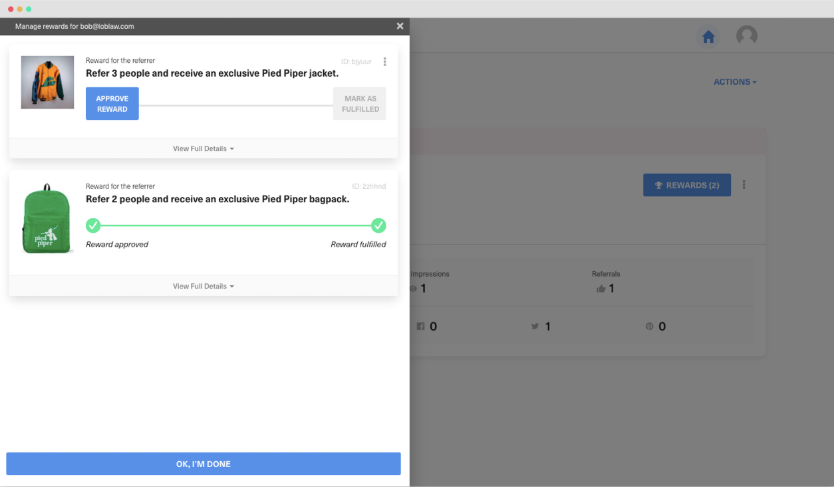
GrowSurf allows you to design white-labeled referral programs that integrate effortlessly into your product UI to enhance the customer referral journey.
With its robust tracking system, every new registration is directly tied to the referring user. And because referral tracking connects seamlessly with your existing signup flows and landing pages, you don’t need to change how new leads or users sign up.
Who it’s for:
Product and marketing teams at growing companies in B2C, SaaS, fintech, AI, healthtech, education, and insurance industries.
Key features:
- Campaign quickstart: Automatically retrieves the brand logo, colors, and ideas for rewards and promotional copy to simplify the referral campaign creation process.
- Dynamic rewards: Assign variable incentive tiers customized to specific referrer segments or key attributes of the referred user, including their chosen subscription plan.
- Landing page assessment: Leverage AI to analyze your referral landing page and get actionable insights to improve referral conversion rates.
Pricing:
- Startup: $179/mo. for up to 2,500 participants
- Business: $449/mo. for up to 10,000 participants
- Custom plan for over 150,000 participants
Pros:
- Clear analytics: Provides useful and easy-to-understand performance insights.
- Easy, developer-friendly setup: Simple to implement and well-suited to technical teams.
Cons:
- Limited customization: Could offer more flexibility to tailor campaigns to specific needs.
- Referral credit issues: Referral credits may not always update, and there’s no manual option to correct referral records.
- Unclear campaign management: The interface for managing campaign assets and setting up campaigns could be better.
7. Friendbuy
Friendbuy is an enterprise-grade referral, influencer, and loyalty campaign software for businesses that want to drive customer growth.
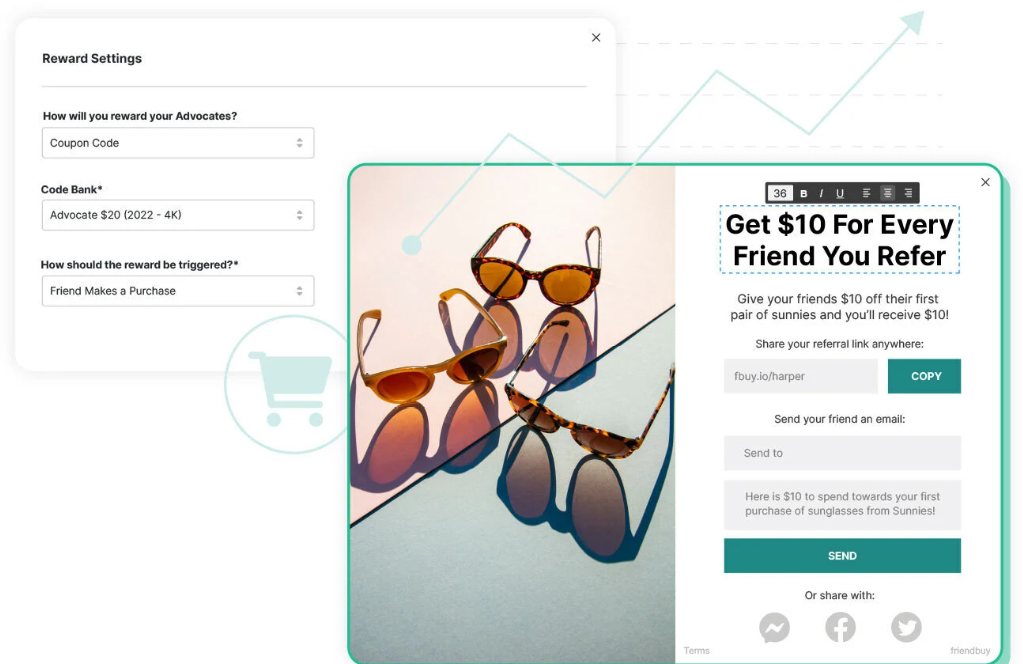
Friendbuy helps you identify and activate customers within your existing user base and scale campaigns with A/B testing, fraud prevention algorithms, and deep integrations.
You can place referral experiences as widgets across your website or mobile app, with robust infrastructure for premium onboarding, full referral funnel visibility, and performance measurement.
Who it’s for:
Enterprise brands in e-commerce, financial services, travel & hospitality, and retail industries.
Key features:
- A/B testing: Experiment with incentives, placements, and creative variations, and measure outcomes against acquisition metrics.
- Enterprise-level fraud governance: Protect attribution accuracy and program economics with behavioral signal monitoring, email similarity detection, validation workflows, and new customer validation.
- Cohort-level analytics: Compare referrals against other customer acquisition channels and gauge their impact on your brand.
Pricing:
Friendbuy’s pricing is available on demand.
Pros:
- Easy referral management: Makes it simple to manage referral programs.
- Responsive support: The Friendbuy team is knowledgeable, responsive, and helpful.
- Smooth rewards management: Customers can earn and redeem rewards successfully on the platform.
Cons:
- Reporting discrepancies: Some users have reported occasional pixel issues that have led to discrepancies in reporting.
- Slow code-related fixes: Development issues involving code can take longer to resolve.
- Limited API development tools: A JavaScript library for interacting with the API would make implementation and debugging easier.
8. FirstPromoter
FirstPromoter is another all-in-one growth platform built to run affiliate, referral, and influencer marketing initiatives for SaaS brands.
Through its centralized reporting page, businesses can handle and monitor multiple campaign types in one place.
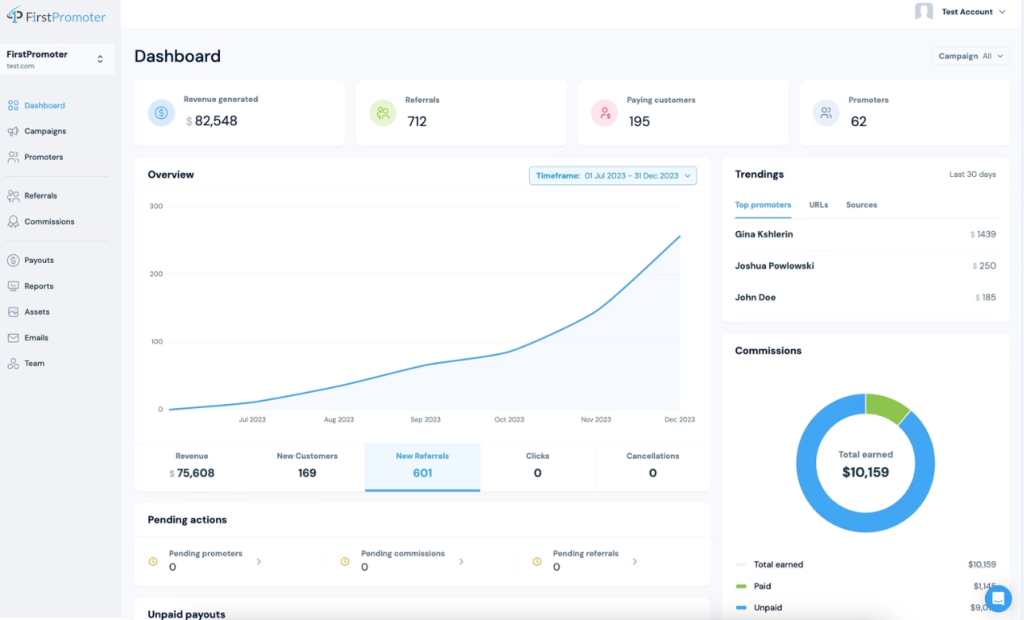
FirstPromoter’s referral tracking software shows the full cycle of your referral campaigns, tracking each referred client to the exact billing event that confirmed it.
You get to see who referred whom, on which plan they were converted, and the revenue earned.
Similar to GrowSurf, the referral experience can be embedded in your product, matching your brand’s theme with rewards set to automated or manual fulfillment.
Who it’s for:
SaaS and subscription-based companies that need referral program software with robust tracking capabilities.
Key features:
- Referral program dashboard: Centralized hub where you can view revenue generated from referral campaigns, including paying customers, top promoters, clicks, cancellations, and more.
- Referrer experience: A campaign page for referrers where they can find their unique links or coupon codes, referrals, rewards, and payout methods.
- Automated emails: Contact referrers with one-time or trigger-based email sequences that begin when a customer joins, reaches new milestones, or hasn’t been active.
Pricing:
- Starter: $49/mo.
- Business: $99/mo.
- Enterprise: $149/mo.
Pros:
- Smooth setup: Easy setup process with helpful onboarding.
- Responsive support: Provides strong customer support and precise tracking.
- Clean interface: Modern, user-friendly interface that’s easy to navigate.
Cons:
- Limited reward customization: Offers few options for customizing how rewards appear on different promoter pages.
- Limited commission options: Doesn’t allow sales commissions to be offered alongside referrer commissions.
9. InviteReferrals
InviteReferrals is a straightforward referral and advocacy platform for teams that want an accessible referral marketing tool without extensive customization.
It can help create referral strategies, campaign designs, and launch your programs.
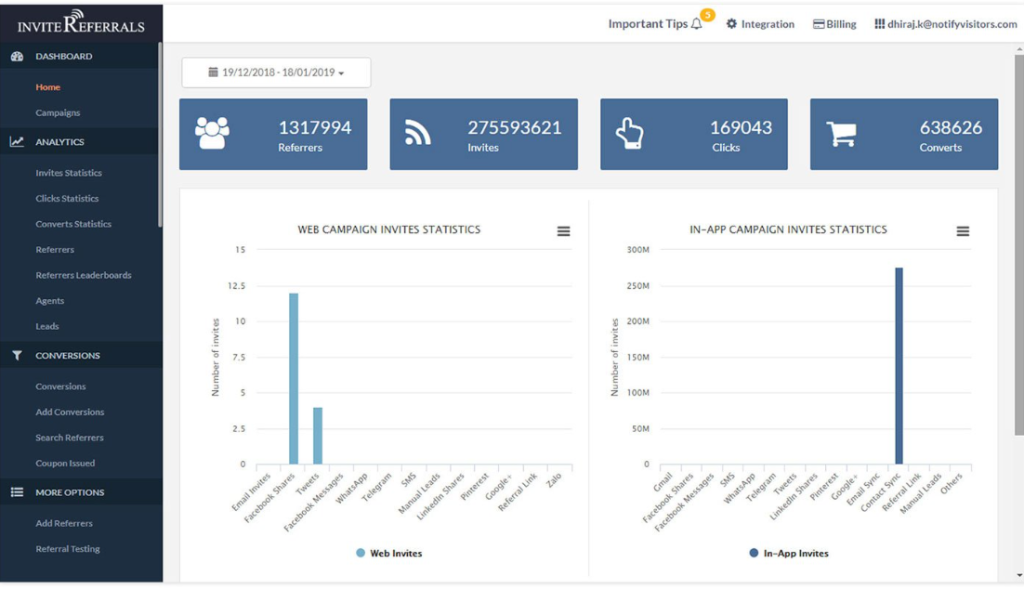
InviteReferrals lets users launch campaigns in over 20 languages and supports tracking throughout the program, from shares to clicks and successful referral conversions across registrations, sales, or mobile application installs.
Who it’s for:
Small and enterprise businesses that prioritize simplicity and affordability.
Key features:
- Full automation: Automate referral tracking, participant and reward notification emails, and discount code management and distribution.
- WYSIWYG editors: An editing hub for designing the referral campaign from widgets to emails without requiring tech expertise.
- Personalized coupon-based tracking: Upload unique promo codes that InviteReferrals automatically assigns to participants and users to track referral sales and distribute rewards.
Pricing:
InviteReferrals offers a free 14-day trial with paid plans starting from $99 per month.
Pros:
- Simple to use: Offers a straightforward experience for managing referral programs.
- User-friendly interface: Easy for both influencers and customers to use.
Cons:
- Time-consuming setup: The initial setup process can take some time.
- Slow support: The support team can be slow to respond to queries.
- SDK UI issues: The SDKs have UI issues that may require frequent adjustments.
10. KickoffLabs
KickoffLabs is a referral software solution for creating waitlists, giveaways and contests, product launches, and referral campaigns.
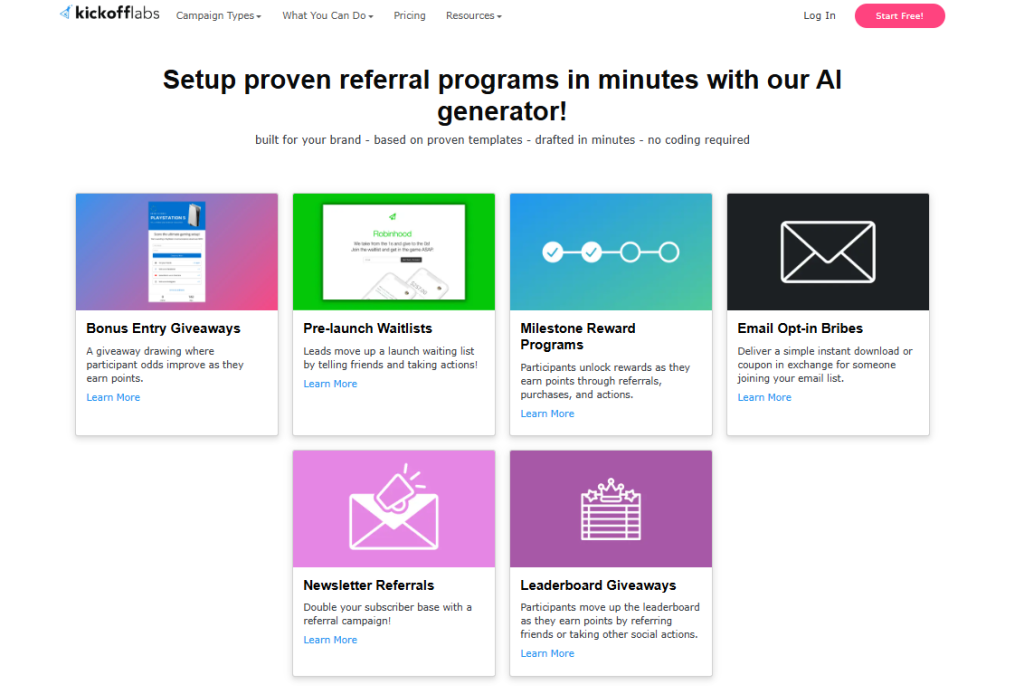
KickoffLabs lets you build programs from templates or with AI, which you can embed as a widget, a popup, or even connect to an existing form.
This tool identifies key influencers from your customer base to invite as referral participants and tracks which leads bring in new clients.
Additionally, KickoffLabs features automated A/B testing, allowing you to optimize your campaign for maximum conversion performance.
Who it’s for:
Small, growing, and enterprise teams that want to run pre-launch waitlists, contests, giveaways, milestone rewards, and referral programs.
Key features:
- AI generator: Leverage KickoffLabs’ AI tool to create viral giveaway and referral programs for your business.
- Intelligent A/B testing: Run split tests on your contest landing pages to discover top-performing variants without sacrificing conversions.
- Done-for-you campaigns: Hire KickoffLabs’ team to design, develop, and implement your referral campaign.
Pricing:
- Hobby: $19/mo.
- Premium: $69/mo.
- Business: $145/mo.
- Enterprise: $289/mo.
Pros:
- Simple setup: Easy to understand and personalize giveaways, with helpful support when needed.
- A/B testing: Makes it easy to run split tests and see which variations perform better.
- Customizable lead capture: Offers customization, social media integrations, and lead/data capture.
Cons:
- Limited email integrations: Doesn’t support some email-related actions, such as tracking link clicks within emails.
- Limited design flexibility: Fine-tuning the site to look exactly as desired can be difficult.
- Complex integrations: Integrating data with existing systems can be challenging when working with specific tools and software.
What features should referral program software have?
When evaluating referral program tools for your business, you want to consider the following features:
- Link and code generation: Does it generate unique links or codes for each participant? This simplifies sharing for your customers while ensuring you can attribute each successful referral to the correct source.
- Referral tracking and attribution: Refer-a-friend program tools must track conversions across web browsers, desktop applications, and mobile applications.
- Flexible reward management: A good referral tool should offer multiple reward options, from double-sided incentives to coupon codes, cash, gift cards, free products, or loyalty points. It should provide tiered or milestone rewards with automated distribution once a specific action is verified.
- Multiple sharing options: Look for referral software that gives your customers different ways to share the referral experience — SMS, email, copy-paste link, social media, or even unique names.
- Dedicated dashboard: A client hub where program participants can track referrals, rewards, request payouts (where possible), and find sharing options.
- Fraud protection and security: The tool should flag and prevent fraudulent activities like duplicating emails or IP addresses.
How to choose the right referral program software
You’ve seen what exactly to look for in a referral tool. But with so many options available, how do you choose the right one?
Here’s what we advise:
- Define your goal: Decide what you’re trying to achieve with a referral program. Do you want to reduce customer acquisition costs (CAC), test a new market, launch a product, or increase repeat purchases? Shortlist tools that can help you accomplish those goals.
- Evaluate your budget: Check the shortlisted tools’ pricing pages to confirm whether they match your budget. You don’t want to invest in software that’s far above your budget or locks you into a long-term contract.
- Check integration depth: Look for software that connects with your existing tech stack. Evaluate how easy it is to integrate with third-party tools. Are there native integration options, or do you have to connect tools via Zapier?
- Read reviews for support responsiveness: You want to look at each tool’s support rating. Do customers have good things to say about the support team’s response rate and availability?
- Look at reporting depth: Next, make sure the tool offers detailed analytics and reporting, especially if you want to optimize campaigns and improve ad spend. Confirm that it can monitor referral rate, conversion rate, or ROI at least.
- Confirm that the tool matches your industry: Make sure the software fits your business type and industry, since different tools focus on specific niches. If you’re an e-commerce brand, ReferralCandy or Yotpo are built for you, with GrowSurf or FirstPromoter designed for SaaS brands.
How to get started with referral program software
After choosing a preferred referral program tool for your business, you can follow this framework to launch a campaign on most apps:
- Define your trigger and incentive: Decide what referral actions will trigger a reward (e.g., purchase, sign-ups, or installations) and choose an incentive model. It’s always a good idea to give two-sided rewards if customer lifetime value is high enough, as it motivates the referrer and the referred. And select the reward type: discount codes, cash, store credits, gift cards, etc.
- Create a landing page or widget: Build a page or embeddable widgets, popups, or banners for your referral campaign that explains how it works. Tools like Viral Loops include templates for each, so it’s easy to get started.
- Set up tracking and integrations: Install tracking pixels on your landing page and post-purchase flow, and connect them to your CRM or email platform for automated invites, updates, and reward notifications.
- Configure fraud rules: Define what classifies as fraudulent activity, enable automated detection when someone breaks the rules, and place a hold on payout to cover refunds or cancellations.
- Test and launch: Deploy the campaign to a small cohort, run a test, and if it performs well, promote it via email, receipts, and social.
- Analyze and automate: Use the tool’s analytics dashboard to monitor reach, participation rate, conversions, and ROI. Leverage automation to place reward fulfillment and participant invitations on autopilot.
While these steps might vary across tools, the structure is largely the same.
You can see how this looks in practice. Book a live demo with Viral Loops to see how a referral program runs in real time.
Frequently asked questions (FAQs)
Q1. What types of referral programs can you run with referral software?
Here are some top options:
- Customer referral program: Existing clients are incentivized to invite others.
- Affiliate program: Third-party marketers promote the brand for a commission.
- Employee referral program: Encourage employees to invite others to use your product or buy from the brand in exchange for a reward.
- Loyalty campaigns: Customers are rewarded for performing specific actions like making a purchase, subscribing to your newsletter, or reposting the brand’s content on social media.
Q2. Is referral program software worth it?
Yes, referral program software is worth it for most businesses because it can help:
- Increase customer growth organically.
- Automate parts of the campaign that would otherwise have been handled manually, like tracking, reward fulfillment, conversion verification, or link creation.
- Prevent budget drain by identifying fraudulent activities in the campaign.
Q3. How does referral software track referrals and conversions?
Referral program software mostly assigns participants a unique link, code, or name. Then it tracks participant activity through cookies, URL parameters, pixels, or event-based triggers tied to your CRM, billing, or e-commerce tool.
Q4. Can referral program software automatically send rewards?
Yes, referral marketing tools can automate reward fulfillment once a referral has been verified. Some can automatically apply store discounts or app credits to user accounts, send cash deposits or gift cards, and reduce or skip invoices for subscription-based services.
![9 Best Referral Marketing Platforms [In-Depth Comparison]](https://viral-loops.com/blog/wp-content/uploads/2025/06/UPDATE-9-Best-Referral-Marketing-Platforms-In-Depth-Comparison.png)
![12 Best Referral Factory Alternatives: Full Comparison [2026]](https://viral-loops.com/blog/wp-content/uploads/2026/05/12-Best-Referral-Factory-Alternatives_-Full-Comparison-2026.png)