![10 Best Referral Rock Alternatives: Full Comparison [2026]](https://viral-loops.com/blog/wp-content/uploads/2025/09/10-Best-Referral-Rock-Alternatives_-Full-Comparison-2026.png)
Referral Rock is a referral marketing platform that helps service businesses, e-commerce brands, tech companies, and enterprises run word-of-mouth marketing campaigns.
However, users across various review sites have complained about its limited customization for complex campaigns, poor UI, a narrow integration ecosystem, and insufficient support for B2B SaaS referral models.
Thankfully, you can consider several Referral Rock alternatives for referral campaigns.
Some of the best options, along with their key features and pricing, are in the table below.
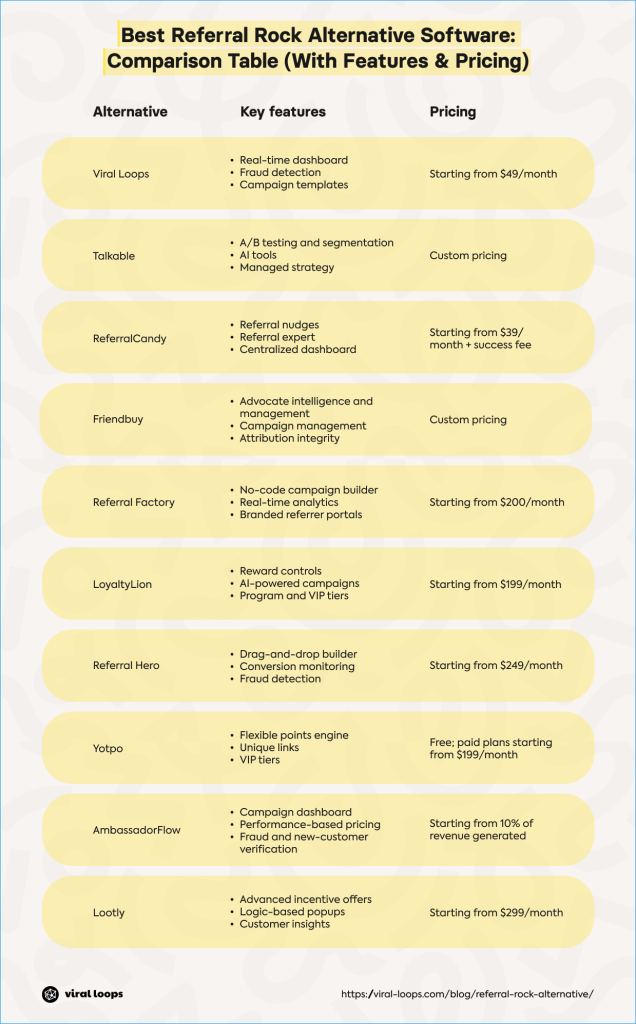
Disclosure: This article was created by Viral Loops and may reference its own products and services. The content reflects the author’s perspective and is based on publicly available information, accurate as of September 2026. Companies and tools are listed for informational purposes only and are not ranked or endorsed unless explicitly stated.
Why do people switch from Referral Rock?
To understand user sentiment toward Referral Rock, we analyzed user feedback and reviews across third-party platforms.
Here’s what we found:
Good tool but poor UI
Melissa, an operations specialist, says:
“Referral Rock is easy to use[…] The user interface feels a bit dated. The colors are a bit muted, and you have to click around a lot to find what you’re looking for. It’s not as intuitive of an interface as one would expect for the current decade.”
Steep learning curve
Lee L, a computer science professional, likes that Referral Rock runs in the background and integrates well with HubSpot.
Here’s where Lee had an issue with this tool:
“The initial learning curve can be a bit steep, especially when navigating the more advanced campaign settings and reward rules.”
Unintuitive dashboard
Juan T., a VP of marketing, says Referral Rock provides leads with the highest conversion rate, but:
“The one thing I’m not crazy about is the new dashboard, as the older one provides more insights, not only on referrals captured, but those qualified, approved or denied. ”
Whether you have run into these exact friction points or faced different challenges, evaluating other referral platforms is a good next step.
In the following section, we examine the leading alternative referral marketing solutions and how each one executes word-of-mouth marketing campaigns.
1. Viral Loops
Viral Loops is a referral marketing platform for teams that want to launch giveaways, waitlists, always-on referral programs, and affiliate campaigns without accompanying technical complexity.
Our tool offers a library of templates for different campaigns and industry types, modeled on successful referral programs.
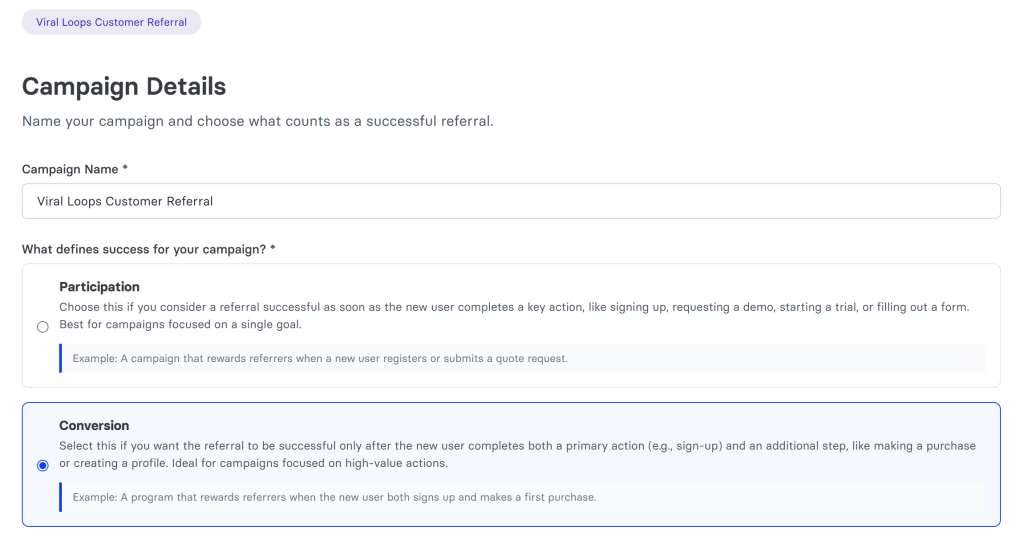
You can embed growth programs into your online store or website and build landing pages to host the referral program.
We offer built-in tracking to monitor campaign performance, automated reward fulfillment, and a dashboard to track progress.
Our support team is always available to help, and we have a campaign wizard that guides users on how to launch referral programs from scratch.
We also offer an AI tool that detects existing sign-up forms on your site and connects them to your customer referral program without manual setup.
Key features:
- Real-time dashboard: Get live tracking of shares, referrals, and rewards organized by channel.
- Fraud detection: Built-in checks to catch self-referrals, suspicious activities, and duplicate entries.
- Campaign templates: Access to pre-built flows for referral programs, waitlists, giveaways, and brand ambassador programs styled after proven viral campaigns.
- Campaign wizard: AI support for guided programs set up from start to finish.
- Concierge services: Viral Loops helps design and implement referral campaigns on select plans.
Pricing:
Viral Loops offers a free 14-day trial and four paid plans:
- Starter: $49/mo.
- Plus: $139/mo.
- Growing: $229/mo.
- Power: $399/mo.
Integrations:
Viral Loops integrates with Salesforce, HubSpot CRM, Mailjet, Leadpages, Marketo, AWeber, Wishpond, Instapage, Stripe, Tremendous, ConvertKit, MailChimp, and Mixpanel.
Pros:
- Automates referral marketing: “I’ve had a really positive experience using Viral Loops. If you’re not the type of person who enjoys manually asking for referrals, this platform makes the whole process much easier with well-designed campaign templates inspired by successful brands.”
- Intuitive UI and extensive documentation: “The interface is clean and straightforward, so getting started doesn’t take much effort. On top of that, there’s plenty of documentation and helpful resources available whenever needed. ”
- Great customer service: “The customer service is very good and these guys really know what they are doing. They spent a lot of time helping me set things up!”
Cons:
- Learning curve: “There is a learning curve, and you really have to engage with the subject matter. However, support responds very quickly if you get stuck.”
Best for:
- B2B SaaS teams
- Newsletter creators
- E-commerce businesses
- Startups
- Fintech brands
2. Talkable
Talkable is a referral marketing platform for established enterprise e-commerce brands that lets you run influencer programs, sweepstakes, and leaderboard marketing campaigns.
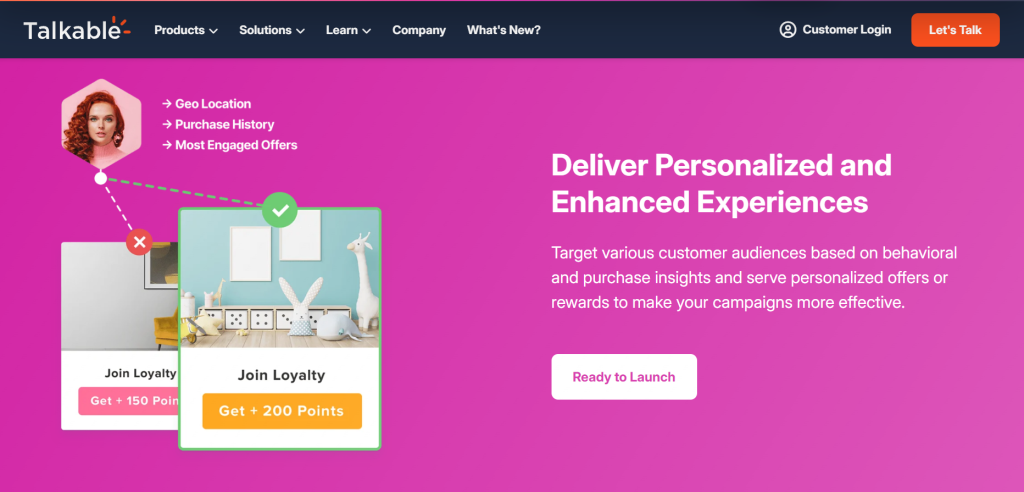
Instead of templates, Talkable offers a campaign builder paired with a strategy team and AI tool to help you design and launch growth campaigns.
It lets you segment audiences, serve offers/rewards to users based on their activity, and enable users to create referral videos.
Key features:
- A/B testing and segmentation: Built-in experimentation tool to identify the best offer and messaging for different audience segments
- AI tools: Help streamline the campaign setup by crafting copy and suggesting different approaches you can leverage.
- Managed strategy: A dedicated team to help build and test campaigns rather than leaving setup to users.
Pricing:
Talkable’s pricing is not publicly available and is quoted per account.
Integrations:
Talkable connects with Shopify, Salesforce, BigCommerce, HubSpot, Klaviyo, Tango, Magento, Shopify Plus, and Mailchimp.
Pros:
- Seamless website integration: Talkable integrates smoothly with the company’s website.
- Easy-to-follow UI/UX: The platform’s interface is intuitive and easy to navigate.
- Hands-off account management: Talkable’s team handles much of the heavy lifting and works with customers to improve their referral channel.
Cons:
- Promotion limitations: Some of Talkable’s promotional recommendations may conflict with strict MAP policies.
- Limited revenue breakdowns: The main revenue chart could offer more flexible breakdowns by month, week, quarter, or year.
- Slower onboarding without technical support: Companies without an in-house technical team may experience a longer onboarding curve.
Best for:
- Enterprise retail and DTC brands across health and wellness, fashion, food and beverages, beauty, and furniture industries.
3. ReferralCandy
ReferralCandy is a referral and affiliate platform for online stores on Shopify, WooCommerce, BigCommerce, or Magento.
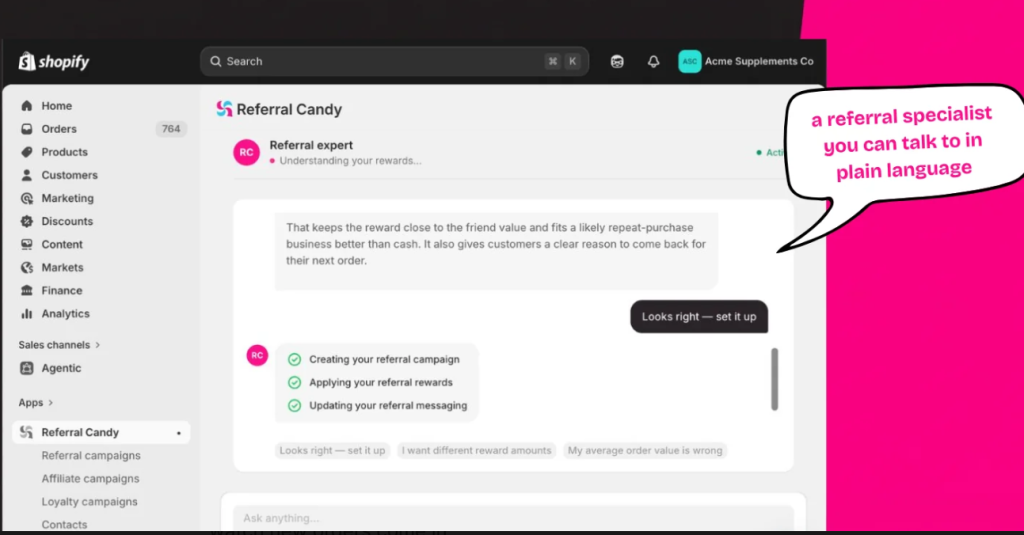
You can launch campaigns from templates or with the help of ReferralCandy’s new AI feature to create and refine campaigns using your store’s real data.
It has a campaign editor where you can drag and drop elements and customize rewards and copy to match your brand’s style.
Key features:
- Referral nudges: Allows you to position referral campaigns directly where shoppers are most engaged, such as on product pages, shopping carts, or homepage referral widgets.
- Referral expert: A built-in AI assistant for launching referral programs.
- Centralized dashboard: Track sales from referral links and coupon codes, and monitor overall performance to know what’s working and which customer is driving revenue.
Pricing:
- Basic: $39/mo. + 10.5% success fee
- Grow: $79/mo. + 3.5% success fee
- Scale: $249/mo. + 1.5% success fee
- Enterprise: $799/mo. + $0.25 success fee
Integrations:
ReferralCandy integrates with Shopify, Klaviyo, Mailchimp, Recharge, BigCommerce, Magento, WooCommerce, Customer.io, custom stores hosted on other platforms, and subscription apps like Skio, Casa, and Recurpay.
Pros:
- User-friendly and easy to configure: The app is simple to use and set up.
- Strong anti-fraud protection: Its anti-fraud system is robust, while referral management remains easy.
- Responsive customer support: The support team is quick to respond and proactively helps resolve urgent issues.
Cons:
- Limited branding flexibility: The platform could offer more customization options to better match your brand and user experience.
- Complex email template editing: Modifying email templates can be difficult for users who aren’t familiar with Liquid or HTML, and manual email sending would be a useful addition.
- Occasional glitches: The platform sometimes experiences glitches that require manual fixes.
Best for:
- Premium e-commerce marketers across health and wellness, pet, fashion, beauty, kids, sports, electronics, and food industries
4. Friendbuy
Friendbuy is organic growth software for large brands that want to increase customer acquisition with loyalty campaigns, influencer marketing, and referral programs.
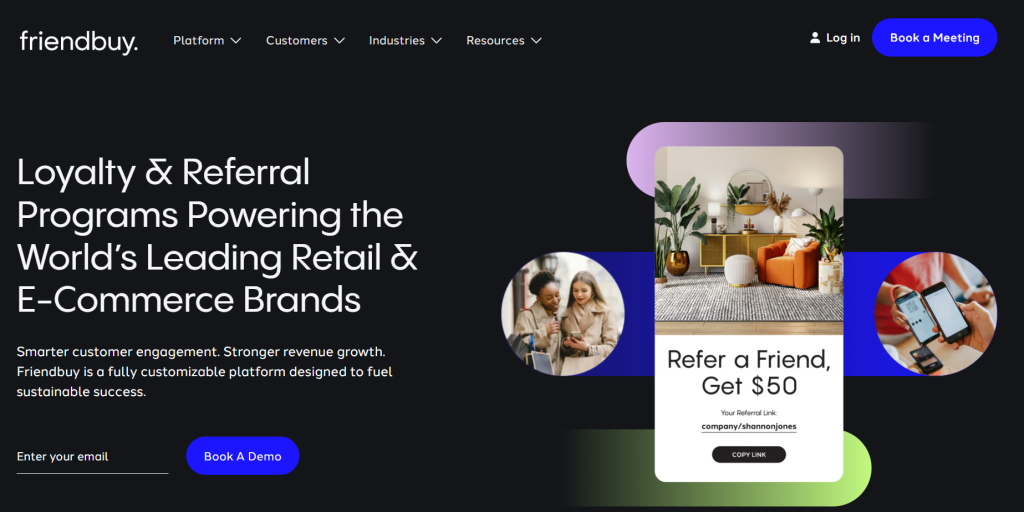
You partner with its customer team to build and launch referral and loyalty campaigns. Friendbuy helps you find and activate high-value customers and recommend offers that would encourage them to join.
It lets you set up automated triggers that invite customers at moments they convert.
Key features:
- Advocate intelligence and management: Provides tools for identifying and managing top referrers based on purchases or order volume and creating offers to activate them.
- Campaign management: Offers segmentation, A/B testing, and customizable templates with event-triggered actions.
- Attribution integrity: Friendbuy lets you monitor activities across multiple devices and email signals that survive broken links.
Pricing:
Friendbuy’s pricing is available on demand.
Integrations:
Friendbuy integrates with Shopify, Attentive, Braze, Klaviyo, Salesforce, Segment, Recharge, Stripe, and Ordergroove, and has an API.
Pros:
- Smooth onboarding and integrations: The platform offers a straightforward onboarding process and seamless data integrations.
- Easy referral management: Friendbuy makes it simple to manage referral programs.
- Seamless customer referrals: The platform provides an easy referral experience for customers sharing with friends.
Cons:
- Confusing reporting: Some reports can be difficult to understand, particularly those relating to the way certain metrics are calculated or presented.
- Limited API integration options: A JavaScript library for interacting with the Friendbuy API would make implementation and debugging easier than injecting scripts.
Best for:
- Enterprise brands across e-commerce, retail, service, travel, hospitality, and financial services industries.
5. Referral Factory
Referral Factory is a no-code referral and affiliate platform for mid-market and enterprise businesses that want to launch, build, and scale white-labeled referral campaigns.
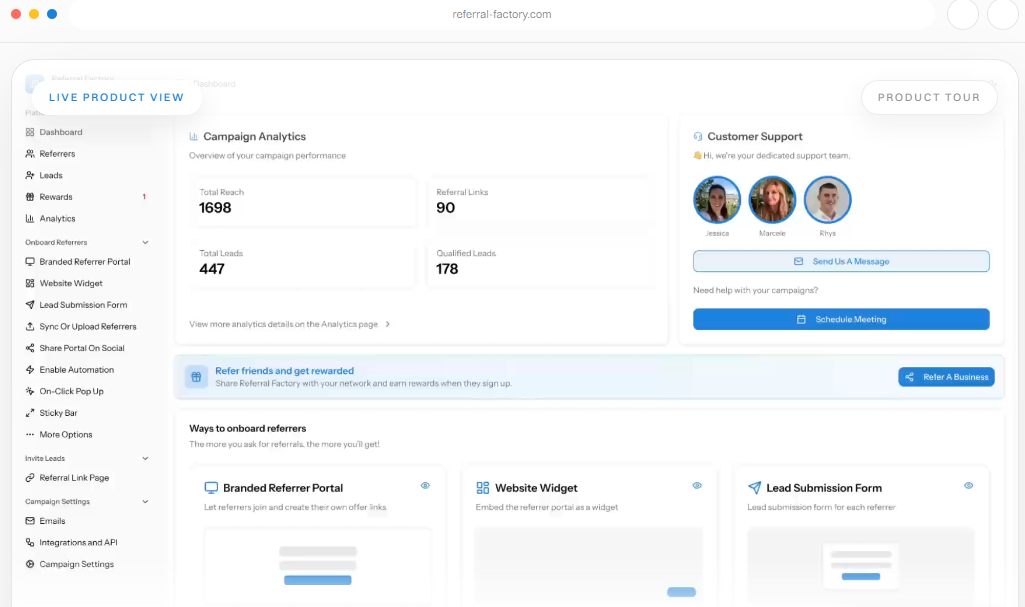
It lets you connect growth campaigns to CRM software to streamline program invitations.
Referral Factory is known for its tracking software, enabling you to monitor reach, referred leads, qualified customers, and due rewards across different paths where referrers share the link.
You can also automate reward fulfillment with cash, gift cards, discounts, credits, or custom offers.
Key features:
- No-code campaign builder: AI-assisted campaign creation to help you get referral programs up and running.
- Real-time analytics: Monitor referral performance at a granular and program level alongside reward management.
- Branded referrer portals: On-brand dashboard where customers can find their referral link and share the experience to other platforms.
Pricing:
- Basic: $200/mo.
- Pro: $400/mo.
- Enterprise: $1,000/mo.
Integrations:
Referral Factory connects with Monday.com, Rewards, Make.com, Zapier, Intercom, HubSpot, Salesforce, Pipedrive, and Zoho, including API and webhooks.
Pros:
- Flexible campaign customization: The platform offers plenty of flexibility when creating referral campaigns and customizing them to fit your needs.
- Intuitive interface: The clean interface and straightforward setup make the platform easy to navigate.
- All-in-one referral management: Businesses can build campaigns, track referrals, manage rewards, send communications, and monitor performance from one dashboard.
Cons:
- Limited guidance for advanced settings: Some advanced settings could benefit from clearer instructions and guidance.
- Difficult pop-up setup: Setting up the Online Pop-Up can be frustrating because the process isn’t clearly explained on the platform.
- Campaigns don’t default to draft mode: New campaigns could be easier to manage if they remained in draft mode until all settings were configured, with a clear ‘go live’ button when ready.
Best for:
Mid- and enterprise marketers across these industries: solar and sustainability, SaaS and software, insurance, finance, education, home services, fitness, HR, and health and beauty.
6. LoyaltyLion
LoyaltyLion is primarily a loyalty platform for Shopify and Shopify Plus brands, with referral as one of its point-earning actions alongside reviews, purchases, and social engagement.
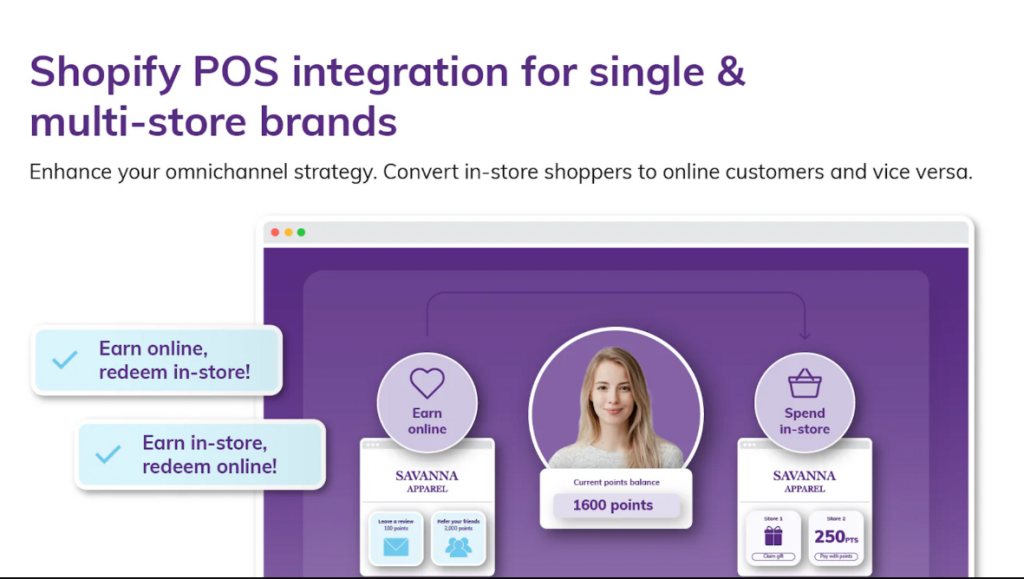
It helps monitor sales patterns and identifies where a loyalty campaign will drive the most impact.
You can then automatically request referrals from satisfied customers after a purchase or when they leave a review.
Key features:
- Reward controls: Set minimum spend and approval periods for referral campaigns, and limit discounts to specific products.
- AI-powered campaigns: Connect your program to LLMs like Claude to query the campaign’s configuration and performance.
- Program and VIP tiers: Create reward tiers based on spend or points to encourage high customer spend and repeat purchases.
Pricing:
- Classic: $199/mo. for 500 monthly order volumes
- Advanced: Available on demand
- Plus: Custom pricing
Integrations:
LoyaltyLion connects with Shopify, Shopify Plus, Attentive, HubSpot, Klaviyo, Mailchimp, Omnisend, Recharge, PostPilot, Skio, Tapcart, and Zendesk.
Pros:
- Easy customer rewards: LoyaltyLion makes it simple to reward customers with points and encourage repeat purchases.
- Seamless integrations: The platform integrates easily with Shopify and Klaviyo.
- Excellent customer support: The LoyaltyLion team provides strong onboarding and ongoing support, going above and beyond to meet customer needs.
Cons:
- Limited loyalty page customization: The out-of-the-box loyalty page offers limited customization options.
- Difficult reward tracking: Tracking previously used rewards can become complicated as the number of redeemed rewards grows.
- Limited styling flexibility: More flexibility for styling on-site widgets and the rewards page would make it easier to match a brand’s look and feel.
Best for:
- E-commerce brands that want to run loyalty and referral campaigns together.
7. Referral Hero
Referral Hero is AI-powered affiliate and referral marketing software for digital and offline businesses. It lets you partner with influencers for a campaign and add gamified elements to encourage participation.
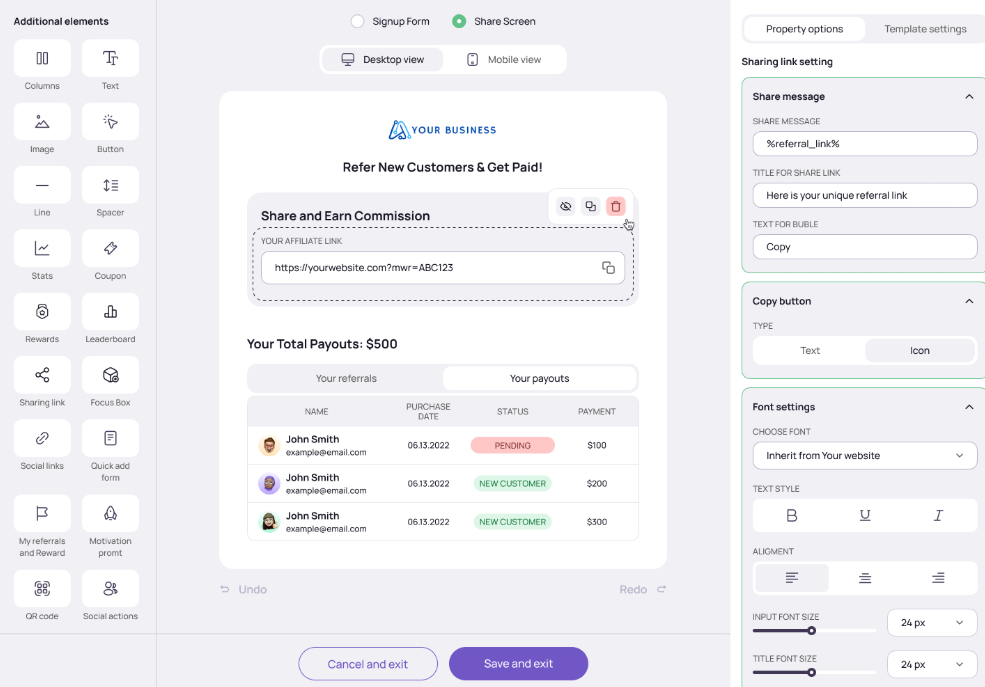
Referral Hero provides widgets you can add to your store and supports full integration into your web app or mobile application.
This tool also offers detailed tracking based on what you define as a successful referral, new leads, bookings, active subscriptions, or purchases.
Key features:
- Drag-and-drop builder: Design a growth experience by moving elements around and incorporating gamification.
- Conversion monitoring: Monitor every stage of the user journey, from initial link clicks and social shares to completed conversion events, including participant referral metrics and K-factor.
- Fraud detection: Built-in checks to prevent spam and suspicious activities, alongside incentive and reward management.
Pricing:
- Basic: $249/mo.
- Pro: $399/mo.
- Pro+Done for you service: Available on demand
Integrations:
Referral Hero connects with Stripe, HubSpot, Salesforce, GoHighLevel, Intercom, Zoho, MailChimp, Klaviyo, ActiveCampaign, HighLevel, AWeber, Google Analytics, Sendlane, Squarespace, and Unbounce.
Pros:
- Powerful and reliable platform: ReferralHero makes launching and managing referral programs straightforward.
- Robust automation: Automation eliminates much of the manual work involved in tracking referrals, distributing rewards, and managing participants.
- Quick campaign setup: You can launch referral campaigns quickly without needing technical assistance.
Cons:
- Confusing reporting: Some reports can be difficult to understand when you’re getting started.
- Complex triggers and rules: It can take time to fully understand how the platform’s triggers and rules interact.
Best for:
- Mid-market and enterprise teams across home service, dentist, fintech, SaaS, and offline businesses.
8. Yotpo
Yotpo is a customer retention marketing platform that bundles reviews and user-generated content with loyalty and referral programs.
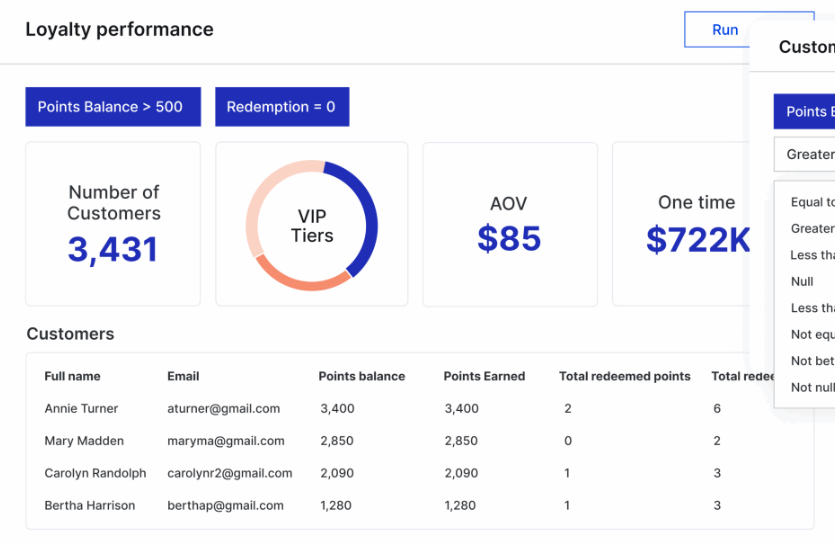
It lets you control how AI engines recommend your product, provide social proof on your site with quality reviews, and turn customers into brand advocates with rewards.
Yotpo approaches referral campaigns as an add-on to its loyalty program solution. This way, you’re inviting customers right at checkout who have enjoyed your service and have a good purchase history. And since it’s mostly loyal customers, there are fewer chances of reward abuse or fraudulent activities.
Key features:
- Flexible points engine: Lets you award points for different customer actions like purchases, referrals, account creation, or social follows
- Unique links: Generate ready-to-share links for customers with no added friction.
- VIP tiers: Create a tier-based program and offer exclusive experiences and perks to top customers.
Pricing:
Here is Yotpo’s pricing for loyalty and referral programs:
- Free plan
- Pro: $199/mo. for 500 monthly order volume
- Premium: Available on demand
Integrations:
Yotpo connects with Shopify, WooCommerce, Attentive, Klaviyo, Mailchimp, Fuego, Dondy, Attentive, Shopify, Shopify Plus, Talkable, Attentive, and Shopify POS.
Pros:
- Easy to use and customize: Yotpo is user-friendly and makes it easy to automate emails and adjust their layouts.
- Strong Shopify integration: The platform works seamlessly with Shopify and displays products effectively.
- SEO-friendly product reviews: Its product review integration can help showcase reviews for search visibility and to build trust.
Cons:
- Duplicate email notifications: Review notifications may sometimes be sent twice for the same customer review.
- Limited retail integrations: It can be difficult to figure out how to integrate Yotpo with other major retail platforms.
- Too many features without specialization: The platform covers a wide range of functions, but some users feel individual offerings like SMS aren’t as competitive as dedicated tools.
Best for:
- Enterprise e-commerce brands
- DTC businesses
9. AmbassadorFlow
AmbassadorFlow is e-commerce referral software that’s focused on turning customers into ambassadors by activating at checkout and via email, SMS, widgets, pop-ups, or app inserts.
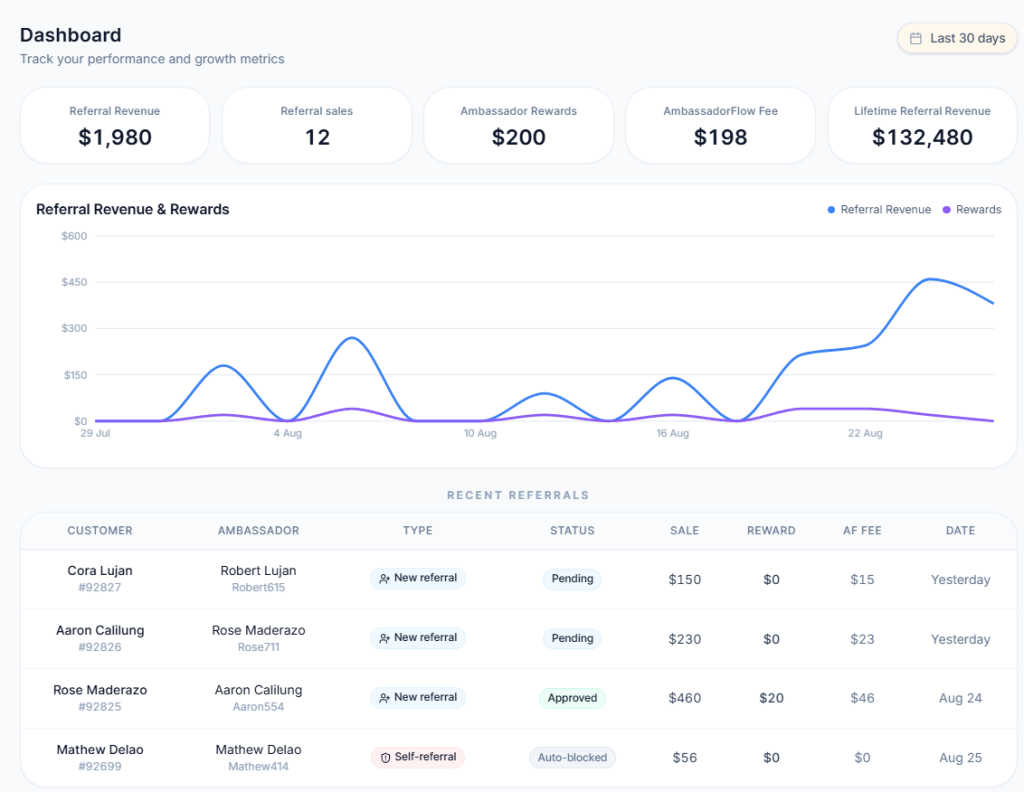
AmbassadorFlow’s only reward is store credit to ensure every incentive referrers earn is spent on your store. Plus, it will only charge when they generate revenue or for new customers.
Key features:
- Campaign dashboard: Monitor campaign performance and track referrals, rewards, and fees in one dashboard.
- Performance-based pricing: Provides a model that charges users based on referral revenue rather than a flat fee.
- Fraud and new-customer verification: Automated checks to block self-referral or discount abuse.
Pricing:
- Performance plan: 10% of revenue generated
- Grow plan: $99/mo. + 3% of referral revenue
- Scale plan: $199/mo. + 1% of referral revenue
Integrations:
AmbassadorFlow connects with Klaviyo, Shopify, WooCommerce, Magento, BigCommerce, Wix, and Squarespace.
Pros:
- All-in-one automation: The platform automates ambassador recruitment, sales tracking, and reward management.
- Strong fraud protection: It automatically blocks self-referrals and discount abuse, reducing the need for manual fraud checks.
- Quick and intuitive setup: The platform is quick to set up, with an easy-to-understand dashboard and a natural referral experience for customers.
Cons:
As a newer platform, AmbassadorFlow has limited user feedback available. For this section, we compared it with alternative solutions to identify its limitations:
- E-commerce-only focus: The tool’s model is built around Shopify and WooCommerce, making it a bad fit for other business types.
- Limited integrations: AmbassadorFlow is only natively integrated with Shopify and WooCommerce, along with a few third-party apps.
Best for:
- E-commerce brands in fashion, beauty, health, home, food, electronics, pet, sports, and jewelry.
10. Lootly
Lootly is another customer loyalty platform with built-in referral, influencer, and affiliate marketing tools for e-commerce businesses.
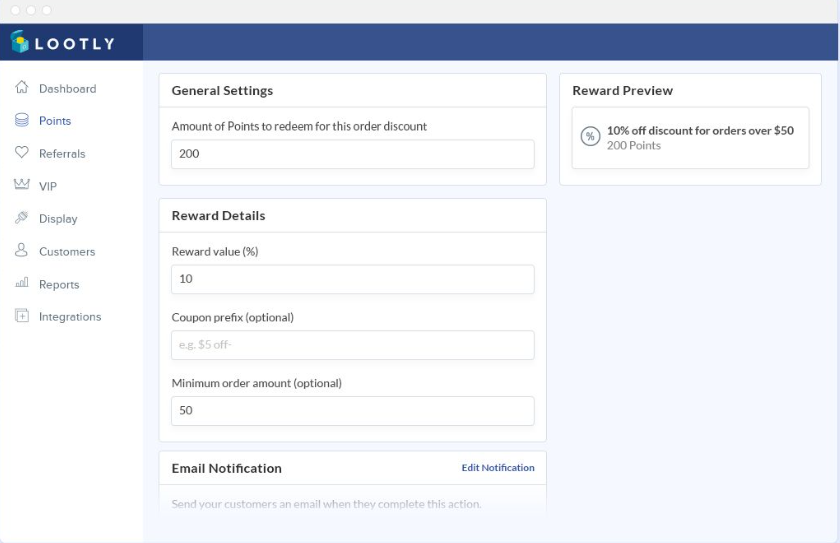
Lootly lets users create incentives and points relevant to their product, brand identity, and customer journey.
You can add rules to restrict customer access based on their spending, tags, or points earned.
Key features:
- Advanced incentive offers: Design custom reward structures, including flat-fee or tiered payouts, with automated distribution of promo codes and uncapped commission tracking.
- Logic-based pop-ups: Capture referrals at checkouts using pop-ups you can customize to match your brand’s style.
- Customer insights: Discover how customers interact with your program, from referral revenue to referral orders, shares, click breakdown, and top referrers.
Pricing:
- Pro: $299/mo.
- Advanced: $699/mo.
- Enterprise: Available on demand
Integrations:
Lootly integrates with WooCommerce, Recharge, Klaviyo, Shopify, PowerReviews, Magento, Attentive, and a custom API for additional or advanced connections.
Pros:
- Customer referral incentives: Lootly helps businesses attract customers through referrals while rewarding them for purchases.
- User-friendly platform: The platform is easy to use and offers live chat support for assistance.
- Good value for loyalty rewards: Lootly provides strong value for businesses looking for loyalty and rewards features.
Cons:
- Difficult customer support access: It can sometimes be difficult to get in touch with the support team.
- Limited features on lower plans: Customization, payment methods, and sharing options vary between the Pro and Advanced plans.
Best for:
- E-commerce brands that want to improve their customer relationships and turn customers into ambassadors.
What are the best open-source Referral Rock alternatives?
Open-source referral platforms enable you to host, maintain, and support referral programs in-house. They provide fully visible code that you can adapt to your business’s needs.
To use this kind of referral tool, your team will need a dedicated tech team to write code and launch the referral campaigns.
The best open-source Referral Rock alternatives are listed below, along with why they’re good alternatives:
- RefRef: This is a good open-source alternative because it’s self-hosted with referral attribution, customizable rewards, and built-in fraud monitoring.
- Referrq: Referrq is for businesses that want to run their own white-labeled affiliate program. It’s MIT-licensed and comes with an affiliate portal, tiered commission rules, and over 30 documented API endpoints.
- Weferral: This has a Node.js and React referral and affiliate tracker with recurring, one-time, and monthly commission options and a full REST API.
What are the best free Referral Rock alternatives?
While free referral software tools are quite rare, they’re a good option for businesses with a limited budget. However, they typically cap usage at order volume, participant count, or feature depth.
If you want something to help you get started quickly, here are some of the best free Referral Rock alternatives:
- Viral Loops: We have a free trial that gives you full access to everything needed to build, launch, and preview a real campaign. For 14 days, you will see what it’s like to create a referral program without heavy investment.
- Yotpo: Offers a free plan covering basic points and referral campaign functionality, allowing small stores to run referral programs. Keep in mind, though, that deeper referral tracking and analytics may not be accessible on the free tier.
- Smile.io: Smile’s free tier provides a bundled referral program with a points-based loyalty system for up to 200 monthly orders. It’s a good option for e-commerce businesses.
What are the best Referral Rock alternatives for e-commerce referral programs?
E-commerce brands need referral tools with native platform integrations, reward automation, fraud detection, and, most importantly, the ability to sync with your checkout and order flow.
Here are Referral Rock alternatives for e-commerce referral programs that fit the criteria:
- Viral Loops: Viral Loops is a good fit for e-commerce businesses because of our native integration with Shopify and WooCommerce, enabling you to install and launch referral campaigns directly to your store. The integration ensures widgets automatically adjust to your store’s theme wherever they’re placed. Plus, there’s native integration with Tremendous and Stripe for automated reward fulfillment.
- ReferralCandy: This tool is a good alternative because it’s built for e-commerce platforms like Shopify, WooCommerce, and Magento, with post-purchase widgets, embedded signup forms, and fraud detection that bans suspicious referral actions.
- Friendbuy: Designed for fast-growing DTC brands with advocate management, A/B testing, and automated reward fulfillment across gift cards, credits, and coupons.
How to choose a Referral Rock alternative
To choose the best Referral Rock alternative for your needs, consider your goals and how each platform aligns with your objectives, budget, growth plans, and technical requirements.
The right option should provide features your business needs, including the flexibility to expand the program later. Here’s what to search for in a tool:
- Campaign builder flexibility: Look for software that’s customizable, enabling you to tailor referral flows, rewards, landing pages, and participant experiences.
- Integration depth: Check the integration options the tool provides, and confirm whether it connects with your existing tech stack.
- Reward structure options: You need tools that let you offer flexible reward types, tiers, and rules that align with how you want to incentivize referrers and referrals.
- Fraud prevention capabilities: A platform should have built-in safeguards against self-referrals, duplicated accounts, and reward abuse.
- Analytics and attribution accuracy: Ensure you can monitor campaign performance, shares, revenue, conversions, and track referrals.
- Pricing model transparency: Check that the subscription fees align with your budget as you scale or factor in other add-ons.
- Long-term scalability: Confirm that the pricing, average order volume, participant limits, and features can support your growth.
- API access and developer tools: Consider API capabilities if you think the business will need deeper customization or custom integrations.
Over to you!
If you made it this far, we hope you now feel confident about choosing your next referral program software.
The right option should make it easy for you to launch, connect with your tech stack, and scale with your business.
A tool like Viral Loops, for instance, lets you create campaigns from templates or API snippets to add to your website, automates reward fulfillment, and provides the guidance needed to get started.
Schedule a free demo to see how Viral Loops helps simplify and launch your growth campaign.
![12 ReferralCandy Alternatives in 2026 [Full Comparison]](https://viral-loops.com/blog/wp-content/uploads/2022/07/12-ReferralCandy-Alternatives-in-2026-Full-Comparison.png)
![12 Best Referral Factory Alternatives: Full Comparison [2026]](https://viral-loops.com/blog/wp-content/uploads/2026/05/12-Best-Referral-Factory-Alternatives_-Full-Comparison-2026.png)
![9 Best Referral Marketing Platforms [In-Depth Comparison]](https://viral-loops.com/blog/wp-content/uploads/2025/06/UPDATE-9-Best-Referral-Marketing-Platforms-In-Depth-Comparison.png)
![Best Viral Loops Alternatives in 2026 [Full Comparison]](https://viral-loops.com/blog/wp-content/uploads/2026/06/Best-Viral-Loops-Alternatives-in-2026-Full-Comparision-5.png)