
According to this Impact report, referral marketing is one of the best ways to increase your e-commerce brand’s reach, as it confirms that four out of five new customers discover brands through conversations with others.
But since Shopify doesn’t have a customer refer-a-friend feature, you’ll need referral marketing software that integrates with Shopify.
There are several options to choose from, so we selected the top tools you’ll find useful regardless of the scale of your Shopify store.
Some of the best Shopify referral apps are listed below, along with their key features, pricing, and who they’re best for.
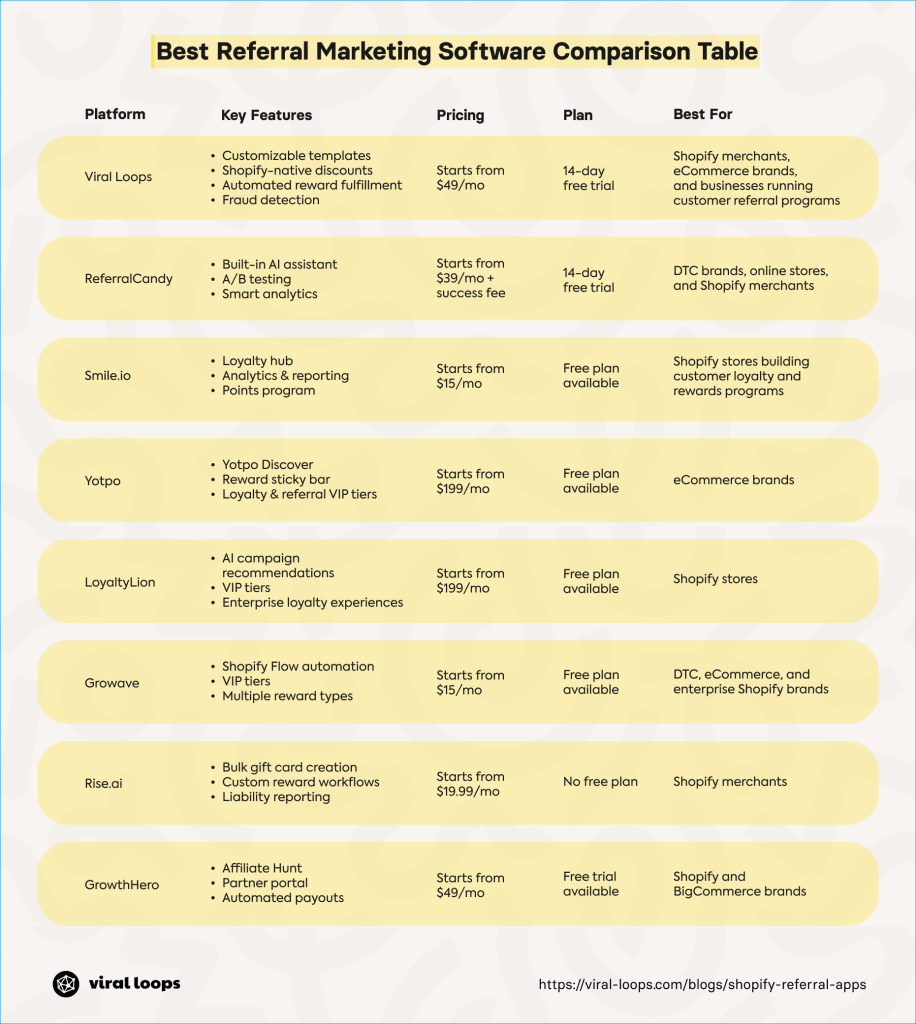
In this guide, you will find a comprehensive comparison of these tools to help you choose the one that suits you best.
Disclaimer: This article was created by Viral Loops and may reference its own products and services. The content reflects the author’s perspective and is based on publicly available information, accurate as of July 2026. Companies and tools are listed for informational purposes only and are not ranked or endorsed unless explicitly stated.
What are Shopify referral apps and why do they matter?
Shopify referral apps are software solutions that help e-commerce stores create, manage, and automate customer referral programs.
Typically available in the Shopify store, they encourage your customers to recommend your store to friends in exchange for rewards such as discounts, store credit, gift cards, loyalty points, or cash incentives.
Shopify referral apps generate unique referral links, monitor who referred whom, verify preferred actions, and distribute rewards when the right conditions are met.
They include features like
- Referral widgets
- Landing pages and post-purchase pop-ups
- Fraud detection
- Referral and conversion tracking
- Automated reward fulfillment
Shopify referral apps matter because the alternative — manual referral campaigns — can be chaotic and time-consuming.
With software, it’s also easier to scale referral campaigns, lower customer acquisition costs (CAC), and boost customer loyalty.
Up next, let’s dive into some of the best Shopify referral apps and what makes them stand out.
1. Viral Loops
Viral Loops is an all-in-one referral management platform that simplifies referral and affiliate marketing campaigns for e-commerce businesses.
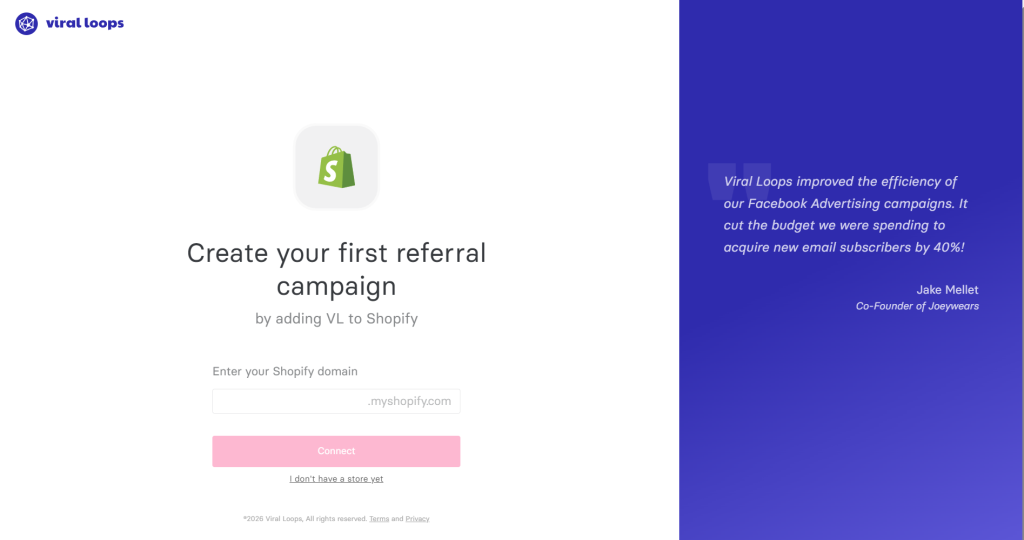
It lets you launch referral programs for customer-driven growth, increased store exposure, and lower acquisition costs using store-matching Shopify referral templates.
Our referral tool installs directly into the store as a widget or page and provides a campaign wizard that walks you through connecting it with Viral Loops, customizing campaign pages, and launching a program.
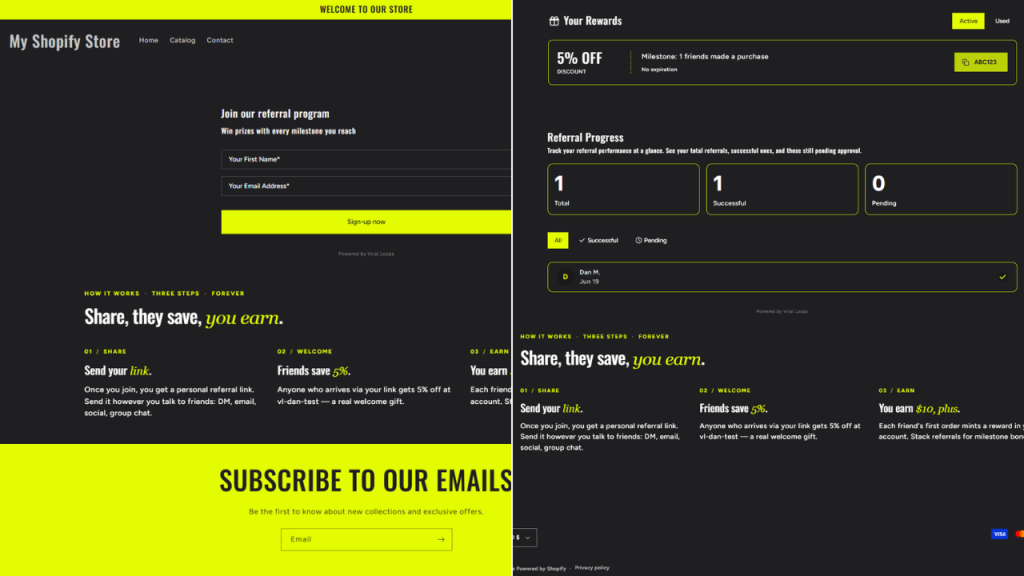
The widgets and pages also automatically adapt to your store’s theme without manual customization, just like in the screenshots below:
Another one of Viral Loops’ differentiators is our Shopify-native discounts that are automatically generated the moment a customer needs them.
On the tracking side, when a referred person makes a purchase, Viral Loops tags them and adds a note indicating who referred them and their referral code, making this information visible in Shopify.
Who is it for:
Shopify merchants, e-commerce brands driving direct sales from referrals, and stores building ambassador programs.
Key features:
- Customizable templates: Merchants have access to multiple templates that match the store.
- Shopify-native discounts: Viral Loops creates discount codes directly within Shopify’s system, based on the reward rules set during campaign setup, and delivers them automatically via referral, milestone, or welcome emails.
- Automated reward fulfillment: Ensures referrers are rewarded once conditions are met with our native integrations with Tremendous and Stripe.
- Fraud detection: Identify spammy entries and prevent fraudulent participants from joining the referral experiences.
- Viral Loops pages and widgets: Design dedicated landing pages to host the referral experience and widgets to embed in your store.
Pricing:
We offer a free 14-day trial and paid plans starting at $49/mo.
Pros:
- Easy to use: “The setup is super easy — you can literally launch a referral campaign in under an hour. The templates are really helpful and based on campaigns that actually worked for other companies, so you’re not starting from scratch.”
- Good customization: “There is a good level of customization, and integration into our CRM wasn’t too difficult.”
- Seamless integration and support: “I was able to integrate it into my stack without fuss. When I did encounter a challenge (turns out it was my configuration error) the Viral Loops team jumped on it within hours and did a thorough job investigating and getting it sorted. That alone has made me want to stay with them.”
Cons:
- Initial learning curve: “As they have [built] out several variations of campaigns, there were … confusing steps to take, but perhaps I just had to familiarize myself [with] their processes. Luckily it was fast to figure out, just go through it, and at the end you can see if it works how you wanted it to.”
2. ReferralCandy
ReferralCandy is an e-commerce referral software program for organic growth.
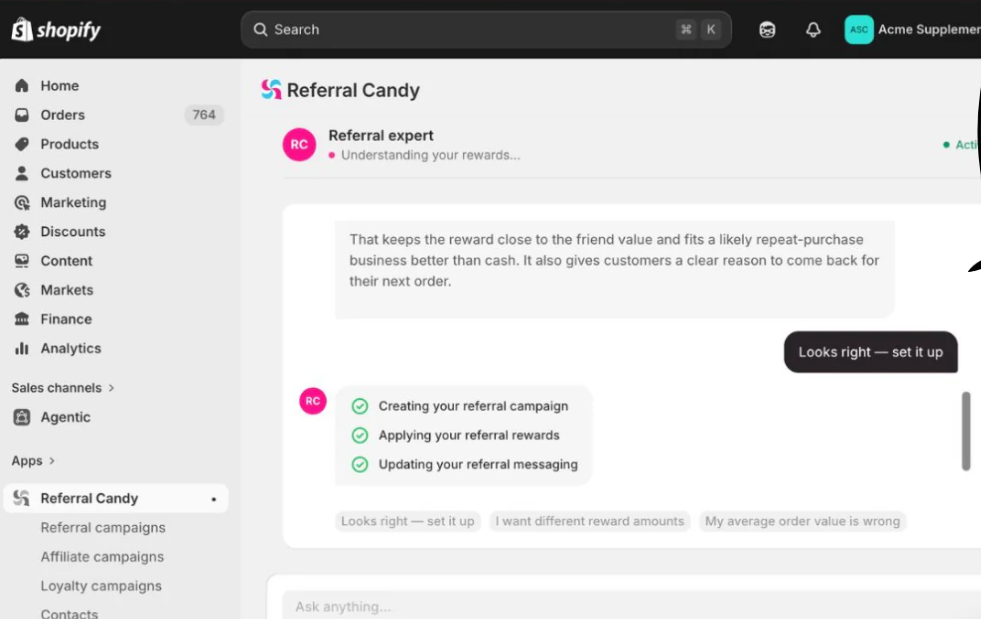
Shopify merchants can launch referral campaigns with branded pages, automated tracking, and clear ROI reporting on ReferralCandy.
This tool also plugs into subscription apps on Shopify, enabling you to turn one-time orders into recurring customers.
Who is it for:
Online stores, DTC, and e-commerce marketers across industries such as health and wellness, fashion, beauty, food, electronics, and sports.
Key features:
- Built-in AI assistant: Helps launch and fine-tune campaigns from your store’s real data.
- A/B testing: Run multiple versions of the same referral campaign to know which copy, assets, and positioning drive the best results.
- Smart analytics: Track new sales from referrals and your top traffic sources, while also knowing whom your top referrers are.
Pricing:
- $39/mo. + 10.5% success fee
- Grow: $79/mo. + 3.5% success fee
- Scale: $249/mo. + 1.5% success fee
- Enterprise: $799/mo. + 0.25% success fee
Pros:
- Easy to navigate: It’s easy to set up a ReferralCandy campaign with Shopify.
- Responsive support: Users say that the customer support is readily available and helpful.
- Seamless integration and intuitive platform: Customers appreciate ReferralCandy’s integration with Shopify and its intuitive dashboard that automates referral processes.
Cons:
- Limited customization: Users complain about having less control over themes, notification settings, and email templates, which would otherwise improve the customization experience.
- Shopify promo code management could be better: Managing promo codes in Shopify could be more intuitive and user-friendly.
- Email editor requires technical knowledge: The email template editor is difficult for non-technical users, and manual email sending is unavailable.
3. Smile.io
Smile.io is a loyalty platform for Shopify brands that want to reward customers for purchases and increase sales through customer referrals.
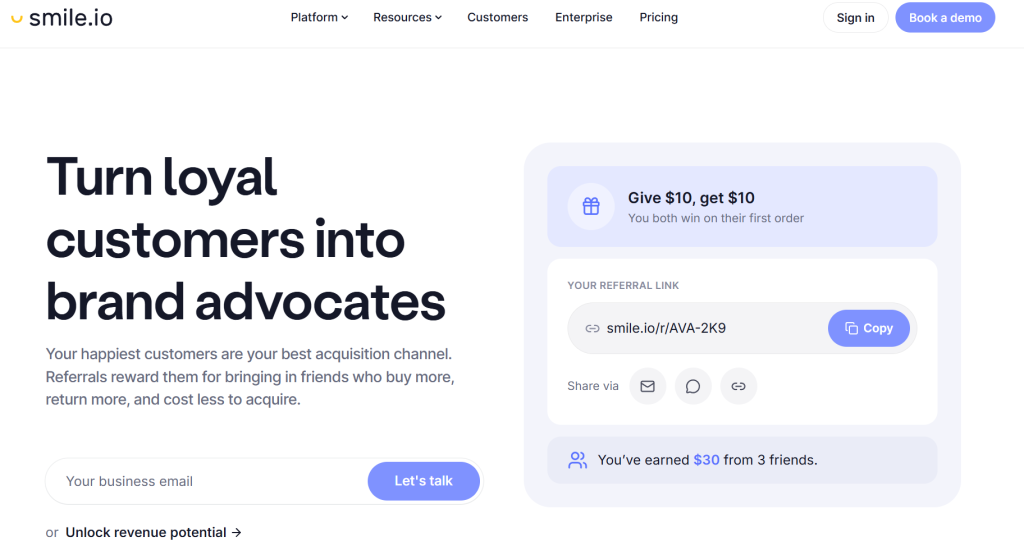
It enables enterprise-level stores to launch loyalty programs that can be embedded within product pages.
Who is it for:
Small to large businesses across niches like lifestyle, fashion, food, beauty, photography, arts, electronics, and pets.
Key features:
- Loyalty hub: Customers have access to a personalized space to track points, claim rewards, and explore their loyalty status.
- Analytics and reporting: Get detailed program performance in real time and monitor how customers engage with the campaign.
- Points program: Offer customers store points they can redeem for free products, free shipping, or discounts.
Pricing:
Smile.io has a free plan for startups and paid plans starting from $15 per month.
Pros:
- Boosts customer loyalty: Rewards encourage repeat purchases and keep customers coming back.
- Scales with your business: The platform grows alongside your business, making it suitable for long-term expansion.
- Comprehensive loyalty features: Smile provides a fairly robust loyalty system with the features users need for their loyalty programs.
Cons:
- Rewards redemption could be improved: More control over redemption limits would help prevent excessive claims.
- Developer knowledge is required: Getting the most out of the platform often requires developer expertise.
- Unavailable features can be distracting: Displaying features that aren’t included in the current plan can be frustrating.
4. Yotpo (formerly Swell Rewards)
Yotpo is another loyalty and referral platform for e-commerce businesses focused on both acquiring and retaining customers.
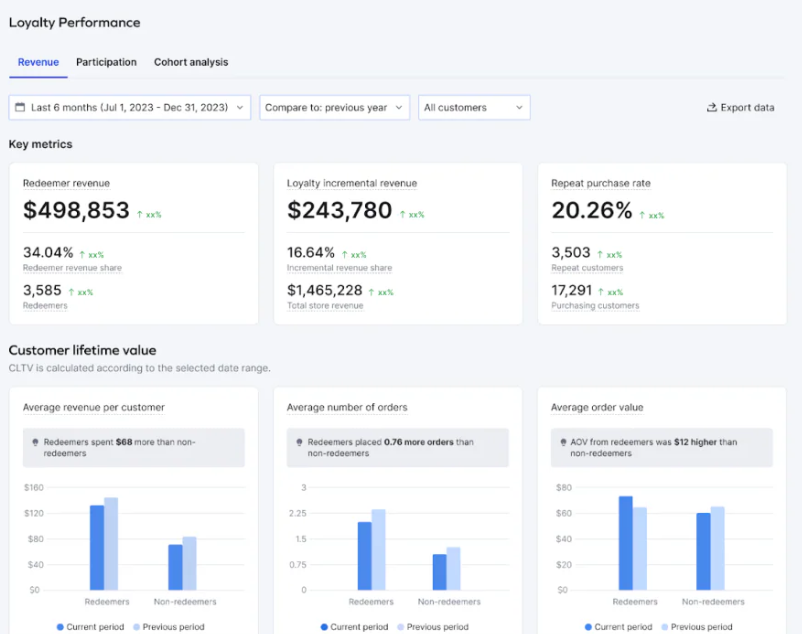
It supports multiple ready-made campaign types, including goal-based spending and social media engagement, making it easy to motivate customers to increase spend and make repeat purchases.
Yotpo also helps online stores to be recommended by AI engines and improve their websites with reviews and UGC.
Who is it for:
E-commerce marketers and enterprises that want to drive more revenue with loyalty programs.
Key features:
- Yotpo Discover: Monitor and control how AI engines recommend your products to shoppers.
- Reward sticky bar: An on-site widget used to invite shoppers to join your program, enabling them to view their available points and redeem them for rewards.
- Loyalty and referral VIP tiers: Customizable tier structures that let you offer exclusive perks, rewards, and recognition that boost engagement, drive retention, and increase customer lifetime value.
Pricing:
Yotpo is free on Shopify for stores with fewer than 100 monthly orders. Paid plans start from $199/mo.
Pros:
- Effective loyalty ecosystem: Users say it offers a rich set of features without sacrificing ease of integration.
- Drives customer engagement: Users claim it helps keep customers engaged with different organic programs.
- Simple setup: The platform is quick and simple to set up.
Cons:
- Limited language options: Some users say Yotpo isn’t very suitable for multi-language websites.
- Occasional bugs: While support is present, merchants report issues with campaign launch.
- Limited integrations: Integrating with large retail platforms can be unclear or challenging.
5. LoyaltyLion
LoyaltyLion is loyalty software that increases customer lifetime value and return rate by rewarding referrals, reviews, and purchases.
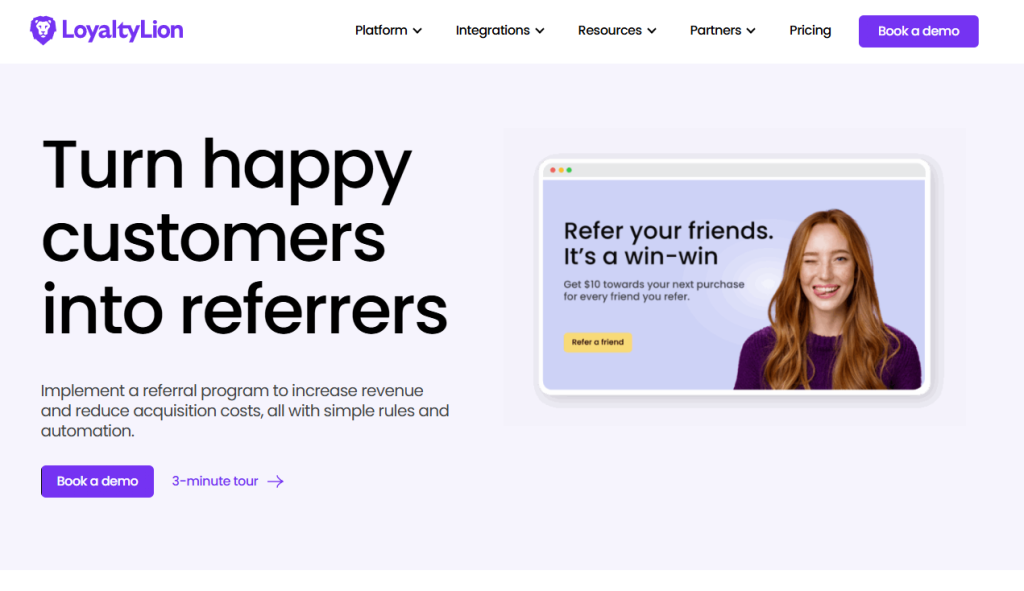
You can embed the referral experience into loyalty programs (at checkout, in customer accounts, and at point of sale (POS)) so it’s easy to find.
Who is it for:
Shopify stores and e-commerce marketers across industries such as fashion, beauty, food and beverage, skincare, and more.
Key features:
- AI campaign recommendation: LoyaltyLion’s AI analyzes your Shopify sales patterns to identify where your loyalty program can drive the greatest revenue impact.
- VIP tiers: Create reward tiers to encourage higher spend and repeat purchases.
- Enterprise loyalty experiences: Build enterprise-level loyalty programs across online and in-store touchpoints.
Pricing:
You can get started with LoyaltyLion for free, with paid plans starting at $199/month.
Pros:
- Easy to navigate and customize: The platform is intuitive, making it simple to manage and tailor your loyalty program.
- Powerful tier-based rewards: Build loyalty programs with tiered rewards that encourage repeat purchases and customer engagement.
- Fast onboarding: The onboarding process is quick and seamless, helping you get started with minimal effort.
Cons:
- Slow support: Resolving issues can take days or even weeks, leading to frustrating delays.
- Limited points reporting: Tracking unspent points requires exporting and analyzing spreadsheets instead of viewing the data directly.
- Complex technical setup: Configuring promotions and Klaviyo dynamic fields can be challenging for non-technical users.
6. Growave
Growave is a retention platform for Shopify brands, providing tools to drive customer retention, showcase reviews and UGC, and grow through referrals.
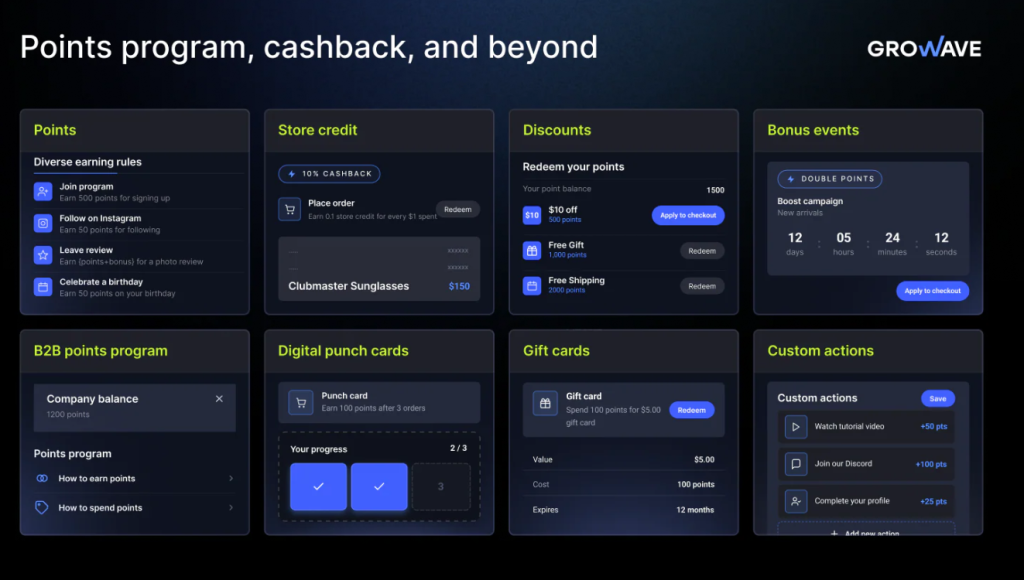
It also lets you add a wish list and gift registry feature to your online store, send automated reminders, and gain insights into what your customers love.
Who is it for:
E-commerce, DTC, B2B, and enterprise brands across the following sectors: beauty, retail, sports, food, baby, jewelry, electronics, and pets.
Key features:
- Shopify flow automation: Growave automates customer engagement around shopping behavior, from personalized reward triggers to review requests and win-back campaigns.
- VIP tiers: Offer custom perks, such as bigger discounts, free shipping, or early access based on customer spending or engagement.
- Multiple reward types: Provide rewards such as free shipping, free products, gift cards, points, or percentage discounts.
Pricing:
- Free plan
- Entry: $15/month
- Growth: $199/month
- Plus: $499/month
Pros:
- User-friendly interface: The platform makes launching loyalty management straightforward.
- Strong Klaviyo integration: Works seamlessly with Klaviyo for review requests and follow-up campaigns.
- Excellent value: Offers a wide range of features at a competitive price.
Cons:
- Limited customization: The built-in theme editor lacks the flexibility and depth offered by some competitors.
- Slow support: Customer support may be slow to acknowledge reported issues, making it more difficult to troubleshoot and resolve problems.
7. Rise.ai
Rise.ai is a gift card and store credit platform for Shopify brands that lets merchants offer credits to customers participating in loyalty and referral programs.
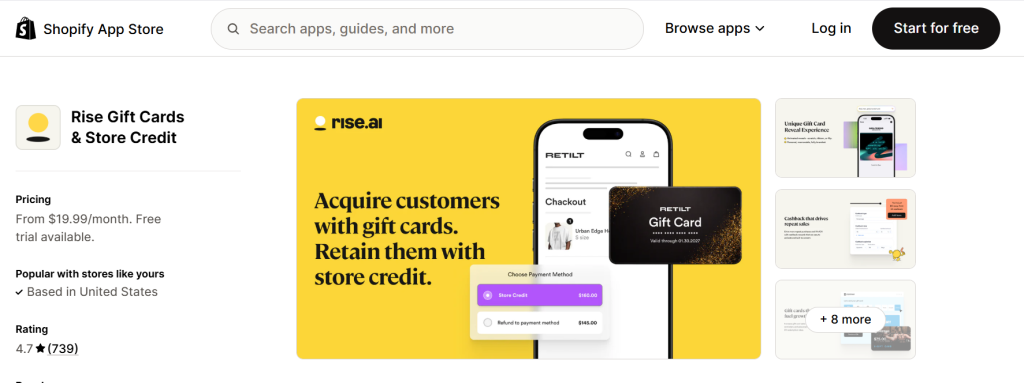
It automates store credit issuance through customizable workflows triggered by customer actions, supports bulk gift-card generation for large campaigns, and syncs with Shopify POS.
This way, rewards apply to both online and in-person purchases.
Who is it for:
E-commerce and DTC brands that want to build repeat-purchase behavior through store credit rather than one-time percentage discounts.
Key features:
- Bulk gift card creation: Generate up to 10,000 gift card codes instantly for targeted campaigns.
- Custom workflow: Automatically trigger store credit rewards based on specific customer actions or events.
- Liability reporting: Get real-time insights from campaigns to manage gift card and store credit liabilities.
Pricing:
- Starter: $19.99/month
- Small-Business: $59.99/month
- Pro: $199.99/month
- Premium: $599.99/month
- Enterprise: Custom pricing
Pros:
- Easy to use: The platform is intuitive and easy to navigate from the start.
- Wide range of features: Offers a strong feature set with a smooth overall user experience.
- Seamless Shopify integration: Integrates effortlessly with Shopify to simplify gift card management.
Cons:
- Sales-based pricing: Charges are based on overall store sales rather than gift card sales, which can increase costs.
- Complicated POS integration: Managing store credit and gift cards still requires actions outside the Shopify POS app.
8. GrowthHero
GrowthHero is a partner marketing platform for e-commerce brands looking to increase sales through referral, influencer, and affiliate marketing campaigns.
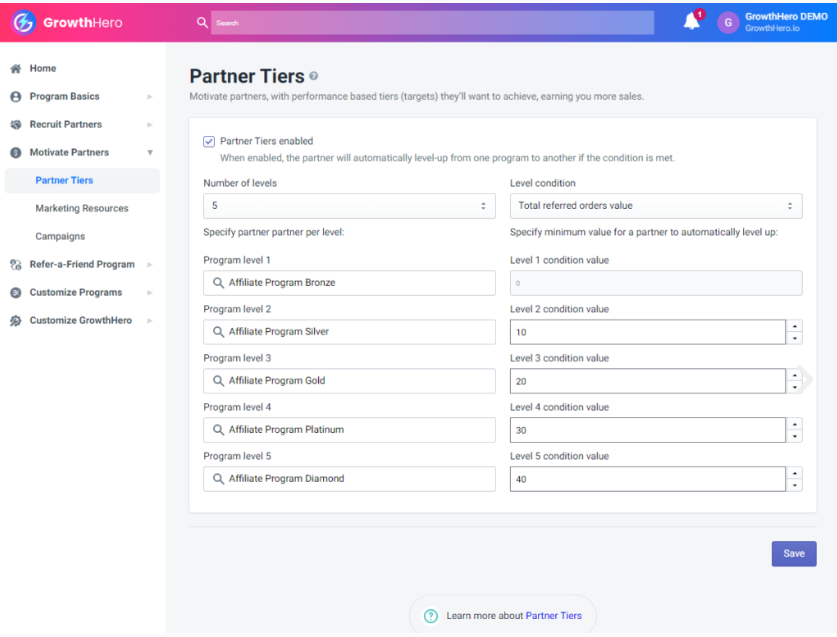
It provides a system that lets merchants set up affiliate campaigns, recruit new partners and influencers, and manage entire programs from the dashboard.
Who is it for:
E-commerce brands on Shopify or BigCommerce that want to run affiliate, influencer, and customer referral programs.
Key features:
- Affiliate hunt: Helps find new affiliates for your campaigns and provides tools for them to discover you.
- Partner portal: Dedicated page for affiliates, customer referrers, and influencers to find their unique link and track progress.
- Automated payouts: Manage and pay out rewards or commissions to partners.
Pricing:
- Starter: $49/month
- Pro: $99/month
- Premium: $199/month
Pros:
- Flexible payment options: It supports various payment models, including tiered options.
- Easy customization: GrowthHero’s email templates and portal pages are simple to modify.
- Simple setup: The intuitive interface makes the platform quick and easy to configure.
Cons:
- Email and integration sync issues: New affiliate emails and Klaviyo synchronization can be unreliable.
- Slow support: Support responses to tickets and emails can take a week or longer.
How does Viral Loops work as a Shopify referral app?
Viral Loops installs as a native Shopify app that you can connect to your store in a few clicks.
First, you sign up or sign in to your account.
Choose our customizable Shopify template, or get a head start with AI. Enter your Shopify domain and click Connect.
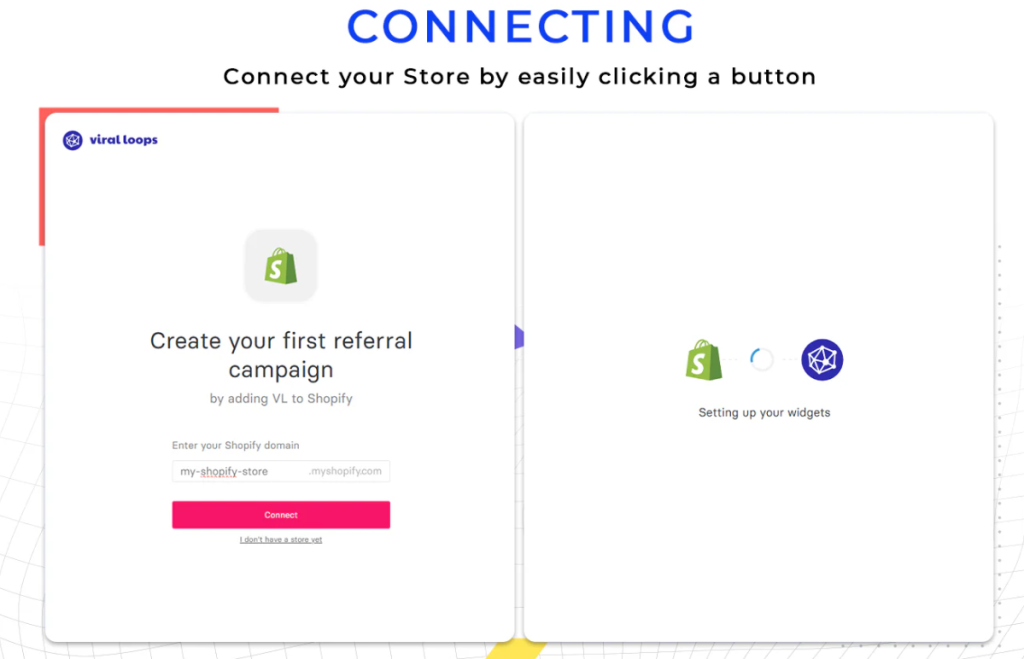
Once connected, set up your campaign by configuring rewards for referrers and referred customers, as well as optional milestone rewards for top advocates.
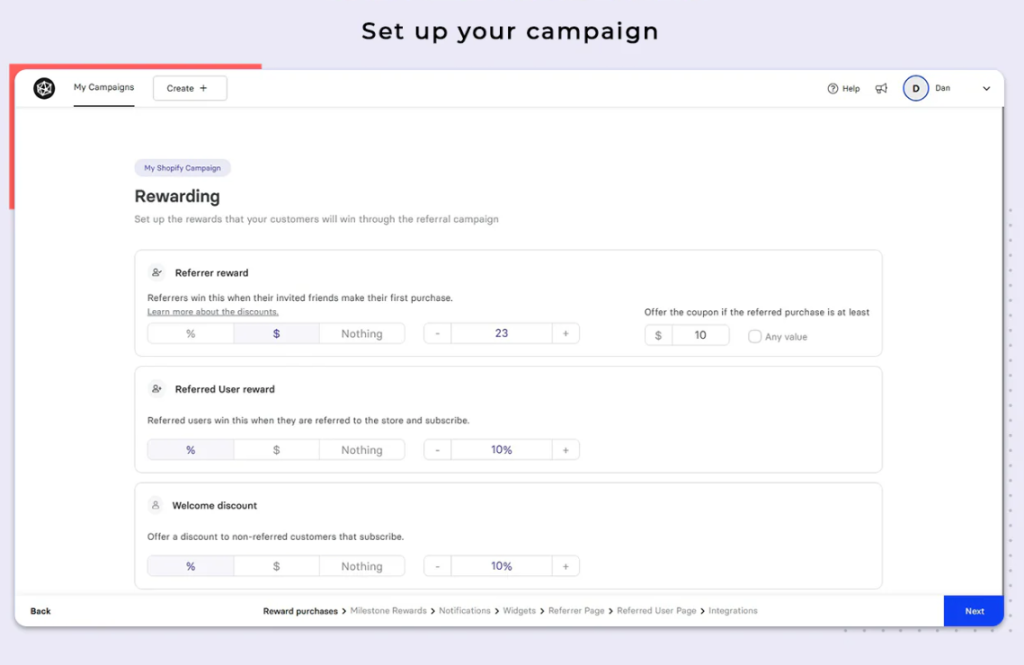
Remember the discount coupon codes we said are native to Viral Loops?
You can set the discount percentage based on your reward rules, with no manual coupon setup required.
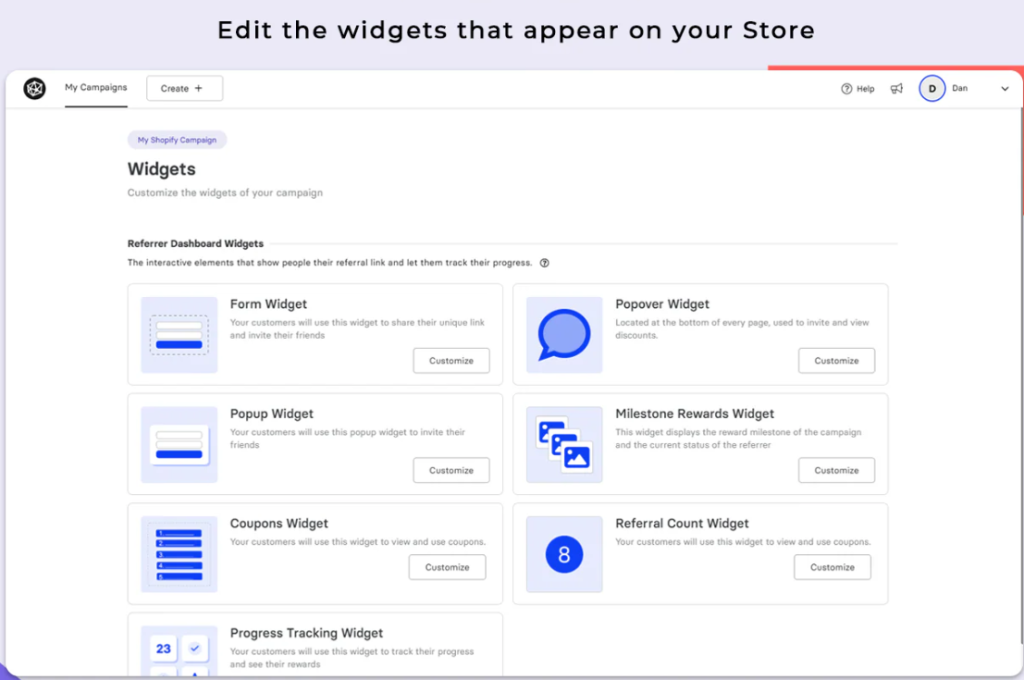
Next, choose and customize the referral widgets you want customers to see on your Shopify store.
You can create a dedicated landing page on Viral Loops to host the campaign that matches your store’s theme, fonts, and colors, though fully custom pages are also an option.
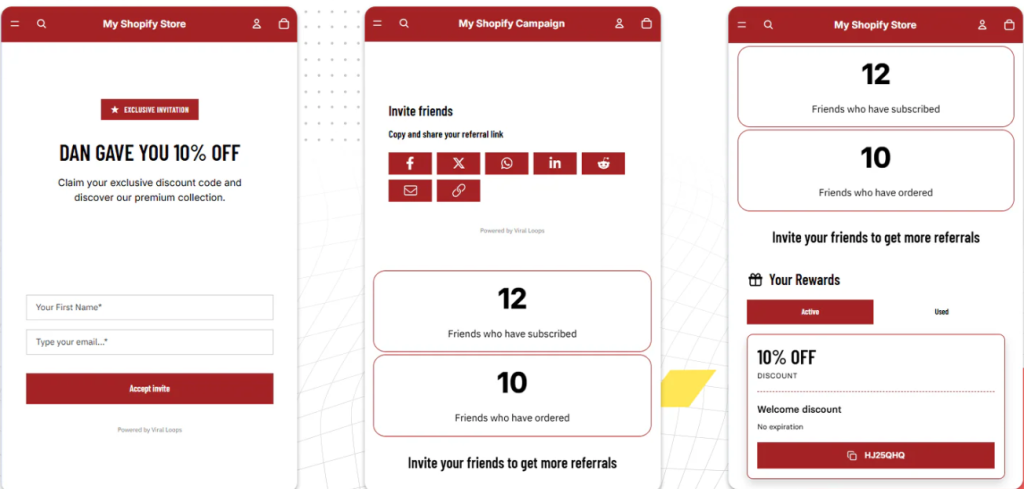
On such a landing page, customers can sign up for the refer-a-friend program, get a unique link, track their referrals, and receive rewards.
When a referred customer makes a purchase, Viral Loops tags them in Shopify as ‘Viral Loops Referred’ and adds an order note indicating who referred them.
The result is a referral program that launches in minutes and ties rewards directly to real purchases, not just signups.
Over to you!
Whether you run a small, medium, or large Shopify business, the referral apps listed in this guide can help you get new customers or retain existing ones.
To choose the right option, assess which of them:
- Is easy for you or your team to use without requiring advanced technical skills or ongoing support.
- Integrates with your tech stack to connect a campaign to the tools you already use.
- Supports your business’s current stage and can scale as you grow.
- Offers automated reward fulfillment.
- Fits your marketing budget.
If you need a starting point, Viral Loops is worth exploring. And not just because it’s our software, but because it’s built for Shopify businesses at any stage and doesn’t require tech skills.
Book a free demo to see how it works in real time.
Frequently Asked Questions (FAQs)
What are the real costs of running a Shopify referral program?
The cost of running a Shopify referral program goes beyond the software subscription.
Most apps start from $30/month, while more advanced plans can cost $100/month or more. However, you’ll also need to budget for referral rewards, marketing, implementation, reward fulfillment, and ongoing program management.
Some apps also charge additional fees based on order volume or number of active referrers. If you offer cash, gift card, or physical rewards, a processing fee may also apply.
There are also extra costs associated with managing word-of-mouth marketing campaigns, developer setup, and fraud protection. Factoring in these costs will give you a more accurate estimate of your total investment.
What features should you evaluate in a Shopify referral app?
Here are some features to look for:
- Customization: The tool’s capability to let you customize referral pages, widgets, and branding to match your store.
- Analytics and reporting: Tracks referrals, conversions, reward payouts, and ROI to measure campaign performance.
- Third-party integrations: How well it connects with tools you use.
- Automated workflows: Can you set up seamless triggers and reward fulfillment?
- Fraud prevention: Check for detection systems like self-referral blocking, same-household detection, and order fulfillment verification.
- Multiple reward options: A good Shopify referral app should offer users multiple rewards.
How do you prevent referral fraud on Shopify?
Most referral apps have built-in fraud protection and help you automatically detect and block common fraud patterns like self-referrals (checking for matching emails, IPs, and device IDs), duplicate accounts, and suspected coupon site spam.
What reward structures drive the highest referral conversions?
Double-sided rewards, where both the referrer and their friend get rewarded, tend to convert better because they lower the friction for the new customer to act.
According to Impact, this reward structure currently dominates referral marketing. Over 78% of programs reward both the referrer and the referred, creating a win-win dynamic that encourages participation.
![9 Best Referral Marketing Platforms [In-Depth Comparison]](https://viral-loops.com/blog/wp-content/uploads/2025/06/UPDATE-9-Best-Referral-Marketing-Platforms-In-Depth-Comparison.png)
![10 Best Referral Program Software Tools [2026]](https://viral-loops.com/blog/wp-content/uploads/2026/09/NEW-10-Best-Referral-Program-Software-Tools-2026.png)
![12 ReferralCandy Alternatives in 2026 [Full Comparison]](https://viral-loops.com/blog/wp-content/uploads/2022/07/12-ReferralCandy-Alternatives-in-2026-Full-Comparison.png)