A Shopify referral program gives happy customers a way to recommend your store to others and rewards them when those recommendations lead to purchases.
From this guide, you will learn:
- What Shopify referral marketing is, how referral links work, and how it differs from affiliate marketing
- Why Shopify stores use referrals to reach new customers, encourage repeat purchases, and build word-of-mouth
- How the referral process moves from an invitation to a tracked purchase and reward
- Which program structures work for different goals
- How to build a Shopify referral program
- Where to promote customer referrals so more buyers see and join the program
- Which Shopify referral software options are available and what to compare before choosing one
- Which mistakes make referral programs harder to manage
- How to improve participation, referral conversion rates, incentives, and campaign messaging over time
- How to put the ideas from this guide into practice for your Shopify store
What is Shopify referral marketing?
Shopify referral marketing encourages existing customers to spread the word about your store.
Here’s how it works: you build a program where a shopper receives a personal link or code, shares it with someone they know, and the store records any purchase that comes from that referral.
If the referral leads to a sale, your program should include a tracking system that connects the purchase to the right referrer and applies a reward.
The reward can be anything you want: store credit, a discount, a free gift, points towards a milestone, etc.
The main difference between referral marketing and an affiliate marketing program is that affiliates are partners or creators promoting your products for commission, rather than customers referring friends, as in the case of referrals.
Why use referral marketing for Shopify stores?
Referral marketing gives Shopify stores a practical way to bring in new customers through people who have already bought from them.
A few specific benefits make referral programs worth considering for your Shopify store:
- A customer shares your store with a friend who already trusts their opinion; that person arrives with positive context instead of discovering the brand cold.
- Store credit and discounts can bring the original customer back for another order. The reward has value for the referrer and creates a reason to shop again.
- Referrals give word-of-mouth a trackable path. Unique links or codes make it possible to see which recommendations actually lead to purchases.
- A referred customer may later become a referrer, too, giving the program room to spread through existing customer relationships.
- Repeat customers who keep recommending the store can gradually become brand advocates.
How does Shopify referral marketing work?
Shopify referral marketing involves building a referral program where a customer gets a personal link or code to share with someone they know.
Their friend follows that invitation to the store and places an order. Special referral software matches the purchase to the customer who shared the link.
After the purchase satisfies the program rules, the software marks it as a successful referral. The merchant then gives the eligible customer the promised referral reward. Some programs can also reward the new shopper.
How customers receive referral links
Customers can receive their personal sharing link after joining a referral program.
How they join depends entirely on the way the program is set up: they may receive their link in a post-purchase email, through referral invitations on thank-you pages, or inside their customer account.
In Viral Loops, we distinguish two ways to join a referral program: auto opt-in, where every user automatically receives their unique link after completing a specific action, and manual opt-in, where they have to join the program on their own.
For each link or code (meaning each participant), referral software creates a separate identifier. That lets the software, and consequently the merchant, connect referred purchases to the right person.
The sharing itself stays simple: customers send the offer through whatever channel makes sense for the person they want to invite — social media, chat, email, SMS, or similar.
Viral Loops, for example, allows participants to share their unique links through:
- X (Twitter)
- Messenger
- Telegram, and more
Tracking Shopify referrals
Referral tracking connects a referred person’s visit or purchase with the customer who referred them.
There are many ways to make this connection. Viral Loops, for example, tracks referrals through unique referral links and codes, browser cookies or local storage, and JavaScript-based tracking. It also supports server-side API tracking.
Once the referred person signs up with your store or completes a purchase—which is the default action for Shopify stores inside Viral Loops— the platform records this as a successful referral and lists it in your dashboard.
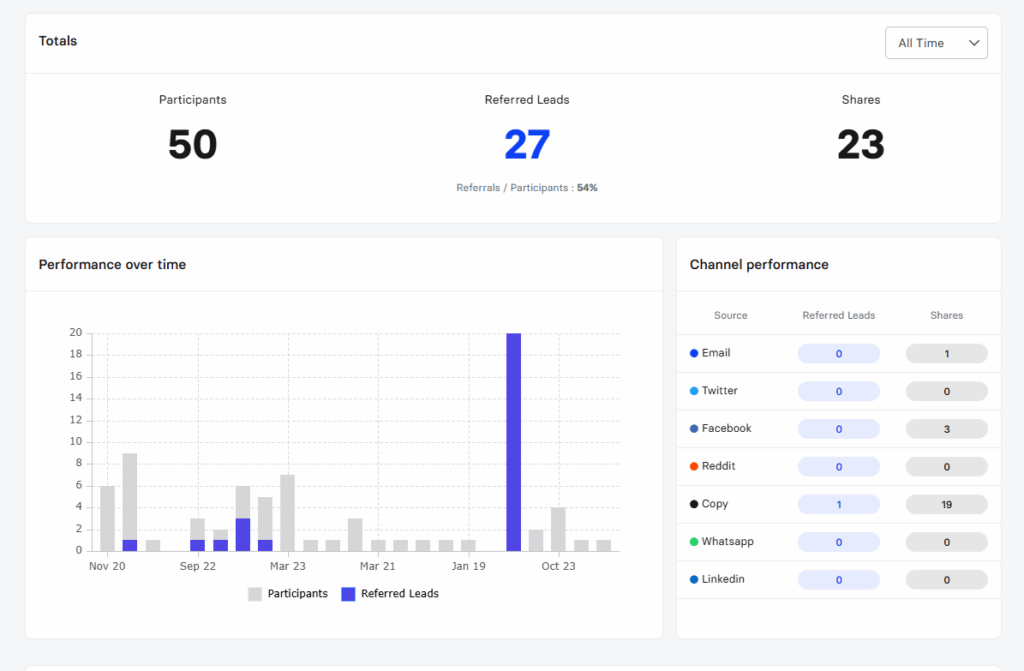
These records help merchants measure referred purchases and compare referral conversion rates with other customer acquisition activity.
How referral rewards are distributed
Merchants send referral rewards only after the referred person satisfies the conditions set for the program.
The reward depends on how the offer works. A referrer might receive a discount, account credit, cash, or a product reward. The referred customer may also receive an incentive, such as a discount for the first purchase.
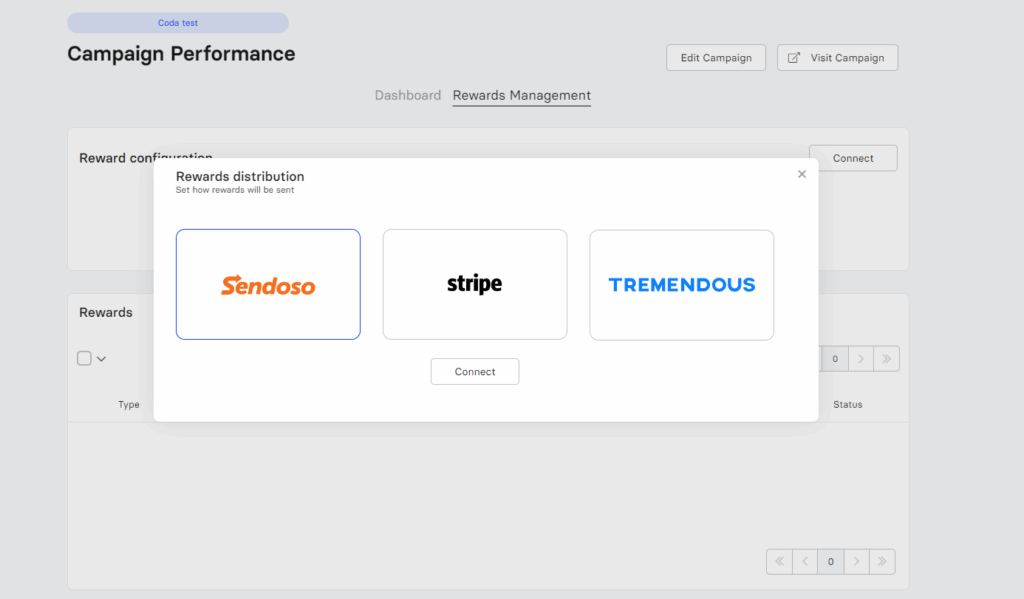
If you’re using a well-rounded referral tool, you can choose between manual reward management and automatic reward management.
Thanks to Viral Loops’ integrations with Stripe and Tremendous, you can automate reward delivery so it requires minimal input on your part.
What types of Shopify referral programs exist?
Shopify stores can rely on several referral program formats. The biggest difference comes down to who gets rewarded and what action earns the reward.
Some programs keep the offer straightforward: if a referred person makes a purchase, the referrer earns a reward. Other programs can be more elaborate, adding milestones, credits, or a little competition.
Common options include:
- One-sided rewards: An incentive to either the referrer or the new customer. For example, a store might give an existing customer $10 in store credit after their friend completes an order.
- Two-sided rewards give something to both the referrer and the referred participant. For example, the referred shopper gets 15% off a first purchase, and the customer who shared the link receives a reward after the sale.
- Tiered rewards increase in importance or value as someone brings in more referrals. Say that one referral earns a small discount, but five referrals earn a free product or larger credit. These are also referred to as referral milestones.
- Store-credit programs keep the reward tied to a future purchase. Instead of sending cash or an actual product, the merchant adds credit to the customer’s account after a qualifying referral.
- Referral contests turn sharing into a competition. Participants can gain entries, points, or leaderboard positions by referring friends, with prizes going to selected or top-performing participants.
Some Shopify merchants also connect referrals with a loyalty program, using loyalty points or VIP tiers as rewards.
Choosing between these types of referral programs starts with the behavior you want to encourage and a reward your customers actually care about.
How do you create a Shopify referral program?
A Shopify referral program needs a goal, a reward people genuinely want, and a simple way for customers to share the offer.
From there, you set the rules. Choose a referral app, test the customer experience, and watch what happens after launch.
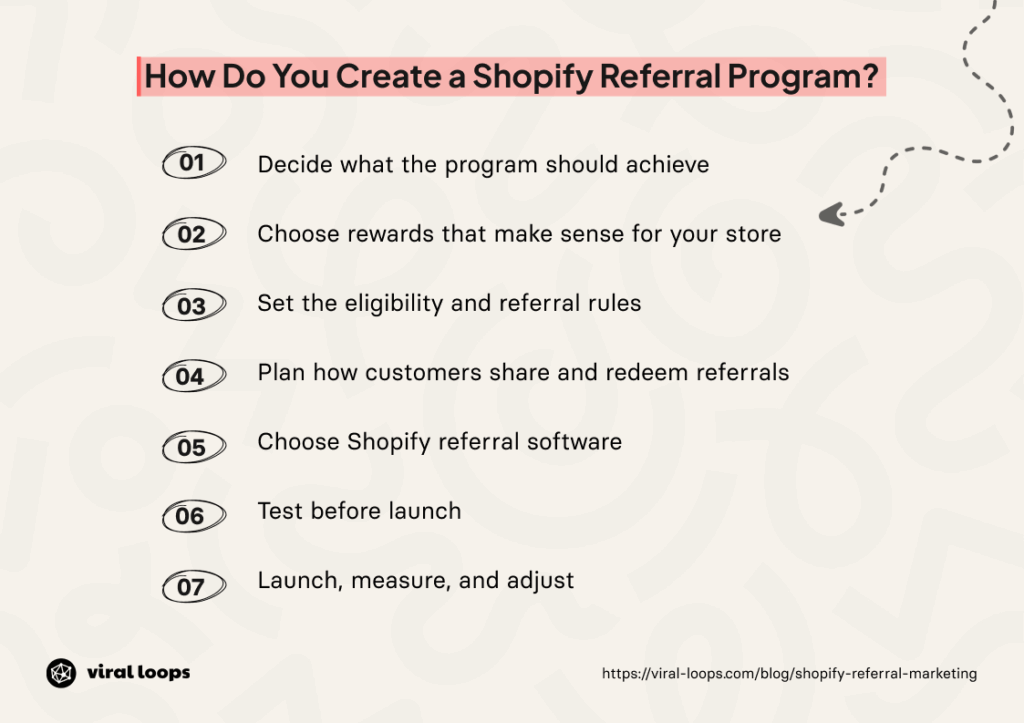
1. Decide what the program should achieve
Think of the outcome you want the program to produce. A program built to attract first-time buyers needs a different setup from one focused on repeat purchases or customer retention.
Choose one or more metrics you can track from the start, such as:
- Number of new customers acquired through referrals
- Number of purchases made by referred customers
- Revenue attributed to referral links
- The percentage of invited customers who complete a purchase
- The participation rate among existing customers
Having a defined goal also makes later decisions easier. Reward size, eligibility rules, and campaign messaging all depend on what you want your customers to do.
2. Choose rewards that make sense for your store
Pick an incentive that gives customers a real reason to share without eating too far into the order margin.
Discounts and store credit work well for stores that want to bring the referrer back for another purchase. Other programs rely on free products, cash rewards, gift cards, or loyalty-program perks.
Shopify supports percentage discounts, fixed-amount discounts, free shipping, and other discount types. Store credit can also work as a payment method for eligible signed-in customers.
Decide if you want to reward only the referrer, the new shopper, or both people. Plus, the program economics should still make sense after accounting for the reward cost — as in, you shouldn’t be losing money on rewards that are more expensive than the value of the new customer you’re bringing in.
3. Set the eligibility and referral rules
Your customers need to know what counts as a successful referral before they start sharing. So, write down the rules in plain language.
Cover points such as:
- Who gets to join the program
- What action completes the referral
- How long a referral remains valid after someone clicks the link
- When the reward becomes available
- Any order value or product requirements
- What happens when an order gets canceled or refunded
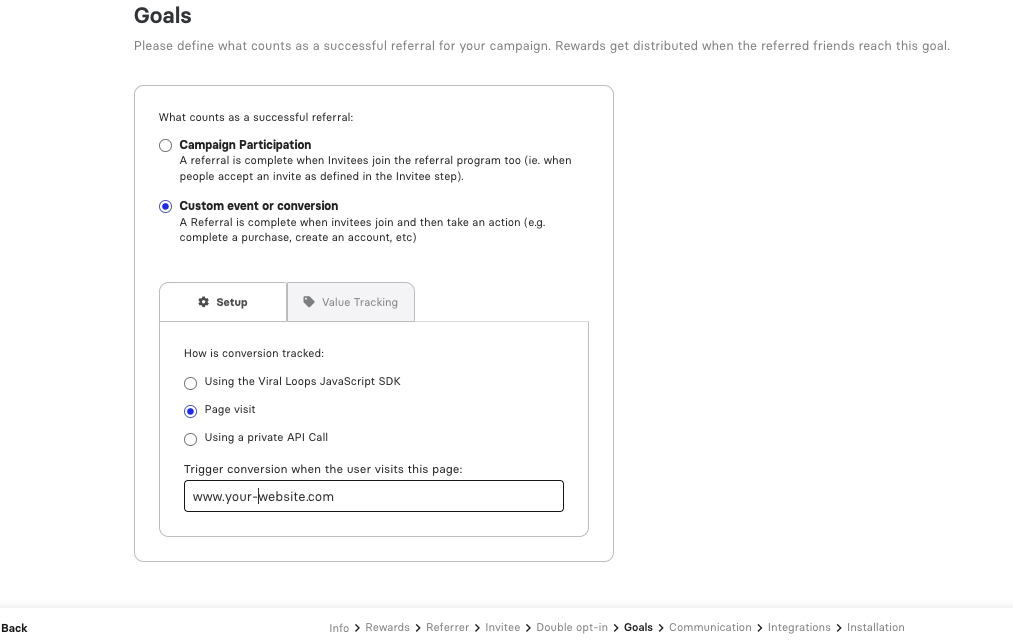
In Viral Loops, a successful referral can be the new person signing up to the store, making a purchase, filling out a form, registering for an event or a newsletter, downloading specific material, or similar. This depends entirely on the goals you set for your campaign in step one.
4. Plan how customers share and redeem referrals
Map the experience from the customer’s first invitation to the final reward.
A typical flow starts with a referral invitation after a purchase or inside a customer’s account. The customer receives a link or code and shares it with a friend.
The referred shopper follows the link, visits the Shopify store, and completes the required action.
Think about where each part appears. Referral landing pages, email messages, customer accounts, thank-you pages, and post-purchase areas all give merchants places to introduce the program.
Similarly, you can choose different ways for referrers to check their progress: dedicated dashboards, embeddable progress-tracking widgets, milestone trackers, referral counters, and leaderboards.
Depending on how you set up the campaign, a referrer could see their successful and pending referrals, how close they are to the next reward milestone, and whether they have any pending or redeemed rewards.
5. Choose Shopify referral software
Referral software handles the parts that can get messy to manage manually, especially unique links, attribution, rewards, and reporting. We’re not saying a referral program platform is a must, but managing everything by hand can get pretty overwhelming pretty fast.
When you start evaluating your options, look at how each tool handles purchase tracking, reward rules, customization, fraud controls, and reporting. Attend demos, ask questions, sign up for free trials, and test out the platforms before you commit to any specific one.
Remember that the right software should make the program easier to manage without adding extra steps or confusing you in the process.
6. Test before launch
Run through the campaign as both the referrer and the referred shopper before opening it up to customers.
Use a test referral to check if:
- The link opens the right page
- The referral gets attributed to the correct person
- The offer appears as expected
- The discount works at checkout
- The purchase shows up in the referral records
- The right reward gets issued after the qualifying action
A short test catches problems before real customers find them.
7. Launch, measure, and adjust
When the program is live, watch how customers use it instead of assuming the initial setup is the right one.
Track the numbers tied to the original goal.
An analytics dashboard makes patterns easier to spot. For example, a low sharing rate points to a problem with the invitation or reward quality, while plenty of clicks with few purchases points to an issue later in the referral flow.
A/B testing also helps with individual parts of the campaign, such as reward amount, referral message, or landing page copy. If you need to make changes, modify one meaningful element at a time so the result tells you something useful.
How can Shopify stores promote customer referrals?
Shopify stores get more customer referrals when the program shows up at moments when customers have a reason to pay attention.
A referral offer buried on a page is easy to miss, so the promotion should appear in strategic places throughout the buying experience.
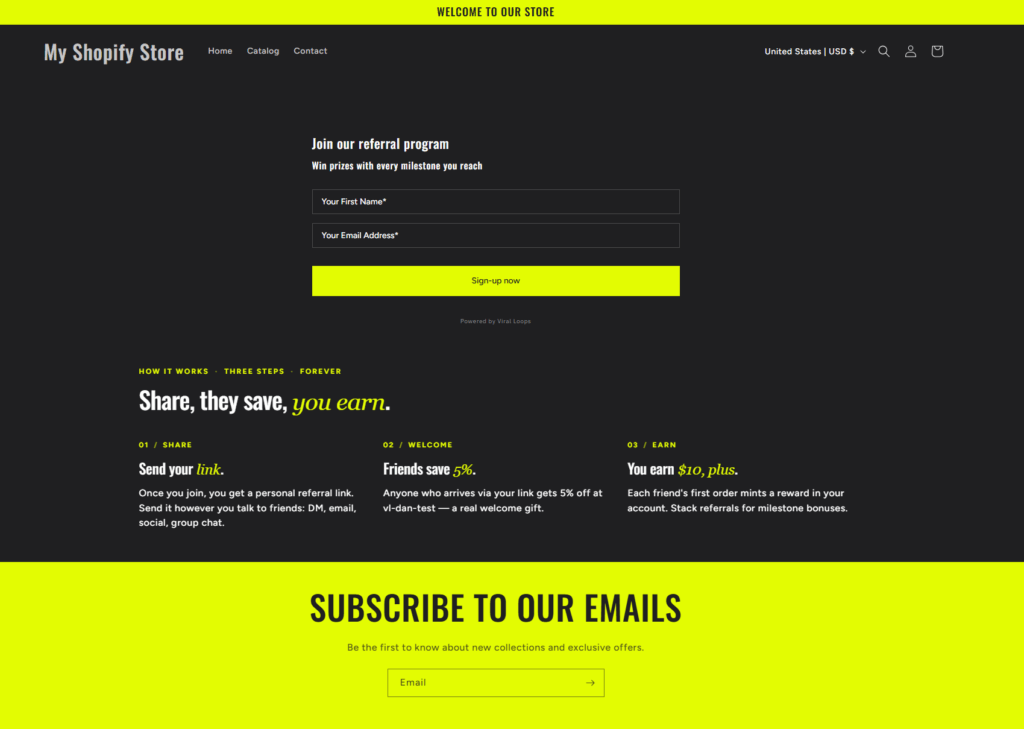
Some practical options include:
- Adding the referral offer to the thank-you page after checkout
- Including referral links in post-purchase emails
- Giving signed-in customers a referral link or shortcut inside their account
- Adding the program to the site footer or another easy-to-find spot
- Asking for referrals after a positive customer review or successful delivery
- Keeping the sharing steps short with direct options for email, text, or social sharing
The easier customers can find and share the offer, the more likely the referral program is to become part of their normal experience with the store.
What referral software works with Shopify?
You have several referral apps to choose from on Shopify, and each one handles the basics a little differently.
Here are five options worth comparing:
- Viral Loops: Built specifically for referral campaigns, Viral Loops offers a Shopify template with unique referral links, purchase tracking, milestone rewards, customizable campaign pages, and fraud detection. You can reward both existing and new customers with discounts, cash, products, and other perks.
- ReferralCandy: Works directly with Shopify and tracks referred purchases through personal referral links. It can also handle reward delivery and includes Shopify app blocks for storefront pages, customer accounts, and thank-you pages.
- Yotpo: Combines referrals with loyalty tools. Shopify stores can reward both the existing customer and the referred friend.
- Refersion: Leans more toward affiliate marketing and influencer programs. It connects to Shopify, creates trackable referral links, records conversions, and includes reporting for clicks and commission payments.
- Rivo: Combines loyalty, rewards, and referrals in one Shopify app. Its referral tools include customizable refer-a-friend pages and features built directly for Shopify.
The best choice depends on the kind of program you want to run. Compare campaign setup, integrations, reward options, tracking, analytics, and automation before landing on one option.
What are common Shopify referral marketing mistakes?
Many referral programs run into trouble for easy-to-avoid reasons: the offer is hard to find, the reward feels weak, or the rules leave people guessing about what happens next.
A few mistakes that are worth watching out for are the following:
- Asking customers to click through too many pages makes sharing feel like work, so keep the referral flow short.
- A small or irrelevant reward gives people little reason to send the offer to someone else.
- Hiding the program on one page that’s easy to miss means plenty of customers never see it.
- Vague terms create questions about who qualifies, what counts as a successful referral, and when the reward arrives.
- Poor tracking makes it harder to connect a purchase with the right referrer or measure how the program performs.
- Weak fraud controls can lead to self-referrals, fake accounts, or other attempts to claim rewards that were never earned.
How can Shopify stores improve referral results?
Shopify stores can improve referral results by closely examining where customers lose interest. For example, existing customers may see the offer and never share it. New customers may click on a referral link but never make a purchase.
Look at the following numbers to see where the drop happens:
- Check the participation rate to see how many customers join the program.
- Compare referral clicks with completed orders to spot problems after the share.
- Try a different reward if the current one gets too little attention, especially if the value feels too low.
- Send different referral messages to different customer groups instead of treating every buyer the same.
- Keep the offer easy to understand, including what the customer gets and what their friend receives.
- Look at average order value, customer lifetime value, CAC, reward costs, and revenue from referred customers.
- Use A/B testing to make changes in your campaign.
- Review results often enough to catch weak spots before they become bigger problems.
Small changes make more sense when they come from real customer behavior, not guesswork.
Over to you!
Shopify referral marketing works better when the program feels simple for the customer. The offer should be easy to understand, share, and track once the referred customer buys.
The setup also has to make sense for the store. That means choosing rewards that fit your margins, setting rules you can explain in a few lines, and using software that handles the repetitive parts without making the process harder.
Viral Loops gives your Shopify store a way to build referral campaigns, track purchases, and manage rewards.
If you want to see how that setup works in practice, book a demo with Viral Loops today.
Frequently asked questions (FAQs)
How much should Shopify referral rewards cost?
There isn’t one reward amount that works for all Shopify stores. Look at your average order value, gross margin, customer acquisition cost, and customer lifetime value to determine the best reward cost for your business.
A lower-margin store needs a tighter reward than one with plenty of room in each order. Fixed discounts, store credit, and percentage-based rewards can all work.
What makes a Shopify referral program successful?
A good Shopify referral program is easy to understand, simple to share, and worth the customer’s time. The reward should feel useful, and the message should make the next step obvious.
Timing matters, too. Promoting the offer after a purchase, in an email, or through ads can bring more attention to the program.
How does Viral Loops support Shopify referrals?
Viral Loops features take care of the parts of a referral campaign that are easy to lose track of manually. You can give your customers personal referral links, follow sign-ups and purchases, and automate reward management.
You can also adjust the campaign itself. You can change the copy, design, and reward setup, while automation handles parts of the referral flow once customers start sharing.