
If you’re a Shopify store owner, you know that while Shopify provides the core features for selling products online, there may be certain functionality your business needs that isn’t available.
That’s where Shopify apps become useful.
They let you customize your store without a lot of technical expertise and add the functionality you need to improve the customer experience and grow your business.
You can use Shopify apps to collect customer reviews, run referral and loyalty programs, display social media feeds, improve your Shopify admin dashboard with better analytics, and more.
In this guide, we’ll explore some of the best Shopify apps for referral marketing, increasing conversions, and building social proof.
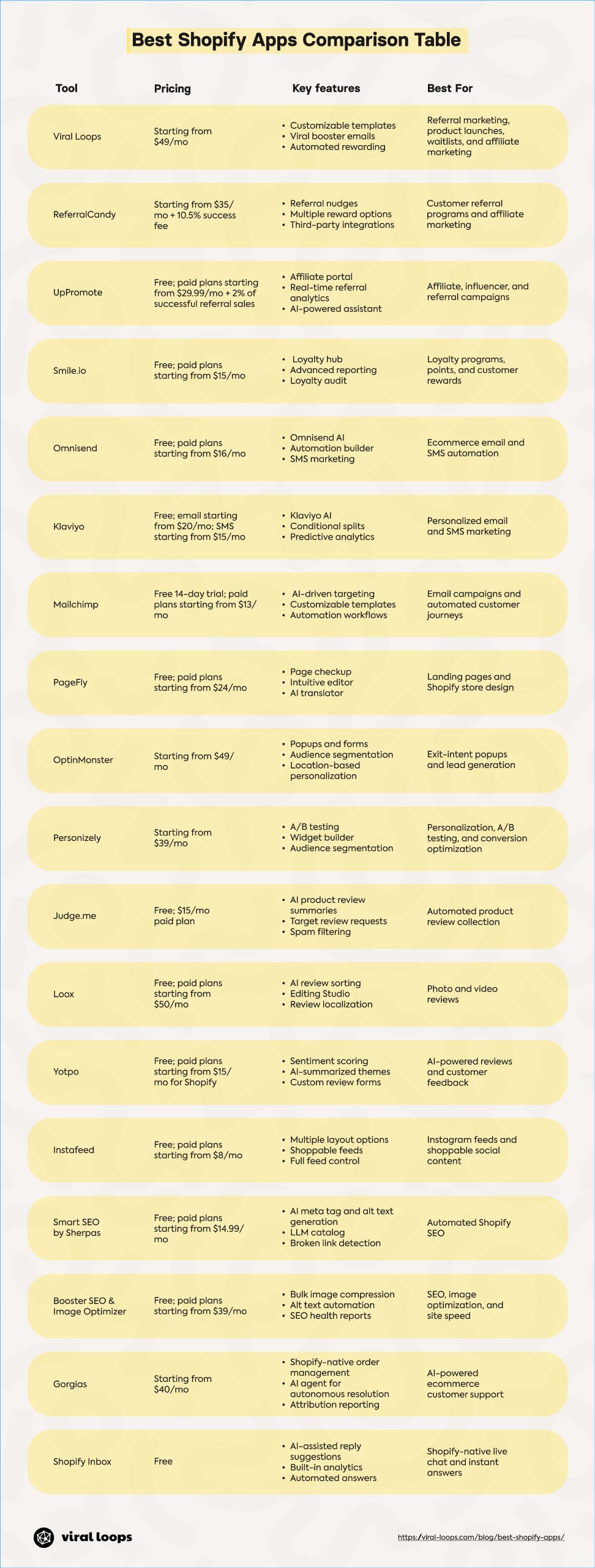
Here’s an overview of these tools, and we’ll compare each app based on its features and pricing to help you find the right options for increasing your store’s sales or leads.
Disclosure: This article was created by Viral Loops and may reference its own products and services. The content reflects the author’s perspective and is based on publicly available information, accurate as of August 2026. Companies and tools are listed for informational purposes only and are not ranked or endorsed unless explicitly stated.
How to choose the right Shopify apps for your e-commerce store
Before diving into the list, we need to make one thing clear: there’s no single best Shopify app for your online store.
The right ones depend on your business needs and what you’re trying to achieve.
Here’s a quick guide to help you choose:
- Define goals & objectives: Start by identifying what you want to achieve. Do you want to increase referrals, get better analytic reports, automate product sourcing, generate more reviews, improve conversions, or build customer loyalty? Choosing an app that aligns with that goal ensures you get more value from it.
- App compatibility: Ensure the app works well with your Shopify store and theme to prevent technical issues and ensure it works as expected.
- Integrations: Confirm that the app integrates with the other tools you already use, making it easy to connect your data and create a more seamless workflow.
- Support: Next, check that the app has reliable support so you’re not stranded during setup or when troubleshooting.
- Customization: How much control does the app offer over its appearance and functionality? Assess the level of customization and whether it can help you create an experience that fits your brand and store.
- Reviews: Read reviews from other Shopify store owners to learn about their experiences with the app. Do they think it’s reliable, easy to use, has good support, and has good overall performance?
- Scalability: You also need to think about whether the app can continue to support your store as it grows. Does it support small, growing, and established businesses?
Best Shopify apps for referral and affiliate marketing
Referral and affiliate marketing are probably one of the most important tools for growing your Shopify store organically. They help store owners increase reach, get new leads and customers, and lower customer acquisition costs.
These apps make it easier to build and manage referral and affiliate programs that turn advocacy into new customers. Here are some of the best referral options for Shopify stores.
1. Viral Loops
Viral Loops is a referral marketing tool that helps Shopify store owners create and launch growth campaigns using templates modeled after brands with successful referral programs.
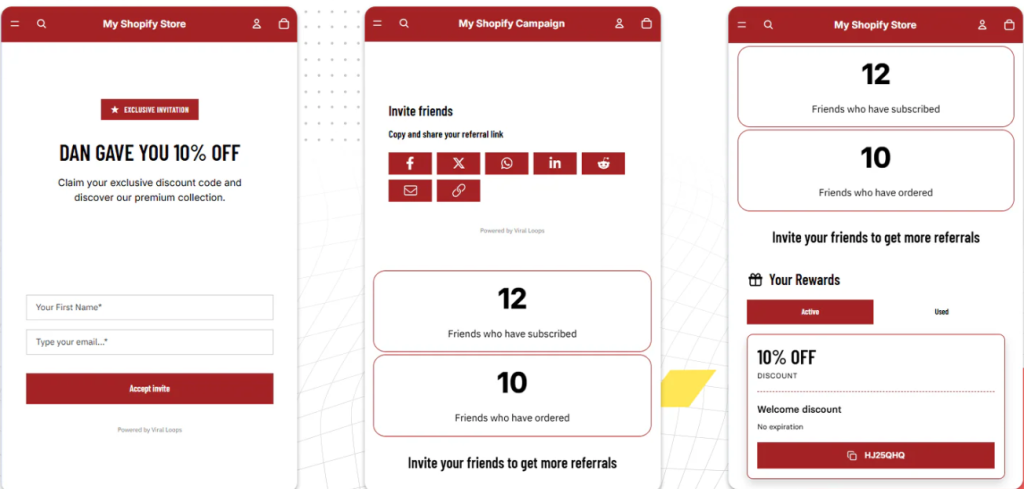
To further simplify how quickly you can launch a campaign, all our plans come with a campaign wizard to guide you through the entire process.
No code or design work is required to get started. You can connect Viral Loops directly into your store as a widget or page and it will automatically adapt to your store’s theme without manual customization.
Plus, you can offer different types of incentives to clients, including our Shopify-native discounts that are generated whenever a customer needs them.
Who it’s for:
New, growing, and established Shopify merchants and e-commerce brands that want to drive traffic and direct sales from referrals.
Key Features:
- Customizable themes that match your brand: Get store-matching referral templates to launch growth campaigns quickly and easily.
- Viral booster emails: Automatically remind referral participants to keep sharing their unique referral links, helping maintain engagement and generate more referrals throughout the campaign.
- Automated purchase-based rewards: Incentivize customers after they complete specific actions and keep the referral cycle running smoothly.
- Referral tracking: Get detailed insights into your campaign performance. Identify top performers, optimize the campaign, and boost referrals.
- Fraud detection: Using our AI-powered fraud detection engine, find and keep spammy entries out of the campaign to protect the referral experience.
Pricing:
We have a free 14-day trial to give you a head start and paid plans starting from only $49 per month.
Pros:
- Useful marketing tool: “Viral Loops is a great tool to drive viral marketing and turn your biggest fans into an army of ambassadors.”
- Provides automation: “The automation helps grow audiences and engagement without requiring complex technical work.”
- Efficient customer service: “Account management support is second to none. Continuous support has made the post-set-up stage so easy.”
Cons:
- Limited built-in hands-on support: “Would love a built-in working session with a rep.”
2. ReferralCandy
ReferralCandy is a marketing tool used to grow a Shopify brand by incentivizing loyal customers to refer others and partnering with influencers or content creators to promote the brand on social media.
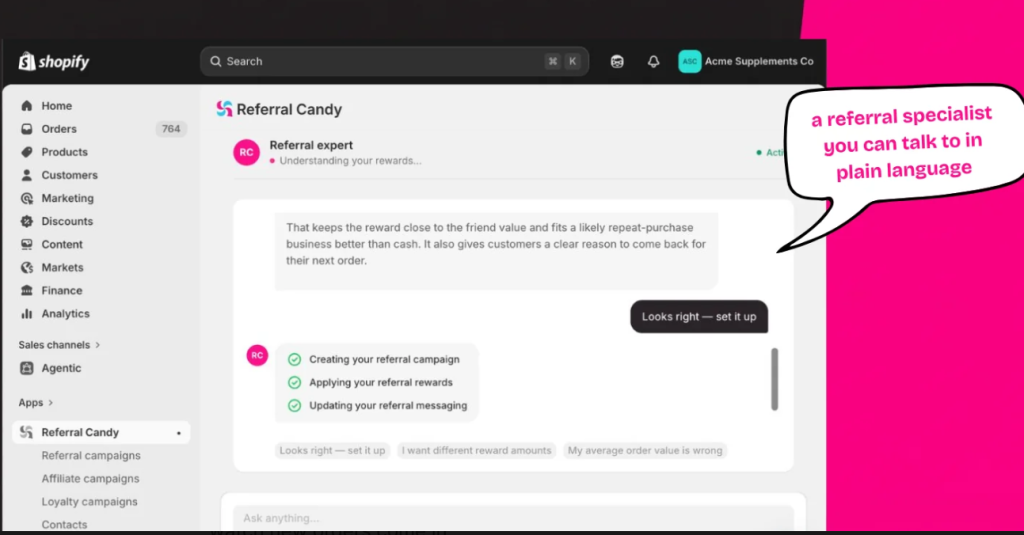
ReferralCandy lets you create custom campaigns from its dashboard, customizing everything from branding to rewards, messaging, emails, and pages.
It has an AI assistant for launching and modifying campaigns using your existing online store’s data.
The referral experiences here can be embedded as widgets, post-purchase pop-up forms, or sign-up forms, so customers can see their referral link regardless of their current stage.
Who it’s for:
Premium e-commerce brands that want to turn recommendations into a growth channel.
Key Features:
- Referral nudges: Place the referral programs where customers are most likely to engage — product, cart pages, or homepage widgets.
- Multiple reward options: Lets you offer free products, discounts, coupons, gift cards, commission, store credits, and custom rewards to participants.
- Third-party integrations: Connects with popular e-commerce stores like Shopify, Shopify Plus, WooCommerce, and BigCommerce, including Google Analytics, Adroll, and subscription apps like Recharge, Skio, and Recurpay.
Pricing:
ReferralCandy offers a seven-day free trial with its paid plans starting at $35 per month + a 10.5% success fee.
Pros:
- Flexible commission structures: Supports tiered commissions based on products and sales volume.
- Fraud detection: Identifies and flags potentially fraudulent activity for review.
- Customizable widget: Sleek, customizable widget that integrates seamlessly with your site.
Cons:
- Limited fraud controls: Doesn’t let you hold referred-friend rewards when a sale is flagged as a potential self-referral.
- Complex setup: Setup can be somewhat complicated and may require assistance.
3. UpPromote
UpPromote is a marketing solution for Shopify store owners who want to launch affiliate marketing, referral, and influencer campaigns.
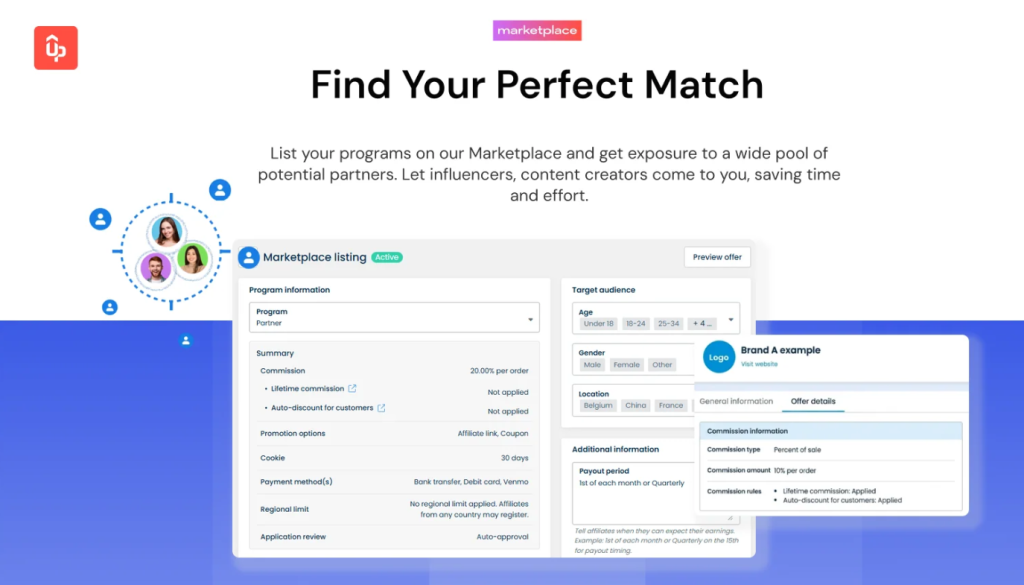
UpPromote’s approach to referral marketing is slightly different from most tools. It begins by defining and customizing referral rewards to be used in incentivizing customers.
Then, you customize a referral widget, pop-up, or page to meet customers where they are.
For affiliate and influencer marketing campaigns, UpPromote offers a marketplace where you can recruit and activate partners to promote your brand to their audience.
It also lets you launch the different campaign types it offers with a unique dashboard for each program.
Who it’s for:
Growing and enterprise-level Shopify brands that want to turn partnerships into a growth channel.
Key Features:
- Affiliate portal: A dedicated dashboard for affiliates and partners to monitor their performance, rewards, and progress.
- Real-time referral analytics: Identify trends and patterns in customer referral behavior with real-time insights, like clicks, referrals, sales, and commissions.
- AI-powered assistant: Get recommendations for commission rates based on successful programs and setup structures that fit your business.
Pricing:
You can start for free and upgrade to paid plans that begin at $29.99 per month plus 2% of successful referral sales.
Pros:
- Easy to use: Offers a straightforward platform with a wide range of affiliate marketing features.
- Simple setup: Makes launching an affiliate program easier than expected.
- Clear affiliate management: Provides a clear dashboard for managing affiliates and tracking performance in one place.
Cons:
- Limited advanced features: Lacks some of the more advanced capabilities offered by competitors.
- Low-quality marketplace applicants: Affiliate applications from the marketplace may not meet expectations.
- No cross-platform support: Difficulty managing multiple Shopify stores and WooCommerce brands from one system.
4. Smile.io
Smile.io is a loyalty platform for Shopify brands looking to create campaigns that increase customer retention.
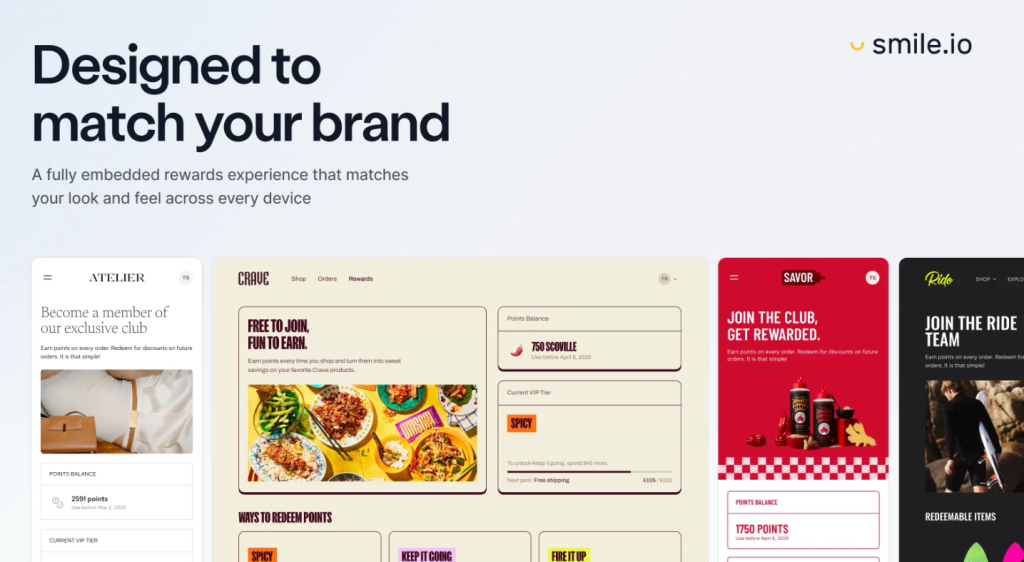
Here, you can run fully embeddable loyalty campaigns integrated into your product pages online, or campaigns that suit your offline stores via Shopify POS or receipt scanning.
Loyalty programs can either take a points approach that rewards customers for purchases, signups, reviews, social follows, and birthday gifts, or a tier-based system that rewards clients as they purchase more or perform specific actions.
Smile.io also lets you run referral campaigns by incentivizing customers with points, discounts, or free shipping for referring others.
Who it’s for:
Small business, mid-market, and enterprise businesses across industries like apparel, electronics, food, health, lifestyle, jewelry, travel, sports, toys, and photography.
Key features:
- Loyalty hub: A personalized space where customers can track points, claim rewards, and explore their loyalty status.
- Advanced reporting: Get detailed insights your team needs, from loyalty benchmarks to program performance.
- Loyalty audit: Evaluate how strong your loyalty program is and identify areas for improvement.
Pricing:
Smile.io has a free plan with paid tiers starting from $15/month.
Pros:
- Helpful support team: Provides hands-on support to troubleshoot issues and guide users through the setup process.
- Comprehensive features: Offers a wide range of loyalty features and options to choose from.
- Email automation: Makes customer communication easier through built-in email automations.
Cons:
- Complex cross-platform syncing: Syncing loyalty points across different sales platforms isn’t always plug-and-play.
- Limited marketing workflows: Makes it difficult to add new customers to Smile and automatically enroll them in loyalty or marketing flows.
Best Shopify apps for email and SMS marketing
Think you need to stay connected with your customers beyond their regular visit to the online store?
Email and SMS marketing apps give you a direct way to keep clients engaged, promote products, share offers, and recover abandoned carts.
Below are some of the best tools. Some combine email and SMS, along with other features, while others offer just one service.
5. Omnisend
Omnisend is a marketing platform for e-commerce stores that want email marketing and SMS tools in one location.
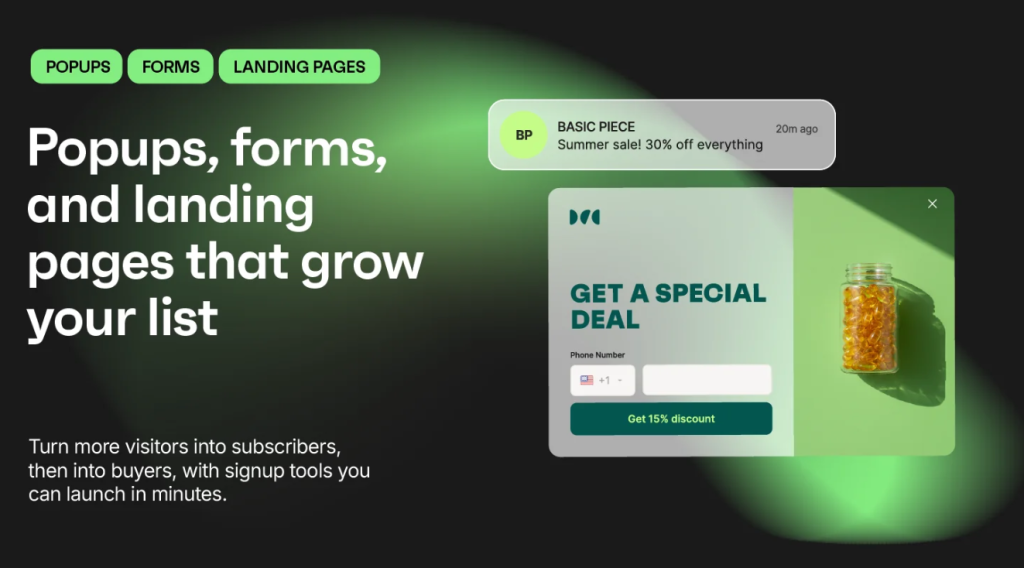
It connects with Shopify, Shopify Plus, Ecwid, WooCommerce, BigCommerce, and other major e-commerce platforms.
While the way Omnisend operates across each platform differs slightly, it offers prebuilt e-commerce templates and drag-and-drop editors to make creating campaigns easy.
It provides list-building tools for creating email lists and lets you segment audiences so you can send the right messages to different clients. Omnisend also supports migration from other email marketing platforms.
Who it’s for:
Startup, growing, and enterprise e-commerce businesses that want to launch email and SMS marketing campaigns.
Key features:
- Omnisend AI: Lets you build forms to capture leads, analyze and segment your audience, and write on-brand copy for campaigns.
- Automation builder: Create automated workflows for new signups, product abandonment, shipping confirmation, cross-sell, or card abandonment, using prebuilt templates, drag-and-drop builders, and conditional logic.
- SMS marketing: Send mass messages to your audience or target specific segments based on behavior, location, lifecycle stage, or purchase history.
Pricing:
Omnisend’s pricing depends on your email list size, but it does have a free plan for up to 250 contacts. Paid plans begin at $16 for 500 contacts and above.
Pros:
- Easy to use: It’s a simple platform with user-friendly templates.
- Comprehensive features: Offers a wide range of features and functionality.
- Strong integrations: Integrates well with other tools and platforms.
Cons:
- Limited ready-to-use templates: Could offer more pre-built templates compared with other email platforms.
- Account stability issues: Some users have experienced unexpected account blocks during setup.
- Account suspensions: High unsubscribe rates can result in account suspension, followed by a lengthy reactivation process.
6. Klaviyo
Klaviyo is a B2C marketing tool that helps you leverage customer data and AI agents to create automated email, SMS, RCS, and WhatsApp campaigns.
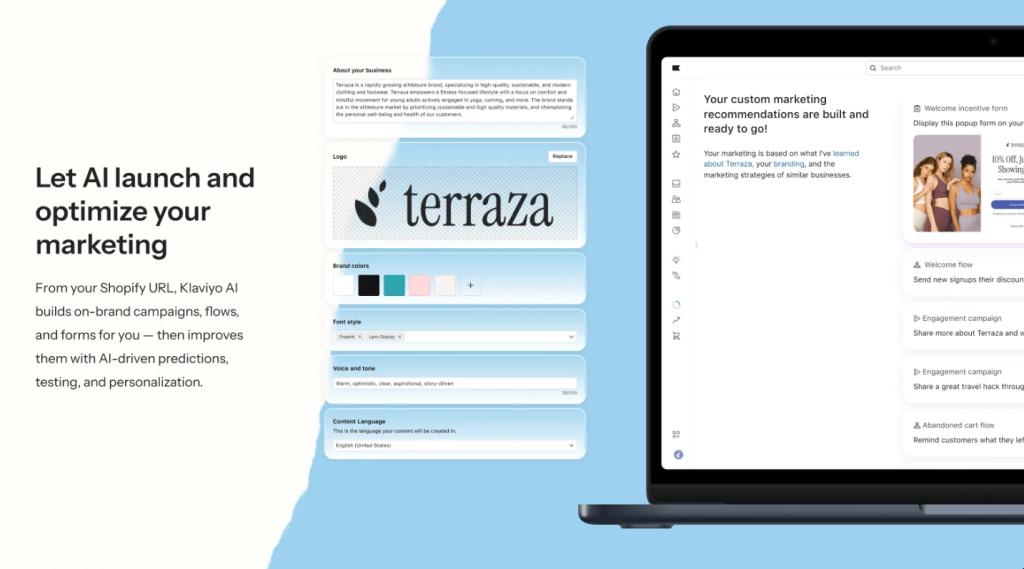
Klaviyo integrates with top e-commerce platforms like Shopify, WooCommerce, Next Commerce, etc., and ensures your orders, products, and customer behavior sync in real time.
This provides an overview of your client data and enables you to engage in more personalized marketing campaigns.
Klaviyo’s strong suit is its deep personalization across email, mobile push notifications, WhatsApp, text, and social media.
Similar to Omnichannel, Klaviyo also offers customizable templates to create campaigns quickly and prebuilt workflows to automate key customer moments.
Who it’s for:
Retail and e-commerce businesses, agencies, wellness brands, and enterprise companies.
Key features:
- Klaviyo AI: Create custom strategy and ready-to-go campaigns, flows, and forms, including audience segmentation with AI, and keep growing with your business.
- Conditional splits: Build automations that route customers down different paths based on their behavior and channel affinity.
- Predictive analytics: Lets you score audiences for lifetime value, churn risk, next order date, or more.
Pricing:
Klaviyo has a free plan with separate paid plans for SMS at $15/month (up to 1,250 SMS/MMS credits) and email at $20/month (for 251-500 contacts).
Pros:
- Rich feature set: Offers a comprehensive range of features that keep users on the platform.
- Strong ROI: Consistently delivers a strong return on investment as part of the marketing strategy.
- Advanced targeting controls: Provides detailed targeting rules for forms, including scroll depth, exit intent, subscriber exclusions, and checkout page exclusions.
Cons:
- Limited order confirmation controls: Once an order confirmation is sent, it can’t be updated or resent to a different email address.
- Slow customer support: Support response times can be very slow, with limited weekend availability and no phone support.
7. Mailchimp
Mailchimp is another marketing platform you can use to grow your e-commerce business with email and SMS campaigns.
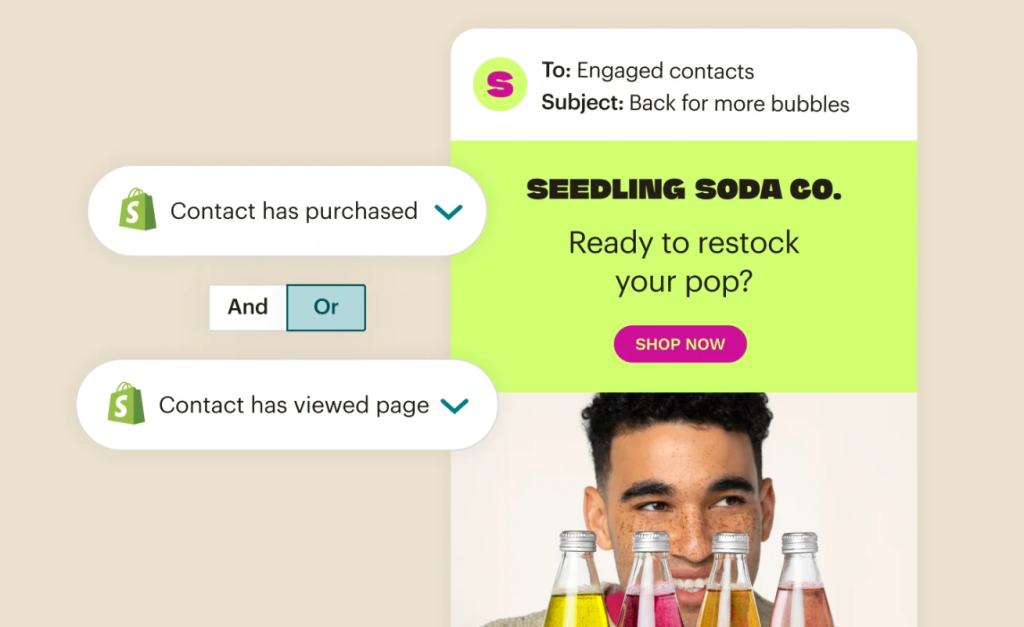
It helps you gather data from your Shopify, Wix, or WooCommerce store and create a campaign strategy based on real-time insights.
With Mailchimp, you can automatically engage customers with welcome emails, abandoned cart reminders, back-in-stock alerts, and personalized product recommendations.
It also supports segmentation so you can deliver personalized email and SMS campaigns.
Who it’s for:
New, growing, and established e-commerce and DTC stores.
Key features:
- AI-driven targeting: Use AI to identify customers most likely to purchase, which takes the guesswork out of who to email.
- Powerful automation: Mailchimp features a library of customizable templates to help you start selling quickly, with behavioral triggers to send emails based on specific actions.
- Automation workflows: Create automated processes for responding to customer purchases, new sign-ups, order confirmations, promoting cross-sell opportunities, and encouraging online reviews.
Pricing:
Mailchimp offers a free 14-day trial with paid plans starting at $13/month for up to 500 contacts.
Pros:
- Powerful and intuitive: Meets the needs of physical product businesses with a broad set of useful features.
- Helpful customer support: Responsive support can help resolve complex integration issues.
- Effective mailing list management: Supports customer mailing lists and makes audience management easier.
Cons:
- Limited Shopify form controls: Combining Shopify’s standard newsletter signup form with tags can make it difficult to create desired automation flows.
- Syncing issues: The app can experience problems syncing data.
- Contact-based pricing: Pricing is based on imported contacts and orders, making it difficult to pay only for a specific segment of your customer base.
Best Shopify apps for increasing conversions
Now, if you need tools to increase conversions for your Shopify stores, you’ll find the tools below to be useful.
8. PageFly
PageFly is an AI-powered page builder for Shopify store owners who want high-converting, optimized landing pages.
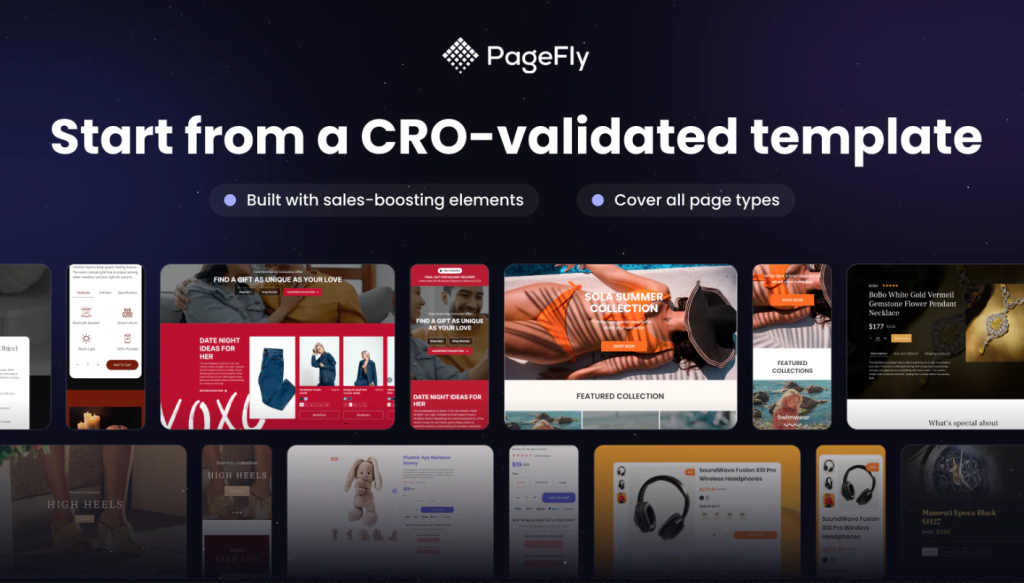
Landing pages here are built using templates or AI, customizable in a visual editor.
PageFly has built-in analytics to track user engagement on your page, allowing you to test what works for the audience.
It offers different features to help e-commerce stores maximize sales, from page audits to click heatmaps, including tracking average order value.
Who it’s for:
Founders, scaling businesses, and enterprise companies who want to improve add-to-cart rate, optimize page performance, and drive measurable sales growth.
Key Features:
- Page checkup: AI tool that scans your landing page’s SEO, copy, layout, and conversion signals and suggests prioritized fixes.
- Intuitive PageFly editor: Build landing pages, product layouts, and promotional sections quickly with its drag-and-drop visual editor.
- AI translator: Localize your page content into any language using artificial intelligence.
Pricing:
PageFly offers a free plan for building one page or section, and paid plans from $24 per month. Paid tiers depend on the size of your business and the number of pages you want.
Pros:
- Intuitive page building: Makes creating pages easier and more efficient.
- AI-assisted coding: Uses AI to help with HTML coding and simplify the page-building process.
- Helpful support: Provides clear, quick, and professional customer support.
Cons:
- Initial learning curve: Can be somewhat difficult to learn at first.
- Inconsistent functionality: Some settings don’t always work as expected.
- Clunky experience: The app can feel somewhat cumbersome to use.
9. OptinMonster
OptinMonster is one of the most popular lead generation tools for marketers who want to convert abandoning visitors into subscribers using engaging pop-ups.
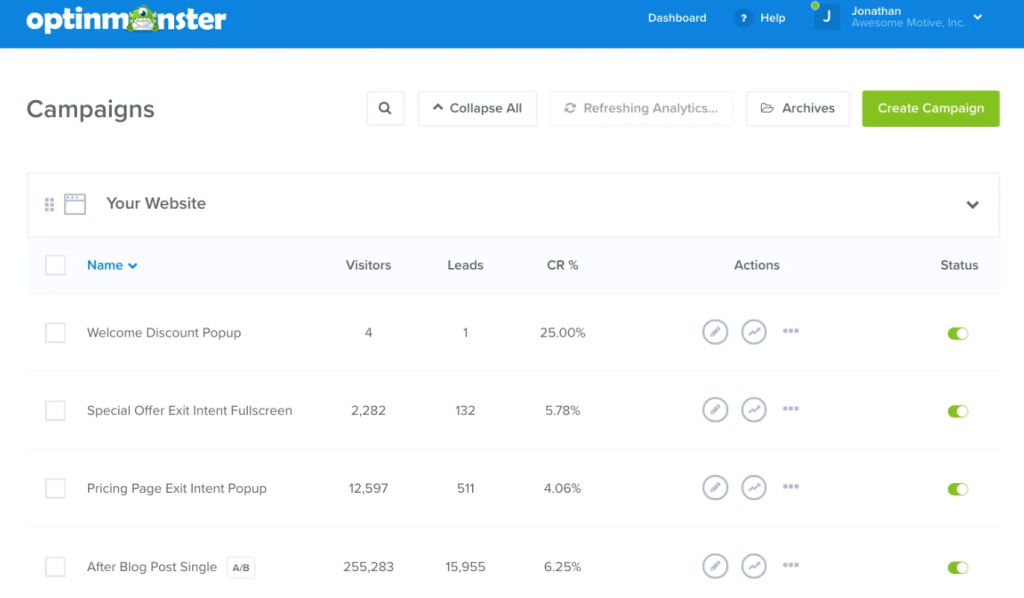
Its focus is on creating experiences through floating bars, slide-ins, gamified bars, or inlines to help you capture engaged shoppers built for the exact page or offer they’re viewing.
OptinMonster also lets you identify and reach out to customers before they leave with an appropriate offer to capture them.
Who it’s for:
E-commerce stores that want to avoid cart abandonment.
Key Features:
- Exit intent popups: Show targeted offers to customers before they leave to reduce cart abandonment and encourage purchase.
- Page-level and category segmentation: Customize campaigns based on the specific page, URL pattern, or category customers are browsing to ensure you display messaging that matches their current interest.
- Location-based personalization: Customize campaign offers based on customers’ locations to highlight region-specific promotions and shipping.
Pricing:
OptinMonster’s pricing tiers begin at $49 per month for its Shopify growth plan.
Pros:
- Custom banners: Makes it easy to create and manage custom banners.
- Easy to use: Accessible for both technical and non-technical users.
- Lead management: Helps track email leads and provides a range of useful templates.
Cons:
- Limited AI capabilities: Doesn’t offer as much AI-powered campaign creation as expected.
- Limited for complex organizations: May not provide enough value for businesses with more complex needs.
- Confusing campaign controls: Some interactions, such as campaign sorting, can make it unclear which campaigns are currently live.
10. Personizely
Personizely is a dedicated conversion-optimization platform that equips marketers with tools to deliver personalized, unique experiences across their websites.
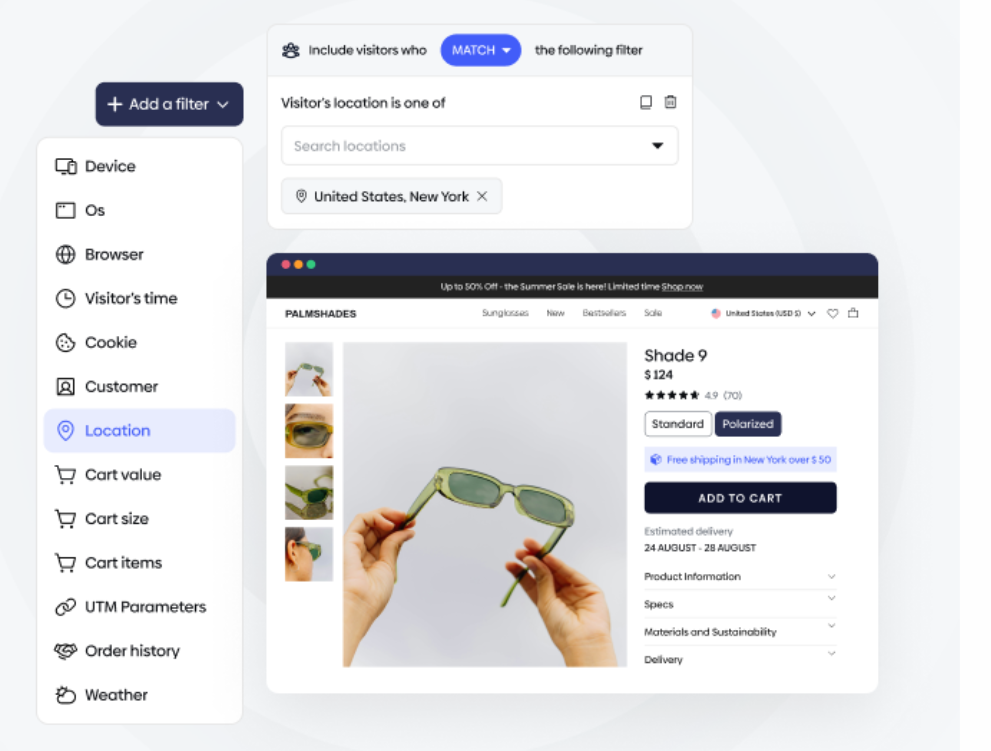
Personizely lets you:
- A/B test campaign ideas, titles, content, or pricing to find what works best for your store.
- Build widgets to capture customer details and personalize their experience by showcasing the right messages at the appropriate time based on user actions.
You also get live insights on personalization and how well a campaign variation is performing against another.
Who it’s for:
E-commerce stores that want to run A/B tests to create personalized campaigns for their audience.
Key Features:
- A/B testing: Run tests of your pricing, shipping rates, themes, popups, banners, or URL redirects to convert more customers and scale the business.
- Widget builder: Create on-brand widgets from templates and customize them in a drag-and-drop editor.
- Audience segmentation: Categorize audiences into visiting or returning customers based on history or cookie data.
Pricing:
There’s a 14-day free trial and paid plans starting from $39 per month for 10k monthly visitors.
Pros:
- Clean interface: Dashboards and the overall UI are easy to navigate.
- Effective A/B testing: Enables testing that can improve conversion rates and make a measurable impact on revenue.
- Strong lead capture: Provides engaging pop-ups and smooth Shopify integration.
Cons:
- Limited documentation: Documentation available is relatively sparse and could provide more guidance.
- Learning curve: The platform can take time to learn because of its extensive feature set.
- Limited advanced analytics: More advanced reporting would help users analyze campaign performance in greater depth.
Best Shopify apps for product reviews and social proof
Want tools that build customers’ confidence in your store and give prospects a sneak peek into the brand?
You need the tools listed in this section.
11. Judge.me
Judge.me is a review app for Shopify stores that want to collect and display customer feedback on their page.
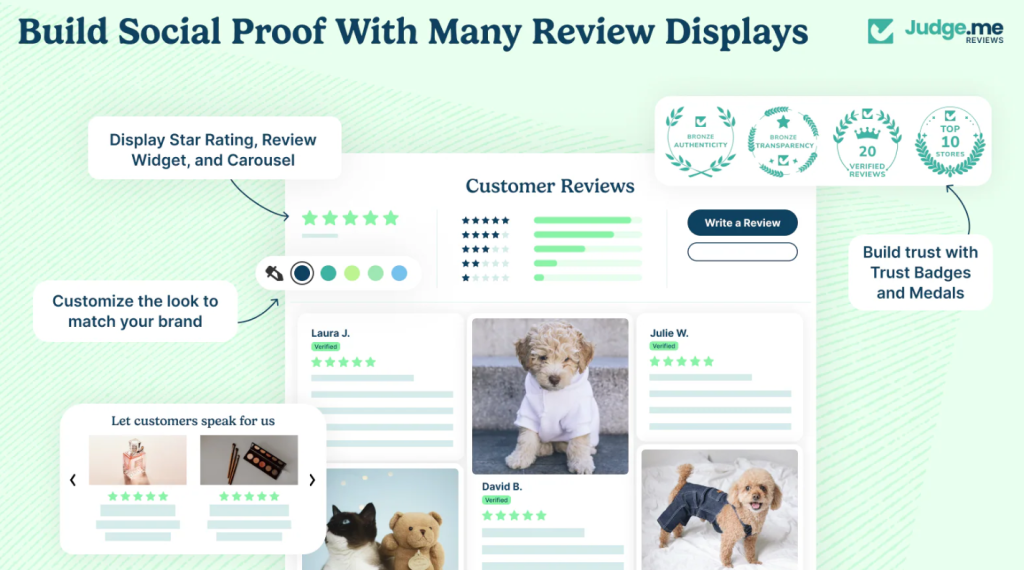
You can automate review requests on products or stores and use text reviews, photos, video galleries, and AI summaries to showcase them on your brand.
Judge.me also lets you automatically share the reviews on third-party e-commerce sites where customers shop, e.g., Google Shopping, Rich Snippets, TikTok Shop, Meta Shop, and the Shop app.
Who it’s for:
New and growing Shopify stores, including drop shippers.
Key features:
- AI product review summaries: Generate multilingual product review summaries with keyword highlights and review quotes.
- Target review requests: Automate review requests via email, SMS, or submission forms, sent at the right time to customers with reminders at specific times.
- Spam filtering: Weed out inappropriate reviews or spam messages from product or store reviews to ensure a respectful environment.
Pricing:
You can use Judge.me for free. It also has a $15 per month flat pricing.
Pros:
- SEO-friendly: Helps improve visibility for ratings in Google Shopping ads and search results.
- Automated review requests: Automatically requests reviews without requiring manual follow-up.
- Comprehensive features: Offers features that meet a wide range of customer needs.
Cons:
- Clunky optimization: Some parts of the platform can be difficult to optimize.
- Theme update issues: Theme updates can repeatedly cause problems with the platform.
- Widget conflicts: Changing widget settings can sometimes create unrelated issues, such as affecting buy buttons.
12. Loox
Loox is a product review app for collecting photo and video reviews from customers.
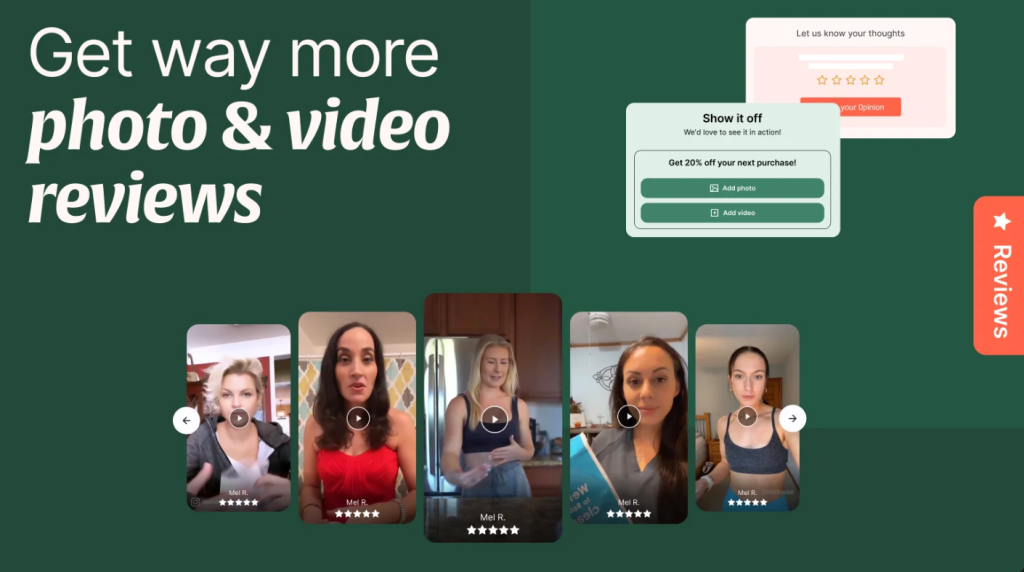
It allows you to send automated review requests to customers and provide multiple ways to collect — QR codes, SMS, review links, or WhatsApp.
Loox then lets you display the visual reviews in beautiful widgets that you can tailor to your brand’s style. It also has multiple automations for syncing reviews across multiple platforms, converting reviews into social media posts, and flagging spammy/problematic reviews before they’re published.
Who it’s for:
E-commerce stores that want to run social proof marketing campaigns.
Key features:
- AI review sorting: Use AI to always show your most persuasive visual reviews, automatically.
- Loox studio: An editing hub where you can turn reviews into social media posts.
- Review localization: Automatically translate reviews and display communications with customers in their native language across widgets, emails, and forms.
Pricing:
Loox is free to use for photo reviews. For video reviews and increased syndication, paid plans begin at $50 per month.
Pros:
- Easy review collection: Makes collecting and displaying customer reviews simple.
- Review request emails: Helps customers submit reviews of their purchases through email.
- Customizable incentives: Lets you offer customers discounts on future purchases in exchange for reviews.
Cons:
- Mobile display issues: The ‘write your review’ box didn’t appear on mobile.
- Limited font customization: Doesn’t support basic fonts like Arial or provide CSS access for further customization.
13. Yotpo
Yotpo is a product review and loyalty software tool for e-commerce brands that want text-based, photo, and video reviews.

You can request reviews with AI-powered prompts to help identify top shoppers, ask guided questions that can produce more conversion-driven reviews, and capture metadata for context like fit, color, or quality to help prospects find reviews that match their current needs.
Another unique differentiator is how Yotpo helps structure reviews to be high-quality and visible on platforms LLMs crawl for answers. This way, AI tools can cite and recommend your brand to shoppers.
Yotpo also provides review insights to help identify trends and topics shoppers mention the most, so you can inform updates or use positive feedback to upsell or encourage referrals.
Who it’s for:
Growing and enterprise e-commerce businesses.
Key Features:
- Sentiment scoring: Spot key topics and score sentiment so you can make informed decisions based on what shoppers say.
- AI-summarized themes: Have review themes automatically summarized into organized structures that LLMs can cite for recommendations.
- Custom review forms: Create branded forms to personalize review requests and trigger them automatically after delivery for maximum response rates.
Pricing:
For Shopify users, Yotpo has a free plan and paid tiers that start at $15 per month. On its website, plans begin from $89/month for 500 monthly orders.
Pros:
- Increased review volume: Helps businesses collect more customer reviews, strengthening social proof and customer engagement.
- Flexible review management: User-friendly platform with flexible options for collecting and displaying reviews.
- Effective email automation: Automated review emails generate strong customer responses, with retailer syndication and helpful support.
Cons:
- Slow support response: Support follow-ups can take longer than the promised response window, leaving issues unresolved.
- Declining review performance: Some users report receiving fewer reviews despite sending a high volume of review requests.
14. Mintt Instafeed
Mintt Instafeed is a social commerce platform that lets you display Instagram Reels, shoppable videos, and UGC as galleries on your Shopify store.
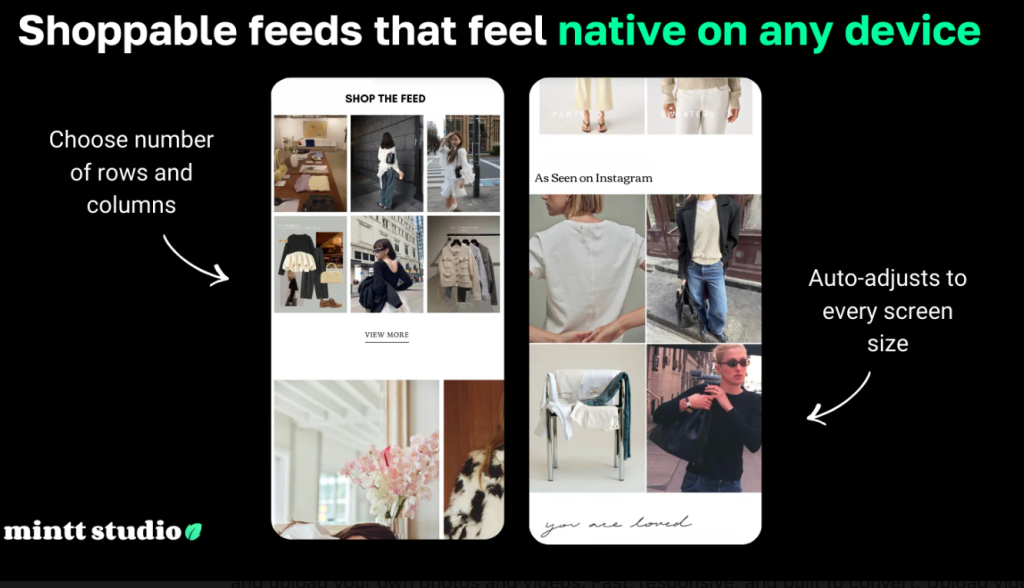
If you’ve partnered with an influencer, for example, videos uploaded to Instagram can be added to your Shopify page to build trust and drive conversion.
It also lets you add tagged posts, hashtags, or product-tagged posts on Instagram to your store and is optimized for performance, ensuring the content doesn’t slow your site’s speed.
Who it’s for:
Shopify store owners with a robust Instagram presence who want to build trust with prospects.
Key Features:
- Multiple layout options: Pick between a slider or grid display to match your brand style.
- Shoppable feeds: Auto-sync Instagram feeds with product tagging, allowing customers to shop directly from posts or add items to cart.
- Full feed control: Pin, hide, or reorder photos and videos to curate what prospects see in the gallery.
Pricing:
Instafeed has a free tier and paid options starting from $8 per month.
Pros:
- Reliable and stable: Works consistently and has proven to be highly stable.
- Easy setup: Simple to set up, connect, and add to a website.
- Automatic product tagging: Automatically tags products in posts and it displays well across devices.
Cons:
- Manual product tagging: Some users, however, mention that tagging products in individual posts can be time-consuming.
- Facebook data requirements: Requires ‘Off-Facebook Activity’ to be enabled, while the Meta sign-in option requests extensive data access.
- Limited customization: There is limited flexibility for customization.
Best Shopify apps for SEO and site speed
When multiple apps are added to your store, additional scripts or code are sometimes introduced, impacting functionality and load time.
Search engine optimization (SEO) and performance tools help you identify issues quickly, ensure your store gets found by search engines and users, and optimize it to run smoothly when shoppers visit.
Here are the top apps Shopify store owners use for SEO and speed:
15. Smart SEO by Sherpas
Smart SEO helps Shopify businesses optimize their stores for search engines and AI to improve rankings, drive sales, and boost organic traffic.
With Smart SEO, meta tags and alt tags are automatically generated, broken links are fixed, and the store sitemap is managed.
It’s built to make complex SEO tasks manageable without technical expertise. Smart SEO can also improve indexing, add noindex tags, and audit your product pages to ensure they’re SEO compliant.
Who it’s for:
Shopify store owners who want to automate SEO maintenance without developer resources.
Key features:
- AI meta tag and alt text generation: Leverage ChatGPT to create contextually accurate meta titles, descriptions, and image alt tags in bulk.
- LLM catalog: Helps your store and products get identified and recommended by AI assistants.
- Broken link detection: Auto-detects broken links for up to 100 pages and flags issues for correction, protecting SEO performance and user experience.
Pricing:
Smart SEO has a free plan and paid options that begin from $14.99 monthly.
Pros:
- Easy SEO auditing: Makes it simple to audit product pages for SEO compliance.
- SEO and speed improvements: Helps improve SEO performance and page speed shortly after installation.
- Automated SEO checks: Automatically scans the website for issues such as broken links.
Cons:
- No bulk keyword editing: Doesn’t offer a bulk editing option for focus keywords.
- Time-consuming process: Editing and saving meta tags across individual tabs can be slow.
- App access and performance issues: Some users experience difficulty opening the app and getting it to work reliably.
16. Booster SEO & Image Optimizer
Booster SEO is a full SEO suite combined with an automatic image optimizer that handles alt text, bulk compression, broken links, meta tags, and speed improvements from a single dashboard.
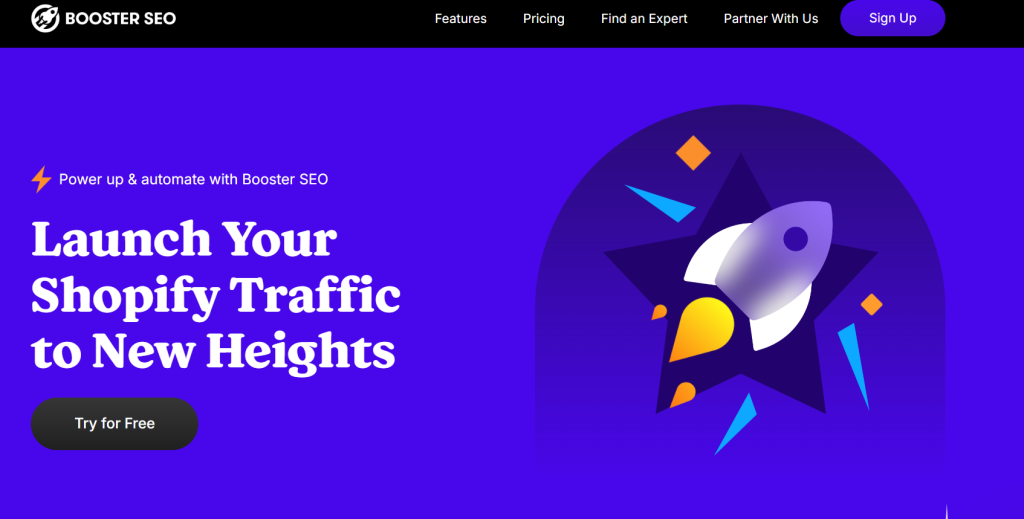
It scans your Shopify store, discovers SEO-related issues, optimizes snippets for better performance, and tracks performance.
Booster SEO also helps your products get found by AI search (Gemini, ChatGPT, or Claude) with LLMs.txt, structured data, and AI-optimized meta tags.
Who it’s for:
Shopify stores that want SEO, AEO, and image optimization in one app.
Key features:
- Bulk image compression: Compress images on your store to reduce load times and URL keyword optimization for better SERP visibility.
- Alt text automation: Write clear image descriptions for your store products to boost SEO and accessibility.
- SEO health reports: Monitor your site’s SEO performance to know what’s improved or still needs attention.
Pricing:
BoosterSEO is available for free with paid plans starting from $39/month.
Pros:
- Helpful AI tools: Uses AI to clean up site issues and fix broken links, saving time.
- User-friendly platform: Easy to use, high-quality, and well-maintained.
- Quick issue detection: Finds and fixes site issues you may not have noticed.
Cons:
- Limited traffic growth: Didn’t deliver the increase in traffic the user expected.
- Slow store analysis: Store analysis can remain in progress for several days, leaving features unavailable.
Best Shopify apps for customer support and live chat
Some of the best Shopify stores have reliable support and a system that helps centralize conversations, surface data alongside each ticket, and automates responses to common customer questions.
They can do that thanks to tools like the apps listed below:
17. Gorgias
Gorgias is an e-commerce helpdesk that centralizes email, chat, social media, and SMS into one platform with direct integration with Shopify, BigCommerce, and Magento, so businesses can automate support.
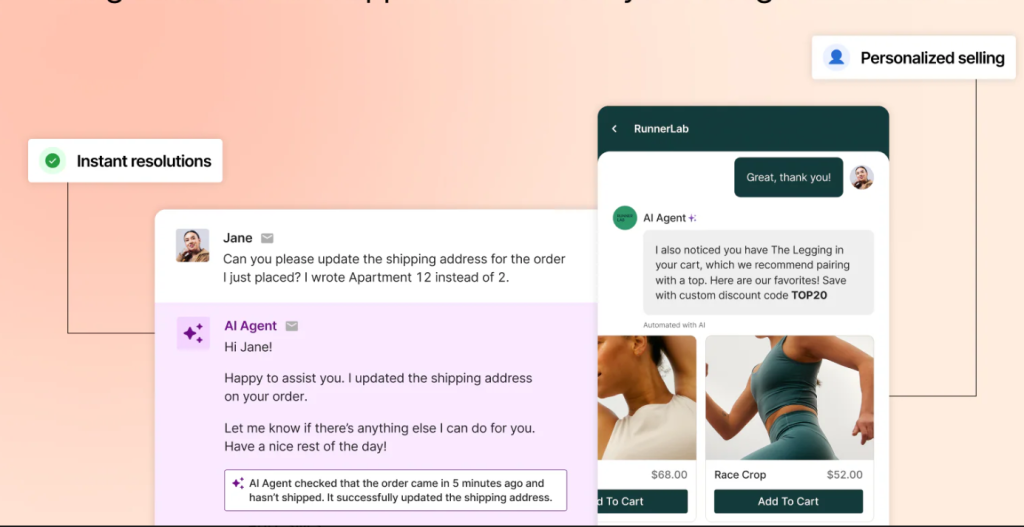
Gorgias has AI agents you can train with brand knowledge, so it can support, sell, and re-engage shoppers at scale.
What makes this tool stand out is that you can use AI to engage shoppers at the right moment, from pre-sale to post-sale. Plus, it helps centralize conversations from different platforms, so you can chat with clients in a single place.
Who it’s for:
DTC and e-commerce brands that handle medium to high ticket volumes.
Key features:
- Shopify-native order management: Agents can help process refunds, edit orders, cancel subscriptions, and check shipping status from tickets without switching between apps.
- AI agent for autonomous resolution: Autonomous handling of inquiries such as return requests, tracking updates, or order status, without human involvement.
- Attribution reporting: Track which support conversations lead to sales so teams can measure the impact of customer service on the business.
Pricing:
Gorgias’ pricing starts from $40 per month for 50 tickets and 30 automated interactions.
Pros:
- Better customer support visibility: Helps identify customer issues and root causes, reducing support volume over time.
- AI-powered performance improvements: Uses AI to help improve overall performance.
- Effective AI shopping assistant: Helps customers find and purchase additional products more efficiently.
Cons:
- Basic Shopify integration: One user says the Shopify integration only provides basic customer data and order history despite being marketed as seamless.
- Limited shipping integrations: Could benefit from integrations with more shipping software.
- Poor onboarding experience: For another user, an onboarding error caused the AI agent to go live with off-brand messaging, negatively affecting hundreds of customer interactions.
18. Shopify Inbox
Shopify Inbox is Shopify’s native live chat tool that streamlines customer conversations from a single location.
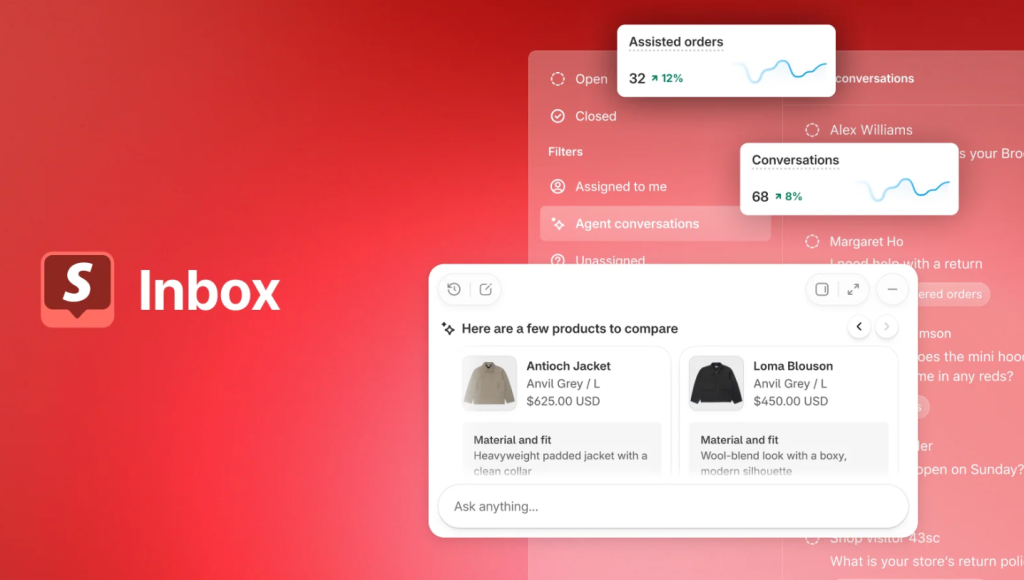
It consolidates real-time messaging, automated replies, and access to customer profiles in a single interface. Shopify Inbox also has AI-powered agents to which buyers can address questions when seeking the right products.
You can run Inbox with or without a customer agent: it learns from your brand’s existing catalog, policies, store content, and you can customize its tone, style, and rules.
Who it’s for:
Small to midsize businesses that want zero-cost native chat for basic customer support.
Key features:
- AI-assisted reply suggestions: Shopify Inbox suggests replies and instant answers, helping agents respond to customer chats faster without drafting answers from scratch.
- Built-in analytics: Get insights into orders assisted, buyer satisfaction, and more details to monitor how well customer agents help with revenue.
- Automated instant answers: Automates FAQ replies for common questions like shipping times and return policies, reducing repetitive manual responses for small teams.
Pricing:
Shopify Inbox is free to use and is available on the Shopify app store.
Pros:
- Easy installation: Simple to install and get up and running.
- Automatic product syncing: Syncs with products and pages to provide accurate, store-specific answers.
- Customizable AI: Lets you tailor the AI to your brand voice and business needs.
Cons:
- No back navigation: Customers can’t return to previous Instant Answers without refreshing the page.
- Limited follow-up: Makes it difficult to follow up with visitors who chat with the business.
- Poor navigation: Removes basic navigation and menu options, making the experience less intuitive.
Over to you
Shopify has a huge library of apps across different key functions, and the right one can make a huge difference for your store.
The key to doing that is defining your business goals first and finding apps built to help you achieve them.
For example, if you want to drive organic growth for your store, generate buzz, and turn customers into a growth channel, you’ll need viral marketing software like Viral Loops to make that happen.
A Shopify store owner who used our tool saw a 15% increase in sales within two days, showing what can happen when you find the right tool for your store’s needs.
Book a demo with Viral Loops to see how it can work for your business.
Frequently Asked Questions (FAQs)
Q1. How many Shopify apps should I install?
There’s no specific number of apps you need for your Shopify stores. Shopify experts on forums like the Shopify community on Reddit and Latenode recommend between five and 16 apps.
But the actual number depends on your store’s needs and scale. It’s advisable to prioritize apps that solve specific problems instead of installing tools speculatively.
Q2. What are the best free Shopify apps?
There are several free options across different functions:
- Shopify Inbox for live chat at no cost.
- Smart SEO for basic meta tag and broken link management.
- Printful for starting a print-on-demand business with features like order tracking.
- Loox for requesting and displaying photo reviews.
- Pagefly for creating dedicated landing pages.
- Spocket for drop shipping with supplies across the US, Europe, and Asia.
- Omnisend for email marketing and SMS campaigns.
- Smile.io for creating loyalty campaigns.
- Hextom: free shipping bar for guiding shoppers to reach the required benchmark for free shipping offers.
- Tidio for AI-powered chatbots and live chat.
- Foxsell for managing product bundles or grouping frequently bought together items to increase upsell chances.
Q3. Do Shopify apps slow down your store?
Yes, Shopify apps can technically slow your website down as they either introduce additional scripts, CSS, or third-party requests. The risks compound when multiple apps load simultaneously.
To minimize impact, only keep apps you actively use, choose apps that meet Shopify’s performance standards, have a Shopify trust badge, and use Google Page Insights to monitor your store’s performance after adding new tools.
Q4. How do I choose a Shopify app?
To choose a Shopify app for your store:
- Think about what problem you’re trying to solve.
- Check whether the app’s features can help solve your pain points.
- Confirm that the app integrates with your existing tools.
- Look at the tool’s ratings and read reviews to understand other users’ sentiments regarding the app.
- Confirm that it has a Built for Shopify badge to ensure optimal performance.
![Best Viral Loops Alternatives in 2026 [Full Comparison]](https://viral-loops.com/blog/wp-content/uploads/2026/06/Best-Viral-Loops-Alternatives-in-2026-Full-Comparision-5.png)
![9 Best Referral Marketing Platforms [In-Depth Comparison]](https://viral-loops.com/blog/wp-content/uploads/2025/06/UPDATE-9-Best-Referral-Marketing-Platforms-In-Depth-Comparison.png)
![12 ReferralCandy Alternatives in 2026 [Full Comparison]](https://viral-loops.com/blog/wp-content/uploads/2022/07/12-ReferralCandy-Alternatives-in-2026-Full-Comparison.png)