After searching for top referral growth platforms for your business, you’ve narrowed it down to two main contenders: Gleam and Viral Loops.
The main difference between them is that Viral Loops is better suited to referral marketing campaigns, while Gleam focuses on reward-based campaigns and promotions.
In this guide, we’ll compare these two platforms across features, usability, and use cases to help you decide which platform is a better fit for your business.
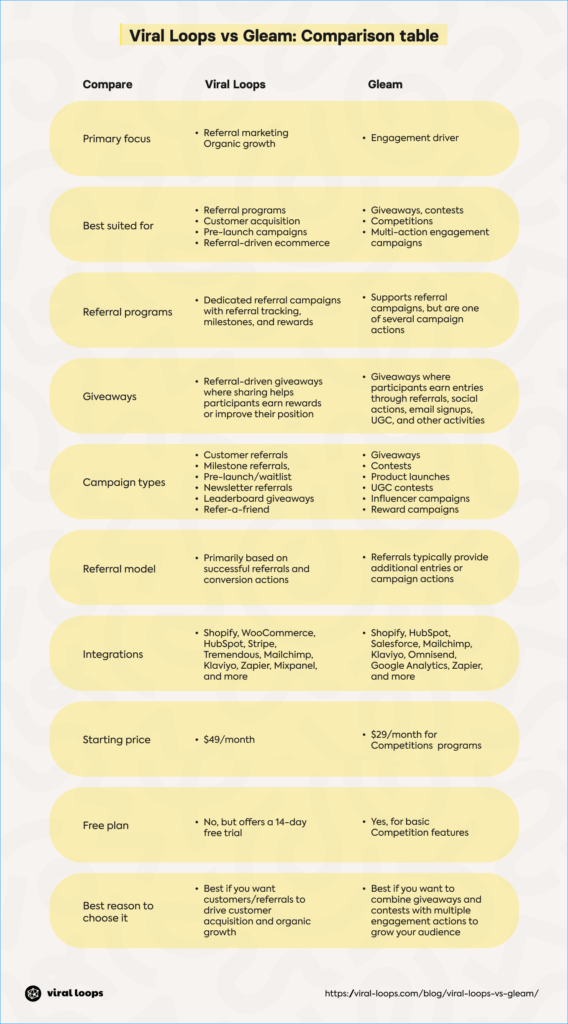
Below is an overview of how the platforms compare:
Disclaimer: This article was created by Viral Loops and may reference its own products and services. The content reflects the author’s perspective and is based on publicly available information, accurate as of September, 2026. Companies and tools are listed for informational purposes only and are not ranked or endorsed unless explicitly stated.
What’s the difference between Viral Loops and Gleam?
The difference between Viral Loops and Gleam is their approach to growth.
Viral Loops focuses on referral growth, helping brands encourage customers to bring in new customers, while Gleam focuses on reward-based campaigns, contests, competitions, and giveaways to drive engagement and grow audiences.
Here’s a better explanation of their differences:
Viral Loops is an all-in-one organic growth platform for companies that want to run referral, affiliate, waitlist, and giveaway campaigns.
It simplifies setting up growth programs by providing templates inspired by campaigns run by billion-dollar brands.
You can decide to run one-off or always-on campaigns to create sustainable word-of-mouth growth.
Gleam, on the other hand, is a platform for rewards, giveaways, and competition programs.
It integrates referral programs with broader growth campaigns, letting participants earn rewards not only by referring new users but also by following social media accounts, signing up to newsletters, submitting user-generated content, and more.
Viral Loops vs. Gleam: Feature comparison
In this section, we’ll cover the different referral features each platform provides, their approaches, and what that could mean for users.
Referral programs and referral tracking
Here’s how both tools approach referral campaigns and tracking.
Viral Loops lets you launch referral programs through customizable, template-based campaigns with built-in tracking.
The campaigns can be widgets embedded in your website and online store or a dedicated landing page (built with our landing page builder) to host the experience.
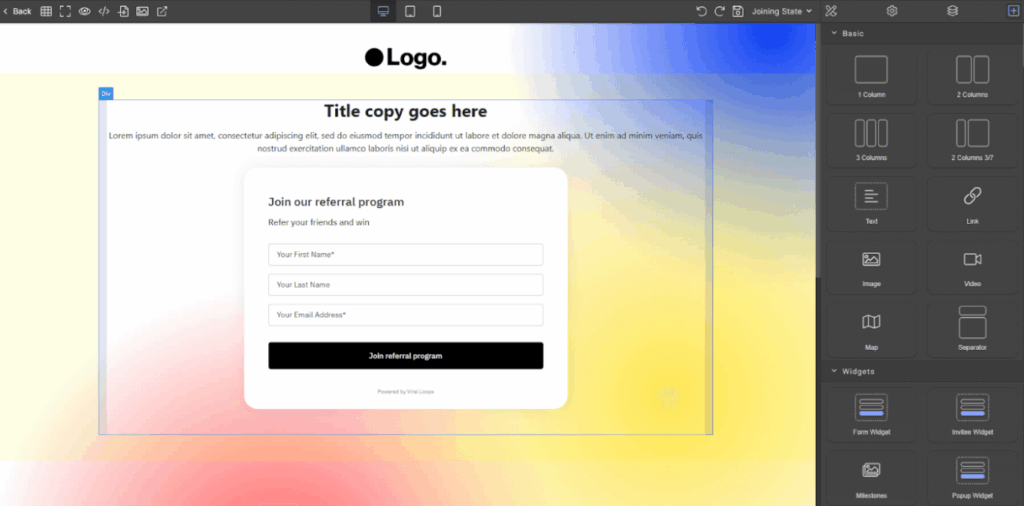
Each participant gets a unique referral link or code that contains a tracking parameter to invite others. When someone clicks the referral link, Viral Loops uses referral identifiers to associate the visitor with the referrer.
Once the visitor completes the desired action (sign-up, purchase, or another campaign-specific goal) the platform matches the completion against the stored referrer ID and logs it as an attributed conversion.
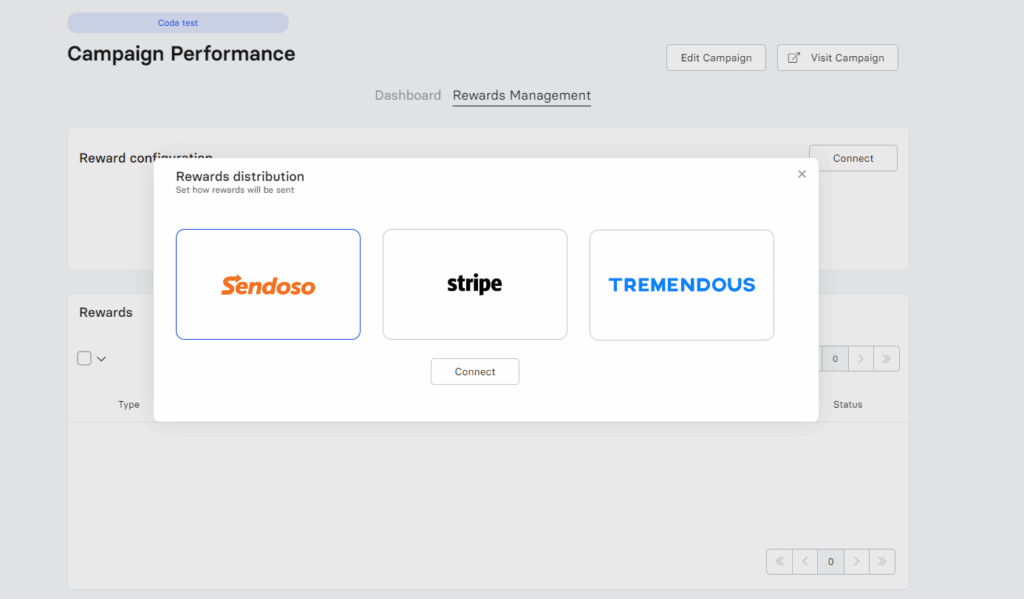
Once a referral qualifies for a reward, fulfillment can be handled manually or automated through supported integrations like Stripe and Tremendous.
Gleam handles referral programs through its Viral Share Action available in its Competitions and Rewards widgets. It works similarly to Viral Loops’ programs: each user gets a unique referral link they can share with their audience, family, or friends.
The referred person clicks on the link, enters the campaign, and the referrer gets either bonus giveaway entries or redeemable rewards.
The difference lies in what you can set up as a ‘conversion’ in the program: Gleam’s Viral Share counts only entries. The flow looks like this:
Referral link → Friend completes a campaign entry → Referrer receives bonus entries or a reward.
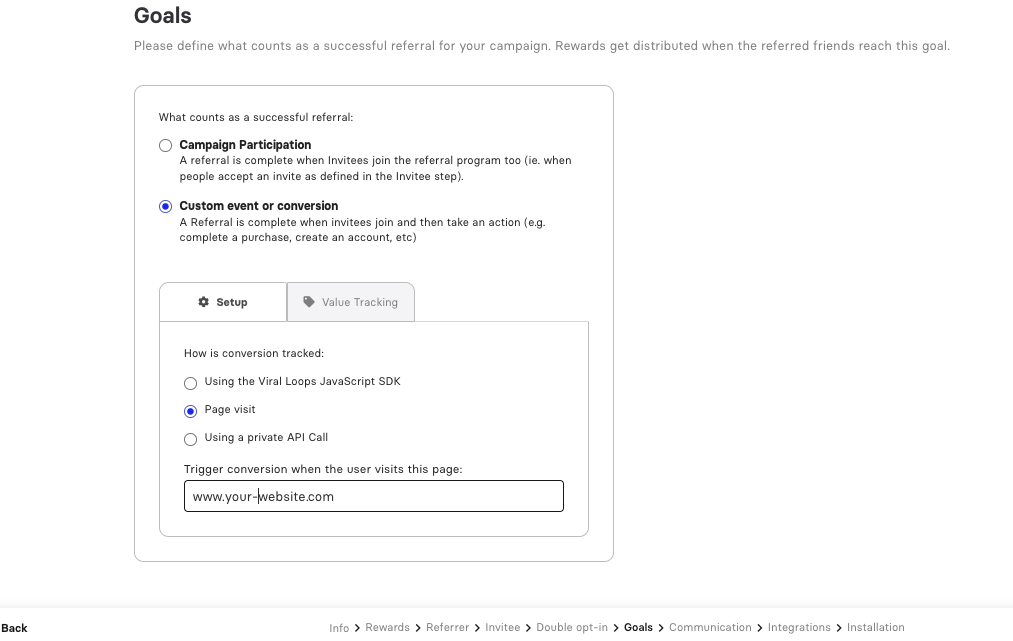
With Viral Loops, you can choose to configure the conversion to something other than a simple entry:
Referral link → Friend signs up → Friend purchases, subscribes, or completes onboarding → Referral becomes successful → Reward.
Additionally, Gleam offers purchase, sign-up, and feature usage tracking as a Custom Action Tracking feature on its Business plan, not as a standard campaign capability.
Campaign types
Campaigns on Viral Loops are structured around a refer-a-friend system, allowing you to launch:
- Traditional referral campaigns where existing customers are encouraged to invite new ones to earn a reward.
- Milestone referral campaigns that unlock rewards for participants as they bring in more and more referrals.
- Pre-launch and viral waitlist campaigns that grant early access as customers climb a referral queue.
- Newsletter referral campaigns where subscribers earn rewards for bringing in new readers.
- Leaderboard giveaway programs where top referrers get perks.
Gleam offers similar campaign types (refer-a-friend, referral leaderboards, and pre-launch giveaways). However, they’re not standalone programs like Viral Loops, but sit within a broader campaign toolkit.
Here are campaign types you can launch on Gleam:
- Giveaways and contests where participants complete actions such as social follows, email sign-ups, referrals, website visits, or UGC submissions to earn entries.
- Prelaunch giveaways that collect early interest or build a waitlist using referrals or other actions to generate buzz and brand awareness.
- UGC and social media contests where participants submit content or complete social actions for a chance to win prizes.
- Reward campaigns that give participants guaranteed incentives, such as discount codes or other rewards, after they complete the required actions.
Put simply, Viral Loops suits referral-driven campaigns, while Gleam fits businesses that want referral programs alongside contests, giveaways, and UGC encouragement.
Rewards and gamification
On Viral Loops, multiple reward options are available:
- Per-referral rewards: An incentive for a successful referral, such as a gift card, discount, product upgrade, or store credit.
- Milestone rewards: Participants unlock increasingly valuable rewards as they reach specific referral thresholds, such as three, five, or ten successful referrals.
- Leaderboard prizes: Participants who bring in the highest number of successful referrals are rewarded.
- Giveaway entries: Participants are given additional chances to win (more entries) for every successful referral.
You can offer a range of incentives: monetary rewards (cash, discounts, gift cards, etc.), product-based rewards (free products, free product upgrades, extended trials), and experiential rewards (early access, VIP status, etc.)
Depending on the campaign type, rewards can be triggered by referred sign-ups or a subsequent conversion, such as a successful purchase.
Rewards can be fulfilled manually or automatically. In the manual model, you have to select rewards and send them to customers. For automated rewards, we integrate with Stripe, Tremendous, and Sendoso to issue them.
Gleam approaches rewards and gamification through two separate products: Competitions and Rewards.
With Competitions, participants can earn more giveaway entries by completing actions such as subscribing to a newsletter, following a specific social media account, or referring a friend through Viral Share. You can assign different entry values to different actions, with each successful referral earning additional entries. Winners can then be selected through a random draw.
Gleam also supports leaderboards and bonus-entry mechanics. However, its leaderboard rankings are based on campaign entries, which can come from referrals or other actions.
With Rewards, participants unlock rewards after completing a required number of actions. The rewards can be digital downloads, access links, or coupon codes.
Referrals can be included as a qualifying action, but there’s a catch: the referrer must wait for their invited friend to complete a campaign action before the reward unlocks. This means referral rewards may need to be delivered later.
Campaign customization and setup
Viral Loops provides templates to help you get started quickly. You can pick a template and customize it to match your brand with our drag-and-drop editor.
There’s a campaign wizard that guides you through setup, from defining the program’s goal to setting up a reward, campaign placements, how people accept invites, welcome emails, and installation.
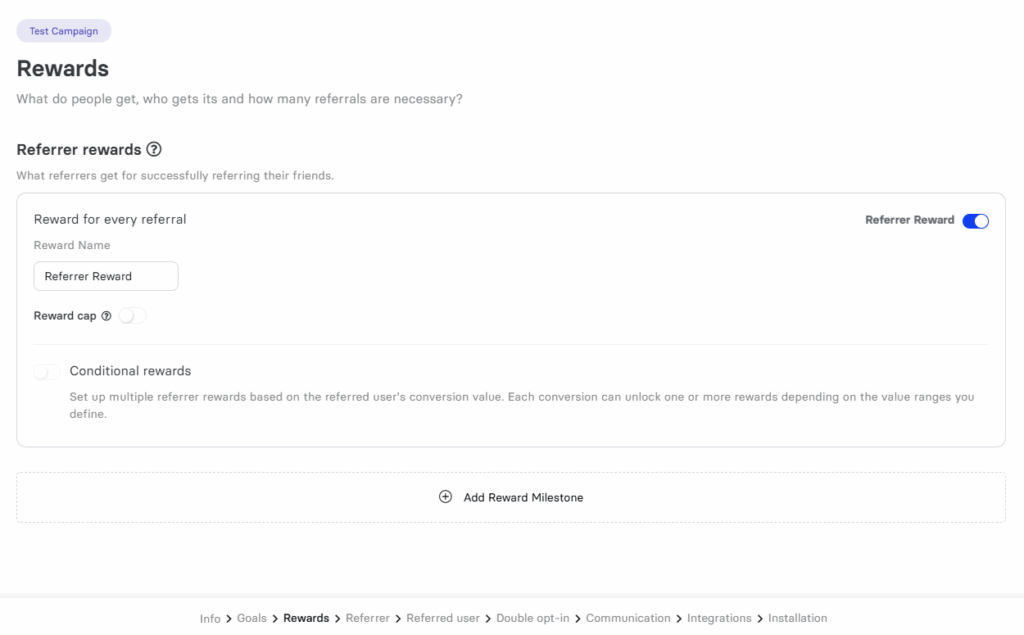
The wizard supports drag-and-drop sections, custom domains, branding, custom CSS, and code editing, so your program can closely match an existing website.
And if you need help setting up the campaign, we offer a Concierge to help with that.
On Gleam, launching a campaign begins with choosing one of its apps (Competition, Rewards, Captures, or Galleries). Then, you pick a template based on the reward campaign and edit it in Gleam’s builder or create one from scratch.
You can configure actions and either use the auto-generated Gleam-hosted landing page or embed a widget on your domain.
Its branding controls become more extensive on higher plans, including custom CSS and the removal of Gleam branding.
Integrations
Viral Loops’ integrations focus on referral and reward workflows, while Gleam offers a broader set that can be more useful when a giveaway needs to feed leads into multiple marketing channels.
Here’s a breakdown of the different integrations both tools offer:
- Email/CRM: Both tools connect to Mailchimp, Klaviyo, HubSpot, Zapier, Marketo, Salesforce, and ActiveCampaign. Gleam adds a longer native list: Sendlane, Omnisend, and more.
- E-commerce: Viral Loops and Gleam both integrate with Shopify.
- Analytics: Both connect with Google Analytics. However, Viral Loops also integrates with Mixpanel, Segment, and Facebook, including built-in conversion tracking tied to referral links.
- Reward fulfillment: Viral Loops integrates natively with Stripe and Tremendous so referral rewards can pay out automatically per person. Gleam has no equivalent native payout integration. Reward delivery relies on manual coupon codes.
Analytics and referral attribution
Viral Loops tracks attribution by monitoring referral chains and overall program growth.
Each campaign participant receives a unique referral link. When this link is clicked, Viral Loops records the connection and attributes the conversion to the person who generated the unique referral link. This way, you can track:
- Participants: The total number of people who have signed up for your referral program to get their unique link.
- Shares: The number of times participants have clicked the social share buttons within the widget.
- Referral conversions: The actual number of new users who joined or purchased because of a referral link.
- Channel performance breakdown: Viral Loops breaks down which channels (email, Twitter/X, Facebook, Reddit, or direct link copies) are driving growth.
- Revenue tracking: The amount of revenue generated directly by your referral program. This is available on higher plans.
- Viral coefficient (K-factor): The average number of new users a single customer brings.
- Fraud and quality metrics (available on higher plans): Track the percentages of invalid, suspicious, or high-risk sign-ups.
Gleam, on the other hand, relies on users completing specific actions. Its reporting analytics break down actions, events, referring sources, location, and top participants.
Here’s what you can measure on Gleam:
- Actions: Shows you a breakdown of the Actions completed by users, e.g., viewing an Instagram post or visiting a site.
- Events: Track certain metrics like Facebook clicks recorded outside the typical Actions.
- Viral Share clicks: How much traffic participants have sent to your campaign.
- Viral sharers: The number of users who join campaigns because of a Viral Share.
- Viral conversion rate: The number of people who moved from clicks to conversions.
- Top users: Track users with the most entries to know whom to award prizes.
- Total impressions: How many times your reward campaign was loaded or viewed.
- Location: Breakdown of countries in which participants join your campaign.
Fraud prevention and entry verification
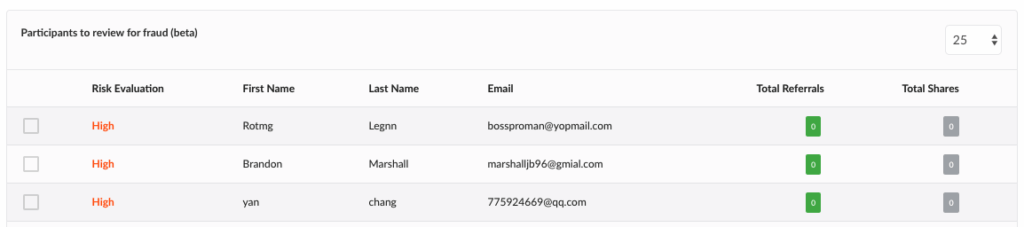
Viral Loops offers a built-in automated protection system to identify and protect your campaigns against fraud by flagging suspicious participants.
Our system marks participants based on their risk level: low, medium, or high. Then, you can review those marked as high risk in your dashboard and either keep them if they are legitimate or delete them.
For added protection, you can also use:
- Our double opt-in feature
- Google’s reCAPTCHA
Power clients get more advanced fraud detection, which identifies fraudulent activity and uses a custom algorithm we created.
Gleam also uses built-in automated fraud filters to block suspicious activity. It analyzes over 20 entry attributes in real time to block bots, spammers, and fake accounts.
You can also manually validate or invalidate entries where necessary.
Viral Loops vs. Gleam: Which is better for your use case?
If you have to choose between Viral Loops and Gleam, the right option depends on your marketing goals.
Here, we’ll explore how each tool compares across different use cases.
Which is better for customer referral programs?
Viral Loops is a no-brainer here because our system and campaigns are built with that in mind. We have multiple template options to help you launch a campaign with referral tracking, tiered rewards, automated fulfillment, milestones, and conversion-based referral actions.
Our integration with Stripe and Tremendous means you can run always-on campaigns where participants need to be tracked and paid over time.
Gleam supports referrals, but they’re typically only one campaign action among several options.
Which is better for giveaways and contests?
Gleam is better for rewards, contests, and giveaway campaigns. Participants earn points and rewards through social actions such as likes and comments, email sign-ups, creating UGC content, and more. You can run several contests with multiple participation methods.
Which is better for prelaunch and waitlist campaigns?
Viral Loops has a good framework for prelaunch and waitlist campaigns. You can drive interest for a new product launch by encouraging participants to refer others to move up a waitlist for early access or other forms of rewards.
Gleam also has a pre-launch option where users can register interest in your upcoming product. They can participate in bonus entry action points to get into priority lists.
Once the product is ready to go live, you can randomly select winners who receive early access.
Which is better for newsletter referral programs?
Viral Loops helps newsletter creators scale their subscriber base by encouraging current readers to share the publication. Each subscriber receives a unique referral link to invite others, unlocking progressively better rewards as they reach higher referral milestones.
Gleam has no dedicated newsletter-growth template like Viral Loops. To run newsletter growth programs, you need to combine a subscribe action with Viral Share for bonus entries in a Competitions campaign.
Viral Loops tracks each subscriber’s referrals individually and rewards them directly, making it a better option for ongoing newsletter growth programs.
Which is better for e-commerce referral programs?
Viral Loops takes the lead here because it’s a more referral-specific platform that allows you to embed campaigns directly into your store. Its conversion tracking and automated reward fulfillment make it a better fit for e-commerce brands that want referrals to contribute to their customer acquisition program.
Viral Loops vs. Gleam: Which should you choose?
Gleam can be your go-to for encouraging actions such as following social accounts, joining an email list, sharing or viewing a post, submitting user-generated content (UGC), or referring friends.
Choose Viral Loops if your goal is organic growth and you want to drive new leads, purchases, or subscribers without increasing customer acquisition costs (CAC).
With our referral tool, you can leverage existing customers for organic growth, incentivizing them to bring in new users.
You can easily begin with templates and leverage AI for assisted onboarding, campaign installation, or fraud pattern analysis.
Book a free demo to see how Viral Loops helps drive sales and business growth in real time.
Frequently asked questions (FAQs)
Q1. Can you migrate from Gleam to Viral Loops?
Yes, you can migrate contact lists from Gleam to Viral Loops by exporting your current lists, email addresses, and participant data from the Gleam dashboard as a CSV file.
Then, import it into Viral Loops as a CSV.
However, you’ll need to recreate campaign settings from scratch.
Q2. Can you import an existing customer or subscriber list into Viral Loops?
Yes, Viral Loops lets you import an existing contact list using a CSV file, with email addresses required and fields such as names, referral counts, and custom data supported. You can also import contacts through integrations such as GoHighLevel, HubSpot, and MailChimp. What’s great about the Viral Loops import functionality is that it can even migrate the relationship between a referrer and a referral into your new setup.
Q3. Can multiple team members manage campaigns in Viral Loops?
Yes, Viral Loops’ Power plan lets you invite up to five team members to collaborate on referral campaigns, assign roles, and provide support for multiple brands.
Q4. Does Viral Loops offer APIs and webhooks for custom referral workflows?
Yes, Viral Loops provides APIs for adding participants, retrieving referral data, recording conversions, and building custom workflows.
Webhooks can send campaign events to your backend or other systems, while the API access supports more advanced server-side referral and conversion tracking.