Referral rewards can motivate customers to go above and beyond in sharing your brand.
This is an experience many of us have seen firsthand, like that one time PayPal gave new users $20 and an extra $20 for anyone who referred them.
Everyone wanted in, and the campaign saw a seven-to-ten-percent daily growth rate, taking PayPal to over 100 million users.
Carefully planned referral rewards can increase participation, drive higher-quality referrals, and help a business grow.
The challenge, though, is choosing the right reward.
With so many options, how do you know what will motivate customers without hurting profitability or creating operational headaches?
This guide answers that very question. We walk through the four criteria that should shape your referral reward strategy.
Let’s see them.
Criterion #1: Unit economics
Our first recommendation for choosing referral rewards is to evaluate your business’s numbers.
Instead of choosing based on what competitors offer or what clients would ideally like (e.g., $50 gift cards) think about what you can afford to give away without eroding profitability.
Copying someone else’s reward structure that doesn’t account for your business margins, customer lifetime value, and acquisition budget is how you end up with a superficially thriving referral campaign that’s actually eating up profits.
As you think about referral rewards, ask, ‘What can we afford?’ Then consider what customers will find attractive.
Here’s how to do that:
Step #1: Determine what a new customer is worth
To set a reward value, you need to know what a new client is worth to your business.
The best way to do that is by calculating new customers’ lifetime value (aka CLV or LTV). This is the total revenue you can expect from a customer throughout the relationship.
For e-commerce brands, here’s a formula to help you calculate the LTV across your customer base:
CLV = Average Purchase Value × Purchase Frequency × Customer Lifespan
- Average purchase value: total revenue ÷ number of purchases.
- Purchase frequency of the average customer in a given period: total purchases by all customers ÷ number of unique customers.
- Customer lifespan: average number of years a customer continues purchasing.
Example: Your e-com brand has an average purchase value of $150, customers purchase five times per year, and stay with your brand for an average of four years.
CLV: $150 5 4 = $3,000
For SaaS or subscription businesses:
CLV = (Average Revenue Per Account × Gross Margin %) ÷ Revenue Churn Rate
- Average revenue per account (ARPA): monthly recurring revenue ÷ number of active customers.
- Gross margin %: (revenue – cost of goods sold) ÷ revenue.
- Revenue churn rate: monthly recurring revenue lost ÷ total monthly recurring revenue.
Example: Your SaaS company has an ARPA of $100 per month, a gross margin of 70%, and a churn rate of 5.5%.
CLV: ($100 0.70) 0.055 =$1,272.73
These numbers reflect how much your customers are worth over a lifetime of doing business with you.
Step #2: Compare referral costs to your existing acquisition costs
Next, benchmark your intended referral rewards against what you already pay to get customers through other marketing channels.
The customer acquisition cost (CAC) is what you spend across channels like Google Ads, influencer campaigns, content programs, or affiliate marketing to bring in one customer.
To calculate CAC: Total sales + marketing costsNumber of new customers
Example: Your e-commerce business spent $2,000 on marketing and sales in the last month and got about 20 new customers.
CAC=$200020 = $100
With a CAC of $100 and a CLV of $3,000 (from the example in Step #1), you have room to offer a competitive referral reward.
Another reason to benchmark referral rewards against other channels is to find out which one brings in customers at the lowest cost.
For instance, if you spend $20 in referral rewards to get a new customer while Meta Ads or influencer campaigns cost significantly more, that shows referral programs are a much more cost-effective channel.
Step #3: Choose a reward budget your business can sustain
With a clear understanding of a new customer’s worth and CAC benchmarks, you can set a reward budget that supports profitability.
A good budget should be significantly lower than your customer lifetime value (CLV) and client acquisition costs (CAC) for other channels (if they bring in more clients).
Setting a figure is only half the equation; the other is ensuring it’s sustainable. Here are a few ways to guide how to make that happen:
- Consider your cash flow model: How and when your business generates revenue should reflect how rewards are structured.
For instance, if you have an annual SaaS plan that generates revenue upfront, there’s more flexibility to pay out rewards. However, monthly subscription models with gradual income mean that paying rewards too early could leave your coffers red.
- Decide when rewards are disbursed: Based on how revenue flows in, choose an ideal time to reward referrals. Tie reward fulfillment to a milestone, such as after customers hit a spending threshold, complete a purchase of X amount, or once the referred customer makes a purchase.
This protects your profit margins and compensates active referrals for participating.
- Test the reward system: Test the model against different scenarios to plan for under- and overperformance, fraud, and success. Build in verification steps, redemption caps, and review terms and conditions to ensure they define qualifying referrals.
Criterion #2: Customer behavior
Thinking of rewards through the lens of customer behavior means asking what motivates people to act.
This is crucial because you’re rewarding people for taking action at a specific moment. As such, the reward type, its structure, and even the delivery method can signal whether the action is worth taking for the customer.
Here’s how to work through it:
Step #1: Define the behavior you want to encourage
Before settling on a reward, define the campaign goals and what customer actions will help the business achieve them.
Ask, ‘What behavior am I rewarding, exactly?’
For instance, if the end goal is high-quality customers, consider rewarding actions closely tied to revenue and long-term value, such as a first purchase, subscription activation, or conversion into sales-qualified leads.
Tiered rewards, where customers unlock more as they refer more, would work when the campaign goal is consistent customer acquisition and loyalty.
Being specific about the action that customers are rewarded for and what you’re trying to achieve prevents you from building a campaign that optimizes for the wrong thing.
Step #2: Make participation as easy as possible
Once you’re clear about the end goal, start thinking about processes:
What customers need to do Expected rewards Compensation timeline
The flow from ‘I’m willing to refer’ to ‘I’ve shared my referral link’ should be so smooth that there’s no opportunity for drop-off.
Here’s how to make that happen:
- Have a clear value proposition, e.g., ‘Give $25, get $25 in store credit.’
- Explain how the campaign works in a few steps, e.g., ‘Step 1: Share your unique link. Step 2: Your friend receives a $25 discount. Step 3: You get $25 after their first purchase.’
- Use a simple sharing process, e.g., one-click sharing and links placed in their dashboards or most frequented areas.
- Provide message templates to aid sharing. Simplify the process of referring others, e.g., ‘Not sure if you’ve heard of [Your Brand], but I’ve been using it recently, and it’s been great. If you decide to try it, this link will get you $25 off your first order.’
- Create a dedicated landing page that describes the campaign and confirms a referral.
- Design a custom dashboard for referrers to keep track of their progress.
Step #3: Decide who gets the reward
Based on the action you’re rewarding, would rewarding both parties make a referral campaign more appealing?
Rewarding referrers only typically means more outbound sharing, with no incentive for referred customers. Incentivizing only new customers, on the other hand, may mean referrers don’t always feel motivated to share.
Impact’s State of Referral Marketing report shows that 78% of SaaS referral programs are double-sided, meaning both the referrer and the referred customer are rewarded.
Which option should you pick?
A general rule of thumb is to consider your marketing goals and business type.
If you’re a new brand trying to break into a new market, consider incentivizing existing customers and trying a two-sided reward system. This can strengthen their connection with your brand.
Established brands focused on sales and customer loyalty can reward new customers or offer dual incentives, giving newbies a reason to buy.
Criterion #3: Product type
Your product itself should also dictate your referral reward structure.
The most successful referral programs rewarded customers with something closely tied to the product itself rather than a generic incentive:
Here’s how you can choose referral rewards that are like an extension of your product:
Step #1: Consider how customers buy your product
Your client’s purchasing behavior can point to an ideal referral reward.
Monitor the customer journey in CRM tools or Google Analytics by analyzing transaction data, purchase frequency, or average order value.
You can even segment customers into first-time buyers, repeat customers, and high-value customers to identify buying patterns between them.
Then, choose rewards that fit, so they’re more relevant and motivating.
For example, if you run a subscription-based business and find that clients stay engaged over time, paying monthly or annually, a natural referral reward to consider is free months, account credits, or plan upgrades.
But if you sell products that have a one-time or low purchase frequency, credit rewards may have limited appeal.
In these cases, cash bonuses, cashbacks, e-gift cards, store credits, or discounts on the next purchase might be more motivating.
Step #2: Match the reward to the value customers receive
Consider why customers choose your product.
For instance, you have a product management platform. A client using the tool for collaboration, brainstorming, or roadmap planning would value an upgrade to a higher tier. It would mean access to more features, seats, and more productivity.
Similarly, a customer buying organic food values the product itself, so a free item or a discount on their next purchase is more valuable than cash.
Focus on rewards that deepen the client’s relationship with your product and motivate them to share.
Step #3: Consider what motivates your audience
Another factor to evaluate is the audience category you’re targeting because different customer segments respond to incentives differently.
Here are different scenarios to help you understand better:
- Customers with low annual income would go all out for cash rewards or discounts.
- Loyal clients who have been with you for a while or have a long purchase history would value exclusive offers and recognition.
- B2B SaaS buyers would respond well to credits, feature unlocks, or early access.
To know what motivates your audience:
- Leverage your CRM tool to identify and understand the different groups you serve.
- Conduct short surveys to know what they value. What would encourage them to refer others or become repeat customers?
Then brainstorm the right incentive for each category.
Criterion #4: Operations
As you think about the ideal referral reward structure, it’s crucial to consider operations.
You need to ensure the entire referral campaign is manageable, from tracking referrals to reward fulfillment and scaling the program. Otherwise, you create a different problem: missed payouts, manual errors, and fraud exposure that costs you money and your customers’ trust.
Here’s how to avoid this:
Step #1: Consider how rewards will be tracked and distributed
Before deciding on a reward, think about the mechanism needed to make it effective.
What will reward fulfillment look like end to end, from attribution and eligibility verification to disbursement?
Cash rewards require payment infrastructure; discount codes need to be generated, distributed, and redeemed; and account credits need to sync with your accounting system.
Rewards that can be tracked and distributed automatically are typically easier to manage than those that require manual effort.
Thankfully, referral software like Viral Loops can automate much of this for you.
You can set up triggers so rewards are sent automatically when a participant reaches a milestone. You can also define the event that triggers the reward (e.g., milestone reached, referral converted, or redemption in the Rewards dashboard).
We also simplify the tracking process, monitoring everything from successful referrals to pending approvals, shares, and more.
Step #2: Protect your program from fraud and abuse
Rewards with monetary value will always attract misuse — duplicate accounts, self-referrals, abuse of discount codes, fake signups, and similar.
As such, you need to build prevention into the loyalty program by:
- Asking for email confirmation.
- Rewarding customers after an action is completed.
- Setting a qualifying period before rewards are paid.
- Monitoring and preventing fraudulent behavior.
Our tool also has several native fraud prevention features to ensure only legitimate participants receive incentives. Viral Loops provides:
- Automated filters that detect and block duplicate accounts, self-referrals, and coupon site spam.
- Customizable rules to align fraud protection with your specific risk tolerance and program goals.
- Comprehensive dashboards to track referral origins and monitor overall activity.
- Verification service integrations to vet users during their initial onboarding.
Step #3: Make sure the reward can scale
A reward structure that works for 50 referrals per month may break down at 1,000 referrals.
Consider whether the reward would be practical if word-of-mouth marketing becomes your main customer acquisition channel.
Can the business afford the reward as the program grows? How about fulfillment costs, support requests, and administrative workload?
Choose a reward the team can deliver consistently without rebuilding from scratch as performance improves.
What are some creative referral reward ideas?
The right option depends on your business type and what customers like, but here are some referral reward ideas to help you get started:
- Exclusive access: You’ve got a new product, service, or feature on the way? Offer customers top beta access or first dibs on what you’re building. It fosters a sense of belonging and makes your customers feel like they’re part of your inner sanctum.
Ideal for: Startups, SaaS brands, mobile apps, or gaming companies.
- Mystery box or surprise gift: Leverage the power of curiosity and expectation to encourage client participation in a referral campaign. Don’t tell them what they’ll get; this referral reward could become a unique experience. Participants can create a memorable unboxing moment they can share on social media, creating viral buzz.
Ideal for: E-commerce, lifestyle, beauty, and subscription-based brands.
- Tiered reward levels (gamification): You offer multiple rewards instead of one, unlocked by continuous sharing. By gamifying your campaign, you motivate people to see what they could get at the next level. This builds momentum, brand awareness, and virality.
Ideal for: Any business type, e.g., e-commerce, newsletter community, or SaaS.
- Branded swag: Premium company swag gives clients VIP treatment and status. Especially if it’s something not readily available on the market. It shows appreciation and subtly raises awareness of your brand.
Ideal for any business, including e-commerce or B2B.
Want more creative referral reward ideas? Check out this page.
How Viral Loops helps you build the right referral reward system
The right referral reward system has just the incentives to motivate participants and the infrastructure to execute it well.
Viral Loops is designed to help with both aspects.
We offer businesses of all types the resources needed to design, manage, and launch a referral program that accounts for the reward structures outlined in this guide.
Here’s how:
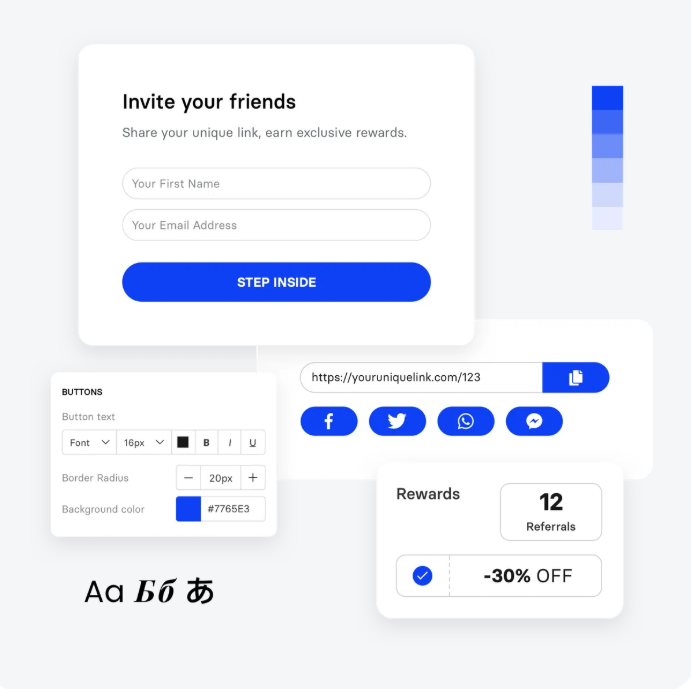
First, you have access to referral program templates based on some of the most successful campaigns out there. In fact, we’ve got templates with a built-in rewards configuration section. This gives you a good starting point without having to create from scratch.
Secondly, you can configure how and when rewards are triggered and fulfilled.
You can do this manually or automatically through our dashboards’ Pending Reward menu.
If you go the manual route, you send rewards once eligible participants qualify. Automation simplifies the process: you establish specific triggers to ensure rewards are dispatched when a participant hits a milestone or reaches a set referral count.
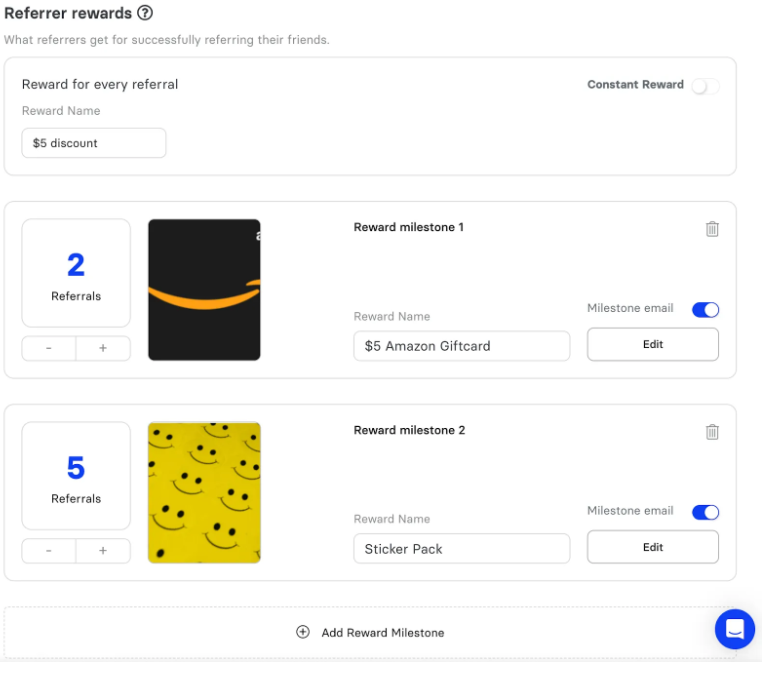
This is possible thanks to our native integration with Tremendous (for automatic Amazon gift card distribution) and Stripe (for account coupons and credits).
Once a goal is reached and participants qualify, you click an approval button, and rewards are forwarded.
Thirdly, we’ve got AI-powered fraud protection systems trained on seven years of referral data to detect fraudulent referrals and ensure fairness. Our analytics dashboard also gives you performance data to flag complex situations and help refine reward structures over time.
Don’t just take our word for it.
Book a free software demo to see how Viral Loops can work for you.